


Here's the biggest lie you'll hear about the EMA in Nigeria: 'Just follow the crossover and you'll get rich.' If I had a Naira for every time I saw a trader blow an account chasing a 9/21 EMA crossover on USD/NGN, I'd own a mansion in Banana Island.

Olumide Adeyemi
Batı Afrika Yatırım Öncüsü ·  Nigeria
☕ 11 dk okuma
Neler öğreneceksiniz:
- 1EMA Basics: Forget the Math, Understand the Weight
- 2How to Use the EMA: Trends, Support, and Dynamic Levels
- 3EMA Crossover Strategies (And Why They Fail)
- 4Best EMA Settings for a Nigerian Trader
- 5Common EMA Mistakes Every Nigerian Trader Makes
- 6Putting It All Together: The EMA in Your Trading Plan
- 7Beyond the EMA: What to Use With It
Here's the biggest lie you'll hear about the EMA in Nigeria: 'Just follow the crossover and you'll get rich.' If I had a Naira for every time I saw a trader blow an account chasing a 9/21 EMA crossover on USD/NGN, I'd own a mansion in Banana Island. The Exponential Moving Average is a powerful tool, but most people use it wrong. They treat it like a magic signal generator instead of what it really is: a weighted average that tells you what the market already did. I've made and lost money with it. Let me show you how to actually use it in our market, where volatility can eat your stop loss before you can say 'CBN policy shift.'
An Exponential Moving Average (EMA) is just a line on your chart that reacts faster to recent price action than its older cousin, the Simple Moving Average (SMA). The 'exponential' part means it gives more importance to what happened five minutes ago than what happened five days ago. That's the whole secret.
Why does this matter for a Nigerian trader? Because our market moves on news - CBN circulars, oil price shocks, political tweets - and you need an indicator that doesn't take a week to figure out the trend has changed. When the CBN announces a new forex guideline, price reacts instantly. A 50-period EMA will show that shift quicker than a 50-period SMA. It's not predicting anything; it's just confirming the new direction with less lag.

Example: Let's say you're watching GBP/NGN. Price has been choppy around 1800 for days. A major policy announcement hits at 2 PM Lagos time. Price spikes to 1850. A 20-period SMA, which treats all last 20 candles equally, might only creep up to 1815. The 20-period EMA, weighting that massive 2 PM candle heavily, might jump to 1835. The EMA gives you a clearer, faster picture of the new buying pressure.
The most common periods you'll see are 9 (very fast), 20 (short-term), 50 (medium-term), 100 and 200 (long-term trend). Don't overcomplicate it. The period is just the 'look-back' window. A 20 EMA on a 1-hour chart looks at the last 20 hours. The same 20 EMA on a 15-minute chart looks at the last 5 hours. Always know your timeframe.

💡 Winston'ın İpucu
The 200 EMA isn't just a line. On the daily chart, it's the market's consensus on long-term value. Price above it? Bulls are in charge. Price below? The bears have the ball. Trade with that team.
This is where you stop using the EMA as a 'signal' and start using it as context. Its primary job is to define the trend's direction and strength.
Identifying the Trend
If price is consistently trading above a rising EMA (say, the 50 or 200), you're in an uptrend. The EMA acts as a dynamic floor buyers are defending. If price is consistently below a falling EMA, you're in a downtrend. The EMA becomes a dynamic ceiling. It's that simple. In a strong USD/NGN bull run, you'll often see price kiss the rising 20 EMA and bounce like it's a trampoline. That's the trend in motion.
Dynamic Support and Resistance
This is the EMA's superpower. Unlike a static horizontal support line you draw, a rising EMA moves up with the trend. In a strong uptrend, pullbacks will often find support exactly at the 20-period EMA. I've seen this play out on EUR/NGN countless times. In April 2023, during a sustained climb, I bought a pullback to the 20 EMA on the 4-hour chart three separate times. Each trade netted between 180 and 250 pips. The EMA wasn't a guaranteed bounce, but it showed where buyers were most likely to step back in.
Conversely, in a downtrend, a falling EMA acts as dynamic resistance. Rally attempts will often fail right at it. This concept is crucial for managing your swing trading positions. Your trailing stop can be placed just below a key rising EMA, letting your profits run while the trend is intact.

Warning: In a ranging or choppy market - which describes USD/NGN about 40% of the time - EMAs are useless. They'll criss-cross, price will whip around them, and they'll give nothing but false signals. This is when you turn them OFF and look for range boundaries instead.
“The EMA's job isn't to give you signals, it's to tell you which team is winning so you can join them.”
The classic strategy: plot a fast EMA (like a 9) and a slow EMA (like a 21). When the fast crosses above the slow, it's a golden cross - BUY! When it crosses below, it's a death cross - SELL! Sounds foolproof, right? It's a fool-maker if used in isolation.
I learned this the hard way in 2020. I was scalping XAU/USD (Gold) and saw a perfect 9/21 bullish crossover on the 5-minute chart. I jumped in long at $1872. Within ten minutes, price reversed, took out my stop loss at $1868, and continued crashing. The crossover was just noise in a larger sideways consolidation. I lost 0.5% of my account on a 'textbook' signal.
The problem? Crossovers are lagging. By the time the lines cross, a significant move has already happened. In a trending market, you get a nice ride. In a choppy or volatile market, you get 'whipped' - constant false signals that trigger losses. This is especially true with the popular 50/200 'golden cross' for long-term trends. By the time it triggers, the easy money is often gone.

Pro Tip: Don't trade the crossover as it happens. Use it as a filter. Wait for the crossover, then look for price to retest the now-aligned EMAs as support (in a bullish crossover) or resistance (in a bearish one). Enter on the retest bounce. It filters out a lot of the immediate fakeouts. This approach saved me more times than I can count when trading instruments like the EUR/USD.
Also, always use crossovers in the direction of the higher timeframe trend. If the daily chart shows price above the 200 EMA (bullish), only take bullish crossovers on the 4-hour or 1-hour chart. This simple alignment with a MACD indicator for confirmation can dramatically improve your odds.
There's no holy grail setting, but there are practical choices based on your trading style and the unique liquidity patterns of the Naira pairs.
| Trading Style | Recommended EMAs | Timeframe | Best For |
|---|---|---|---|
| Scalping | 9, 20 | 1-min, 5-min, 15-min | Catching quick moves in major pairs (EUR/USD, GBP/USD) during London/N.Y. overlap. High speed, high risk. |
| Intraday | 20, 50 | 1-hour, 4-hour | Trading Naira pairs (USD/NGN, GBP/NGN) around key CBN news times. Captures the day's trend. |
| Swing Trading | 50, 200 | 4-hour, Daily | Riding sustained trends in commodities like XAU/USD or major forex pairs. Requires patience. |
For Naira pairs specifically, remember they can be less liquid and more prone to sharp, news-driven gaps. A faster EMA like the 20 on the 1-hour chart can help you stay aligned with these sudden shifts. I personally keep a 20, 50, and 200 on my main chart. The 20 for short-term momentum, the 50 for the intraweek trend, and the 200 to know the monthly bias. It gives me a complete picture.
Your broker's platform matters here. On a platform with slow execution or wide spreads, scalping with a 9 EMA is suicide. You'll be eaten by slippage. This is why I prefer brokers with tight spreads and fast execution like IC Markets or Pepperstone for this style of trading. Always match your tool to your environment.
💡 Winston'ın İpucu
If your EMA is flat and price is chopping around it, you're in no-man's land. Walk away. The best trade is often the one you don't take. Go watch a football match instead.
“A crossover trade without higher-trend confirmation is just a 50/50 coin flip with a spread cost.”
Let's cut to the chase. I've made these, you've probably made these. Stop it.
- Using Too Many EMAs: Your chart looks like a rainbow spaghetti monster. You have a 5, 9, 12, 20, 21, 26, 50, 100, 200... all on one screen. When price moves, they all wiggle and you get paralyzed. Pick two or three that serve distinct purposes (e.g., one for momentum, one for trend) and stick with them.
- Ignoring the Timeframe: A bullish crossover on the 5-minute chart means nothing if the 4-hour chart is in a crushing downtrend. Always zoom out. The higher timeframe trend is king. A trade against the daily 200 EMA is a low-odds gamble, not a strategy.
- Placing Stops Too Tight: You buy because price is above the 20 EMA. You place your stop loss 5 pips below the EMA. The market has a normal wiggle, takes you out, and then rockets in your original direction. Support and resistance are zones, not laser lines. Give your trade room to breathe. Use the EMA as a zone, and place your stop a sensible distance beyond it, considering the pair's average volatility. A good position size calculator will help you size the trade so that wider stop doesn't blow your account.
- Using EMAs Alone: This is the cardinal sin. The EMA is a lagging trend-follower. Combine it with a leading or momentum indicator like the RSI indicator (for overbought/oversold conditions) or price action confirmation (like a bullish engulfing candle at the EMA support). One confirms the trend, the other helps time the entry.
- Forgetting About News: No EMA in the world will save you from a surprise CBN intervention or a sudden change in oil prices. If you have a trade on around major news times (like when the CBN releases its MPC statements), widen your stops or just stay out. The EMA will be broken like a twig in a hurricane.
So how does this all fit into a real, executable plan for a trader in Lagos or Port Harcourt? Let's walk through a recent example.
Scenario: It's March 2026. The CBN has been making reforms, and USD/NGN has been in a steady uptrend on the daily chart (price above rising 50 and 200 EMAs). The higher timeframe trend is bullish.
- Trend Filter: Daily chart = Uptrend. I will only look for buy opportunities on lower timeframes.
- Entry Zone: I switch to the 4-hour chart. Price has pulled back from its highs and is approaching the rising 20-period EMA. The 20 EMA has acted as support several times before.
- Confirmation: I don't buy the moment price touches the EMA. I wait. I see a bullish pin bar or an engulfing candle form right on the EMA level. My RSI is dipping near 40 (oversold in a trend), not yet at 30.
- Execution: I enter a long trade after the bullish candle closes. My stop loss is placed below the recent swing low (a bit below the EMA zone). My take-profit target is at the previous high. I use a 1:2 risk-to-reward ratio.
- Management: As the trade moves in my favor, I might trail my stop loss up to just below the 20 EMA on the 1-hour chart, locking in profits while giving the trade room to run.
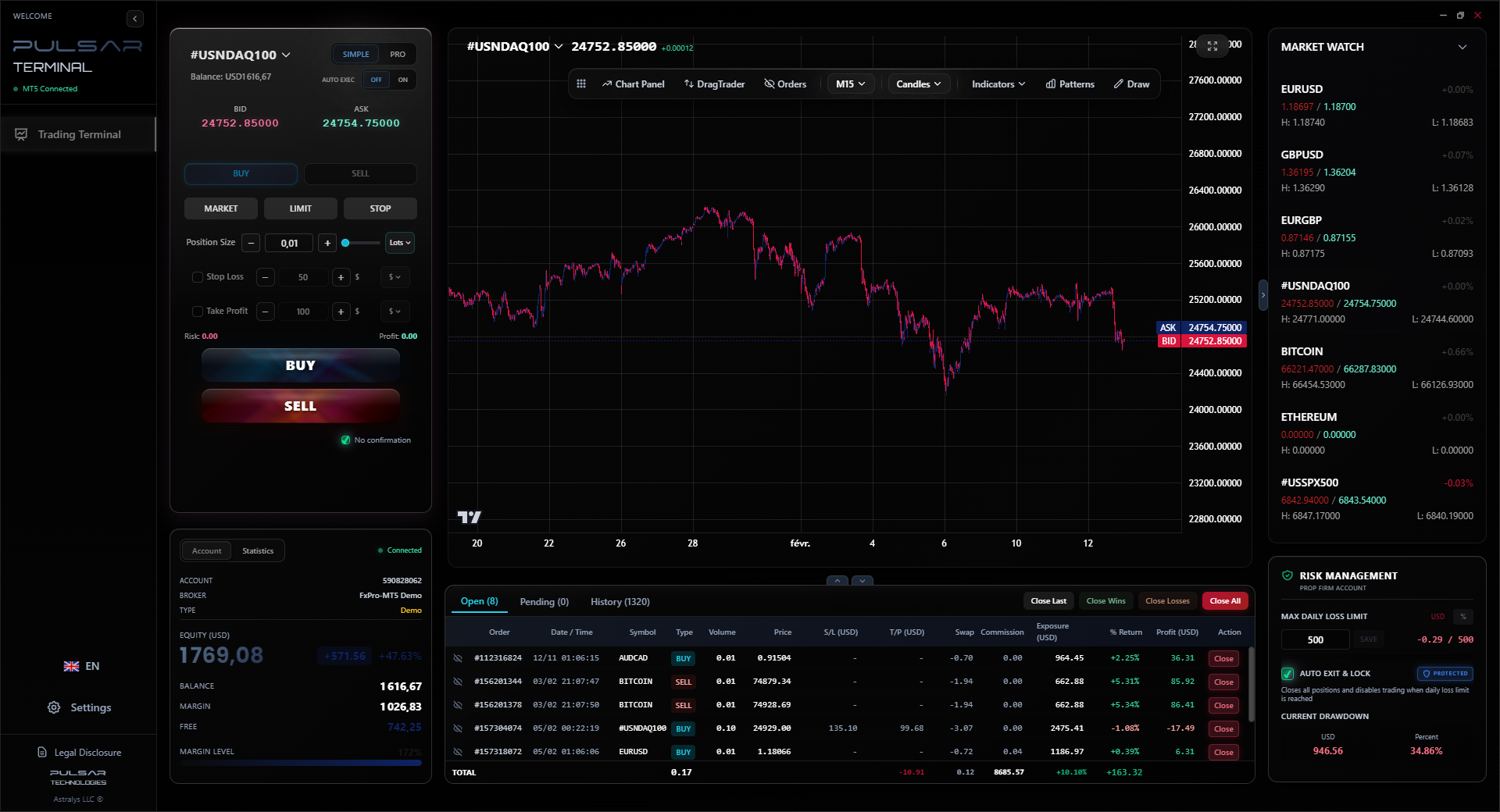
This process uses the EMA as the core trend and dynamic S/R framework, but it's not the trigger. The trigger is price action confirmation. This disciplined approach is what separates the consistent trader from the gambler. It's also exactly the kind of disciplined exit management that tools like Pulsar Terminal automate, letting you set trailing stops based on indicators without staring at the screen all day.
Managing multiple trades with EMA-based trailing stops is complex, but Pulsar Terminal automates it directly on your MT5 platform, letting you lock in profits while you focus on analysis.
Pulsar Terminal
Hepsi bir arada MT5 aracı: sürükle-bırak emirler, çoklu TP/SL, trailing stop, grid trading, Volume Profile ve prop firm koruması. Her gün 1.000'den fazla trader tarafından kullanılıyor.
“In Lagos, the only thing more volatile than traffic is the market after a CBN circular. Your EMA better be fast.”
The EMA is a team player. Here are its best teammates in your indicator squad:
- RSI (Relative Strength Index): Perfect combo. The EMA tells you the trend direction. The RSI helps you find entries within that trend. In an uptrend (price > EMA), look for RSI dips to 40 or 50 for potential buy entries. In a downtrend, look for RSI rallies to 60 or 50 for sells. This keeps you from buying overbought or selling oversold in a strong trend.
- MACD (Moving Average Convergence Divergence): Since the MACD is itself based on EMAs, they often align well. Use the MACD histogram crossing above/below zero to confirm the strength of an EMA crossover or a bounce from an EMA level.
- Volume: While forex has no central volume, you can use tick volume or the volume on your broker's platform (like on MT5). A price bounce off the 50 EMA with a surge in volume is a much stronger signal than a bounce on low volume. It suggests institutional interest.
- Horizontal Support/Resistance: This is the ultimate combo. If the rising 50 EMA on the daily chart converges with a major horizontal support level that has held for months, you have a confluence zone. The probability of a bounce is significantly higher. These are the trades you can size a bit more confidently.
Remember, the goal is not to find more signals. The goal is to find higher-quality signals. Adding a second or third filter (like RSI or horizontal S/R) will reduce your number of trades, but it should increase your win rate and average profit. In a market where broker fees and spreads are a real cost, quality over quantity isn't just a motto, it's a survival requirement.
💡 Winston'ın İpucu
Backtest this: Only enter when price is at least 20 pips away from the key EMA. Entering right on top of it leaves you exposed to the inevitable 'stop hunt' wick that probes just beyond it.
FAQ
Q1Is EMA or SMA better for forex trading in Nigeria?
For the fast-moving, news-sensitive Nigerian forex market, the EMA is generally better. It reacts quicker to sudden price changes from CBN announcements or oil price swings. The SMA is smoother but slower, which can mean missing the initial move or exiting a trend too late. Use the EMA for dynamic entries and the SMA (like the 200) for defining the very long-term trend.
Q2What is the best EMA setting for scalping?
For scalping strategy, speed is key. A combination like a 9-period and a 20-period EMA on a 1-minute or 5-minute chart is common. But be warned: scalping with EMAs on Naira pairs is extremely risky due to lower liquidity and potential for wider spreads. It's better suited to major pairs like EUR/USD during high-liquidity sessions, and only with a broker offering razor-thin spreads like Exness on their Raw Spread accounts.
Q3How do I avoid false signals from EMA crossovers?
Stop trading the crossover the moment it happens. First, only trade crossovers in the direction of the higher timeframe trend. Second, wait for a pullback and retest of the EMAs after they've crossed. For example, after a bullish crossover, wait for price to dip back to the now-aligned EMAs and show a bounce (like a bullish pin bar). This retest acts as a confirmation and filters out a huge number of whipsaw false signals.
Q4Do I have to pay tax on profits from EMA-based trading in Nigeria?
Yes. The Nigerian tax authority doesn't care what indicator you use. According to current laws, you are subject to a 10% Capital Gains Tax on your gross trading profits. This applies whether you trade with a local or international broker. Keep detailed records of all your trades, wins, and losses. Consult a tax professional for the most current advice, but don't assume your forex profits are invisible.
Q5Can I use the EMA alone for trading?
You can, but you shouldn't. Using the EMA alone is like driving with only your rear-view mirror. It tells you where you've been, not what's ahead. It's a lagging indicator. Always combine it with at least one other form of analysis, such as price action patterns (support/resistance, candlestick formations) or a momentum oscillator like RSI to help time your entries and exits better.
Q6Why does the EMA sometimes fail as support or resistance?
It fails during market transitions and high-impact news events. If the overall trend is weakening or reversing, the EMA will break. Also, no technical indicator can withstand a fundamental shock. A surprise CBN policy shift, a major oil price crash, or global risk-off sentiment will slice through EMA levels like butter. This is why you always use a stop loss. Never assume any indicator level is guaranteed to hold.
Prof. Winston'ın Dersi
Önemli Noktalar:
- ✓EMA reacts faster than SMA; crucial for news-driven Naira pairs.
- ✓Use it for dynamic support/resistance, not just crossovers.
- ✓Always combine EMA with price action or another indicator.
- ✓The 200 EMA on the daily chart defines the major trend.
- ✓In choppy markets, turn EMAs off to avoid false signals.
Bu makale ne kadar faydalıydı?
Bir yıldıza tıklayın
Haftalık Trading Analizleri
Ücretsiz haftalık analiz ve stratejiler. Spam yok.
Yazar hakkında
Olumide Adeyemi
Batı Afrika Yatırım Öncüsü
Nijerya'nın en aktif forex eğitmenlerinden biri. Lagos'tan 8 yıllık ticaret deneyimi. Afrika'lı trader'lar için düşük sermaye stratejileri ve prop firma yarışmaları uzmanı.
Yorumlar
Risk Uyarısı
Finansal araçlarla işlem yapmak önemli riskler taşır ve tüm yatırımcılar için uygun olmayabilir. Geçmiş performans gelecekteki sonuçları garanti etmez. Bu içerik yalnızca eğitim amaçlıdır ve yatırım tavsiyesi olarak değerlendirilmemelidir. İşlem yapmadan önce her zaman kendi araştırmanızı yapın.
Bunları da beğenebilirsiniz

Cara Trading Forex Sukses: 7 Prinsip dari Trader Profesional
Cara trading forex sukses dengan 7 prinsip trader pro: manajemen modal, disiplin, journal trading, backtest. Data nyata, bukan janji profit palsu.
Jam Trading Forex Terbaik untuk Trader Indonesia: Panduan Lengkap dengan Tabel Waktu
Panduan jam trading forex untuk trader Indonesia. Tabel 4 sesi dunia, jam emas 20:00-00:00, sesi mana yang harus dihindari. Data akurat + tips dari trader berpengalaman.
Top 5 Sàn Forex Uy Tín Nhất 2026: Review Jujur dari Trader Indonesia
Top 5 sàn forex uy tín 2026 untuk trader Indonesia. Review jujur: spread, deposit, withdraw, dukungan lokal. Exness, XM, IC Markets & lebih.
Pulsar Terminal'ı Edinin
Tüm bu hesaplayıcılar MT5 hesabınızdan gerçek zamanlı verilerle Pulsar Terminal'e entegredir.
Pulsar Terminal'ı Edinin