


Ever watched a currency pair like USD/ZAR fall, hit a certain price, and then just...

David van der Merwe
Gelişen Piyasalar Yatırımcısı ·  South Africa
☕ 9 dk okuma
Neler öğreneceksiniz:
Ever watched a currency pair like USD/ZAR fall, hit a certain price, and then just... bounce? Like it hit an invisible floor? That floor has a name, and understanding it is one of the most powerful skills you can have. So, what is support in forex? It's not just a line on a chart. It's a psychological battleground where buyers step in, thinking the price is a bargain, and overwhelm the sellers. For us trading from SA, getting this right means knowing when the rand might find its feet against the dollar or euro. Let's break it down, from the basic theory to how you actually trade it with our local brokers and rules.
At its core, support is a price level where a downtrend tends to pause or reverse because buying interest (demand) becomes strong enough to overcome selling pressure (supply). Think of it as a price floor. It's where a bunch of traders collectively decide, "Okay, this is cheap. I'm buying."
This isn't magic. It happens for a few concrete reasons. First, traders who missed the earlier move see a dip as a buying opportunity. Second, traders who are already long (bought) might see this level as a good place to add to their position, averaging down. And third, traders who sold short might decide to take their profits here, which requires them to buy back, adding more buying pressure.
The opposite concept is resistance, which is the ceiling. Together, they form the basic building blocks of nearly every chart analysis method. I made the mistake early on of drawing these levels based on where I wanted the price to bounce, not where it actually had before. That's a quick way to lose money.

Example: Look at USD/ZAR on a daily chart. You might see it fall to around 18.50, bounce up to 19.20, fall back to 18.50, bounce again, and then eventually break lower. That 18.50 level, tested multiple times, is a classic support zone. Each test weakens it, like a floorboard getting creakier.

💡 Winston'ın İpucu
A level is only truly broken when the market closes decisively beyond it. Ignore the intraday spikes and fakeouts. Patience at the break saves capital.
“Support isn't a magic line; it's a psychological battleground where buyers finally overwhelm sellers.”
Look for Previous Lows
The most straightforward way is to look left on your chart. Find areas where the price has previously stopped falling and reversed. The more times the price has touched or approached this level and bounced, the stronger and more significant the support is considered. A level tested three times is far more reliable than one tested just once.
Volume is Your Friend
A true support bounce often comes with a noticeable spike in trading volume as buyers aggressively step in. If the price touches a level and bounces on low volume, be skeptical. It might not hold next time. Most platforms, including the popular MT4 and MT5 used by brokers like XM and Exness, have volume indicators you can add.
Round Numbers and Psychological Levels
Don't underestimate round numbers. Price action around levels like 1.1000 for EUR/USD or 19.00 for USD/ZAR is often more volatile because many traders place their orders there. It becomes a self-fulfilling prophecy.
Use Indicators as Confirmation, Not the Source
Indicators like moving averages (the 50 or 200-period are common) or pivot points can act as dynamic support, but the strongest levels are usually those horizontal zones formed by pure price action. I use the RSI indicator to look for oversold conditions when price nears a key support, but I never enter a trade based on the RSI alone.
Here’s a quick comparison of how support can appear:
| Type of Support | What It Looks Like | Reliability |
|---|---|---|
| Horizontal (Static) | A clear, flat price level tested multiple times. | High. The classic "floor." |
| Trendline (Dynamic) | An upward-sloping line connecting higher lows in an uptrend. | Medium-High. Breaks can signal trend change. |
| Moving Average | A curving line like the 50 EMA that price bounces from. | Medium. Works great in strong trends. |

Warning: A common mistake is drawing your line through the wicks of candles. For support, you should generally draw the level along the bodies or closes of the candles where the buying actually overwhelmed selling. The low wick shows the battle, but the close shows who won.
“Trading a support bounce without a confirmed close above the level is just guessing.”
Trading from SA adds a few local flavours to the mix. First, you're probably watching ZAR pairs like USD/ZAR, EUR/ZAR, and GBP/ZAR. These can be more volatile than the major pairs, so your support and resistance levels need a bit more breathing room - think of them as zones, not laser-precise lines.
Second, remember our use cap. The FSCA limits retail traders to 30:1. This is a good thing, especially when trading support breaks, which can be wild. Back in the day, I got overconfident and used crazy use on a "sure thing" support bounce on GBP/JPY. The level broke, and the resulting margin call was a brutal but necessary lesson. The 30:1 rule forces more sensible position sizing.
A Real Trade Example (The Good and The Bad)
Let me give you a real example from last year. EUR/USD was in a downtrend but kept finding support around 1.0720. It had bounced three times. On the fourth approach, I saw a bullish pin bar candle form right at 1.0725, with the RSI showing oversold. I went long at 1.0730.
The Good: My stop loss was placed just below the support zone at 1.0690 (40 pips risk). The price bounced nicely, and I took half my position off at 1.0800 for a 70-pip profit. I trailed the stop on the rest.
The Bad: Another time, with USD/ZAR, I saw support at 18.40. It bounced once, and I jumped in on the second touch without waiting for confirmation. The "bounce" was weak, the level broke, and I stopped out. I ignored the fact that the US Fed was speaking that day - major news trumps technical levels every time.

Pro Tip: When trading a support bounce, wait for the candle to close above the support level before entering. That confirms the buyers have actually won the battle for that period. Entering on the touch is guessing; entering on the close is confirming.
💡 Winston'ın İpucu
The third touch of a support level is often the charm for a break. The first touch establishes it, the second confirms it, the third exhausts the buyers. Be extra cautious.
“The previous floor becomes the new ceiling. A broken support level is a gift for finding short entries.”
This is critical. Support doesn't hold forever. A support break is a major event, often signaling that the selling pressure has finally overwhelmed all the buyers at that level. The previous floor now becomes a new ceiling (resistance). This is where you can make money on the downside, but you have to be sharp.
When a key support level cracks - especially on a closing basis and with high volume - it often leads to a sharp, fast move down. Many stop-loss orders are clustered just below these levels, fueling the drop.
How to trade a break:
- Don't jump in immediately. False breaks (or "stop hunts") are common. The price will often dip below support, trigger all the stops, and then zip back above.
- Wait for a retest. The most reliable break trades come after the price falls, then pulls back up to retest the broken support level (now acting as resistance). If it gets rejected there, that's your signal to go short.
- Measure the move. A rough guide is that the subsequent drop can be at least equal to the size of the previous trading range above the support.
This retest principle is a cornerstone of swing trading and is why having a platform with good drawing tools is key. You need to clearly see that old level.
“The previous floor becomes the new ceiling. A broken support level is a gift for finding short entries.”
You can't trade these levels effectively with rubbish tools. Thankfully, our FSCA-regulated brokers offer solid platforms.
MetaTrader is King: MT4 and MT5 are ubiquitous for a reason. Their drawing tools for horizontal lines, trendlines, and channels are perfect for marking support. Most local brokers, from IC Markets to Pepperstone, offer them. The FSCA's client money segregation rules mean your funds are safer with these regulated entities, which matters when you're planning trades around critical levels.
Consider Costs: When you're trading bounces and breaks, costs matter. Every pip counts. Look at the spread on your chosen pair. For example, trading the volatile USD/ZAR might have a wider spread (sometimes 80-100 pips) compared to EUR/USD (often under 1 pip on raw accounts). An ECN account with a low spread but a commission might be cheaper for high-frequency scalping around support.
My Local Setup: I use an FSCA-regulated broker with MT5. I keep a simple chart: candlesticks, a 50-period EMA for dynamic support/resistance, and my manually drawn horizontal lines. I've found keeping it simple stops me from overcomplicating the clear price action story.
Remember, while international brokers are an option, using an FSCA-regulated one gives you protection under our laws, including the 30:1 use cap and segregated accounts. It's worth the peace of mind.
💡 Winston'ın İpucu
If you can't immediately see at least two clear prior tests forming a level, it's not a level worth trading. Don't force it. The market will always provide another opportunity.
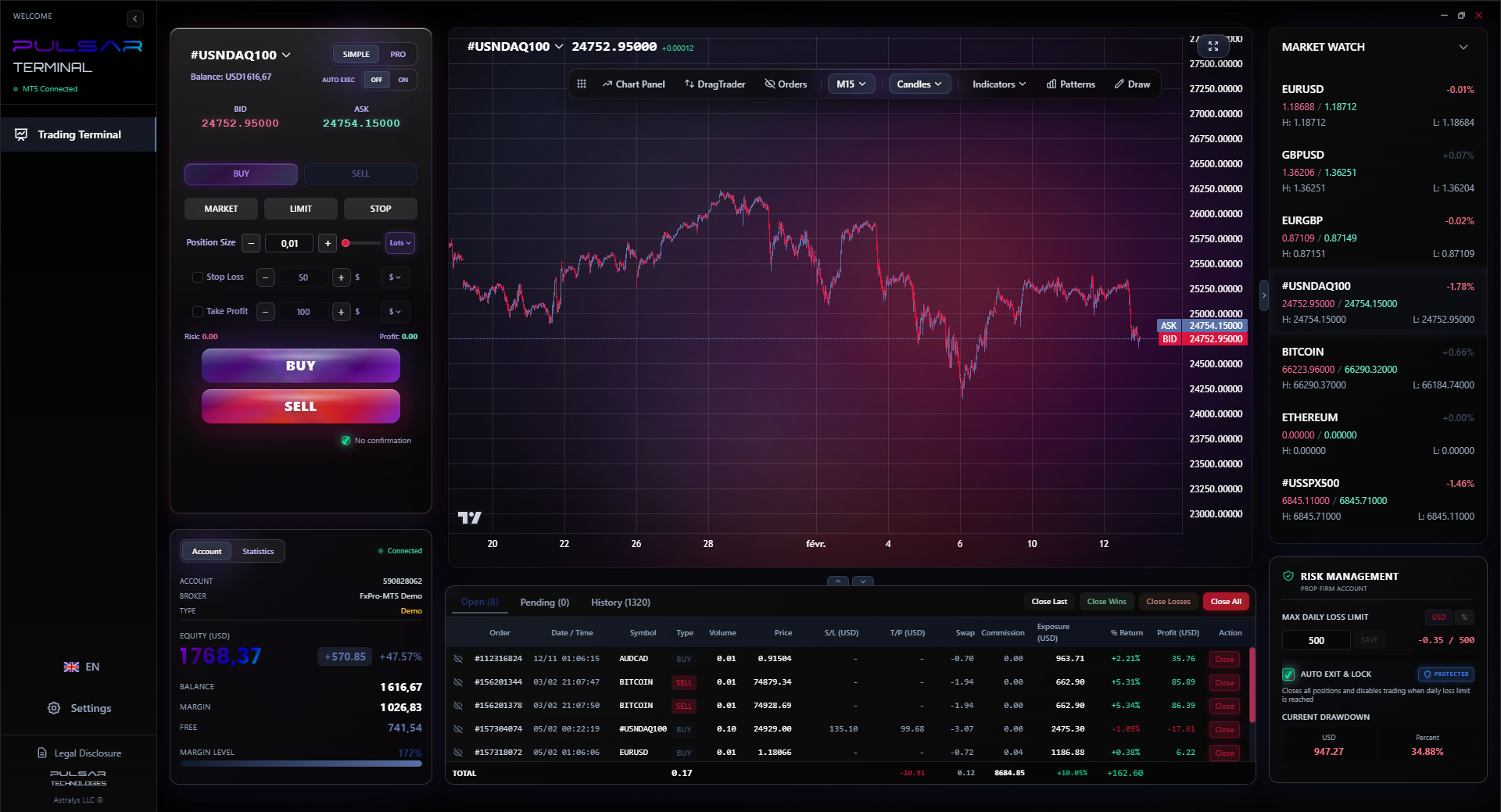
Manually drawing and managing trades around support zones is time-consuming, but tools like Pulsar Terminal automate order placement and advanced risk management directly on your MT5 charts.
Pulsar Terminal
Hepsi bir arada MT5 aracı: sürükle-bırak emirler, çoklu TP/SL, trailing stop, grid trading, Volume Profile ve prop firm koruması. Her gün 1.000'den fazla trader tarafından kullanılıyor.
“The FSCA's 30:1 use cap isn't a restriction; it's a guardrail that saves you from yourself when levels break.”
Here’s the raw truth: support and resistance work because of trader psychology - fear and greed. At support, greed ("I'm getting a discount!") battles fear ("It's going to keep falling!"). Your job is to read who's winning.
Pitfall 1: The Hope Trade. This was my biggest early flaw. You buy at support, it breaks, and instead of admitting you're wrong and taking the small loss, you "hope" it will come back. You hold, the loss grows, and it becomes emotional. Always, always use a stop loss.
Pitfall 2: Overcrowding the Chart. Drawing a support line on every minor low creates noise. Focus on the major, clear levels that have seen significant price reactions. If you can't spot it in 3 seconds, it's probably not a strong level.
Pitfall 3: Ignoring the Context. A support level during a strong bull market is powerful. The same level during a major economic news event (like a SARB interest rate decision) is meaningless. News will smash through technical levels. Check the economic calendar.
, understanding what is support in forex is about understanding crowd behavior. It's not a perfect science, but it gives you a massive edge by showing you where the market has historically made important decisions. Start by simply marking these levels on your charts every day. You'll start to see the market's memory in action.
FAQ
Q1Is support a guaranteed price floor?
No, absolutely not. No level in trading is guaranteed. Support is an area of increased buying interest, not a force field. It can and does break, especially during major news events or strong trend changes. Always use a stop loss when trading based on support.
Q2What's the difference between support and a moving average?
Support is typically a static, horizontal price level. A moving average (like the 50-day EMA) is a dynamic, constantly updating line. The MA can act as support in an uptrend, but it moves as price moves. Static horizontal support is generally considered stronger because it represents a specific price where buyers have consistently shown up.
Q3How wide should a support 'zone' be?
For major pairs like EUR/USD, a zone of 10-20 pips is often sufficient. For more volatile pairs like USD/ZAR or exotic crosses, you might need to widen it to 50-100 pips to account for the wider spreads and volatility. Look at the recent price action - the zone should encompass the area where the candles consolidated or reversed.
Q4Can I use support for scalping?
Yes, but you need to be very precise. Scalpers often use lower timeframes (like 1-minute or 5-minute charts) and look for support levels that align with those on higher timeframes for confluence. The spreads and execution speed of your broker become critically important for scalping.
Q5How does FSCA regulation affect how I trade support?
The main impact is the 30:1 use limit for retail traders. This forces you to use proper position sizing and reduces the risk of a catastrophic blowout if a key support level breaks violently against you. It's a protective measure that encourages more sustainable trading habits.
Q6What's the best timeframe to find strong support?
Start with the higher timeframes. Daily and weekly charts show the most significant, institutionally-relevant support levels. A level that holds on the weekly chart is far stronger than one on the 15-minute chart. Use the higher timeframe to identify the major zone, then drill down to a lower timeframe (like 1-hour or 4-hour) for a more precise entry.
Prof. Winston'ın Dersi
Önemli Noktalar:
- ✓Always wait for a candle close beyond support to confirm a break.
- ✓Use higher timeframes (Daily/Weekly) to find the strongest levels.
- ✓Place stop losses 10-20 pips beyond the support zone, not on it.
- ✓A level tested 3+ times is strong, but also prone to breaking.
- ✓News and economic data will always trump a technical level.
Bu makale ne kadar faydalıydı?
Bir yıldıza tıklayın
Haftalık Trading Analizleri
Ücretsiz haftalık analiz ve stratejiler. Spam yok.
Yazar hakkında
David van der Merwe
Gelişen Piyasalar Yatırımcısı
Johannesburg merkezli, gelişmekte olan piyasa dövizlerinde 11 yıllık deneyime sahip trader. ZAR pariteleri, FSCA düzenlemeli ticaret ve Güney Afrika piyasa analizi uzmanı.
Yorumlar
Risk Uyarısı
Finansal araçlarla işlem yapmak önemli riskler taşır ve tüm yatırımcılar için uygun olmayabilir. Geçmiş performans gelecekteki sonuçları garanti etmez. Bu içerik yalnızca eğitim amaçlıdır ve yatırım tavsiyesi olarak değerlendirilmemelidir. İşlem yapmadan önce her zaman kendi araştırmanızı yapın.
Bunları da beğenebilirsiniz

Cara Trading Forex Sukses: 7 Prinsip dari Trader Profesional
Cara trading forex sukses dengan 7 prinsip trader pro: manajemen modal, disiplin, journal trading, backtest. Data nyata, bukan janji profit palsu.
Jam Trading Forex Terbaik untuk Trader Indonesia: Panduan Lengkap dengan Tabel Waktu
Panduan jam trading forex untuk trader Indonesia. Tabel 4 sesi dunia, jam emas 20:00-00:00, sesi mana yang harus dihindari. Data akurat + tips dari trader berpengalaman.
Top 5 Sàn Forex Uy Tín Nhất 2026: Review Jujur dari Trader Indonesia
Top 5 sàn forex uy tín 2026 untuk trader Indonesia. Review jujur: spread, deposit, withdraw, dukungan lokal. Exness, XM, IC Markets & lebih.
Pulsar Terminal'ı Edinin
Tüm bu hesaplayıcılar MT5 hesabınızdan gerçek zamanlı verilerle Pulsar Terminal'e entegredir.
Pulsar Terminal'ı Edinin