


Here's the truth most trading 'gurus' won't tell you: you don't need a single formal qualification to be a forex trader in South Africa.

David van der Merwe
Gelişen Piyasalar Yatırımcısı ·  South Africa
☕ 10 dk okuma
Neler öğreneceksiniz:
- 1The Legal Reality: No Degrees Required
- 2The Six Real-World Qualifications You Actually Need
- 3Costs, Minimum Deposits, and Real Numbers
- 4Getting Started: The South African Pathway
- 5Common Pitfalls (And How to Avoid Them)
- 6Advanced Considerations: Prop Firms and Beyond
- 7Final Verdict: Your Trading License is Self-Issued
Here's the truth most trading 'gurus' won't tell you: you don't need a single formal qualification to be a forex trader in South Africa. No degree, no certificate, no license. The FSCA doesn't require it. But that's the most dangerous part. Because while you legally can start trading with zero qualifications, you'll almost certainly lose your money if you do. The real 'qualifications' aren't on paper. They're the skills, knowledge, and regulatory savvy you build yourself. Let me show you what you actually need to survive and profit in the ZAR market.
Let's get the official stuff out of the way first. As an individual retail trader in South Africa, you are not legally required to hold any specific academic qualification, professional certification, or government license to open a trading account and start buying and selling currency pairs. The Financial Sector Conduct Authority (FSCA), our main watchdog, regulates the brokers, not you. Their job is to make sure the companies offering CFDs and forex are licensed Financial Services Providers (FSPs), often with an additional ODP license for derivatives.
This means you, sitting in Cape Town or Johannesburg, can legally fund an account and trade. Your profits are yours (though taxable, more on that later). This lack of a formal barrier is why forex has exploded here, with over 200,000 active traders. It's accessible. But accessibility is a double-edged sword. It lets everyone in, including people completely unprepared for the volatility.

Warning: Trading with an unregulated or offshore broker might offer higher use, but it means you forfeit all FSCA protections. If that broker disappears with your money, you have virtually no recourse. Always check the FSCA's financial services provider register first.
The real qualification starts with choosing the right playing field. I made the mistake early on of chasing 500:1 use with an offshore bucket shop. I turned R5,000 into R15,000 in a week on wild bets. Felt like a genius. Then the 'broker' rejected my withdrawal, citing obscure 'terms of service.' I lost it all. That was my R5,000 lesson in the value of regulation. Now I only use FSCA-regulated entities like Pepperstone or IC Markets for my serious capital.
Forget university. Your trading education happens in the market, often paid for in rands. Here are the non-negotiable qualifications you have to earn.
1. A Rock-Solid Understanding of Risk
This is your first and most important exam. You need to know, instinctively, how much you can afford to lose on a single trade without it ruining your week or your account. This isn't vague. It's a number, usually 1-2% of your capital. You need to master using a position size calculator for every single entry. The FSCA helps by capping use at 30:1 for retail clients, which prevents the insane blow-ups you see elsewhere, but you still need your own discipline.
2. Regulatory and Tax Savvy
You need to understand the local rules. First, South African residents are not allowed to speculate against the Rand (ZAR). This means you can't just short USD/ZAR for fun. Second, your profits are taxable income. You must keep careful records of all trades for SARS. Third, know the exchange controls. You can use your annual R10 million foreign capital allowance to fund international accounts if needed.
3. Psychological Resilience
This is the qualification most people fail. Can you stick to your plan when a trade goes R1,000 against you? Can you avoid revenge trading after a loss? I remember a brutal week trading EUR/USD where I took three consecutive losses, totaling R2,800. My plan said stop. My ego said 'get it back.' I took a fourth, oversized trade out of frustration. It hit my stop loss in 20 minutes. Another R1,200 gone. That R4,000 lesson in emotional control was more valuable than any book.
4. Technical & Fundamental Analysis Literacy
You don't need a PhD in economics, but you need a working method. Can you read a chart? Do you understand what drives the Rand? This means getting comfortable with tools like support/resistance, trend lines, and maybe an indicator or two like the RSI or MACD. It also means watching local events - SARB interest rate decisions, political news, commodity prices (our economy is tied to them).
5. Practical Platform Proficiency
Your qualification is knowing your trading platform inside out. In South Africa, that's most likely MetaTrader 4 or 5. Can you place a limit order? Set a stop-loss? Understand what the spread is costing you? You need to be able to execute your plan without fumbling. A mis-click can cost you hundreds of rands.
6. A Funded Account with 'Risk-Only' Capital
Your final qualification is capital, but not your rent money. You need money you can afford to lose completely. Realistically, while some brokers offer $0 minimums, starting with less than R5,000 makes it very hard to manage risk properly on standard lots. A R10,000 account risking 1% per trade gives you a R100 risk buffer - that's a sane starting point for a beginner to learn without being wiped out by a single margin call.

💡 Winston'ın İpucu
Your first R10,000 in the market is tuition fees, not investment capital. Expect to pay for your education.
“The real 'qualifications' aren't on paper. They're the skills, knowledge, and regulatory savvy you build yourself.”
Let's talk numbers, because your qualification includes understanding what this actually costs. It's not just your starting capital.
Minimum Deposits: This varies wildly. Many top brokers now offer $0 minimums (like Fusion Markets or BlackBull Markets). Others might ask for R1,500-R4,000. My advice? The broker's minimum is irrelevant. Your minimum should be an amount that, if lost, doesn't impact your life. For most new traders, that's between R5,000 and R20,000.
The Real Cost of Trading: This is where you get qualified or get cleaned out.
- Spreads: The difference between buy and sell. On a major pair like EUR/USD, you might pay 0.8 pips on a standard account. On a ZAR pair like USD/ZAR, expect 80-150 pips because it's an exotic. That's a huge cost just to enter.

Example: Buying 1 mini lot (10,000 units) of USD/ZAR with a 100 pip spread. Each pip is worth about R0.10 on a mini lot. So your trade is down R10.00 (100 pips * R0.10) the moment you open it. You need the market to move 100 pips just to break even.
- Commissions: Some ECN accounts charge $3-$7 per standard lot round turn but offer raw spreads near 0.0.
- Swap Fees: Holding a position overnight? You'll pay or earn a small fee based on interest rates. These can add up if you're a swing trader holding for weeks.
use: The FSCA's 30:1 cap is a blessing in disguise. It forces you to put up more of your own money, which makes you think twice. On a R10,000 account at 30:1, you control R300,000 worth of currency. That's plenty to make money (and lose it) if you're not careful.
So, how do you get these 'qualifications'? Here's a practical, local pathway.
- Education First, Money Last: Spend 3-6 months on a demo account. Not a week. Months. Treat the virtual R100,000 like real money. Test a scalping strategy or a swing approach. Learn the platform.
- Choose a Local-Friendly, Regulated Broker: Pick an FSCA-regulated broker that supports ZAR deposits and EFT payments. XM and Tickmill offer ZAR accounts, which simplifies things. Check their spreads on the pairs you want to trade.
- Start Absurdly Small: When you go live, fund your account with your 'risk capital.' Then, trade micro or nano lots. Your goal for the first 100 trades isn't profit. It's to execute your plan perfectly, manage your emotions, and keep a detailed journal.
- Get Your Admin in Order: Open a separate spreadsheet for your trades on day one. Note entry, exit, pips, profit in Rands, and the reason for the trade. This journal is your first real trading qualification. It's also your tax document.
- Graduate Slowly: Only increase your position size after you have a proven, consistent record over at least 6 months. Not a hunch. A record.

Pro Tip: Fund your account using your broker's local South African bank details if they have them. An EFT from FNB or Standard Bank is usually free and clears in hours. Avoid international card deposits if you can; the bank's forex conversion fees will eat into your capital before you even trade.
💡 Winston'ın İpucu
A trading journal is more valuable than any analyst report. If you didn't write down why you took a trade, you didn't have a reason.
“Accessibility is a double-edged sword. It lets everyone in, including people completely unprepared for the volatility.”
I've failed at most of these, so learn from my losses.
Pitfall 1: Chasing the 'Perfect' System. You'll buy courses, indicators, and signals promising 90% wins. They don't exist. I wasted over R15,000 on this garbage early on. Your edge comes from consistency and risk management, not a magic indicator.
Pitfall 2: Underestimating the ZAR's Volatility. Our currency can move fast on local political or economic news. Trading USD/ZAR requires extra caution and wider stops. Don't treat it like the steady EUR/USD.
Pitfall 3: Ignoring the Total Cost. That 'free' trade with a 150-pip spread on USD/ZAR isn't free. You're starting in a deep hole. Always calculate your break-even point including costs.
Pitfall 4: Using Too Much use. Even at 30:1, it's easy to over-use a small account. On a R5,000 account, a single standard lot (100,000 units) is effectively 20:1 use on a major pair. That's a R500 move against you wiping out 10% of your account. Use the use cap as a maximum safety net, not a target.
Pitfall 5: Trading Without a Stop-Loss. This is suicide. Every trade must have a predefined exit point for failure. Always. No exceptions.
Once you've 'qualified' yourself with a year or two of consistent personal trading, you might look at proprietary trading firms. These are companies that give you capital to trade for a share of the profits. They are a world apart from retail trading.
Their 'qualifications' are brutal, standardized tests. You'll typically pay an evaluation fee (say, R2,000 for a $100,000 challenge). You then have to hit a profit target (e.g., 10%) within a time limit while adhering to strict daily and maximum loss rules (e.g., no losing more than 5% in a day, 10% total).
This is where the qualifications we discussed become critical. The discipline needed to pass is extreme. One emotional, oversized trade can blow your entire challenge in an hour. The firms automate their risk checks, so there's no mercy.
If you're considering this path, your personal trading journal should show months of discipline. You should be using tools that help enforce rules. Managing a prop firm challenge requires robotic adherence to risk limits, which is exactly what a tool like a trading terminal is built for.
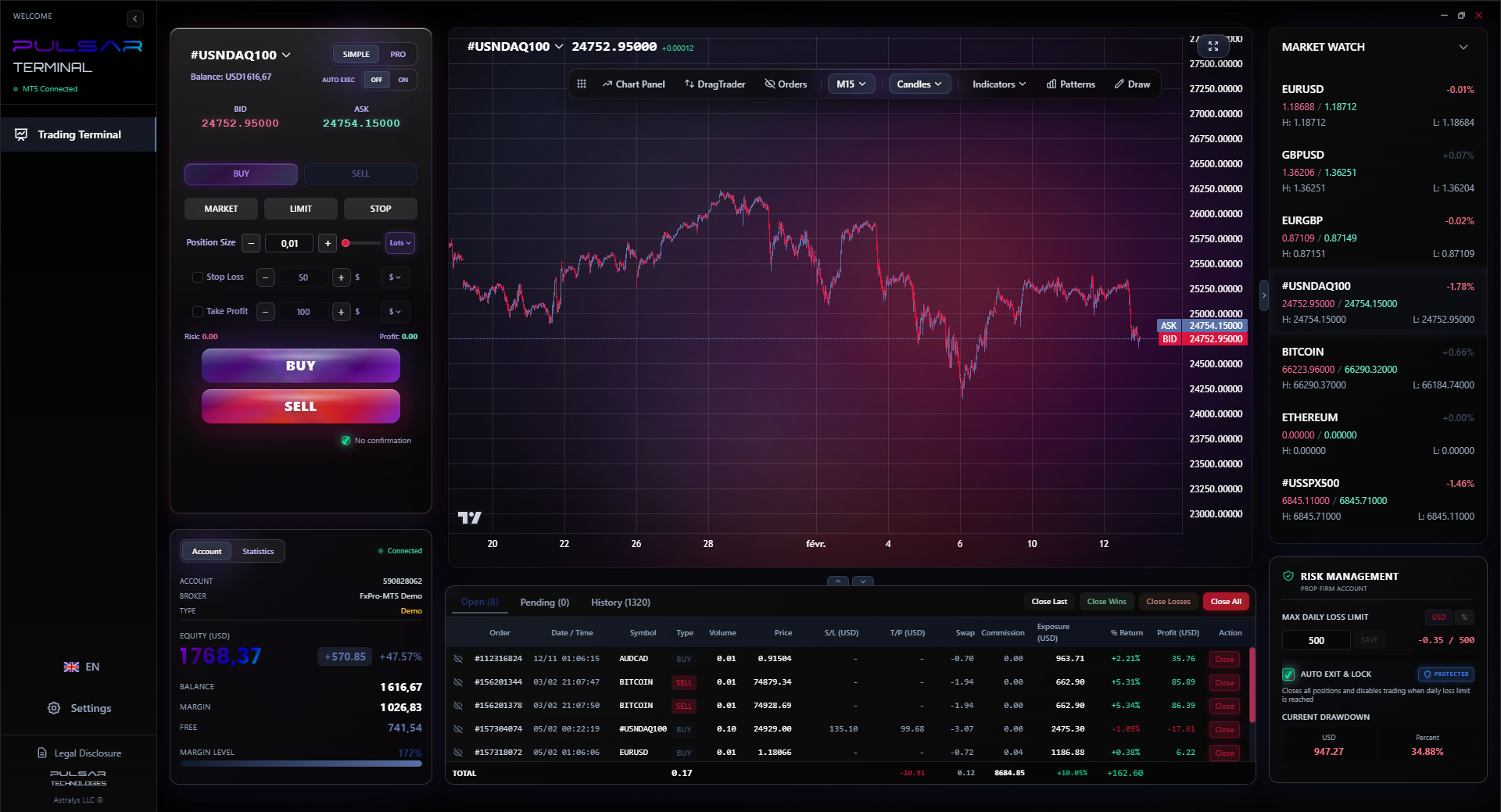
Passing a prop firm challenge requires strict, automated loss management to avoid breaching daily limits, which is where a tool like Pulsar Terminal's prop firm protection feature becomes useful.
💡 Winston'ın İpucu
The FSCA's 30:1 use cap isn't a restriction, it's a life jacket. The sea is rough enough.
Passing a prop firm challenge requires strict, automated loss management to avoid breaching daily limits, which is where a tool like Pulsar Terminal's prop firm protection feature becomes invaluable.
Pulsar Terminal
Hepsi bir arada MT5 aracı: sürükle-bırak emirler, çoklu TP/SL, trailing stop, grid trading, Volume Profile ve prop firm koruması. Her gün 1.000'den fazla trader tarafından kullanılıyor.
“Your certificate of completion isn't a diploma. It's a brokerage statement showing three consecutive months of disciplined, profitable trading after all costs.”
So, what qualifications do you need to be a forex trader in South Africa? Officially, none. In reality, you need to issue yourself a license built on:
- Capital you can lose (R5,000-R20,000 to start seriously).
- Risk management mastery (never risk more than 1-2% per trade).
- Emotional discipline (a traded, reviewed journal is proof).
- Regulatory awareness (trade with FSCA brokers, know the tax rules).
- A tested, simple method (you don't need 10 indicators, you need one you understand deeply).
Your certificate of completion isn't a diploma. It's a brokerage statement showing three consecutive months of disciplined, profitable trading after all costs. That's the only qualification that truly matters in this game. Everything else is just theory. Now, go open a demo account and start your real education. The market is the only examiner that counts, and it's testing you on every single trade.
FAQ
Q1Do I need a license from the FSCA to trade forex personally?
No. The FSCA licenses and regulates the brokers (Financial Services Providers), not individual retail traders. You can legally open an account and trade without any government-issued trading license.
Q2Is a finance degree or similar qualification helpful for forex trading?
It can provide useful background knowledge on economics, but it's absolutely not necessary. I know successful traders with backgrounds in engineering, teaching, and art. The most critical skills - risk management, discipline, and emotional control - aren't taught in a traditional finance degree. Practical screen time is far more valuable.
Q3What is the minimum amount I need to start trading forex in South Africa?
While some brokers allow deposits as low as R70, that's not practical for learning proper risk management. A realistic minimum to start learning seriously is between R5,000 and R10,000. This allows you to trade micro lots and absorb inevitable early losses without blowing your account on a single bad trade.
Q4Can I trade ZAR pairs like USD/ZAR as a South African?
You can, but with a major caveat. South African residents are prohibited from speculating against the Rand. In practice, this means you need a legitimate underlying reason for the trade (like hedging an international business exposure), which most retail traders don't have. It's a complex area, and many traders simply avoid ZAR pairs to stay clear of regulatory grey areas.
Q5How are my forex trading profits taxed in South Africa?
Profits from forex trading are considered taxable income by SARS. You must declare them on your annual tax return. It's crucial to keep a detailed, time-stamped log of all your trades (including entries, exits, and profits/losses in Rands) as supporting documentation. Losses can often be offset against other income, but consult with a tax professional.
Q6Are online forex trading courses worth it as a qualification?
Most are not. I've bought many and found them overpriced and filled with basic information you can find for free. The real value in paid education comes from small, focused mentorship or communities, not the generic 'get rich quick' courses. Your best initial 'course' is a demo account, a few good books on trading psychology, and thousands of hours of chart review.
Q7What's the biggest mistake new traders make regarding qualifications?
They believe the qualification is a secret strategy or indicator they can buy. It's not. The real qualification is the boring, repetitive discipline of managing risk on every single trade, logging it, and reviewing it without ego. The traders who focus on perfecting their process qualify themselves. The ones looking for a magic bullet disqualify themselves with losses.
Prof. Winston'ın Dersi
Önemli Noktalar:
- ✓No legal license needed, but FSCA-regulated brokers are non-negotiable.
- ✓Risk management (1-2% per trade) is your primary qualification.
- ✓Start with real risk capital: R5,000 to R20,000 minimum.
- ✓ZAR pairs have wide spreads (80-150 pips); factor that in.
- ✓Your trading journal is your only proof of qualification.
Bu makale ne kadar faydalıydı?
Bir yıldıza tıklayın
Haftalık Trading Analizleri
Ücretsiz haftalık analiz ve stratejiler. Spam yok.
Yazar hakkında
David van der Merwe
Gelişen Piyasalar Yatırımcısı
Johannesburg merkezli, gelişmekte olan piyasa dövizlerinde 11 yıllık deneyime sahip trader. ZAR pariteleri, FSCA düzenlemeli ticaret ve Güney Afrika piyasa analizi uzmanı.
Yorumlar
Risk Uyarısı
Finansal araçlarla işlem yapmak önemli riskler taşır ve tüm yatırımcılar için uygun olmayabilir. Geçmiş performans gelecekteki sonuçları garanti etmez. Bu içerik yalnızca eğitim amaçlıdır ve yatırım tavsiyesi olarak değerlendirilmemelidir. İşlem yapmadan önce her zaman kendi araştırmanızı yapın.
Bunları da beğenebilirsiniz

Cara Trading Forex Sukses: 7 Prinsip dari Trader Profesional
Cara trading forex sukses dengan 7 prinsip trader pro: manajemen modal, disiplin, journal trading, backtest. Data nyata, bukan janji profit palsu.
Jam Trading Forex Terbaik untuk Trader Indonesia: Panduan Lengkap dengan Tabel Waktu
Panduan jam trading forex untuk trader Indonesia. Tabel 4 sesi dunia, jam emas 20:00-00:00, sesi mana yang harus dihindari. Data akurat + tips dari trader berpengalaman.
Top 5 Sàn Forex Uy Tín Nhất 2026: Review Jujur dari Trader Indonesia
Top 5 sàn forex uy tín 2026 untuk trader Indonesia. Review jujur: spread, deposit, withdraw, dukungan lokal. Exness, XM, IC Markets & lebih.
Pulsar Terminal'ı Edinin
Tüm bu hesaplayıcılar MT5 hesabınızdan gerçek zamanlı verilerle Pulsar Terminal'e entegredir.
Pulsar Terminal'ı Edinin