


Most Nigerian traders get the Friday market close completely wrong, and it's costing them money every single week.

Olumide Adeyemi
Batı Afrika Yatırım Öncüsü ·  Nigeria
☕ 10 dk okuma
Neler öğreneceksiniz:

Most Nigerian traders get the Friday market close completely wrong, and it's costing them money every single week. They think it's a simple clock-out time, but it's actually the most dangerous 60 minutes of the trading week. I've watched traders in Lagos, Port Harcourt, and Abuja get their accounts wrecked because they treated Friday's close like any other day. This article isn't about memorizing a time; it's about understanding the strategic shift that happens when liquidity drains from the market. I'll show you the exact WAT (West Africa Time) you need to know, what really happens in that final hour, and how you can use it to protect your capital instead of gambling with it.
Forex doesn't have a single opening bell like the Nigerian Stock Exchange. It's a 24-hour relay race between major financial centers. For us in Nigeria, this means the market is most active when London and New York are open. The session flow looks like this in West Africa Time (WAT):
- Sydney/Tokyo Session: Kicks off around 10:00 PM WAT. It's often quieter, setting the tone.
- London Session: The main event. Opens at 8:00 AM WAT. This is when volatility and volume really pick up. Most of my profitable scalping strategy trades are executed in the London overlap.
- New York Session: Opens at 1:00 PM WAT. The London-New York overlap (1:00 PM to 4:00 PM WAT) is typically the most liquid and volatile period of the entire day.
The official 'close' for the trading week is when the New York session ends on Friday. But here's the catch: liquidity doesn't just vanish at the stroke of 10 PM. It starts fading much earlier, especially on Fridays when big banks and funds square up their books for the weekend. This creates a dangerous environment that many retail traders ignore.
Alright, let's get to the specific answer you came for.
The forex spot market officially closes for the week at 10:00 PM West Africa Time (WAT) on Friday. This is when the New York trading desks shut down (5:00 PM New York EST).

Warning: This is the theoretical close. The practical close, where real liquidity dries up and weird price action starts, begins around 8:30 PM to 9:00 PM WAT. If you're still in a trade past 9 PM WAT on a Friday, you're trading in a ghost town.
I learned this the hard way early on. I was in a short EUR/USD trade, up about 25 pips, and thought I'd let it ride over the weekend for a bigger move. I held past 9:30 PM WAT. The spread on my broker's platform widened from 1.2 pips to over 8 pips in a matter of minutes. Then, a tiny, low-volume spike triggered my stop-loss at 10:05 PM, closing me out for a loss before the price snapped right back. I got 'stopped out' by a phantom move that wouldn't have happened in a liquid market. That was a $120 lesson on the importance of timing.
For reference, here's how it lines up globally:
| Location | Local Time | Equivalent WAT |
|---|---|---|
| New York (EST) | 5:00 PM Friday | 10:00 PM Friday |
| London (GMT) | 10:00 PM Friday | 11:00 PM Friday* |
| Lagos (WAT) | 10:00 PM Friday | 10:00 PM Friday |
*Note: During GMT (when the UK is not on BST), London is only 1 hour behind WAT.

💡 Winston'ın İpucu
Set a recurring phone alarm for 8:30 PM every Friday. When it goes off, close your charts. Your trading week is over. Go spend your Naira.
“The Friday close isn't a pause; it's a 48-hour blackout period where anything can happen.”
You might think, "It's just a weekend, the market will reopen Sunday night." That's a naive and expensive mindset. The Friday close isn't a pause; it's a 48-hour blackout period where anything can happen in the real world, and all that pent-up risk explodes when the market reopens.
The Liquidity Drain
Major players - investment banks, hedge funds, multinational corporations - don't like carrying unnecessary risk over the weekend. They start closing out or hedging their positions in the afternoon (New York time). This mass exodus means fewer buyers and sellers. With less liquidity, it takes less money to move prices. This leads to erratic, exaggerated swings that don't reflect true market sentiment. Your stop-loss becomes a target in this thin market.
The Weekend Gap Risk
This is the big one. From Friday 10 PM WAT to Sunday 10 PM WAT, the forex market is closed. But the world isn't. Geopolitical events, surprise economic data releases from other time zones, central bank comments, or political drama can all occur. When the market reopens on Sunday, the price can "gap" - open at a significantly different level than Friday's close. I've seen EUR/USD gap over 80 pips on a Sunday night due to an unexpected election result. If you were in a trade, your broker would execute your stop or take-profit at the first available price, which could be miles away from where you set it. Using a position size calculator is useless if a gap can blow through your entire risk management plan.

Pro Tip: Treat any open position you hold past 8:30 PM WAT on Friday as a new, much riskier trade. The rules change. Your risk per trade should effectively be halved if you decide to hold, because the potential gap risk doubles.

So what should you actually do? You have three logical choices, and only one of them is stupid.
1. The Close-Out Strategy (Recommended for 95% of Traders) This is the simplest and safest. Your goal is to be flat (no open positions) by 9:00 PM WAT at the latest. Don't try to squeeze out the last few pips. Close all trades, take your weekly profit or loss, and review your journal. This strategy eliminates weekend gap risk entirely. It forces discipline and gives you a mental break. I make it a rule to never hold a standard swing trading position over the weekend. The stress isn't worth the potential reward.
2. The Strategic Hold (For Experienced Traders Only) Sometimes, you have a massive winner that's part of a longer-term trend, and closing it would incur huge swap fees or break your thesis. If you must hold:
- Widen Your Stops: Your technical stop based on Tuesday's volatility is irrelevant. Move your stop-loss to a level that can withstand a 50-70 pip gap against you. This often means giving back a chunk of profit.
- Hedge with Options (If Available): This is advanced. You might buy a cheap out-of-the-money option to protect against a catastrophic gap.
- Only Hold Core Positions: This should be a tiny fraction of your portfolio.
3. The Gambler's Approach (The Stupid Choice) This is holding speculative, short-term trades over the weekend hoping for a gap in your favor. You're not trading; you're buying a lottery ticket with worse odds. I don't do this anymore. The one time I tried it "for fun" with a 0.01 lot on GBP/USD, I got gapped 120 pips against my position on a Sunday. It wiped out two weeks of careful profits from my main account.
Managing trades in this final window is where good software helps. Manually widening stops on multiple positions is a hassle. A tool that lets you drag and adjust orders on the chart before the close can save crucial minutes and prevent errors.

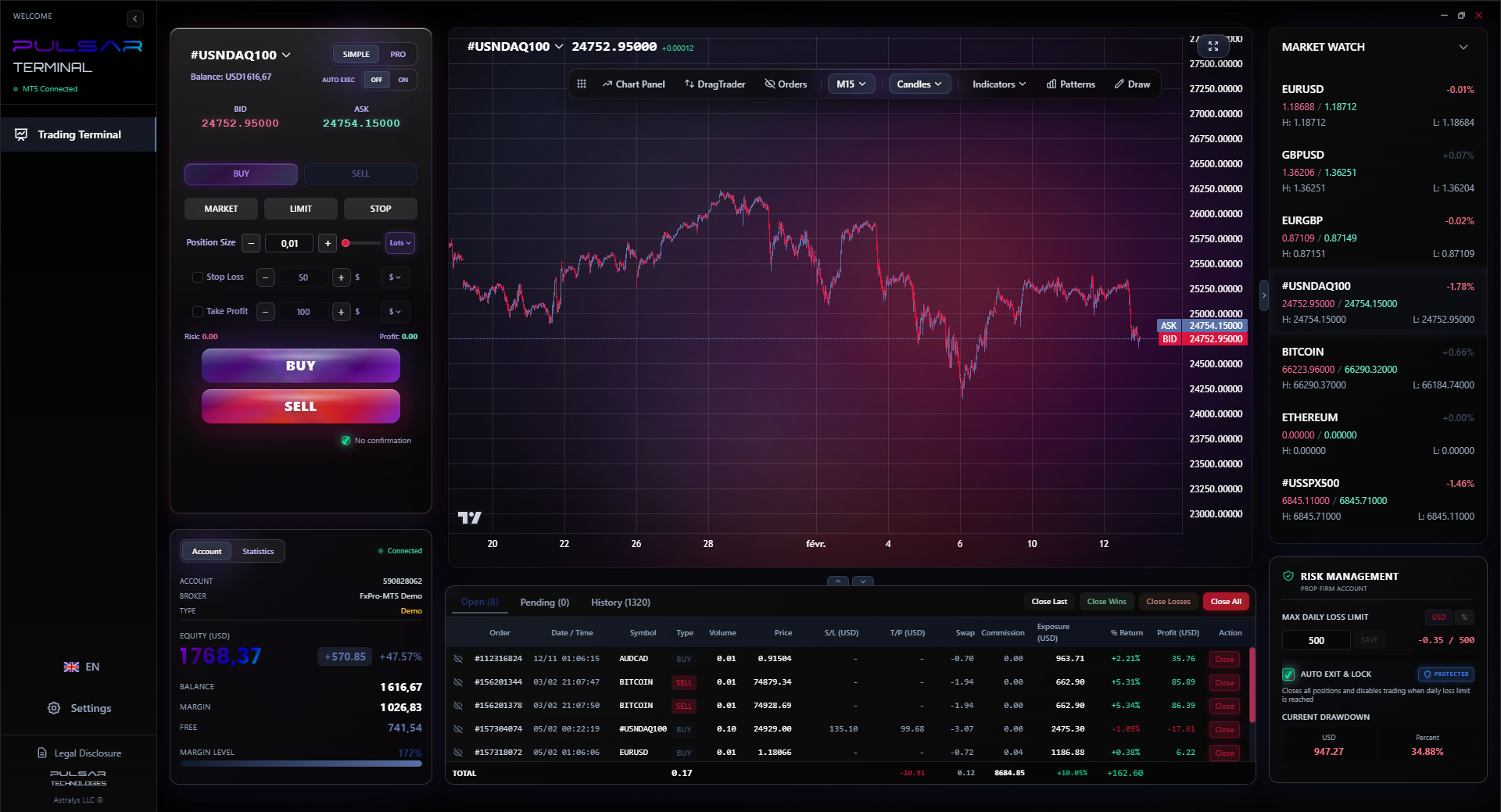
Managing multiple trades and adjusting stops in the frantic hour before the Friday close is where a tool like Pulsar Terminal saves you from costly manual errors on your MT5 platform.
Pulsar Terminal
Hepsi bir arada MT5 aracı: sürükle-bırak emirler, çoklu TP/SL, trailing stop, grid trading, Volume Profile ve prop firm koruması. Her gün 1.000'den fazla trader tarafından kullanılıyor.
“If you're still in a trade past 9 PM WAT on a Friday, you're trading in a ghost town.”
The market reopens at 10:00 PM WAT on Sunday. This is when the Sydney session begins. But don't mistake the opening bell for the green light.
The first hour (10:00 PM - 11:00 PM WAT) is often defined by two things:
- Gap Closure: There's a common tendency for the price to move back to "fill" the weekend gap. This isn't a guarantee, but it's a frequent pattern as liquidity returns and the initial overreaction is reassessed.
- Erratic Volatility: Liquidity is still low. The first candles can be wild and spiky. It's generally wise to avoid entering new trades for the first 60-90 minutes. Let the market settle. I use this time to plan my week, set alerts, and analyze the weekly charts, not to jump into trades.
This is also a key time to check your broker. Some brokers, especially offshore ones, may show quotes during this period but have massively widened spreads. I've seen spreads on exotic pairs blow out to 20+ pips at the Sunday open. Always check the live spread definition before placing a trade in this session. A good IC Markets review or Pepperstone review will often comment on their weekend spread behavior.
💡 Winston'ın İpucu
The Sunday night open is for planning, not trading. Use that hour to mark up your weekly charts with key levels from the Friday close. Let the amateurs chase the ghosts.

Let's be blunt about the errors I see constantly in our trading communities.
Mistake 1: Trading the Friday Afternoon News. The US economic data (like NFP) often comes out at 1:30 PM WAT. The volatility spike is real, but it's followed by the liquidity drain. Traders get in late on the move, then get reversed in the thin market before the close. The move is often over by 3:00 PM WAT.
Mistake 2: Ignoring Swap Rates (Rollover). If you hold a position past 10:00 PM WAT (the broker's daily rollover time), you'll earn or pay swap interest. For some currency pairs, like going long USD/TRY, the swap cost can be enormous and can eat your profit over a weekend. Always check the swap rates on your platform before deciding to hold.
Mistake 3: Setting Tight Stops Before the Close. Placing a 15-pip stop-loss at 9:45 PM WAT on a Friday is asking for it to be hunted. Market makers and algorithms know where the retail stops are clustered in thin volume. Widen them significantly or just close the trade.
Mistake 4: Reopening Trades Too Early on Sunday. Eagerness kills accounts. That bounce at 10:05 PM WAT might look like a great entry, but it's often just noise. Wait for the London session at 8:00 AM WAT on Monday for confirmed, high-volume price action. Patience here is a strategy in itself.
💡 Winston'ın İpucu
If you wouldn't enter a trade at 9:45 PM Friday, you shouldn't be in one. That's the simplest litmus test for weekend risk.

“Treat any open position you hold past 8:30 PM WAT on Friday as a new, much riskier trade.”
Not all brokers handle the weekend the same way. This is crucial for Nigerian traders using international brokers.
- Trading Hours: Most brokers will stop accepting new orders a few minutes before 10:00 PM WAT and will close all pending orders (like limits/stops) that are not attached to open positions. Your open positions will remain open but be subject to gaps.
- Spreads: This is a major differentiator. Some brokers have a "weekend mode" where they keep symbols tradable but with astronomical spreads (e.g., 50 pips on EUR/USD) to discourage trading. Others simply close. Check your broker's specification sheet. I've found brokers like Exness and XM have relatively clear policies on this, which is why reading a detailed Exness review or XM review is part of your homework.
- Margin Requirements: Some brokers increase margin requirements over the weekend. If you're heavily leveraged, a small gap could trigger a margin call the moment the market opens Sunday. Always know your broker's weekend margin policy.
- Platform Access: Your MT4/MT5 platform will still be online, but the prices will be frozen from Friday close until Sunday reopen. Don't panic if you log in on Saturday and see no movement; that's normal.

FAQ
Q1What is the exact forex market close time in Lagos on Friday?
The official spot forex market closes at 10:00 PM West Africa Time (WAT) every Friday, which corresponds to the 5:00 PM EST close in New York.
Q2Is it safe to hold forex trades over the weekend?
Generally, no. Holding trades exposes you to weekend gap risk, where the market can open with a large price difference on Sunday. For most retail traders, especially those using use, the risk outweighs the potential reward. It's safer to close positions before the Friday liquidity drain begins (around 9:00 PM WAT).
Q3What time does forex open on Sunday in Nigeria?
The forex market reopens at 10:00 PM WAT on Sunday with the Sydney session. However, liquidity remains very low until the London session opens at 8:00 AM WAT on Monday.
Q4Can I trade during the weekend gap?
No, you cannot trade while the spot forex market is officially closed (from Friday 10 PM WAT to Sunday 10 PM WAT). Some brokers may offer limited products or futures with weekend trading, but the core spot FX market is closed.
Q5Why do spreads widen before the Friday close?
Spreads widen because liquidity providers (big banks) pull out of the market to avoid weekend risk. With fewer participants, the cost of making a market (the bid-ask spread) increases. It's a sign of higher transaction costs and greater slippage risk.
Q6Does the Friday close time change with daylight saving?
Yes, but only relative to other time zones. The 10:00 PM WAT Friday close in Nigeria remains constant because Nigeria does not observe daylight saving. However, the corresponding New York time will shift between 4:00 PM EDT (when the US is on DST) and 5:00 PM EST. Your broker's platform time will adjust automatically.
Q7What should I do if I have a profitable trade open on Friday evening?
The prudent action is to close it and bank the profit before 9:00 PM WAT. If you are adamant about holding, you must widen your stop-loss significantly to account for potential gap risk and be prepared to give back a portion of those unrealized profits.
Prof. Winston'ın Dersi
Önemli Noktalar:
- ✓Official close is 10:00 PM WAT Friday, but liquidity dies by 9:00 PM.
- ✓Weekend gaps can easily exceed 50-100 pips, wrecking tight stops.
- ✓Always check your broker's weekend spreads and margin rules.
- ✓The safest strategy is to be flat by 9:00 PM WAT every Friday.
Bu makale ne kadar faydalıydı?
Bir yıldıza tıklayın
Haftalık Trading Analizleri
Ücretsiz haftalık analiz ve stratejiler. Spam yok.
Yazar hakkında
Olumide Adeyemi
Batı Afrika Yatırım Öncüsü
Nijerya'nın en aktif forex eğitmenlerinden biri. Lagos'tan 8 yıllık ticaret deneyimi. Afrika'lı trader'lar için düşük sermaye stratejileri ve prop firma yarışmaları uzmanı.
Yorumlar
Risk Uyarısı
Finansal araçlarla işlem yapmak önemli riskler taşır ve tüm yatırımcılar için uygun olmayabilir. Geçmiş performans gelecekteki sonuçları garanti etmez. Bu içerik yalnızca eğitim amaçlıdır ve yatırım tavsiyesi olarak değerlendirilmemelidir. İşlem yapmadan önce her zaman kendi araştırmanızı yapın.
Bunları da beğenebilirsiniz

Cara Trading Forex Sukses: 7 Prinsip dari Trader Profesional
Cara trading forex sukses dengan 7 prinsip trader pro: manajemen modal, disiplin, journal trading, backtest. Data nyata, bukan janji profit palsu.
Jam Trading Forex Terbaik untuk Trader Indonesia: Panduan Lengkap dengan Tabel Waktu
Panduan jam trading forex untuk trader Indonesia. Tabel 4 sesi dunia, jam emas 20:00-00:00, sesi mana yang harus dihindari. Data akurat + tips dari trader berpengalaman.
Top 5 Sàn Forex Uy Tín Nhất 2026: Review Jujur dari Trader Indonesia
Top 5 sàn forex uy tín 2026 untuk trader Indonesia. Review jujur: spread, deposit, withdraw, dukungan lokal. Exness, XM, IC Markets & lebih.
Pulsar Terminal'ı Edinin
Tüm bu hesaplayıcılar MT5 hesabınızdan gerçek zamanlı verilerle Pulsar Terminal'e entegredir.
Pulsar Terminal'ı Edinin