


Over 90% of retail traders lose money.

Olumide Adeyemi
Batı Afrika Yatırım Öncüsü
☕ 12 dk okuma
Neler öğreneceksiniz:
- 1Forex Trading: It's Just Buying and Selling Money
- 2How It Actually Works for a Trader in Ghana
- 3Is It Legal in Ghana? The Regulatory Grey Zone
- 4The Real Costs: Spreads, Fees, and the GRA
- 5How to Start Trading in Ghana: A Step-by-Step Reality Check
- 6Mistakes I See Every Ghanaian Trader Make
- 7Survival Kit: Strategy and Risk Management
- 8The Final Question: Is This For You?
Over 90% of retail traders lose money. That's the statistic you need to tattoo on your brain before you even think about what's forex trading. In Ghana, with the cedi's wild swings, the idea of trading dollars and euros can feel like a lifeline. I get it. But this isn't a get-rich-quick scheme. It's a global financial battlefield where the big banks and hedge funds feast on the unprepared. This guide won't sugarcoat it. I'll show you what forex trading really is, how it works for us here, and the cold, hard rules you need to survive.
At its core, forex trading is simple. You're speculating on the value of one currency against another. You buy a currency pair if you think the first currency will strengthen, or sell it if you think it will weaken. The entire global economy runs on this. When a company in Tema imports goods, they need to convert cedis to dollars. That's a forex transaction. What we do as traders is try to profit from the price movements between those conversions.
The market is massive, with a daily turnover hitting $9.6 trillion. That liquidity means you can get in and out of trades quickly, but it also means prices can move violently on news. You're not buying a physical asset. You're buying a contract for difference (CFD) on the price movement. If the price goes your way, you profit. If it goes against you, you lose. It's that blunt.

Warning: Don't confuse trading with sending money abroad. You're not actually receiving physical dollars. You're trading a derivative product whose value is based on the exchange rate. Your profit or loss is in the currency of your trading account, which for most Ghanaians is USD.
The Major Currency Pairs
You'll trade in pairs, quoted like USD/GHS or EUR/USD. The first currency is the 'base', the second is the 'quote'. If EUR/USD is 1.0850, it means 1 Euro buys 1.0850 US Dollars. The majors involve the USD, EUR, GBP, JPY, CHF, CAD, AUD, and NZD. As a Ghanaian, you might be tempted to trade USD/GHS directly, but most international brokers don't offer it. Your exposure to the cedi's value comes from your deposit and withdrawal conversions.

💡 Winston'ın İpucu
The spread is your first enemy. If your strategy needs a 20-pip move to break even, you've already given the house a huge edge. Trade pairs with the tightest spreads, especially when starting.
Here's the practical reality. You won't be calling the Bank of Ghana for a quote. You'll use an online broker's platform, like MetaTrader 4 or 5. You deposit money - say, $500 - which gets converted from cedis at your bank's or payment provider's rate. That money is your margin. The broker then gives you use, which is a loan to control a larger position.
Let me give you a real example from last year. I saw the US Dollar strengthening broadly. I went short on EUR/USD at 1.0730 with a standard lot (100,000 units). My broker, IC Markets, offered 1:500 use on that account type. That meant I only needed about $215 of my own money as margin to control that $100,000 position. The trade went my way, and I closed at 1.0650 for an 80-pip profit. That's $800. Sounds great, right? But the use is a double-edged sword. A move of just 21.5 pips against me would have wiped out my entire $215 margin. That's the risk.

Example:
- Trade: SELL EUR/USD 1.0730
- Position Size: 1.00 (Standard Lot)
- Pip Value: $10
- use Used: 1:500
- Margin Required: ~$215
- Exit: 1.0650
- Profit: 80 pips x $10 = $800
Your profit or loss is calculated in pips. One pip is typically a 0.0001 move for pairs like EUR/USD. The broker makes money through the spread, which is the difference between the buy and sell price. If EUR/USD is quoted as 1.0850 / 1.0852, the spread is 2 pips. You start the trade in a loss by that amount. This is why understanding spread definition and using a position size calculator is non-negotiable.
“Your goal for the first year is not to get rich. Your goal is to not blow up your account.”
This is the most critical section for any Ghanaian. Forex trading is legal. No law says you can't do it. However, as of right now, there is no specific Ghanaian regulator licensing or overseeing the online forex brokers you see advertised on Instagram.
The Bank of Ghana (BoG) regulates banks and forex bureaus for physical currency exchange. The Securities and Exchange Commission (SEC) Ghana regulates the stock market. Neither has a framework for the international, online CFD forex trading we're discussing. This creates a grey zone. You are legally allowed to trade, but you have zero regulatory protection from the Ghanaian government if your broker vanishes with your money.
There is movement. In February 2026, the SEC Ghana presented draft guidelines to regulate this space. This is promising, but it's not law yet. Until then, your safety net is the broker's international license. This is why I only ever use brokers regulated by top-tier authorities like the UK's FCA or Australia's ASIC. Their client money protection rules are what you rely on.
The BoG has also been active, but for different reasons. They've tightened rules on using foreign currency for domestic transactions (cedi is king here) and on moving money in and out to fight money laundering. This can affect how you fund your account. Always use the official channels your broker provides.

Pro Tip: If a 'broker' claims to be 'licensed by the Bank of Ghana' for online retail forex trading, run. Check the BoG's official list of authorized interbank FX brokers - firms like IC Securities. These are for institutional, interbank market activities, not for your $500 retail account. Your protection comes from a broker's offshore license.
Let's talk about what this actually costs you. Your main cost is the spread. On a major pair like EUR/USD with a good broker, you might see a 0.1 to 1.0 pip spread. On exotic pairs or during volatile news, it can widen to 5 pips or more, eating your potential profit instantly.
Some brokers, like Pepperstone with their Razor account, offer raw spreads from 0.0 pips but charge a commission per lot traded. Example: $3.50 per side per 100k lot. So, a round turn (open and close) costs $7. You need to factor this into your strategy, especially for scalping strategy.
Then there's the swap or overnight fee. If you hold a position past 5 PM New York time, you pay or receive interest based on the difference between the two currencies' central bank rates. For a long EUR/USD trade, you might pay a small daily fee if US rates are higher than EU rates.
The Tax Man Cometh
This is where many Ghanaian traders get blindsided. The Ghana Revenue Authority (GRA) considers trading profits as income. It's taxable. The personal income tax rate scales up to 35%. If you're trading through a registered company, corporate tax is 25%. You are required by law to declare this income. I know traders who've made life-changing money only to get a nasty letter from the GRA years later with penalties and back-interest. Keep careful records of every deposit, withdrawal, and trade statement. Consult a local accountant who understands trading income. Ignorance isn't a defense.
💡 Winston'ın İpucu
Your phone is your worst trading tool. The small screen hides critical context. Do your analysis on a proper computer monitor. Use the phone only for monitoring set-and-forget trades.
“If their signals were so good, why are they selling them for GHS 50 a month instead of trading their own millions?”
- Education First, Money Last: Spend 3-6 months on a demo account. Learn what a pip definition is, how use works, and what a margin call feels like - with fake money. I blew up my first demo account twice before I even considered real cash.
- Choose a Regulated International Broker: Your safety is their foreign license. I've had good experiences with Exness for their local deposit options and XM for educational resources. Check their minimum deposit. Some start at $10, others at $200. Don't deposit more than you can afford to lose completely.
- Fund Your Account: Use the broker's approved methods. Many now support MTN Mobile Money and Vodafone Cash. Your cedi will be converted to USD at the provider's rate. Be aware of any fees and the exchange rate you're getting compared to the interbank rate (which was about GHS 11.01/$ in early April 2026).
- Start Small, Use Minimal use: This is my biggest piece of advice. That 1:500 use is a trap for new traders. Start with 1:10 or 1:20. If you deposit $500, trade micro lots (1,000 units) where a pip is worth $0.10. Your goal for the first year is not to get rich. Your goal is to not blow up your account.
- Develop a Simple Strategy: Don't try to use 10 indicators. Pick one major pair like EUR/USD or XAU/USD (Gold). Learn its personality. Combine price action with one or two indicators like the RSI indicator or MACD indicator. Write down every trade - why you took it, your emotion, the outcome.
Your first real-money trades should feel boring. If your heart is pounding, your position is too big.
I've mentored dozens of traders from Accra to Kumasi. The same errors keep killing accounts.
Chasing the Cedi Narrative: We all watch the cedi fall against the dollar and think, 'I should just short the cedi!' But you can't directly short USD/GHS on most platforms. So, traders pile into long USD positions against other currencies, assuming the dollar's strength against the cedi means it's strong against everything. That's a dangerous correlation assumption. In 2024, when USD/GHS hit 16.48, the US Dollar Index (DXY) was actually in a corrective phase against the euro and yen. Traders going all-in on long USD/JPY got crushed.
Overleveraging on Small Accounts: 'I only have $100, so I need 1:500 use to make it worthwhile.' No. You need a bigger capital base, or you need to accept that growing $100 takes time and insane discipline. use turns a 2% market move into a 100% account loss. I did this myself in 2018. I turned $1,000 into $5,000 in a month using high use on news trades. I felt invincible. The next month, two bad trades wiped out the $5,000 and the original $1,000. The loss wasn't just financial; it took me six months to regain the confidence to trade properly.
Ignoring the Time Zone: The London and New York sessions are when volume and volatility are highest. If you're only trading at 10 PM Ghana time, you're missing the main moves. Either adjust your schedule for swing trading longer-term setups, or accept you're trading in a thinner, more unpredictable market.
Trusting 'Signal Sellers' on WhatsApp: If their signals were so good, why are they selling them for GHS 50 a month instead of trading their own millions? They're not. They're selling you a dream. Your education is the only signal service you'll ever need.
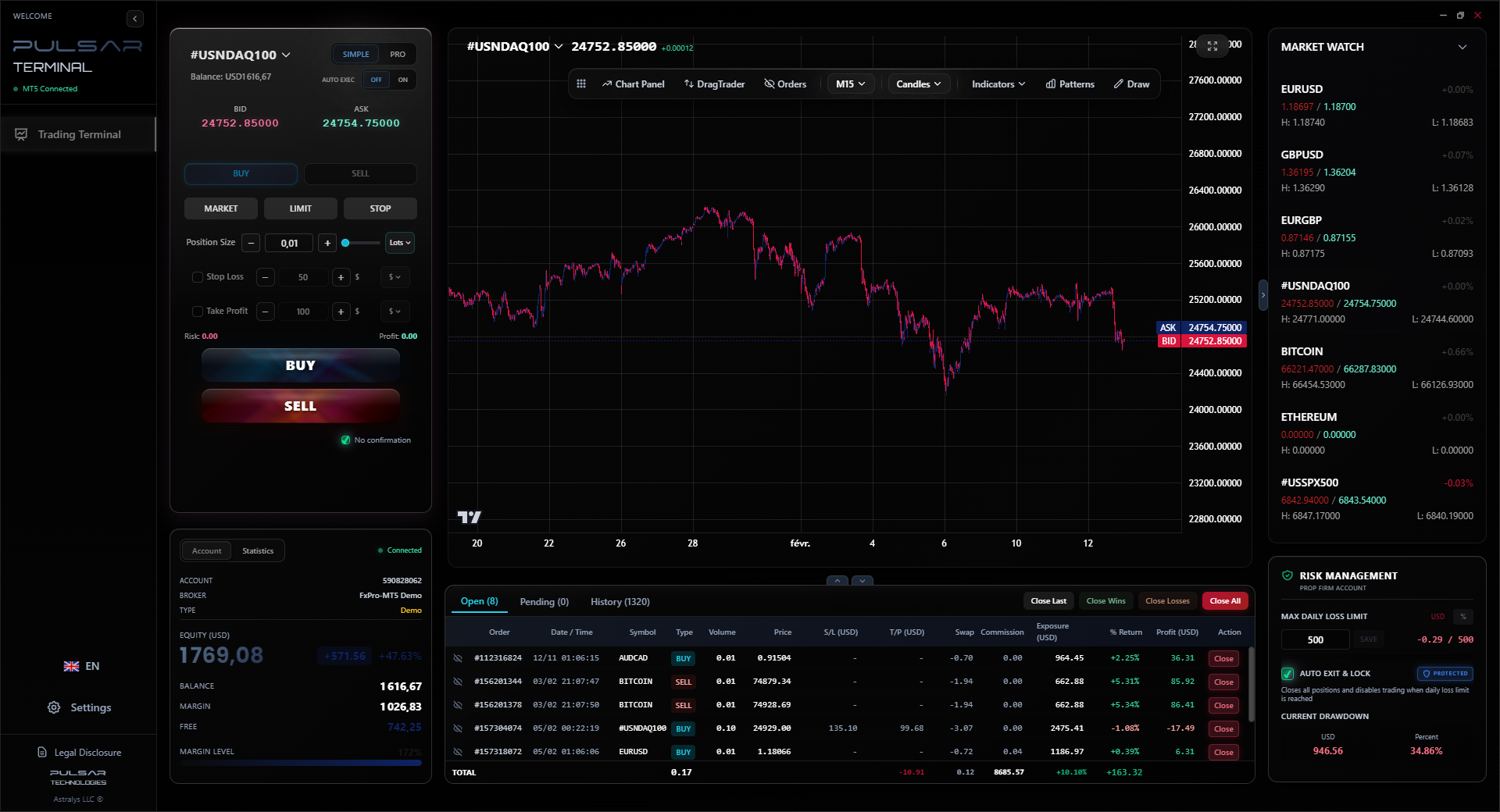
Managing multiple trades and setting precise stop-losses is complex, which is why tools like Pulsar Terminal automate these tasks directly within your MT5 platform.
Pulsar Terminal
Hepsi bir arada MT5 aracı: sürükle-bırak emirler, çoklu TP/SL, trailing stop, grid trading, Volume Profile ve prop firm koruması. Her gün 1.000'den fazla trader tarafından kullanılıyor.
“The market is the ultimate teacher, and it charges very high tuition fees.”
Forget profits for now. Your primary strategy must be capital preservation.
The 1% Rule: Never, ever risk more than 1% of your account balance on a single trade. If you have a $1,000 account, your maximum loss per trade is $10. You use your stop-loss distance and position size to make this happen. A position size calculator does this math for you. This rule alone will prevent account blow-ups.
Use Stop-Losses Religiously: A stop-loss is not a suggestion; it's a mandatory exit order. Before you click buy or sell, you must know where you're wrong and place that stop. My worst loss ever - a $12,000 hole - came from 'riding out' a losing trade because I 'believed' in my analysis. The market didn't care about my beliefs.
Have a Profit Target: Know when you'll take profit. A common framework is a 1:2 or 1:3 risk-to-reward ratio. If you risk $10 (10 pips on a mini lot), aim for a $20 or $30 profit (20 or 30 pips). This means you can be wrong more than you're right and still be profitable.
Keep a Trading Journal: This is your mirror. Write down the chart setup, your emotional state ('FOMO after missing earlier move'), the outcome, and a screenshot. Review it weekly. You'll see your patterns of failure clearly. I learned I lose most often on Monday mornings trying to force a trade. Now, I don't trade on Mondays.
Pro Tip: Your strategy should fit your personality. If you're impatient, don't try to be a swing trader holding for weeks. Look at shorter timeframes. If you hate staring at screens, then scalping isn't for you. The market will expose your weaknesses faster than anything else in life.
💡 Winston'ın İpucu
The most important candle on your chart is the one forming right now. Stop over-analyzing the past 50 candles. Price action is about reaction, not just history.
Forex trading isn't a side hustle. It's a skill-based profession that requires study, discipline, emotional control, and significant risk capital. It's brutally hard. The allure of beating the cedi's depreciation is strong, but the path is littered with losses.
Ask yourself honestly:
- Can you afford to lose every cedi you put in?
- Are you disciplined enough to follow rules even when you're scared or greedy?
- Do you have the patience to spend months learning without making a pesewa?
- Can you handle the stress of seeing your hard-earned money fluctuate by the second?
If you answered no to any of these, save your money. Buy treasury bills, invest in a mutual fund, or start a small business. Forex trading will only amplify your financial and emotional vulnerabilities.
If, after all these warnings, you're still determined, then you have the first ingredient: resilience. Start with the demo account. Learn the mechanics. Treat it with the seriousness of a university course. The market is the ultimate teacher, and it charges very high tuition fees. Your job is to make those fees as small as possible while you learn. Good luck. You'll need it.
FAQ
Q1Can I trade the Ghana Cedi (GHS) directly on forex platforms?
Generally, no. Most major international brokers (like Exness, IC Markets, XM) do not offer USD/GHS or other GHS pairs for retail trading. You trade major pairs like EUR/USD, and your account is denominated in USD. Your exposure to the cedi's value comes when you deposit (converting GHS to USD) and withdraw (converting USD back to GHS).
Q2How much money do I need to start forex trading in Ghana?
Technically, some brokers allow you to start with as little as $10. Practically, starting with less than $200-500 is a severe handicap. With a small account, you're forced to use risky use to see meaningful gains. A more realistic starter amount is $500-$1000, traded with very low use (1:10 or 1:20) and micro lots, so you can properly implement risk management without being wiped out by a few bad trades.
Q3Which forex brokers are legal and safe for Ghanaians to use?
Since Ghana lacks a specific online forex trading regulator, your safety depends on the broker's international license. Look for brokers regulated by top-tier authorities like the UK's Financial Conduct Authority (FCA), the Australian Securities and Investments Commission (ASIC), or the Cyprus Securities and Exchange Commission (CySEC). Brokers like Pepperstone (ASIC), Exness (CySEC, FCA), and IC Markets (ASIC) are popular choices that accept Ghanaian clients and offer local payment methods.
Q4Do I pay tax on my forex trading profits in Ghana?
Yes. The Ghana Revenue Authority (GRA) considers trading profits as taxable income. You are legally required to declare this income, and it will be taxed at the applicable personal income tax rate (which can be up to 35%). Keep detailed records of all your trading statements, deposits, and withdrawals. It is highly advisable to consult with a local accountant familiar with investment income.
Q5What's the difference between a forex bureau and a forex trading broker?
A forex bureau (like Forex House) is a physical business licensed by the Bank of Ghana to exchange physical currencies for travel, business, or remittances. You get a fixed rate and receive physical cash or a transfer. A forex trading broker provides an online platform where you speculate on the price movements of currency pairs using derivatives (CFDs). You never receive physical currency; you only profit or lose based on price changes. They are not licensed by the BoG for this activity.
Q6Is use good or bad for a beginner?
For a beginner, use is almost always bad. It's a tool that amplifies both profits and losses. New traders consistently underestimate risk and overuse use, which leads to rapid account blow-ups. I advise every new Ghanaian trader to start with a maximum of 1:10 use, or even just 1:1, to learn how price moves affect their capital without the catastrophic risk. Treat high use (1:100, 1:500) as a dangerous power tool you're not yet qualified to use.
Q7Can I make a living from forex trading in Ghana?
Theoretically, yes. Realistically, it's an extremely difficult goal that takes years of consistent, disciplined practice and a significant starting capital base. Most who try fail. You need a proven, mechanical strategy, iron-clad risk management, and the emotional stability to handle drawdowns. Before considering it a 'living,' you should have at least 2-3 years of documented profitable performance and enough capital so that your monthly target is a small percentage (2-5%) of your account, not a large one you're forced to chase.
Prof. Winston'ın Dersi
Önemli Noktalar:
- ✓Risk max 1% of your account per trade. No exceptions.
- ✓use above 1:20 is a beginner's trap.
- ✓The spread is a guaranteed cost; factor it in first.
- ✓GRA taxes trading profits. Keep perfect records.
- ✓Your safety is the broker's international license, not a local one.
Bu makale ne kadar faydalıydı?
Bir yıldıza tıklayın
Haftalık Trading Analizleri
Ücretsiz haftalık analiz ve stratejiler. Spam yok.
Yazar hakkında
Olumide Adeyemi
Batı Afrika Yatırım Öncüsü
Nijerya'nın en aktif forex eğitmenlerinden biri. Lagos'tan 8 yıllık ticaret deneyimi. Afrika'lı trader'lar için düşük sermaye stratejileri ve prop firma yarışmaları uzmanı.
Yorumlar
Risk Uyarısı
Finansal araçlarla işlem yapmak önemli riskler taşır ve tüm yatırımcılar için uygun olmayabilir. Geçmiş performans gelecekteki sonuçları garanti etmez. Bu içerik yalnızca eğitim amaçlıdır ve yatırım tavsiyesi olarak değerlendirilmemelidir. İşlem yapmadan önce her zaman kendi araştırmanızı yapın.
Bunları da beğenebilirsiniz

Cara Trading Forex Sukses: 7 Prinsip dari Trader Profesional
Cara trading forex sukses dengan 7 prinsip trader pro: manajemen modal, disiplin, journal trading, backtest. Data nyata, bukan janji profit palsu.
Jam Trading Forex Terbaik untuk Trader Indonesia: Panduan Lengkap dengan Tabel Waktu
Panduan jam trading forex untuk trader Indonesia. Tabel 4 sesi dunia, jam emas 20:00-00:00, sesi mana yang harus dihindari. Data akurat + tips dari trader berpengalaman.
Top 5 Sàn Forex Uy Tín Nhất 2026: Review Jujur dari Trader Indonesia
Top 5 sàn forex uy tín 2026 untuk trader Indonesia. Review jujur: spread, deposit, withdraw, dukungan lokal. Exness, XM, IC Markets & lebih.
Pulsar Terminal'ı Edinin
Tüm bu hesaplayıcılar MT5 hesabınızdan gerçek zamanlı verilerle Pulsar Terminal'e entegredir.
Pulsar Terminal'ı Edinin