


Looking to trade gold but tired of the margin calls, overnight swaps, and volatility of futures? You're not alone.

Rajesh Sharma
Senior Forex Analyst ·  India
India
☕ 10 min read
What you'll learn:
Looking to trade gold but tired of the margin calls, overnight swaps, and volatility of futures? You're not alone. Most retail traders get chewed up trying to outsmart the gold market with use. The Axis Gold Exchange Traded Fund offers a different path: a regulated, liquid way to get pure gold exposure on the Indian exchanges. It's not a get-rich-quick scheme, but for building a real position in gold, it might be the most sensible tool you've never considered.
Let's cut through the marketing fluff. The Axis Gold Exchange Traded Fund (NSE: AXISGOLD) is a mutual fund scheme that's listed and traded on the stock exchange like a share. Its single job is to track the domestic price of physical gold. For every unit you own, the fund holds the equivalent value in physical gold bars (99.5% purity, LBMA standard) in a vault. You're not buying a promise or a derivative; you're buying a direct, securitized claim on actual metal.
Think of it as the bridge between the commodity market and the equity market. You get the price movement of gold, but you trade it through your normal demat account with the same ease as buying Reliance or TCS. No worrying about margin calls, no contract expiry dates, and no physical delivery headaches. The fund manager, Axis Mutual Fund, handles all the storage, insurance, and logistics. Your only job is to decide when to buy and sell.

Warning: Don't confuse this with a Gold Fund of Fund (FoF). That's a different product that invests in this ETF. You want the ETF itself - it's traded on the exchange, has lower costs, and gives you direct control over your entry and exit price.
This is where most guides gloss over the details. You need the numbers to know if this is a viable trading instrument or just a long-term hold.
The Expense Ratio: Your Silent Fee The fund charges 0.56% per year. This isn't a brokerage fee you pay directly; it's taken from the fund's assets, which slightly drags on its performance versus the actual gold price. For a ₹1 lakh investment, that's ₹560 per year, whether you make money or not. It's low for a managed product, but it's a real cost that compounds over time.
Trading Costs: What You Pay to Play You'll pay your normal equity brokerage (often a flat ₹20 per trade for delivery) plus Securities Transaction Tax (STT) of 0.1% on the sell side, and GST on the brokerage. There's no exit load from the fund, so you can sell anytime without penalty.
Key Stats at a Glance:
| Specification | Detail |
|---|---|
| Symbol | AXISGOLD (NSE, BSE) |
| Launch Date | 10 November 2010 |
| AUM (Apr 2026) | ~₹5,389 Crore |
| Underlying | Physical Gold (1 unit ≈ 1 gram value) |
| Min. Investment | 1 Unit (Market Price) |
| Expense Ratio | 0.56% p.a. |
| Exit Load | 0% |
A Critical Regulatory Change Starting 1 April 2026, SEBI changed how Gold ETFs are valued. They used to track international benchmarks like LBMA. Now, they must use polled spot prices from Indian exchanges like the MCX. This is huge. It means the Axis Gold ETF's Net Asset Value (NAV) will more accurately reflect the true domestic price, including import duties and rupee fluctuations. For you, the trader, it means the price on your chart should have a tighter, more logical relationship to the gold you hear about on the news.

Example: If MCX Gold is at ₹74,500 per 10 grams, the indicative value of one Axis Gold ETF unit should be roughly ₹7,450 (74,500 / 10). The trading price will hover around this NAV, with minor deviations due to market sentiment.
“The lack of use in a Gold ETF is a feature, not a bug. It forces you to be right on direction.”
Trading the Axis Gold ETF isn't about catching 100-point moves in a day. It's about capturing the medium-term trends in gold, which are often driven by macro factors like real interest rates, dollar strength, and geopolitical fear.
Forget Day Trading, Think Swing Trading
This instrument is perfect for swing trading. The liquidity is good, but the intraday moves are often subdued compared to gold futures. Your edge comes from patience. I've had more success holding a gold ETF position for weeks based on a clear macro view than I ever did trying to scalp it.
A Personal Trade: In early 2023, I built a position in AXISGOLD around ₹5,200 per unit. The setup was simple: the RSI indicator on the weekly chart was coming out of oversold territory, and the Fed was hinting at a pause in rate hikes (which is typically gold-positive). I used a simple 20-week moving average as a trailing guide. I didn't touch it for months. I closed half around ₹6,800 in late 2023 and let the rest run with a mental stop. That patience beat every frenetic futures trade I made that year.
Use Technicals, But Anchor to Fundamentals
You can absolutely use chart patterns and indicators. Look for support/resistance levels on the daily and weekly charts. A MACD indicator crossover on the weekly timeframe can signal a strong trend change. But always ask: "What's the story?" Is the rupee weakening? Are central banks buying gold? That fundamental driver gives you the conviction to hold through minor pullbacks.
The Allocation Mindset
Don't bet the farm. Treat gold as a 5-15% portfolio diversifier. Use the ETF to build that allocation systematically. This is where a position size calculator is non-negotiable. If your total trading capital is ₹10 lakhs, and you want a 10% gold allocation, that's a ₹1 lakh position. That discipline stops you from getting greedy when gold is screaming on the news.

💡 Winston's Tip
Gold ETFs are for capturing the trend, not the tick. If you're checking the price every hour, you've chosen the wrong instrument. Your time is better spent analyzing the weekly chart's structure.
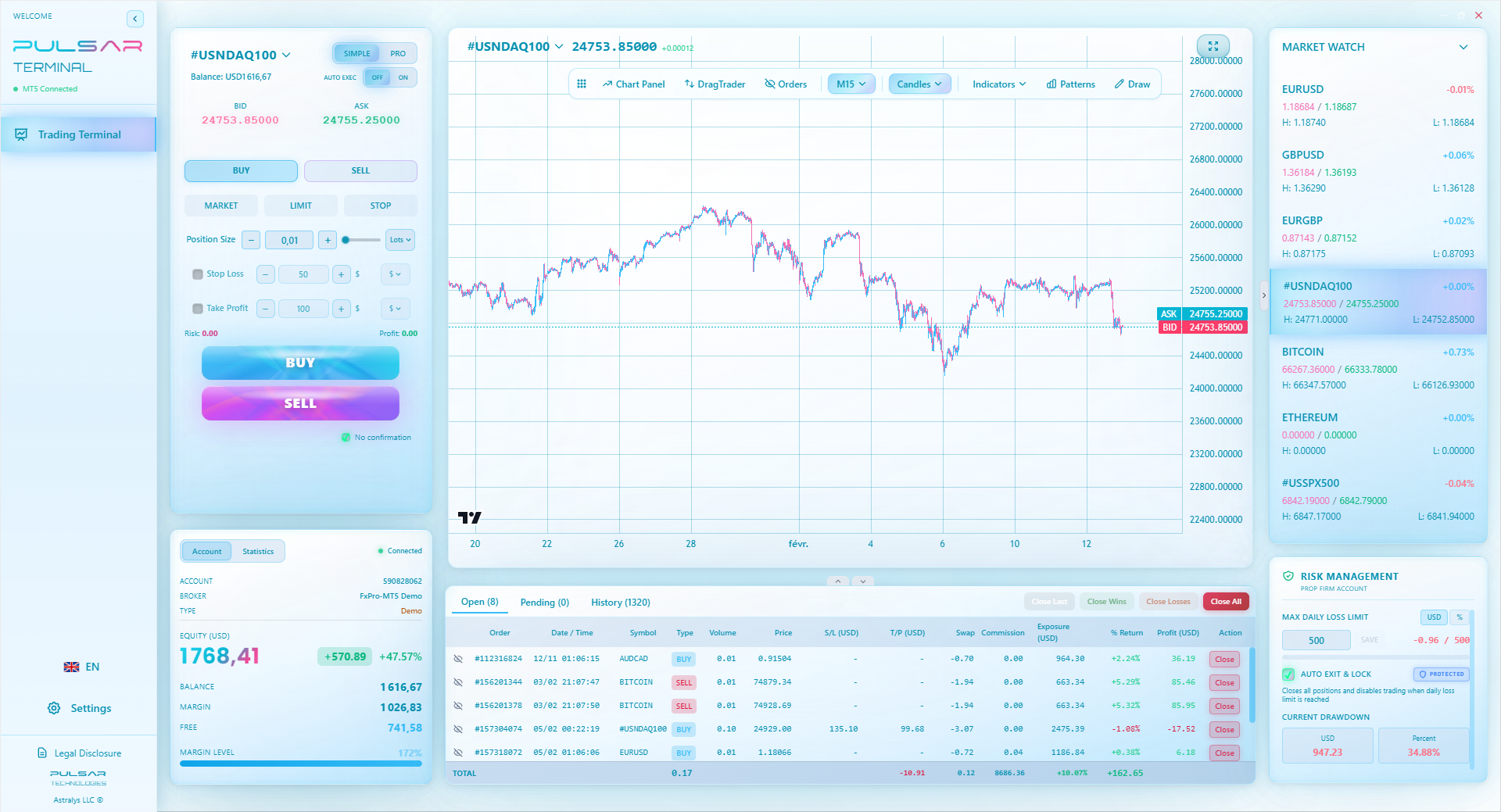
When swing trading an instrument like the Axis Gold ETF, managing your exit with a trailing stop is key, and Pulsar Terminal automates this directly on your MT5 platform.
Pulsar Terminal
The all-in-one MT5 companion: drag-and-drop orders, multi-TP/SL, trailing stop, grid trading, Volume Profile, and prop firm protection. Used by 1,000+ traders daily.
Why choose this over other ways to play gold? Here’s the blunt breakdown.
| Feature | Axis Gold ETF | MCX Gold Futures | Physical Gold (Bars/Coins) |
|---|---|---|---|
| Ownership | Securitized claim on vaulted gold. | A contract for future delivery. | Direct physical possession. |
| use | None. You pay full value. | High (approx. 10x+). Margin required. | None. |
| Carry Cost | 0.56% expense ratio. | Rollover cost, brokerage, MTM margins. | Storage, insurance, making charges (3-15%). |
| Liquidity | High (Exchange traded). | Very High. | Low (sell to jeweller/bank at a discount). |
| Best For | Swing traders, long-term holders wanting clean exposure. | Short-term speculators comfortable with high risk. | Ultra-long-term holders wanting tangible asset. |
| Biggest Risk | Tracking error vs. gold price. | Blowing up your account via margin call. | Theft, loss, and low liquidity when selling. |
For 95% of traders who aren't professional futures scalpers, the ETF wins on simplicity and sleep-at-night factor. The lack of use is a feature, not a bug. It forces you to be right on direction without the magnifying glass of margin blowing up a small move against you. I learned this the hard way losing two months' profits on a single bad gold futures trade because I misjudged the volatility around a Fed announcement.
“Your post-tax return is all that matters. A 15% pre-tax gain in the 30% bracket is a 10.5% real gain.”
The New Tax Reality (Post-April 2023)
This is critical. Forget the old 20% with indexation rule. For investments made after 1 April 2023, all gains from Gold ETFs are added to your income and taxed at your slab rate. Short-term or long-term, it doesn't matter. If you're in the 30% tax bracket and make a ₹50,000 profit, you owe ₹15,000 in tax. This significantly reduces the post-tax return, especially for high-income earners. You must factor this in before calculating your potential profit.
How to Buy in 5 Minutes
- Account: You need a demat and trading account. Any major broker like Zerodha, Upstox, or Angel One works.
- Search: In your trading terminal, search for "AXISGOLD".
- Order: Place a normal equity delivery order (not intraday). Specify the number of units. Remember, 1 unit represents roughly 1 gram's value.
- Hold: The units will land in your demat account. You can sell them anytime the market is open, just like a stock.

Pro Tip: Use a limit order, not a market order. The spread can sometimes be a few rupees, and a limit order ensures you don't overpay. Set your buy limit near the last traded price or the indicative NAV you can find on the Axis Mutual Fund website.
💡 Winston's Tip
The new slab-based taxation is a game-ender for high-frequency trading in Gold ETFs. The math only works for meaningful, held positions where the gross gain is large enough to survive the tax haircut.
I've seen these errors wipe out the benefits of using a "simple" ETF.
1. Chasing Performance: The Axis Gold ETF just had a blistering 1-year return of over 60%. The worst thing you can do now is FOMO in at the top. Gold is cyclical. Buy when it's hated and the charts are basing, not when it's on the front page.
2. Ignoring the Rupee Factor: This ETF tracks domestic gold prices. If gold in dollars stays flat but the rupee falls 5%, your ETF will rise 5%. Your view should be on "gold in INR," not just international headlines. Sometimes you're trading the rupee more than the metal.
3. Treating It Like a Savings Account: It's not. The value can and will drop. From its 2020 peak to its 2022 low, AXISGOLD fell over 15%. You need an exit plan. A simple 10% trailing stop from your entry point can lock in gains and prevent a winning trade from turning into a hope-filled bag-holding exercise.
4. Overcomplicating It: You don't need a complex strategy. A core-satellite approach works: keep 80% of your gold allocation as a long-term core holding in the Axis Gold ETF, and use 20% to try and swing trade around the edges based on clearer technical setups. This satisfies both the investor and the trader in you.
“Sometimes you're trading the rupee's weakness more than the strength of gold itself.”
The Axis Gold Exchange Traded Fund is a superior tool for a specific job. If you want to express a tactical, medium-term view on gold priced in rupees without the existential risk of futures use, it's the best product available to the Indian public. It's transparent, liquid, and cost-effective.
But it's not exciting. It won't give you the adrenaline rush of a leveraged futures win. It's a tool for building wealth steadily, for hedging your portfolio, and for taking a view with risk you can actually stomach. For the trader who's tired of blowing up accounts on volatile instruments, moving a portion of your capital to strategies involving instruments like this ETF is often the first step toward lasting profitability. It teaches you that making money doesn't have to be a heart-pounding gamble. Sometimes, the smartest trade is the boring one you can hold with confidence.
Before you jump in, do the math on post-tax returns for your income bracket. Have a clear reason for buying - a chart level, a macro view, a portfolio rebalancing need. Then, execute with the same discipline you'd use on any other trade. The market doesn't care if it's an ETF or a future; it only cares if you're right or wrong.
FAQ
Q1Is the Axis Gold ETF better than SGB (Sovereign Gold Bonds)?
For trading, yes. SGBs have an 8-year lock-in for the full tax benefit and limited liquidity on the secondary market. The Axis Gold ETF is fully liquid, tradeable anytime, with no lock-in. SGBs are for committed, long-term buy-and-hold investors; the ETF is for active traders and allocators.
Q2What is the difference between Axis Gold ETF and Axis Gold Fund?
The Axis Gold ETF (AXISGOLD) is traded on the stock exchange. The Axis Gold Fund is a Fund of Fund (FoF) that invests in the Axis Gold ETF. The FoF is bought/sold at the day's closing NAV directly from the fund house. The ETF gives you intraday price control and typically has a slightly lower total cost. For trading, use the ETF directly.
Q3How does the new SEBI valuation rule (from April 2026) affect me?
It makes the ETF more accurate and transparent for you. By tying the NAV to Indian exchange prices (MCX), the ETF's price will better reflect the actual gold price you'd get in India, including local taxes and currency effects. It reduces tracking error to the price that actually matters for Indian traders.
Q4Can I do SIP in Axis Gold ETF?
Not directly in the ETF on the exchange. However, you can manually buy a fixed number of units every month through your broker, which simulates a SIP. Many brokers also offer automated equity SIP plans that can include ETFs. Alternatively, the Axis Gold Fund (FoF) offers a formal SIP facility.
Q5What is the real return after tax and expenses?
It's lower than the headline number. If the ETF returns 12% in a year, subtract the 0.56% expense ratio, leaving 11.44%. Then, the entire 11.44% gain is added to your income. If you're in the 30% tax bracket, you pay 3.43% in tax, leaving a net return of roughly 8.01%. Always calculate your post-tax, post-cost return.
Q6Is there a risk that the fund doesn't actually hold the gold?
The risk is extremely low. SEBI mandates that at least 95% of assets be in physical gold or approved instruments. The fund is audited regularly. The custodian (a bank) holds the actual bars. This structure is far safer than any unregulated digital gold platform.
Prof. Winston's Lesson
Key Takeaways:
- ✓Gold ETF returns are taxed at your income slab rate, not a flat 20%.
- ✓The 0.56% expense ratio is a silent, annual drag on performance.
- ✓New SEBI rules (2026) tie NAV to Indian prices for better accuracy.
- ✓Use it for swing trading, not day trading or scalping.
How useful was this article?
Click a star to rate
Weekly Trading Insights
Free weekly analysis & strategies. No spam.
About the Author
Rajesh Sharma
Senior Forex Analyst
Trading Indian and South Asian markets for over 10 years. Started with NSE currency derivatives before moving to international forex. Specializes in USD/INR and emerging market pairs.
Comments
Risk Disclaimer
Trading financial instruments carries significant risk and may not be suitable for all investors. Past performance does not guarantee future results. This content is for educational purposes only and should not be considered investment advice. Always conduct your own research before trading.
You Might Also Like

Cara Trading Forex Sukses: 7 Prinsip dari Trader Profesional
Cara trading forex sukses dengan 7 prinsip trader pro: manajemen modal, disiplin, journal trading, backtest. Data nyata, bukan janji profit palsu.
Jam Trading Forex Terbaik untuk Trader Indonesia: Panduan Lengkap dengan Tabel Waktu
Panduan jam trading forex untuk trader Indonesia. Tabel 4 sesi dunia, jam emas 20:00-00:00, sesi mana yang harus dihindari. Data akurat + tips dari trader berpengalaman.
Top 5 Sàn Forex Uy Tín Nhất 2026: Review Jujur dari Trader Indonesia
Top 5 sàn forex uy tín 2026 untuk trader Indonesia. Review jujur: spread, deposit, withdraw, dukungan lokal. Exness, XM, IC Markets & lebih.
Get Pulsar Terminal
All these calculators are built into Pulsar Terminal with real-time data from your MT5 account. One-click position sizing, automatic risk management, and instant calculations.
Get Pulsar Terminal