


It was October 2015, and I was glued to my screen watching the USD/ZAR blow past R14.00 for the first time.

David van der Merwe
Emerging Markets Trader ·  South Africa
☕ 10 min read
What you'll learn:
It was October 2015, and I was glued to my screen watching the USD/ZAR blow past R14.00 for the first time. The news was full of panic about 'Nenegate' and junk status warnings. My own account? I was down R8,000 on a short position I'd entered too early, convinced I was smarter than the market. That humbling moment taught me more about searching for the 'best forex trader in the world' than any guru ever could. The truth is, the best trader isn't a person you can copy; it's the disciplined, adaptable system you build for yourself, right here in Mzansi.
Let's be real. The idea of one undisputed 'best forex trader in the world' is a marketing fantasy, like finding the world's best braai master. It depends on style, risk appetite, and timeframe. Is the best trader the one who made 1000% in a year (and probably blew up the next)? Or the one grinding out a consistent 20% annually for a decade?
In South Africa, we have unique challenges. Our market hours, the volatility of ZAR pairs, and even load-shedding play a role. A legendary US day trader's strategy might fall apart trying to scalp USD/ZAR during our lunchtime liquidity lull. I learned this the hard way trying to copy a famous European scalping strategy on EUR/ZAR. The spreads were too wide, the moves too jerky. I lost two weeks' profits in one bad session.

Warning: Any 'guru' selling you the secret of the 'world's best trader' is selling a dream, not a reality. Real success is boring, methodical, and personal.
The real question isn't 'who is the best?' but 'what are the best traits?' That's what we can actually learn from and apply. It's about building a system that works for you, with your capital, your psychology, and your South African context.
Forget the names. Focus on the habits. After 12 years and interviewing dozens of consistently profitable traders, from Johannesburg prop desks to independent guys in Cape Town, the same patterns emerge.
Ruthless Risk Management
This is non-negotiable. The best traders aren't the best predictors; they're the best survivors. They define their risk before they enter a trade. A common rule is risking no more than 1-2% of your capital on any single trade. I use a simple position size calculator for every entry. In early 2020, during the COVID crash, this habit saved my account. I was wrong on the direction of gold (XAU/USD) initially, but my 1.5% stop-loss meant a manageable R1,200 loss, not a catastrophe.
A Defined, Repeatable Process
They have a checklist. Every time. It covers entry criteria, stop-loss placement, profit target levels, and the market condition required. Their edge isn't a secret indicator; it's the disciplined application of their process. My own checklist fits on one sticky note next to my screen.
Emotional Detachment
They don't fall in love with their analysis. A losing trade is a cost of doing business, not a personal failure. I used to revenge trade after a loss, which only dug a deeper hole. Now, after two consecutive losses, I'm mandated to walk away for the day. It's the best rule I ever made.

Pro Tip: Your trading journal is your most important tool. Don't just log entries and exits. Log your emotional state for each trade. You'll start to see destructive patterns you can fix.
These traits beat any 'hot tip' from a supposed world champion. They turn trading from gambling into a skilled profession. For managing the emotional rollercoaster, a solid platform from a broker like Pepperstone or IC Markets provides the stability you need to execute your plan without technical headaches.

💡 Winston's Tip
The market's job is to make you feel stupid right before it makes you right. Your job is to have the risk management in place to survive that feeling.
“The 'best forex trader in the world' for you is the disciplined, patient trader you build yourself into.”
Trading from South Africa isn't the same as trading from London or New York. Ignoring this is a fast track to losses. Here’s what you must factor in.
ZAR Pair Volatility: Pairs like USD/ZAR and EUR/ZAR can have massive spreads and gap wildly on political or economic news. A 5-pip spread on EUR/USD is terrible; on EUR/ZAR, it's sometimes just the cost of entry. You need to adjust your position size accordingly to account for this wider spread eating into your potential profit.
Trading Hours: Our time zone (SAST, UTC+2) means the London open happens at 10:00 AM our time, and the US open at 4:00 PM. The most liquid overlap is late afternoon for us. If you have a day job, this might mean focusing on swing trading or trading the London session open.
Regulation & Safety: Always, always verify your broker is licensed by the Financial Sector Conduct Authority (FSCA). This ensures client money segregation and a local recourse if things go wrong. It's your first line of defence. Brokers like XM and Exness have FSCA licensing for South African clients.
The Cost of Trading: Be hyper-aware of costs. Beyond the spread, consider:
- Overnight Financing (Swap): Holding ZAR pairs overnight can incur significant positive or negative swaps depending on the direction. I once held a USD/ZAR short for a week and the positive swap actually paid me more than the profit from the move!
- Currency Conversion: If your broker account is in USD but you deposit in ZAR, there's a conversion fee. Some local brokers offer ZAR-denominated accounts to avoid this.
- Inactivity Fees: Read the fine print. Some brokers will charge you if you don't trade for a few months.
Adapting a global strategy means tweaking it for these local realities. A strategy that assumes 1-pip spreads and 24-hour liquidity will bleed money here if applied blindly.
So, should you study famous traders? Absolutely. But study their principles, not their specific trades.
Look at someone like Bruce Kovner. A key lesson from him is the concept of 'pyramiding' – adding to a winning position as the market proves you right, but doing so in a way that your average entry price remains favourable. I tested a simplified version on a long EUR/USD trend in 2017. I entered with 50% of my planned position, added 30% after a key breakout, and the final 20% after a successful retest. It amplified a decent win into a great one.
Another universal lesson is from Paul Tudor Jones II: focus on capital preservation. He's famous for saying, "I'm always thinking about losing money as opposed to making money." This mindset flips the script. Your primary goal isn't to hit a home run; it's to stay in the game tomorrow.

Example: You have a R100,000 account. A 50% loss requires a 100% gain just to get back to breakeven. A 20% loss only needs a 25% gain to recover. Protecting your capital isn't conservative; it's mathematically smart.
Don't try to replicate George Soros's 'Quantum Fund' bet against the Pound. Instead, understand the principle he exploited: trading against an unsustainable central bank policy. In our world, that could mean having a framework to identify when the SARB's stance might be out of sync with reality.
The tools have evolved, but the psychology hasn't. Using a modern MACD indicator or RSI is just a new way to apply the old discipline of waiting for confirmation and managing risk.
💡 Winston's Tip
If you can't explain your edge in one simple sentence, you don't have one. Complexity is the enemy of execution.
“High use on volatile ZAR pairs is a recipe for a margin call. I never use more than 1:30, even on what I think is a sure thing.”
This is where the rubber meets the road. You're not trying to find the best trader; you're trying to become a consistent one. Here's a practical blueprint.
1. Find Your Niche: Are you a scalper, a day trader, or a swing trader? Your personality dictates this. I'm impatient, so I gravitated towards day trading. My friend is more analytical and prefers weekly swing trading charts. Test different timeframes with small capital to see what suits you.
2. Backtest and Forward-Test: Have a hypothesis? Test it on historical data first (backtest). Then, trade it in a demo account for at least a month (forward-test). Record everything. I once spent three months perfecting a mean-reversion strategy on USD/ZAR, only to find it failed spectacularly in trending markets. That was three months of demo time well spent, saving real money.
3. Define Your Edge Precisely: Your edge is the specific market condition where your strategy has a statistical advantage. Mine is: 'During the first 2 hours of the London session, if price rejects a key daily level with a clear pin bar on the 15-minute chart, I enter in the direction of the rejection.' That's specific and testable.
4. Engineer Your Environment: Remove friction. Set up your charts the same way every day. Use hotkeys for orders. The less you have to think about mechanics, the more you can focus on the trade. This is where technology is a true ally.
5. Embrace the Grind: Profitable trading is about repeating your process hundreds of times, not about the one magical trade. Your weekly goal shouldn't be 'make R10,000'; it should be 'execute my plan flawlessly on every setup that appears.' The profits follow the process.
This systematic approach removes the emotion and the desperate search for a guru. It turns you into your own mentor.
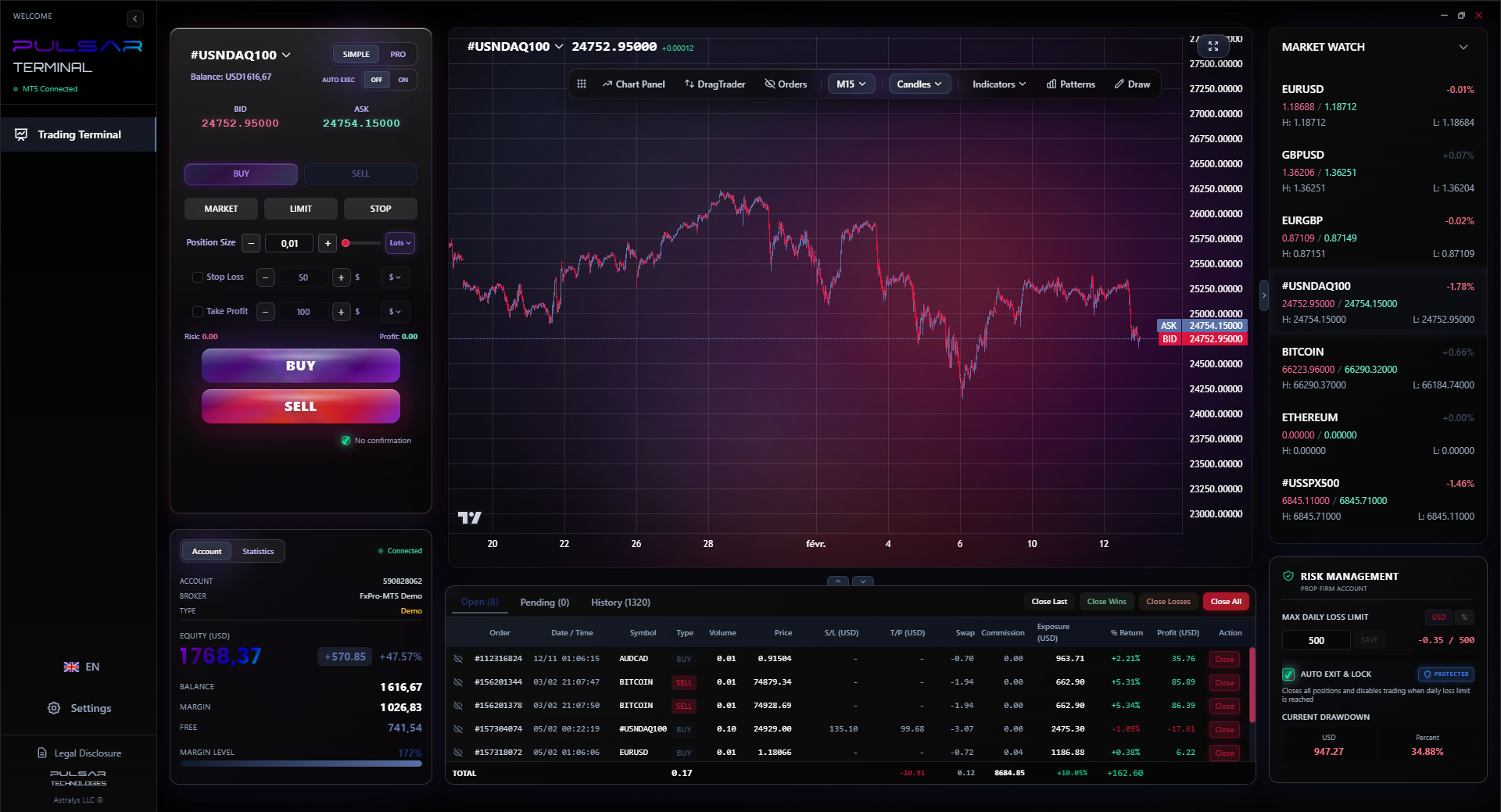
Building a repeatable process is key, and tools like Pulsar Terminal for MT5 let you automate your trade management rules, like partial closures and trailing stops, so your plan executes exactly as you designed, every single time.
Pulsar Terminal
The all-in-one MT5 companion: drag-and-drop orders, multi-TP/SL, trailing stop, grid trading, Volume Profile, and prop firm protection. Used by 1,000+ traders daily.
Let me save you some money and heartache by sharing the mistakes I see (and have made) repeatedly.
Chasing 'Black Box' Systems: That WhatsApp group selling a robot that 'never loses'? It's a scam. If it worked, they'd be using it, not selling it for R500 a month.
Overleveraging: With some brokers offering 1:500 or even 1:1000 use, it's tempting. This is a trap. High use on volatile ZAR pairs is a recipe for a margin call. I never use more than 1:30, even on what I think is a sure thing. There's no sure thing.
Trading Around Budget Speeches & SARB Announcements: Unless you're an institutional pro, the insane volatility around these events is a minefield. The spread can widen so much your stop-loss gets hit immediately. I now simply close all ZAR-related positions before major local news and watch from the sidelines.
Ignoring Total Cost: You might get a 'zero spread' account but pay a $10 commission per lot. Or a wide spread but no commission. You need to calculate the total cost per pip for your typical trade size to compare brokers fairly. A cheap broker like IC Markets might be cheaper for a high-volume scalper, while another structure might suit a swing trader better.
Neglecting Your Mindset: This is the biggest one. You can have the best strategy in the world, but if you're stressed about bills, tired, or emotionally drained, you will make poor decisions. Trading is a performance sport. Manage your mental capital as carefully as your financial capital.
💡 Winston's Tip
Your trading plan is a love letter to your future self, who will be scared, greedy, and desperate. Write it clearly so they can follow it.
“Your weekly goal shouldn't be 'make R10,000'; it should be 'execute my plan flawlessly on every setup that appears.'”
Feeling overwhelmed? Good. That means you're taking it seriously. Here's a simple, no-BS plan for your first six months.
Months 1-2: Education & Paper Trading.
- Read about market basics, risk management, and psychology. Don't touch a live account.
- Open a demo account with a reputable FSCA broker. Practice executing trades. Get used to the platform. Try to 'lose' money on the demo. It's harder than you think and teaches you about risk.
Months 3-4: Strategy Development.
- Pick one simple strategy. Maybe a moving average crossover on the 4-hour chart. Maybe support/resistance on the daily.
- Backtest it on 2-3 years of data for a major pair like EUR/USD. Then forward-test it on your demo for a full month. Keep a detailed journal.
Months 5-6: Micro-Live Trading.
- Open a live account with the minimum possible deposit.
- Trade the smallest position size allowed (often a micro-lot). Your goal is not to make money. Your goal is to execute your tested plan under real emotional pressure and to break even after costs.
- If you can't break even trading micro lots for two months, go back to demo. You're not ready.
This slow, boring process filters out the gamblers and builds the foundation for the real traders. The 'best forex trader in the world' for you is the disciplined, patient trader you build yourself into, one smart decision at a time.
FAQ
Q1Who is officially the best forex trader in the world?
There's no official title or ranking. Performance is private, and past results don't guarantee future success. Figures like George Soros or Stanley Druckenmiller are famous for specific trades, but the 'best' trader is the one who survives and thrives consistently over decades, not the one with the single biggest win.
Q2Can I copy the trades of a successful trader in South Africa?
You can, through social trading platforms, but I'm wary of it. The copy trade executes in real-time for you, but you have no control over the risk management or exit. What if the master trader has a 5% stop-loss but you can only afford a 2% risk? You're blindly following without understanding the context. Use it for idea generation, not as a substitute for your own education.
Q3What's a realistic monthly return for a good retail forex trader in SA?
Anything consistently between 5% and 15% per annum is excellent. Monthly, that's roughly 0.4% to 1.25%. Anyone promising you 10%+ per month is either lying, taking insane risk, or about to blow up. I aim for a 1% monthly target on my risk capital. In a great year, I might hit 20-25%. Consistency beats home runs every time.
Q4Do I need a lot of money to start forex trading in South Africa?
No. Many FSCA-regulated brokers allow you to start with under R1,000 (or $50-$100). The key is to start with money you can afford to lose completely and trade micro lots. The goal with a small account is to learn and prove your process, not to get rich. Your initial investment is tuition, not capital.
Q5Is forex trading taxable in South Africa?
Yes. The South African Revenue Service (SARS) views forex trading profits as income if you're trading frequently (seen as carrying on a trade). It's subject to your marginal income tax rate. Keep careful records of all your trades, deposits, and withdrawals. Speak to a tax consultant who understands trading.
Q6What's the most important quality for a beginner trader in SA?
Patience. Patience to demo trade for months. Patience to wait for your perfect setup instead of forcing trades. Patience to let winners run. The market will always be there tomorrow. Impatience is the number one account killer I've seen in my 12 years.
Prof. Winston's Lesson
Key Takeaways:
- ✓Risk management (1-2% per trade) is non-negotiable survival.
- ✓Your edge must be specific, simple, and statistically tested.
- ✓Adapt global strategies for ZAR volatility and SA time zones.
- ✓Patience in execution beats frantic genius every single time.
How useful was this article?
Click a star to rate
Weekly Trading Insights
Free weekly analysis & strategies. No spam.
About the Author
David van der Merwe
Emerging Markets Trader
Johannesburg-based trader with 11 years in emerging market currencies. Specializes in ZAR pairs, FSCA-regulated trading, and South African market analysis.
Comments
Risk Disclaimer
Trading financial instruments carries significant risk and may not be suitable for all investors. Past performance does not guarantee future results. This content is for educational purposes only and should not be considered investment advice. Always conduct your own research before trading.
You Might Also Like

Cara Trading Forex Sukses: 7 Prinsip dari Trader Profesional
Cara trading forex sukses dengan 7 prinsip trader pro: manajemen modal, disiplin, journal trading, backtest. Data nyata, bukan janji profit palsu.
Jam Trading Forex Terbaik untuk Trader Indonesia: Panduan Lengkap dengan Tabel Waktu
Panduan jam trading forex untuk trader Indonesia. Tabel 4 sesi dunia, jam emas 20:00-00:00, sesi mana yang harus dihindari. Data akurat + tips dari trader berpengalaman.
Top 5 Sàn Forex Uy Tín Nhất 2026: Review Jujur dari Trader Indonesia
Top 5 sàn forex uy tín 2026 untuk trader Indonesia. Review jujur: spread, deposit, withdraw, dukungan lokal. Exness, XM, IC Markets & lebih.
Get Pulsar Terminal
All these calculators are built into Pulsar Terminal with real-time data from your MT5 account. One-click position sizing, automatic risk management, and instant calculations.
Get Pulsar Terminal