


You want to skip the challenge and get funded fast.

James Mitchell
Senior Trading Analyst
☕ 13 min read
What you'll learn:
- 1What "Instant Funding" Actually Means (And What It Costs)
- 2My Personal Instant Funding Tests (With Real Numbers)
- 3The 5 Non-Negotiable Criteria for Choosing a Firm
- 4Breaking Down the Top Contenders (2025)
- 5The Only Trading Strategy That Works with Instant Funding
- 6The Instant Funding Death Traps (And How to Sidestep Them)
- 7So, Is Instant Funding Actually Right For You?

You want to skip the challenge and get funded fast. Who can blame you? The promise of instant funding prop firms is intoxicating: trade a real account with a firm's capital, right now, no 30-day evaluation. But here's the brutal truth most reviews won't tell you. The 'instant' part is real. The 'funding' part? That's where they get you. I've traded with four of the biggest names, blown up three accounts, and finally found a model that doesn't feel like a rigged casino. Let's cut through the hype.
Instant funding isn't free money. It's a high-stakes rental agreement. You pay a one-time or monthly fee for immediate access to a simulated account that behaves like a live one. If you're profitable, you get a share of the profits (usually 80-90%). If you hit their loss limit, often called a maximum daily loss or maximum drawdown, the account is closed. You're out the fee. That's the business model.
The key difference from a challenge? There's no profit target to pass. You start funded. This sounds amazing until you realize the risk parameters are often tighter than a traditional evaluation. They can afford to give you instant access because the rules are designed to make blowing up statistically likely. I learned this the hard way with my first $10,000 instant account. A single bad trade that went 1.5% against me triggered the daily loss limit. Account gone. Fee lost. It happened in under an hour.

Warning: The 'instant' gratification is a psychological tool. It lowers your guard and encourages you to trade faster and with less preparation than you would for a 30-day challenge. This is by design.
The cost structure is critical. You'll see two main types:
| Fee Type | How It Works | The Catch |
|---|---|---|
| One-Time Fee | Pay once (e.g., $299). Keep the account as long as you don't break rules. | Often has stricter, hidden drawdown rules that compound on losses. The firm makes money when you fail. |
| Monthly Fee | Pay a smaller recurring fee (e.g., $99/month). | This can be cheaper short-term, but it's a constant drain. A breakeven month still costs you the fee, eroding your profit share. |
Before you even look at firms, you must understand this: you are not their client. You are their customer. The fee is their primary revenue stream. Your success is a secondary, less reliable income source for them. This fundamental conflict of interest shapes every rule in their book. For a deeper look at how these rules work, see our guide on the dreaded margin call and how prop firms calculate risk.

💡 Winston's Tip
The market's volatility is a given. Your prop firm's rules are a variable. Always trade the stricter of the two limits.
“Instant funding isn't free money. It's a high-stakes rental agreement.”
I put my own money on the line. Here’s the raw data from my experiments. I traded a simple, conservative swing trading strategy on each, focusing on major FX pairs like EUR/USD.
Test 1: Firm A (One-Time Fee Model)
- Account: $10,000 Instant
- Fee: $289
- Result: Blown in 2 days.
- What Happened: The stated daily loss was $500 (5%). Seemed fair. What I missed was the 'trailing drawdown' rule. After my first winning trade (+$180), my drawdown limit moved up to $10,180. My loss buffer was still only $500 from that new high. A volatile swing in gold (XAU/USD) hit my stop loss, causing a $450 loss. Because of the trailing rule, this loss was measured from $10,180, not my starting balance. I was now only $50 from my daily limit. The next minor adverse tick closed the account. The fee was gone.
Test 2: Firm B (Monthly Fee Model)
- Account: $25,000 Instant
- Fee: $97/month
- Result: Lasted 3 weeks, then blown.
- What Happened: The lower upfront cost felt safer. The profit split was 85%. I was up $750 by week three. Then, I broke my own rule and tried scalping during a news event. Slippage on an entry was worse than expected. The combined loss from two quick trades hit 3.5%, breaching the 'maximum loss per trade' rule - a rule I'd glossed over in the terms. Account closed. I was profitable overall, but the rule violation overrode that.
Test 3: Firm C (One-Time Fee, 'Scaling' Model)
- Account: $50,000 Instant
- Fee: $549
- Result: Lasted 4 months. Withdrew $2,100 profit.
- What Happened: This was the first model that felt sustainable. The daily loss was a static 5% of the initial balance, not a trailing one. The profit target to 'scale' to a larger account was clear and achievable. I used a strict 1% risk per trade, managed with a position size calculator. The platform was stable (they used a common broker like IC Markets). I made consistent, small withdrawals. This is the experience that changed my mind - it proved a well-structured instant program could work.
The lesson? The devil isn't just in the details. It's in the one paragraph of the FAQ you didn't read. Your trading plan must conform to their rules first, the market's second.


“Your trading plan must conform to *their* rules first, the market's second.”
After losing nearly $1,000 in fees, I built this checklist. If a firm misses even one point, walk away.
1. Static vs. Trailing Drawdown
This is the most important line in any agreement. You must find a firm with a STATIC maximum drawdown. This means your loss limit is based on your starting account balance. A trailing drawdown, which moves with your equity high, is a near-guaranteed failure mechanism for all but the most perfect traders. It turns your own profits against you.
2. Clear, Sensible Rule Structure
Look for simple, non-compounding rules. A maximum daily loss, a maximum overall loss, maybe a limit on weekend holdings. Avoid firms with: 'maximum loss per trade' percentages that are tiny (e.g., 2%), rules against specific strategies like news trading, or hidden fees on withdrawals. Read every word of their 'Terms of Service' page. Yes, all of it.
3. Realistic Profit Targets & Scaling Plans
What happens when you're successful? The best instant funding prop firm will have a clear, automatic scaling plan. For example, make 8% profit, get bumped to a larger account. The targets should be challenging but fair - usually between 6-10% total profit. If they demand 20% before any growth, they don't expect you to get there.
4. Reputable Trading Platform & Broker Link
You need to know what you're trading on. Is it a genuine MT4/MT5 connection to a real, well-regulated broker like Pepperstone or XM? Or is it their own proprietary, clunky platform with questionable execution? Slippage and requotes can kill a strategy. Stick to firms using mainstream platforms you trust.
5. Transparent, Timely Payouts
Search for user reviews specifically about withdrawals. Don't look at the shiny testimonials on their site. Go to independent forums. Are people complaining about pending withdrawals for weeks? Are there hidden 'processing fees' that eat 10% of your profit? A firm that makes it easy and fast to get your money is a firm confident in its model.

Pro Tip: Before paying a fee, do this: Open a free demo account on their platform. Paper trade for a week exactly as you would with real rules. Track every trade against their stated limits. You'll quickly feel if the rules are playable or a straitjacket.
“Your trading plan must conform to *their* rules first, the market's second.”
Based on my tests and ongoing community feedback, here’s a breakdown of the major players. This isn't sponsored. It's my assessment.
The Conservative Choice: FTMO (Now Offering Instant) Yes, the challenge giant has an instant offering. It's pricier, but it borrows credibility from their established model.
- The Good: Extremely clear rules, static drawdown, top-tier broker links, legendary payout reputation.
- The Bad: Higher fee structure. The 'instant' account has a one-stage verification (a smaller profit target) before full scaling kicks in, so it's not purely instant in the sense of no targets.
- Verdict: If you want the closest thing to a 'safe' instant model and are willing to pay for it, this is a top candidate. It feels less like a trap.
The Aggressive Scalper's Option: The5ers 'High Stakes' Program This program is built for traders who want high use and fast action.
- The Good: True instant start, high use options, straightforward profit split (100% up to a target, then 50/50).
- The Bad: The rules are tighter. Maximum daily loss is low, and drawdown rules require intense discipline. It's easy to get stopped out in a volatile session.
- Verdict: Excellent for very disciplined, short-term traders who understand volatility. Terrible for beginners or swing traders.
The One to Avoid: Any Firm with 'Trailing from Balance High' I won't name a specific firm here, because many do this. If you see the phrase "Maximum Drawdown is calculated from your account's highest point (balance + floating profit)," close the tab.
- Why: This model is mathematically hostile. Let's say you have a $10k account with a 5% ($500) trailing drawdown. You make $1,000. Your new drawdown level is $10,500. You now have to protect that full $1,000 profit plus your original $500 buffer from any loss. A single 4% retracement can wipe you out from a position of being up. It's a predatory rule.
Your research shouldn't stop here. Go to each firm's website right now and find their rules. Apply the 5-point checklist from the previous section. The right firm for you depends entirely on your strategy and risk tolerance.
💡 Winston's Tip
View your initial fee not as a cost, but as the price of a very expensive textbook. Your first goal is to learn the rules well enough to not have to buy it twice.
“The 'instant' gratification is a psychological tool. It lowers your guard.”
You can't just port your usual strategy into an instant funding account. The rules demand adaptation. The strategy that finally worked for me is what I call Defensive Swing Trading.
The core principle: Your primary goal is not to hit a profit target. Your primary goal is to avoid hitting the daily loss limit. Profit is a secondary outcome. This flips your entire psychology.
Here’s how it works:
- Risk Per Trade: Never, ever risk more than 0.5% of your account's initial balance on a single trade. With a $10k account, that's $50. This gives you at least 10 losing trades in a day before hitting a typical 5% daily loss limit. It feels tiny, but it's your armor. Use a calculator for this religiously.
- Trade Selection: Only trade instruments with smooth volatility. Major FX pairs (EUR/USD, GBP/USD) are better than volatile indices or crypto. You're looking for clean technical setups on the 4-hour or daily chart, not 1-minute noise.
- Wider Stops, Smaller Position: Instead of a tight 10-pip stop risking 1%, use a 50-pip stop and reduce your position size by 80%. Your dollar risk is the same ($50), but you're giving the trade room to breathe. This was the single biggest change that saved my third account. It prevents you from getting whipsawed out by market noise.
- Aggressive Breakeven Management: The moment a trade goes 1.5x your risk in profit, move your stop to breakeven. Lock out the loss. Now, the trade can only be a winner or a scratch. This protects your daily loss buffer.
- One Trade at a Time: Do not compound risk with multiple positions. Wait for a trade to hit breakeven or close before considering the next. Your daily loss limit is your most precious resource.
This strategy is boring. It won't make you 100% a month. But it will keep you in the game. It turns the prop firm's tight rules into a strength, forcing a discipline most retail traders lack. For more on this style, our guide on swing trading fundamentals is a great start.

Example: On my $50k test account (static $2,500 max daily loss). My risk per trade was $250 (0.5%). I entered a EUR/USD long at 1.0850 with a stop at 1.0800 (50 pips). My position size was 0.5 lots (50 pips x $5 per pip = $250 risk). It ran to 1.0925 (+75 pips), I moved stop to 1.0855 (above breakeven). It later reversed and stopped me out at 1.0855 for a +$25 gain. A tiny win, but more importantly, I preserved my full $2,500 daily buffer for the next setup.

“The 'instant' gratification is a psychological tool. It lowers your guard.”
I've seen traders, including myself, fall into these traps repeatedly.
Pitfall 1: Chasing Losses After a Bad Start. You lose 2% in the morning. The pressure mounts. You think, "I need to get back to even before the day ends." You increase your size on the next trade, trying to make back the loss quickly. This is the fastest route to a blown account. The daily loss limit is a cliff, not a slope.
The Fix: If you lose 2%, you're done for the day. Full stop. Close the platform. The rule isn't just a firm requirement; make it your own iron law. Live to trade tomorrow with 98% of your buffer intact.
Pitfall 2: Ignoring 'Maximum Loss Per Trade'. Many firms have this separate from daily loss. You might have a 5% daily loss ($500 on $10k) but a 2% max loss per trade ($200). If your stop loss is too wide and your position size is too big, a single trade can violate this and close the account, even if you're miles from your daily limit.
The Fix: Know all the rules. Program your position size calculator with the SMALLER of your daily risk or per-trade risk. Let that dictate your maximum position.
Pitfall 3: Overtrading in the First 48 Hours. The excitement of a 'live' account is real. You feel compelled to trade. This leads to forcing low-probability setups just to be in the market.
The Fix: Treat the first week as a paid demo. Your goal is not profit. Your goal is to execute 3-5 trades that perfectly follow your plan and the firm's rules. Even if you end the week flat, that's a massive success.
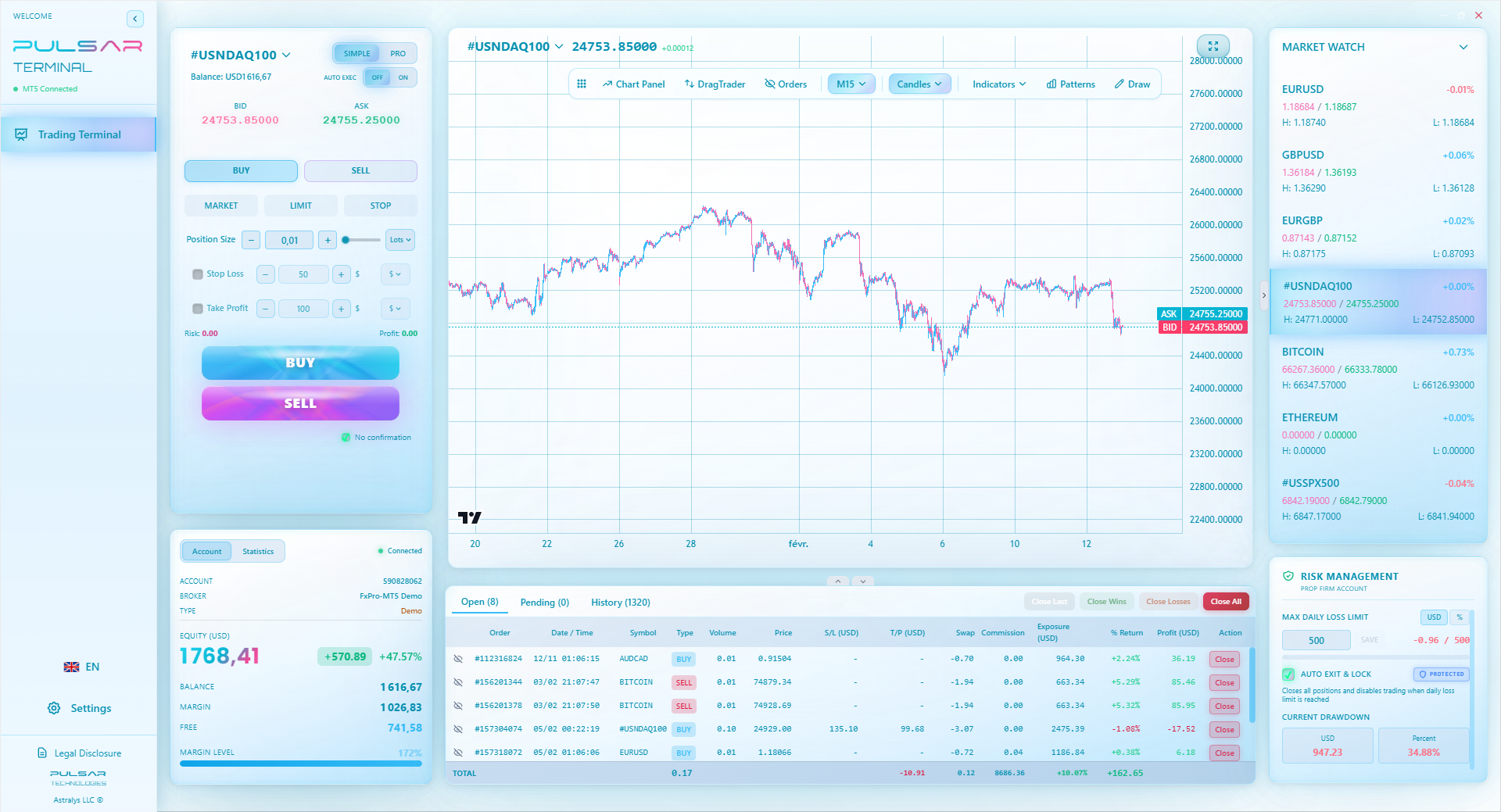
Managing these risks manually is stressful. This is where technology can be a lifesaver. Using a trading terminal that lets you set hard limits on trade risk and automatically move stops to breakeven takes the emotion out of the equation. It enforces the discipline the instant funding model demands.

Managing the strict daily loss limits of a prop firm is stressful; Pulsar Terminal lets you set hard-coded risk limits and automate breakeven stops, enforcing the discipline these accounts demand.
Pulsar Terminal
The all-in-one MT5 companion: drag-and-drop orders, multi-TP/SL, trailing stop, grid trading, Volume Profile, and prop firm protection. Used by 1,000+ traders daily.
“Your primary goal is not to hit a profit target. Your primary goal is to avoid hitting the daily loss limit.”
Let's be brutally honest. Instant funding is not for beginners. If you're new to trading, the traditional challenge model is better. It's a cheaper, slower education. Failing a $150 challenge is better than blowing a $500 instant account fee in a day.
Instant funding is for the trader who:
- Has a proven, documented strategy with at least 6 months of profitable demo/small live results.
- Has the discipline of a monk and won't deviate from a plan under pressure.
- Is frustrated by the time-lag of challenges and has the capital to front a larger fee for immediate access.
- Understands that the first goal is capital preservation, not explosive growth.
If that's you, then finding the best instant funding prop firm is a viable path. Start small. Choose a firm with static drawdown and clear terms. Fund the smallest account they offer. Prove you can navigate their rules for 2-3 months and make consistent withdrawals.
Then, and only then, consider scaling up. The instant funding world is full of landmines, but the path through them is clear if you're willing to check your ego at the door and trade not just against the market, but against the firm's designed probability curve. Your edge isn't just your analysis. It's your ability to manage risk within a constrained system.

FAQ
Q1What is the biggest advantage of an instant funding prop firm?
Time. You skip the 30+ day evaluation phase and start trading a 'funded' account immediately. This is great for experienced traders with a working strategy who don't want to wait or repeatedly pay challenge fees.
Q2What is the single most important rule to look for?
A STATIC maximum drawdown. Avoid any firm that uses a trailing drawdown calculated from your account's highest equity point. This static rule is the difference between a fair test and a probable failure.
Q3Can I really make money with instant funding?
Yes, but the odds are steeper than with a traditional challenge. The fee structure means the firm profits when you fail. To succeed, you need a strategy focused on extreme risk management (0.5% risk per trade or less) and the discipline to follow all their specific rules to the letter.
Q4How do instant funding payouts work?
Typically, you request a withdrawal of your profits (usually after a minimum amount, like $100). The firm processes it, often on a weekly or bi-weekly schedule, and sends you your profit share (e.g., 80%) via bank transfer, crypto, or other methods. Always check their payout terms for fees and processing times.
Q5Should I start with a one-time fee or monthly fee account?
If you are confident and disciplined, a one-time fee can be cheaper in the long run. If you're testing the waters or your strategy is lower frequency, a monthly fee might offer lower initial risk. Just remember, a monthly fee is a constant cost that eats into your profitability.
Q6Are there any instant funding firms with no daily loss limit?
Extremely rare, and I'd be very skeptical. The daily loss limit is the primary risk control mechanism for the firm. A firm without one is either running a different business model or is an outright scam. A sensible daily limit protects them, and in turn, forces necessary discipline on you.
Prof. Winston's Lesson
Key Takeaways:
- ✓Insist on a STATIC drawdown, not a trailing one.
- ✓Never risk more than 0.5% of your starting balance per trade.
- ✓One loss-making trade should never exceed 2% of your account.
- ✓If you lose 2% in a day, you are done trading for that day.
How useful was this article?
Click a star to rate
Weekly Trading Insights
Free weekly analysis & strategies. No spam.
About the Author
James Mitchell
Senior Trading Analyst
Based in New York with over 9 years of trading experience. Focuses on major USD pairs, prop firm challenges, and the US regulatory landscape.
Comments
Risk Disclaimer
Trading financial instruments carries significant risk and may not be suitable for all investors. Past performance does not guarantee future results. This content is for educational purposes only and should not be considered investment advice. Always conduct your own research before trading.
You Might Also Like

Cara Trading Forex Sukses: 7 Prinsip dari Trader Profesional
Cara trading forex sukses dengan 7 prinsip trader pro: manajemen modal, disiplin, journal trading, backtest. Data nyata, bukan janji profit palsu.
Jam Trading Forex Terbaik untuk Trader Indonesia: Panduan Lengkap dengan Tabel Waktu
Panduan jam trading forex untuk trader Indonesia. Tabel 4 sesi dunia, jam emas 20:00-00:00, sesi mana yang harus dihindari. Data akurat + tips dari trader berpengalaman.
Top 5 Sàn Forex Uy Tín Nhất 2026: Review Jujur dari Trader Indonesia
Top 5 sàn forex uy tín 2026 untuk trader Indonesia. Review jujur: spread, deposit, withdraw, dukungan lokal. Exness, XM, IC Markets & lebih.
Get Pulsar Terminal
All these calculators are built into Pulsar Terminal with real-time data from your MT5 account. One-click position sizing, automatic risk management, and instant calculations.
Get Pulsar Terminal