


If you've been online for five minutes, you've seen it: 'Open a forex account and make millions from your phone!' It's the biggest lie sold to young Nigerians.

Olumide Adeyemi
West African Trading Pioneer ·  Nigeria
☕ 11 min read
What you'll learn:

If you've been online for five minutes, you've seen it: 'Open a forex account and make millions from your phone!' It's the biggest lie sold to young Nigerians. The truth is, a forex account is just a tool, and like any tool, you can build a house or smash your thumb with it. I've seen too many people blow up accounts because they focused on the wrong things. Let's cut through the noise. I'll show you what a forex account really is for a Nigerian trader, how to set one up without getting scammed, and how to actually use it to trade, not just gamble.
Think of your forex account as your digital trading desk. It's not just a wallet where you deposit Naira. It's the interface between you, your broker, and the global market. When you buy EUR/USD, you're not sending money to Europe. You're placing an order with your broker, who acts as your counterparty.
There are a few core components you need to understand:
The Broker Platform (MT4/MT5): This is your trading terminal. MetaTrader 4 or 5 is the standard. Your account login gives you access to this software where you'll analyze charts and execute trades.
The Account Currency: This is crucial. Most international brokers offer accounts in USD, EUR, or GBP. As a Nigerian, this means your first financial decision is a currency conversion. You deposit NGN, it gets converted to USD (usually at a bank rate plus a fee), and that USD balance is what you trade with. Profits and losses are in USD, and when you withdraw, it's converted back to Naira. This two-step conversion eats into your returns, so you must factor it in.
use & Margin: This is the double-edged sword. Your broker lets you control a large position with a small deposit (your margin). A 1:500 use means with $100, you can control a $50,000 position. Sounds great, right? Here's the catch I learned the hard way: it amplifies losses just as fast. A 1% move against you wipes out your $100 margin. I once got cocky with high use on a seemingly sure thing in GBP/JPY. The pair spiked 80 pips against me in minutes, and I got a margin call before I could even react. That $500 lesson taught me to treat use like fire – useful but dangerous.

Warning: Nigerian social media 'gurus' love to flaunt high use as a benefit. It's not a badge of honor. It's the fastest route to an empty account for a new trader.
Your account type (Standard, ECN, Raw Spread) determines your trading costs, primarily the spread. An ECN account might have tighter spreads but charge a commission per trade. For a high-volume scalping strategy, that can be better. For a swing trading style, a standard account with no commission might be cheaper.
“A forex account is just a tool, and like any tool, you can build a house or smash your thumb with it.”
This is the most important decision you'll make. You're trusting this company with your money. The landscape here is... messy. You have three categories:
International Brokers with Local Presence: These are your best bet. Firms like Exness, IC Markets, XM, and Pepperstone are regulated by top-tier authorities (like CySEC in Cyprus or ASIC in Australia) AND have tailored services for Nigeria. They offer local bank deposits, Naira accounts (sometimes), and customer support that understands our banking issues. Their regulation overseas is your primary safety net.
Pure International Brokers: Regulated abroad but no local office. Funding can be a headache involving international wire transfers and hefty fees from your Nigerian bank.
'Local' Brokers: Be extremely careful. Many are just introducing brokers or white labels. The key question: who holds your money? If they're not clearly regulated by a reputable foreign body, walk away. I've had friends lose funds to brokers that just vanished overnight.
What to Verify Before You Deposit
- Regulation: Go to the broker's website, find their license number (e.g., CySEC 123/456), and verify it on the regulator's official website. Don't just take their word for it.
- Deposit/Withdrawal Methods: Do they accept direct bank transfers to a Nigerian bank? What about USSD or debit cards? How long do withdrawals take? Read the fine print on fees.
- Spreads & Slippage: Check the typical spreads on the pairs you want to trade, like EUR/USD, during both London and New York sessions. A broker offering unbelievably low spreads all the time is often a red flag.

Pro Tip: Open a demo account with your top 2-3 choices. Test their platform speed, execution, and customer support response time with a fake inquiry. It's the best trial run you can get.

💡 Winston's Tip
Your first deposit should be money you are 100% prepared to lose. Consider it tuition for the most expensive school you'll ever attend: the market.
“The glamorous 'lifestyle' pics are a distraction. The real work is quiet, disciplined, and focused on the numbers.”
This is the practical hurdle. You can't just click 'deposit' and be done. Here’s the real-world process.
Step 1: The Conversion Hit You initiate a deposit of, say, ₦500,000. Your broker gives you instructions to pay a Nigerian bank account (in Naira). You make the transfer. The broker's payment processor receives the Naira, converts it to USD at their rate. This rate is almost never the official CBN rate you see on Google. It's usually 2-5% worse. So your ₦500,000 might become $320 instead of the $330 you expected. That's your first cost.
Step 2: The Funding Methods
- Bank Transfer: Most common. Slow (can take 24 hours) but reliable.
- Debit/Credit Cards: Instant, but many Nigerian cards fail on international merchant payments. Also, your bank might block it as 'suspicious'.
- E-Wallets: Some brokers accept them, but they add another layer of fees.
Step 3: The Withdrawal Reality This needs to be smooth. A good broker processes withdrawals back to your source (bank account) within 24-48 hours. You'll receive USD, which your Nigerian bank will convert to Naira at their buying rate. Again, not the best rate. Keep a record of all transactions for your own tracking.

Example: You deposit ₦1,000,000. After conversion, you get $1,250 in your trading account. You trade well and grow it to $1,500. You withdraw. Your bank receives ~$1,500, converts it at ₦1,480/$, giving you ~₦2,220,000. Your profit is ₦1,220,000, but note the two conversion costs baked in. Always think in your final Naira value, not just the USD P&L in your platform.
“The glamorous 'lifestyle' pics are a distraction. The real work is quiet, disciplined, and focused on the numbers.”
Brokers offer a menu of accounts that can be confusing. Here’s the simple breakdown:
| Account Type | Best For | Key Feature | The Catch |
|---|---|---|---|
| Standard | Beginners, swing traders | No commission, all-in spread. Simple. | Spreads are wider, especially on exotics. |
| ECN/Raw Spread | Scalpers, high-volume traders | Raw spreads from liquidity providers, very tight. | Charges a commission (e.g., $3.5 per lot). |
| Cent Account | Absolute beginners testing with real money | 1 Cent = 1 USD in value. Lets you trade micro-lots with tiny risk. | Not all brokers offer it. Can create bad habits if you don't scale up properly. |
My advice? Start with a Standard account if you're new. The all-in cost is easier to calculate. You're not trading enough volume for the ECN commission model to be beneficial yet. I made the switch to an ECN account only after my average position size grew above 2 standard lots per trade, where the savings on the spread outweighed the commission.
use Setting: When you open the account, they'll ask what use you want. Just because they offer 1:1000 doesn't mean you should take it. Start low. 1:50 or 1:100 is more than enough. You can always request an increase later, but starting too high is a recipe for instant ruin. This is a key setting in your position size calculator.
💡 Winston's Tip
The most important button on your trading platform isn't 'Buy' or 'Sell.' It's the one that opens your position size calculator. Use it first, every time.
“Your number one job is to protect your capital. Everything else is secondary.”
Opening the account is easy. Managing it is the real work. This is your operational playbook.
Risk Management Is Not a Suggestion
Your number one job is to protect your capital. This means:
- Position Sizing: Never risk more than 1-2% of your account balance on a single trade. If you have a $1,000 account, your max loss per trade should be $10-$20. Use a position size calculator for every single trade. No exceptions.
- Stop-Loss Orders: ALWAYS use one. Before you even think about your profit target, place your stop. It's your lifeline. I enter my stop loss the moment my trade is executed. A trick I use? I set my stop based on market structure, not an arbitrary dollar amount. If the market proves me wrong by breaking a key level, I'm out.
The Psychology of the Balance Screen
Watching your account balance fluctuate is emotional torture if you let it. You must decouple your self-worth from your daily P&L. I had a rule: I only checked my account balance at the end of the week. During the day, I focused on whether my trades followed my plan, not whether they were in profit by 3 pips.
Record Keeping Like a Pro
Keep a journal. Not just 'bought EUR/USD, made $50.' Log:
- The chart setup (e.g., 'RSI indicator divergence on H1, bounce off daily support')
- Entry, stop, target prices
- The reason for the trade
- The emotional state ('Felt impatient, entered early')
- Screenshot of the chart
This journal will be worth more than any trading course. It turns your account history into a learning tool.
Pro Tip: Once a month, withdraw a portion of your profits. Even if it's small. Getting money back into your Nigerian bank account reinforces that this is real, builds discipline, and protects your capital from yourself during a potential losing streak.

“Your number one job is to protect your capital. Everything else is secondary.”
We face unique cultural and environmental traps. Here are the big ones.
1. Chasing 'Quick Funding' from Prop Firms: Prop firm challenges are everywhere. The promise is huge: pass a challenge, get a $100,000 account. The reality is brutal. Their rules (like max daily loss) are designed for you to fail. I spent over $800 on challenge fees before I passed one. The psychological pressure is immense. If you go this route, you need iron-clad rules. A tool that can automate the daily loss limit is the only reason I finally succeeded.
2. Overtrading Due to FOMO: The Nigerian trading community on WhatsApp and Telegram is hyper-active. You'll see screenshots of '100 pip gains' all day. This creates immense Fear Of Missing Out (FOMO). You start jumping into trades just to be in the market. I've blown weeks of patience on 30 minutes of FOMO-driven trades. Your account can't sustain that.
3. Ignoring the Naira Devaluation Hedge: Many traders just think 'make USD profit.' Smart traders also see their forex account as a hedge against Naira devaluation. If you hold USD in your trading account, its Naira value increases as the Naira weakens, even if you're not trading. It's a secondary benefit.
4. Not Accounting for True Costs: Remember the double conversion on deposit/withdrawal? Add in spreads, potential overnight swap fees, and data costs for your internet. Your trade needs to overcome all of this just to break even. A common mistake is seeing a 10-pip move as profit, forgetting the 1.5-pip spread and other costs ate a chunk of it already.
Your forex account is a business ledger. Every cost must be tracked. The glamorous 'lifestyle' pics are a distraction. The real work is quiet, disciplined, and focused on the numbers on your screen and in your journal.
💡 Winston's Tip
Withdraw your initial capital as soon as your profits allow it. Trading with 'house money' removes a huge layer of psychological pressure.
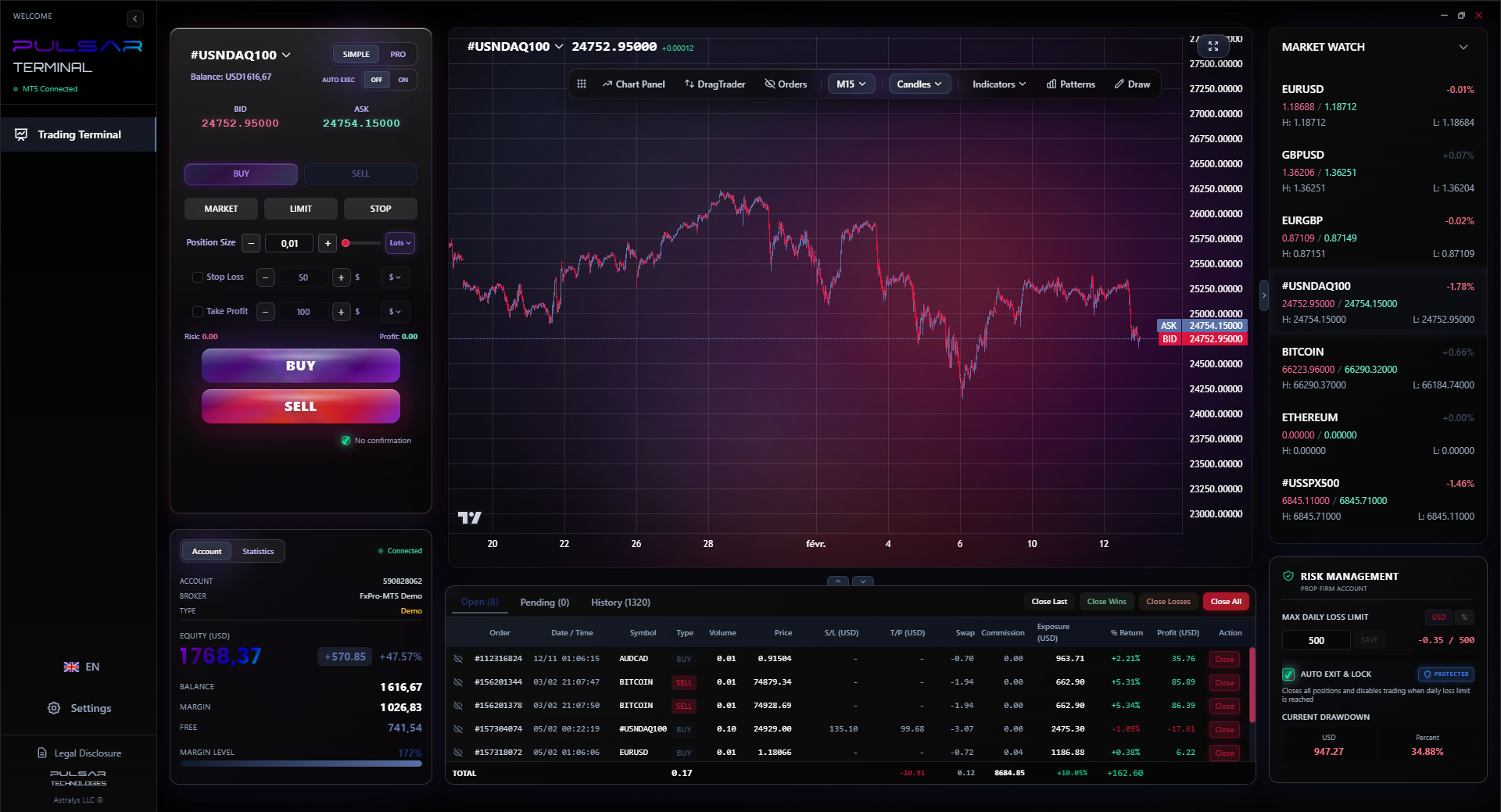
Managing the strict daily loss limits of a prop firm challenge is incredibly stressful, but tools like Pulsar Terminal can automate this protection directly on your MT5, shutting off trades before you breach the limit.
Pulsar Terminal
The all-in-one MT5 companion: drag-and-drop orders, multi-TP/SL, trailing stop, grid trading, Volume Profile, and prop firm protection. Used by 1,000+ traders daily.
“The Nigerian trading community on WhatsApp is hyper-active. This creates immense Fear Of Missing Out. Your account can't sustain that.”
Let's say you've done everything right. You started with ₦150,000, traded well, and grew your account by 20% in six months. What next?
Phase 1: Consistency Over Size Don't rush to deposit more money. Prove you can be consistently profitable across different market conditions (ranging, trending, volatile) for at least 6-12 months. Your track record is your most valuable asset.
Phase 2: Gradual Capital Increase Once consistent, you can add capital in increments. Maybe you withdraw your initial deposit and trade only with profits. Or you add another 50% to your account size. The key is to scale your position size gradually. If you were trading 0.01 lots with $1,000, don't jump to 0.1 lots with $10,000. Go to 0.02, then 0.03. Your psychology needs to adjust to the larger dollar values.
Phase 3: Systematization This is where tools become critical. Managing multiple trades, moving stops to breakeven, taking partial profits – doing this manually on multiple charts is stressful and error-prone. This is where a platform that lets you drag-and-drop orders and set multi-level take-profits becomes a force multiplier. It lets you execute complex trade management plans with a single click, removing emotion.
The Ultimate Goal: Separation Your goal should be to get to a point where your trading system runs almost independently of your daily mood. Your forex account is a capital allocation machine. You feed it a strategy and risk parameters, and it executes. The less you have to 'decide' in the heat of the moment, the better your results will be. That's when you've truly graduated from a gambler to a trader.

FAQ
Q1What is the minimum amount I need to open a forex account in Nigeria?
Technically, some brokers allow you to start with as little as $5 or $10 (especially with cent accounts). Practically, I wouldn't recommend starting with less than ₦100,000 - ₦150,000. Why? Transaction fees and spreads will eat a tiny account alive. You need enough buffer to withstand a few losing trades while learning without immediately blowing up.
Q2Is forex trading legal in Nigeria?
Trading forex with international, regulated brokers is a legal activity for individuals. The Central Bank of Nigeria (CBN) restricts banks from facilitating payments for unlicensed binary options and FX margin trading platforms, but it does not criminalize you, the individual, for trading with a licensed overseas broker. The key is using a reputable, regulated international broker, not an unlicensed 'local' platform.
Q3Which is better for Nigerians, a USD or a Naira forex account?
If your broker offers a true Naira-denominated account (where your balance and P&L are in NGN), it can simplify things by removing the USD conversion on each trade's profit/loss. However, these are rare. Most Nigerians use USD accounts. The benefit of a USD account is that it holds its value against the Naira. Your $1,000 is still $1,000 even if the Naira weakens, effectively giving you a currency hedge.
Q4How do I avoid forex trading scams in Nigeria?
Stick to major international brokers with verifiable regulation (like Exness, IC Markets, XM). Avoid any 'broker' that contacts you first via WhatsApp/Instagram promising guaranteed profits. Never send money to a personal bank account. Always verify the company's license on the regulator's official website (e.g., CySEC, FCA, ASIC). If they're not regulated by a top-tier authority, it's a hard pass.
Q5How are my forex trading profits taxed in Nigeria?
As of now, there is no specific capital gains tax on individual forex trading profits in Nigeria. However, this is a fluid area of law. It's crucial to maintain clear records of all your deposits, withdrawals, and trading statements. Consult with a Nigerian accountant for the most current advice, as tax regulations can change.
Q6Can I use my phone to trade forex successfully?
You can execute trades and monitor positions on your phone. But for serious analysis, charting, and developing strategies, a computer is non-negotiable. The small screen leads to missed details and encourages impulsive, poorly-planned trades. Use your phone for management, but do your planning on a desktop platform like MT5.
Q7What is the single biggest mistake new Nigerians make with their first account?
Using excessive use because the broker allows it. They see 1:500, think 'more profit,' and then a normal 20-pip move wipes out their entire deposit. They blame the market, but the mistake was risking 5% or 10% of their account on a single trade. Always, always control your risk per trade.
Prof. Winston's Lesson
Key Takeaways:
- ✓Start with use no higher than 1:100.
- ✓Never risk more than 2% of your account per trade.
- ✓Verify your broker's license on the regulator's official site.
- ✓Factor in the double Naira-USD conversion cost on all trades.
- ✓Keep a detailed trading journal for every single trade.
How useful was this article?
Click a star to rate
Weekly Trading Insights
Free weekly analysis & strategies. No spam.
About the Author
Olumide Adeyemi
West African Trading Pioneer
One of Nigeria's most active forex trading educators. 8 years of experience trading from Lagos. Specializes in low-capital strategies and prop firm challenges for African traders.
Comments
Risk Disclaimer
Trading financial instruments carries significant risk and may not be suitable for all investors. Past performance does not guarantee future results. This content is for educational purposes only and should not be considered investment advice. Always conduct your own research before trading.
You Might Also Like

Cara Trading Forex Sukses: 7 Prinsip dari Trader Profesional
Cara trading forex sukses dengan 7 prinsip trader pro: manajemen modal, disiplin, journal trading, backtest. Data nyata, bukan janji profit palsu.
Jam Trading Forex Terbaik untuk Trader Indonesia: Panduan Lengkap dengan Tabel Waktu
Panduan jam trading forex untuk trader Indonesia. Tabel 4 sesi dunia, jam emas 20:00-00:00, sesi mana yang harus dihindari. Data akurat + tips dari trader berpengalaman.
Top 5 Sàn Forex Uy Tín Nhất 2026: Review Jujur dari Trader Indonesia
Top 5 sàn forex uy tín 2026 untuk trader Indonesia. Review jujur: spread, deposit, withdraw, dukungan lokal. Exness, XM, IC Markets & lebih.
Get Pulsar Terminal
All these calculators are built into Pulsar Terminal with real-time data from your MT5 account. One-click position sizing, automatic risk management, and instant calculations.
Get Pulsar Terminal