


You've seen the ads: a guy on a beach with three laptops, sipping a cocktail while the money rolls in.

David van der Merwe
Emerging Markets Trader ·  South Africa
☕ 9 min read
What you'll learn:
You've seen the ads: a guy on a beach with three laptops, sipping a cocktail while the money rolls in. That's the 'forex lifestyle' fantasy sold to you. But what's the reality for a South African trader? Is it freedom and Lambos, or is it a grind with the FSCA and SARS looking over your shoulder? I've been trading from SA for over a decade, and I'll tell you this straight: the real forex lifestyle isn't about the destination. It's about building a sustainable, disciplined process that works within our unique rules. Let's cut through the nonsense.
The fantasy is universal: quit your job, trade two hours a day from your poolside, and live off the profits. The South African reality has some very specific roadblocks. First, our regulators aren't sleeping. The FSCA has clamped down hard, capping use at 30:1 for retail traders. That means you can't just YOLO a R5,000 account with 500:1 use and hope for a miracle. It's a good rule, honestly. It forces you to trade properly, but it also means the get-rich-quick dream is officially dead on arrival.
Then there's the Rand. You can't legally speculate against your own currency. So forget about shorting ZAR/USD from your SA-based account as a simple retail client. Your trading world is primarily major and minor pairs that don't involve the Rand. This changes your strategy from the get-go.
The biggest reality check? SARS. Every cent of profit you make, whether it's with an FSCA-regulated broker like Khwezi Trade or an international one, is taxable income. I learned this the hard way in my third year. Made a decent profit, didn't set aside a third for tax, and had a very unpleasant conversation come filing season. That's not a glamorous part of the forex lifestyle brochure.

Warning: If you think you can trade with an offshore broker and SARS won't find out, you're playing a dangerous game. They have data-sharing agreements. Your forex profits are not a secret.

💡 Winston's Tip
The market's job is to take your money. Your job is to not give it to them. Patience is the only free edge you have.
The only real 'lifestyle' comes from treating this like a business. That means proper accounting, risk management, and a clear separation between your trading capital and your living expenses.
Start With the Right Broker
Your choice of broker is your business's foundation. You need one that's FSCA-regulated for peace of mind. I've used a few. IC Markets and Exness are solid for their raw spreads and execution speed, which is crucial if you're into scalping. For a truly local feel, Khwezi Trade offers ZAR accounts, which saves on conversion fees. Don't just look at use offers (they're all capped at 30:1 for you anyway). Look at spreads on the pairs you'll actually trade, deposit/withdrawal methods (EFT is a must), and platform stability.
Capital and Risk: The Non-Negotiables
With R10 million in annual foreign capital allowance, funding isn't the issue. The issue is what you do with it. The single biggest destroyer of the forex lifestyle is poor risk management. You must use a position size calculator for every single trade. No exceptions. Your goal isn't to make a million on one trade; it's to make 2% this week without blowing up your account.
Here's a personal mistake: In 2017, I got cocky on a GBP/USD short. Instead of my usual 1% risk, I went for 5%. The pair spiked on some unexpected Brexit news, and I hit a margin call. Wiped out two months of careful profits in 20 minutes. That was the day I stopped treating trading like gambling and started treating it like a business. The lifestyle only works if you're still in the game tomorrow.
“The real luxury of a successful forex lifestyle isn't the car. It's the emotional stability.”
Forget the beach. Here's a real Tuesday for me, based in Cape Town.
5:30 AM: Alarm goes off. London is opening, and the overlap with Asia creates the first real volatility of my day. I'm not trading yet. I'm scanning. I check economic calendars (SARB announcements are key for us), look at overnight price action on my core pairs like EUR/USD, and review any open swing trading positions.
7:00 - 10:00 AM: My main trading window. London is in full swing, liquidity is high. I'm not glued to the screen. I have my setups, my alerts are set. Maybe I take one or two trades if my criteria are met. The rest of the time? I'm analyzing, reviewing my journal. This isn't frantic clicking. It's patient execution.
10:30 AM: London quietens down. I'm done with active trading. I update my trade journal with notes, screenshots, and emotional state. This is more important than any indicator.
Afternoon: This is 'business admin' time. Maybe I review my broker statements for tax records. Maybe I work on a new script for my tradingview. Maybe I just disconnect and go for a hike. The flexibility is real, but the discipline to stop trading is what protects it.

Pro Tip: Your most valuable asset is your attention, not your capital. Schedule your trading like a meeting with your most important client. When the meeting's over, leave the office.
This is the part nobody wants to talk about, but it's the bedrock of your forex lifestyle in South Africa. Get it wrong, and your lifestyle becomes a nightmare.
SARS and Forex: Profits are taxed as ordinary income. You add them to your other income, and you pay according to the sliding scale. You can deduct legitimate expenses: data fees, trading platform subscriptions, a portion of your home office if you trade professionally, and even educational courses (keep those receipts!). Losses can be carried forward to offset future profits.
Record Keeping: You need a bulletproof system. I use a simple spreadsheet: Date, Pair, Position Size, Entry, Exit, P&L in ZAR, Broker Statement Reference. Every month, I reconcile this with my broker statement. When tax season comes, it's a 30-minute job for my accountant.
The FSCA's Role: Trading with an FSCA-regulated broker means if something goes horribly wrong - the broker collapses - you have some recourse. Your funds should be segregated. With an unregulated offshore broker, you're on your own. Is saving 0.1 pip on the spread worth that risk? Never.
Let me give you a real number. In 2022, my net trading profit was R247,500. After deductible expenses of about R18,000, my taxable income from trading was R229,500. That got added to my other income. Because I'd been setting aside 30% of my monthly profits into a separate tax savings account, the payment to SARS was stressful but not catastrophic. That's the real forex lifestyle: planning for the taxman.
💡 Winston's Tip
Your trading plan isn't complete until it includes a section titled 'What I Will Do When I'm Wrong.'
“You start for the dream of cars and beaches. You stay for the mastery.”
The market doesn't care about your lifestyle goals. It will test you every day. The difference between a pro and a loser is 90% psychology.
FOMO is a Killer: You see a pair ripping, you jump in late, and you get caught in the reversal. I've done it chasing gold (XAU/USD) moves. Entered at $1815, watched it climb to $1820, then plunge to $1798 because I ignored my own rules. Lost R4,000 on a FOMO trade. The lifestyle requires the discipline to sit on your hands.
Dealing with Losses: You will have losing streaks. If a 3-trade losing streak makes you double your risk to 'make it back,' you're finished. Your system must account for variance. I use the RSI indicator and MACD indicator as part of my confluence, but no indicator prevents losses. Your risk management does.
The real luxury of a successful forex lifestyle isn't the car. It's the emotional stability. It's not getting euphoric on a win or devastated by a loss. It's just executing the plan. That mental quiet is worth more than any single trade.
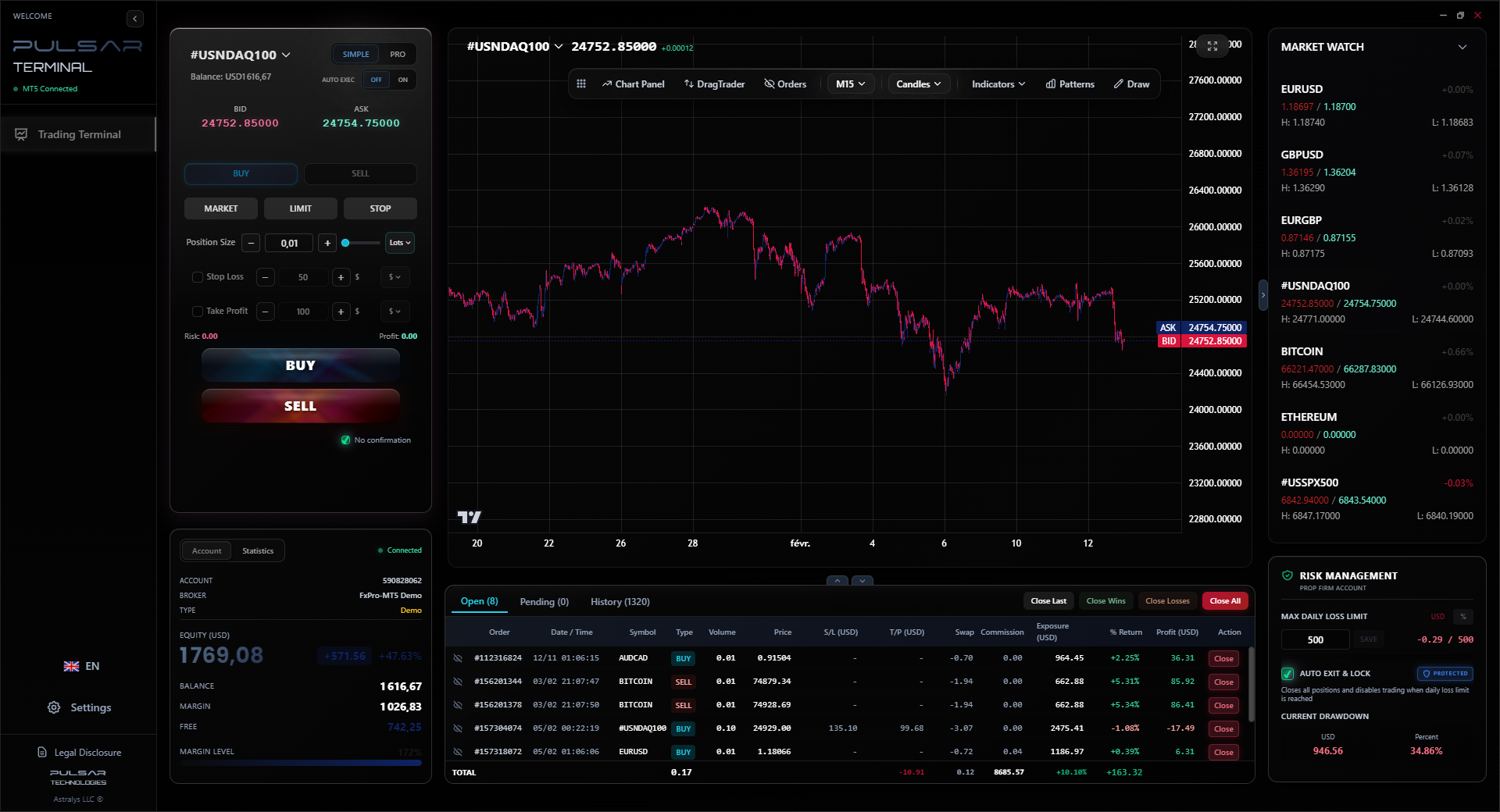
Managing the psychology of multiple open trades is easier when your tools handle the mechanics, letting Pulsar Terminal automate partial closures and trail your stops on MT5.
Pulsar Terminal
The all-in-one MT5 companion: drag-and-drop orders, multi-TP/SL, trailing stop, grid trading, Volume Profile, and prop firm protection. Used by 1,000+ traders daily.
You can't build a house with just a hammer. You need the right tools and daily routines.
Essential Tech:
- A Reliable Internet Connection: Obvious, but load-shedding is our reality. A good UPS or inverter is a business expense, not a luxury.
- Multiple Monitors: You need to see charts, your trading platform, and your journal. Trying to trade off a single laptop screen is like trying to perform surgery with a butter knife.
- A Proper Trading Journal: Not a notepad. Use software or a detailed spreadsheet that forces you to analyze your behavior.
The Daily Routine (The Boring Stuff That Works):
- Pre-Market Prep (30 mins): Review the economic calendar. Check major support/resistance levels. No trading decisions yet.
- Trade Execution Window (Strictly Timed): Define your active hours and stick to them. Mine is 7-10 AM SAST.
- Post-Session Review (15 mins): Journal every trade. What was the setup? Did you follow your rules? How did you feel?
- Weekly Review (1 hour): Every Friday, look at your weekly P&L, win rate, and average win/loss. Tweak your system, not based on one bad trade, but on statistical edges.

Example: My weekly review might show I'm 60% accurate on EUR/USD breakouts but only 40% accurate on GBP/JPY reversals. The logical adjustment? Allocate more capital to the higher-probability setup and either improve or drop the lower one. This is how you evolve.
“The FSCA, SARS, and the market itself are your permanent business partners. Respect them.”
So, is the forex lifestyle achievable in South Africa? Yes, absolutely. But it looks nothing like the ads.
It looks like waking up early, not sleeping in. It looks like careful record-keeping for SARS. It looks like passing on 10 'maybe' trades to wait for the one 'high-probability' setup. It looks like boredom and discipline 95% of the time.
The payoff? Real freedom. Not the freedom to buy a yacht (maybe later), but the freedom to control your time. The freedom to earn a living from anywhere with an internet connection. The freedom that comes from knowing you've built a skill that can't be taken away.
You start for the dream of cars and beaches. You stay for the mastery, the challenge, and the genuine independence. Just remember, the FSCA, SARS, and the market itself are your permanent business partners. Respect them, plan for them, and you might just build a lifestyle that lasts.
Start small. Use a demo account until your strategy is proven. Then trade with real money so small that a loss doesn't hurt. Focus on the process, not the profit. The lifestyle will follow, one disciplined trade at a time.
FAQ
Q1Can I really make a living trading forex in South Africa?
Yes, but it's a profession, not a lottery. You need a proven, disciplined strategy, strict risk management (never risk more than 1-2% per trade), and enough capital to withstand drawdowns without panic. Most importantly, you must treat it as a business with SARS as a key stakeholder. It takes years, not months.
Q2What's the number one mistake new SA traders make?
Ignoring taxes and overusing use. They blow an account with crazy risk, then get a nasty surprise from SARS when they do have a winning streak. Start with the FSCA's 30:1 max use, use a position size calculator, and set aside 25-30% of every profit for tax from day one.
Q3Should I use a South African broker or an international one?
For beginners, an FSCA-regulated broker (local like Khwezi or international like IC Markets with an FSCA license) is safer for fund protection. As you gain experience, you might choose a broker based on spreads and platforms. Always verify their FSP number on the FSCA website first.
Q4How much money do I need to start?
You can start with as little as R500 with some local brokers. But to realistically 'test' a strategy with proper position sizing, I'd recommend at least R10,000. This lets you trade micro lots and practice real risk management without a single pip definition move wiping you out.
Q5How do I handle trading during load-shedding?
It's a business continuity issue. Invest in a decent UPS for your router and monitor, or a larger inverter system. Have your broker's mobile app ready on a phone with data as a backup. Never enter a trade if you know load-shedding is imminent during a volatile news event.
Q6Is forex trading income stable?
No, it's highly variable. Some months are up 10%, some are down 3%. You don't get a salary. This is why you must pay yourself a 'salary' from your trading profits into a separate account and live off that, leaving the rest of the capital to compound and act as a buffer for losing periods.
Prof. Winston's Lesson
Key Takeaways:
- ✓use is capped at 30:1 for a reason. Use less.
- ✓Set aside 30% of every profit for SARS. Immediately.
- ✓Your daily routine is more important than your trading strategy.
- ✓A 2% weekly gain compounds to over 100% a year.
How useful was this article?
Click a star to rate
Weekly Trading Insights
Free weekly analysis & strategies. No spam.
About the Author
David van der Merwe
Emerging Markets Trader
Johannesburg-based trader with 11 years in emerging market currencies. Specializes in ZAR pairs, FSCA-regulated trading, and South African market analysis.
Comments
Risk Disclaimer
Trading financial instruments carries significant risk and may not be suitable for all investors. Past performance does not guarantee future results. This content is for educational purposes only and should not be considered investment advice. Always conduct your own research before trading.
You Might Also Like

Cara Trading Forex Sukses: 7 Prinsip dari Trader Profesional
Cara trading forex sukses dengan 7 prinsip trader pro: manajemen modal, disiplin, journal trading, backtest. Data nyata, bukan janji profit palsu.
Jam Trading Forex Terbaik untuk Trader Indonesia: Panduan Lengkap dengan Tabel Waktu
Panduan jam trading forex untuk trader Indonesia. Tabel 4 sesi dunia, jam emas 20:00-00:00, sesi mana yang harus dihindari. Data akurat + tips dari trader berpengalaman.
Top 5 Sàn Forex Uy Tín Nhất 2026: Review Jujur dari Trader Indonesia
Top 5 sàn forex uy tín 2026 untuk trader Indonesia. Review jujur: spread, deposit, withdraw, dukungan lokal. Exness, XM, IC Markets & lebih.
Get Pulsar Terminal
All these calculators are built into Pulsar Terminal with real-time data from your MT5 account. One-click position sizing, automatic risk management, and instant calculations.
Get Pulsar Terminal