


How many times have you placed a trade, watched it go a few pips against you, and felt that cold sweat when you see your free margin shrinking faster than your confidence? If you're trading in Nigeria without a solid grip on margin, you're basically driving a Danfo bus with no brakes down Third Mainland Bridge at rush hour.

Olumide Adeyemi
West African Trading Pioneer ·  Nigeria
☕ 10 min read
What you'll learn:
- 1What Is Margin? (And Why Your Broker Isn't Your Friend)
- 2How a Forex Margin Calculator Actually Works (The Math, Simplified)
- 3A Step-by-Step Walkthrough: Using a Calculator Before You Trade
- 4The 3 Biggest Margin Mistakes I See Nigerian Traders Make
- 5Margin Calculation as the Heart of Your Risk Management
- 6Advanced Tips: When You're Moving Beyond the Basics
- 7Choosing a Broker: Margin Policy is a Deal-Breaker

How many times have you placed a trade, watched it go a few pips against you, and felt that cold sweat when you see your free margin shrinking faster than your confidence? If you're trading in Nigeria without a solid grip on margin, you're basically driving a Danfo bus with no brakes down Third Mainland Bridge at rush hour. It's not a question of if you'll crash, but when. Let's fix that. This isn't about complex theory; it's about using a simple tool - the forex margin calculator - to keep your hard-earned Naira in your pocket and out of your broker's.
Margin is not a cost or a fee. It's a security deposit. When you trade with use, your broker is fronting you most of the cash for the position. Your margin is your skin in the game. Think of it like a caution fee for an apartment in Lekki - you get it back if you don't wreck the place (your account).
In Nigeria, this gets tricky fast. You're trading instruments priced in USD, but your account might be in Naira. Your broker's system is doing constant conversions in the background. When the CBN decides to have another wobble and the Naira rate shifts, the Naira value of your required margin can change even if the trade hasn't moved. I've seen it happen. A seemingly safe trade suddenly triggers a margin call because the forex rate for calculating collateral moved against me. Your broker's primary relationship is with their risk department, not with you. Their goal is to protect their capital. Yours is to protect yours. The margin calculator is your first line of defense.

Warning: Many new traders confuse margin with the cost of the trade. It's not. It's the portion of your account balance that is 'locked up' as collateral. If your trade loses money, the loss comes from your free margin, not your used margin. When free margin hits zero, you get the dreaded call.

💡 Winston's Tip
Your first calculation with a new broker should be with a demo account. Test their stop-out level by letting a trade go against you. Knowing exactly how they liquidate is more valuable than any textbook theory.
Forget the intimidating formulas. At its core, the calculation is about one thing: the notional value of your trade and your broker's use requirement.
Here’s the basic formula you need to understand: Required Margin = (Trade Size / Account use) * Current Market Price
Let's make it real with a Naira example. Say you have a $10,000 (or equivalent Naira) account with a broker like Exness offering 1:500 use to Nigerian clients.
The Standard Calculation
You want to buy 1 standard lot (100,000 units) of EUR/USD at 1.0850.
- Trade Size: 100,000 EUR
- use: 1:500
- Market Price: 1.0850
Required Margin = (100,000 / 500) * 1.0850 = 200 * 1.0850 = $217
So, to open that 1-lot trade, about $217 of your equity is locked as margin. That seems tiny compared to the $108,500 notional value of the position. That's the power and the peril of use.
The Nigerian Twist: Currency Conversion
Now, if your account is denominated in Naira (NGN), the broker's system does another step. It converts that $217 to Naira at their current rate. If their rate is ₦1,450/$, your required margin in Naira is about ₦314,650. This is the number that matters for your account balance. A good forex margin calculator should let you input your account currency and get this final, local figure. If it doesn't, you're only getting half the picture.

Example: I once set up a gold (XAU/USD) trade using my standard mental math when the Naira was around ₦750/$. By the next day, before gold had moved much, the Naira had weakened to ₦850/$. The Naira value of my required margin increased significantly, eating into my free margin and forcing me to deposit more funds or reduce position size. I learned the hard way to always calculate in my account currency first.
“Using maximum use is like using a rocket engine to get to the corner shop.”
This should be as routine as checking your fuel gauge before a trip from Abuja to Kaduna. Don't skip it.
- Find a Reliable Calculator: Use your broker's built-in tool on their platform or website. They use their exact use tiers and rates. Alternatively, use a trusted independent position size calculator that allows for Naira account input.
- Input Your Variables:
- Account Currency: Select NGN (Naira). This is non-negotiable.
- Account Balance: Your current equity in Naira.
- use: Your chosen account use (e.g., 1:100, 1:500).
- Instrument: Select the pair (e.g., GBP/NGN, USD/NGN, or major pairs like EUR/USD).
- Trade Size: In lots, units, or the monetary value.
- Interpret the Results: The calculator will spit out two crucial numbers:
- Required Margin (NGN): The Naira amount that will be locked.
- Free Margin (NGN): What's left over. This is your breathing room for other trades and to absorb losses.
The Real Test: Before hitting 'Buy' or 'Sell', ask yourself: "If this trade goes against me by 50 pips, what will my free margin be?" If the answer is "dangerously low," your position is too big. Scale down. A proper scalping strategy with tight stops might allow for slightly larger size relative to margin, but for swing trading, you need a much bigger buffer.

Pro Tip: Always run the calculation for the worst-case spread. If the normal spread on EUR/USD is 1 pip but can widen to 5 pips during news, calculate with 5. That spread cost is deducted from your free margin the moment you open the trade.
I've made these. My friends have made these. Let's stop the cycle.
1. Maxing Out use Because It's There. Just because IC Markets or XM offers you 1:1000 use doesn't mean you should use it on every trade. Using maximum use is like using a rocket engine to get to the corner shop. You'll get there instantly, but one small mistake and you're scattered across the neighborhood. High use magnifies margin use, meaning tiny market movements can wipe out your free margin.
2. Ignoring the Currency Effect on Cross Rates. Trading GBP/JPY with a Naira account? You're in for a wild ride. The margin is usually calculated in the quote currency (JPY), then converted to USD, then to Naira. Volatility in any of those pairs affects your Naira margin requirement. It adds layers of risk you might not have calculated.
3. Not Understanding Margin Call vs. Stop Out. This is critical. A margin call is a warning (often at 100% margin level). It means your free margin is gone, and you're running on borrowed time. A stop out is the execution. Your broker will automatically start closing your losing positions, usually beginning with the biggest loser, when your margin level hits a certain threshold (e.g., 50%). You don't want to see either, but confusing them leads to nasty surprises. I learned this trading gold (XAU/USD guide) during a volatile session. Got the margin call email, thought I had time, and watched my position get liquidated at the worst possible price 10 minutes later.
💡 Winston's Tip
If you can't instantly state your total used margin as a percentage of your equity, you're not in control of your account. Make checking this a daily ritual, like checking your phone.

“A forex margin calculator isn't a standalone tool. It's the input for your entire risk management system.”
A forex margin calculator isn't a standalone tool. It's the input for your entire risk management system. Here’s how to wire it in.
First, decide your maximum risk per trade. For most retail traders, that's 1-2% of your account equity. Let's say 1% of a ₦500,000 account is ₦5,000.
Now, work backwards. You want to place a trade on EUR/USD (EUR/USD guide) with a stop-loss 30 pips away. Since 1 pip on a standard lot of EUR/USD is roughly $10 (which fluctuates with the Naira rate), you need to calculate the position size where 30 pips of loss equals ₦5,000 or less.
You use the calculator to test different position sizes. Maybe 0.15 lots requires X margin and results in a loss of roughly ₦4,950 if your stop is hit. That's your trade. The calculator showed you the margin, and you used it to find a position size that respects your risk cap.
The 30% Rule: A personal rule I stick to is never let used margin exceed 30% of my total account equity on all open positions combined. Even during heavy scalping sessions, this keeps me from being overexposed. If my calculations show I'm nearing that limit, I don't open the next trade. It's that simple.
Managing multiple trades and their collective margin drain manually is a headache. This is where discipline meets technology.
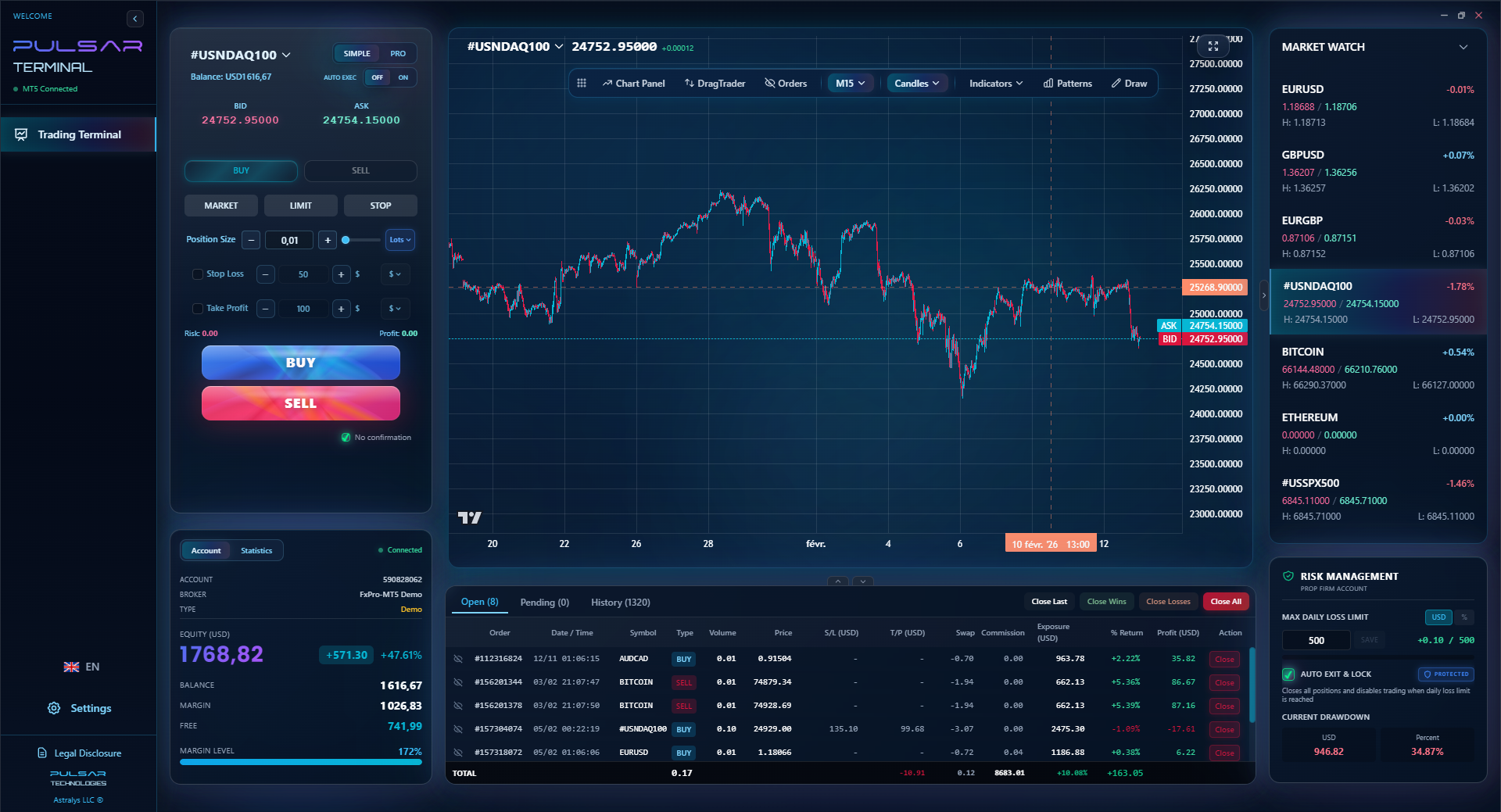
Manually tracking the collective margin of multiple open trades is a recipe for error, which is why tools like Pulsar Terminal integrate real-time margin monitoring directly into your MT5 workspace.
Pulsar Terminal
The all-in-one MT5 companion: drag-and-drop orders, multi-TP/SL, trailing stop, grid trading, Volume Profile, and prop firm protection. Used by 1,000+ traders daily.
Once you've mastered the simple calculation, you can start using margin data strategically.
1. Gauging Market Sentiment and Liquidity. If you're trading during major news (like U.S. NFP or MPC announcements in Nigeria), brokers often increase margin requirements (reduce use) temporarily. This isn't them being difficult; it's because the market's liquidity is thin and volatility is insane. If you see your broker's margin requirements spike for a particular pair, it's a red flag to stay away or trade much smaller sizes. It's the market's way of shouting "Danger!"
2. Hedging and Net Margin. Some brokers offer hedging (holding buy and sell positions on the same pair). Understand their margin policy for hedged positions. Some charge margin on both sides, some on just one. This drastically affects your capital efficiency. Always calculate the net margin effect before setting up a hedge.
3. Correlation and Margin Overload. You might think you have three separate trades: one on EUR/USD, one on GBP/USD, and one on AUD/USD. Your margin calculator says you're using 25% of your equity. But these pairs are often positively correlated. In a strong USD rally, they could all move against you at once. Your effective margin risk is much higher than 25%. Factor correlation into your total margin calculation - add an extra buffer.
Using Indicators for Context: I never calculate margin in a vacuum. I look at the chart. If the MACD indicator is showing strong momentum or the RSI indicator is at extremes, I know volatility could increase. That means I should use a wider stop-loss in my calculation, which forces a smaller position size and lower margin use. The calculator gives you the number, but the chart tells you if that number is safe.
“Your broker's primary relationship is with their risk department, not with you.”
Not all brokers are created equal, especially for Nigerian traders. When you're comparing Pepperstone, Exness, and others, their margin policy should be a top-three deciding factor.
Look for these specifics:
| Feature | Why It Matters for a Nigerian Trader |
|---|---|
| Dynamic vs. Fixed use | Dynamic use (lower use on larger positions) can protect you from yourself. Fixed use is simpler but riskier. |
| Margin Call & Stop Out Levels | What are the exact percentages? 100% for call and 50% for stop out is common, but some are stricter (80%/20%). Know your broker's numbers. |
| Currency Conversion for Margin | How transparent are they about the rate used to convert margin to Naira? Is it a fair market rate? |
| Weekend Margin Requirements | Some brokers increase margin requirements over the weekend when markets are closed. This can tie up your capital. |
| Policy on Nigerian Pairs (USD/NGN, GBP/NGN) | use on these is often much lower (e.g., 1:10). Factor this into your capital planning if you trade local pairs. |
My advice? Open a demo account and test their margin system. Place a few trades, watch how the used and free margin moves. See what happens when you get close to their stop-out level. It's the best education you'll get before risking real Naira.
💡 Winston's Tip
The best traders I know have a printed sheet with their max position size for each major pair based on their 1% risk rule. They don't recalculate from scratch every time; they follow their own pre-calculated plan.

FAQ
Q1Is there a free forex margin calculator I can use for Naira accounts?
Yes, but be careful. Many free online calculators only work in USD, EUR, or GBP. You need one that specifically allows NGN (Naira) as the account currency. The most accurate one is always the calculator provided by your own broker on their client portal or trading platform, as it uses their exact use rules and live conversion rates.
Q2How does use affect my margin requirement?
use and margin have an inverse relationship. Higher use means a LOWER margin requirement for the same trade size. For example, a 1-lot trade at 1:100 use requires about $1,000 margin. The same trade at 1:500 use requires only about $200 margin. This is why high use is dangerous - it lets you open positions much larger than your account can realistically sustain if the trade moves against you.
Q3What's the difference between 'Used Margin' and 'Free Margin'?
Used Margin is the amount of your account balance currently locked up as collateral for your open trades. Free Margin is your account's equity (balance plus/minus floating profit/loss) MINUS the Used Margin. It's the money available to open new positions or absorb losses. If your losses eat up all your Free Margin, you get a margin call.
Q4Can I lose more money than I have in my account?
With a standard retail trading account from a reputable broker regulated by bodies like the FCA or ASIC, you generally cannot. Their stop-out policy is designed to close positions before your balance goes negative (a 'negative balance protection' feature). However, in extreme market conditions (like a 'flash crash' or when a market gaps hugely at the open), it is theoretically possible, though very rare. This is another reason to manage your margin carefully.
Q5Why did my margin requirement change while my trade was open?
Two main reasons: 1) Currency Fluctuation: If your account is in Naira and you're trading USD pairs, a change in the USD/NGN rate will change the Naira value of your required USD margin. 2) Broker Policy Changes: Your broker may increase margin requirements (lower use) for a specific instrument due to upcoming news events or periods of low liquidity, like weekends or holidays.
Q6What is a good margin level percentage to maintain?
There's no single answer, but a common rule of thumb is to keep your Margin Level above 200-300%. Margin Level is (Equity / Used Margin) * 100%. A level of 100% means you have zero free margin. Staying well above 200% gives you a significant buffer against market moves. I personally start getting uncomfortable and look to close positions if my overall margin level drops below 250%.
Prof. Winston's Lesson
Key Takeaways:
- ✓Margin is a security deposit, not a fee. You get it back if you don't blow the trade.
- ✓Always calculate margin in your account currency (NGN) to avoid nasty surprises from forex fluctuations.
- ✓Never let your total used margin exceed 30% of your account equity.
- ✓Use the margin calculator to work backwards from your risk limit (e.g., 1% of account) to find your position size.
- ✓A broker's margin call level is a warning; their stop-out level is the execution. Know both.
How useful was this article?
Click a star to rate
Weekly Trading Insights
Free weekly analysis & strategies. No spam.
About the Author
Olumide Adeyemi
West African Trading Pioneer
One of Nigeria's most active forex trading educators. 8 years of experience trading from Lagos. Specializes in low-capital strategies and prop firm challenges for African traders.
Comments
Risk Disclaimer
Trading financial instruments carries significant risk and may not be suitable for all investors. Past performance does not guarantee future results. This content is for educational purposes only and should not be considered investment advice. Always conduct your own research before trading.
You Might Also Like

Cara Trading Forex Sukses: 7 Prinsip dari Trader Profesional
Cara trading forex sukses dengan 7 prinsip trader pro: manajemen modal, disiplin, journal trading, backtest. Data nyata, bukan janji profit palsu.
Jam Trading Forex Terbaik untuk Trader Indonesia: Panduan Lengkap dengan Tabel Waktu
Panduan jam trading forex untuk trader Indonesia. Tabel 4 sesi dunia, jam emas 20:00-00:00, sesi mana yang harus dihindari. Data akurat + tips dari trader berpengalaman.
Top 5 Sàn Forex Uy Tín Nhất 2026: Review Jujur dari Trader Indonesia
Top 5 sàn forex uy tín 2026 untuk trader Indonesia. Review jujur: spread, deposit, withdraw, dukungan lokal. Exness, XM, IC Markets & lebih.
Get Pulsar Terminal
All these calculators are built into Pulsar Terminal with real-time data from your MT5 account. One-click position sizing, automatic risk management, and instant calculations.
Get Pulsar Terminal