


Here's a fact most new traders ignore: the forex market isn't equally dangerous all the time.

David van der Merwe
Emerging Markets Trader ·  South Africa
☕ 9 min read
What you'll learn:
Here's a fact most new traders ignore: the forex market isn't equally dangerous all the time. Your biggest risk isn't just your trade idea, it's the clock. For us trading from South Africa, the market's 24-hour cycle in SAST creates specific windows of opportunity and, more importantly, periods of pure carnage. I've seen more accounts blown between 3 PM and 7 PM SAST than any other time. This guide isn't about finding the perfect entry; it's about using the forex market hours clock to know when the sharks are feeding so you don't become the bait.
You can have the best scalping strategy in the world, but if you're using it during the dead Tokyo lunch hour, you're just paying spreads for no reason. Conversely, a mediocre idea during the London-New York overlap can get carried to profit by sheer volume. The primary variable the forex market hours clock controls is liquidity - the amount of money sloshing around. Low liquidity means wider spreads, erratic price jumps (slippage), and your stop-loss becoming a polite suggestion to the market. High liquidity tightens spreads and gives price action some semblance of order.
I learned this the expensive way. Early on, I'd place trades late Sunday night SAST (when the Sydney session opens). The spread on EUR/USD would often be 3-4 pips instead of the usual 0.8. I'd be down R400 per lot before the price even moved. My strategy was sound, but my timing was bankrupting me. The market's rhythm dictates the rules. Your job is to trade when the rules favor you, not when you feel like trading.

Warning: Trading during low-liquidity sessions (like the tail end of New York closing or the Sydney open) is like driving on a wet road with bald tyres. Your controls don't work as expected. A small news headline can cause a price gap that blows straight through your stop.
“Your biggest risk isn't just your trade idea, it's the clock.”
Forget GMT. We live and trade in South African Standard Time (SAST, GMT+2). Here’s what the 24-hour cycle looks like from our perspective. This is your foundational map.
The Major Trading Sessions (SAST Times):
| Session | Opens (SAST) | Closes (SAST) | Key Characteristic |
|---|---|---|---|
| Sydney | Monday 00:00 | Monday 09:00 | The quiet opener. Focus on AUD, NZD, JPY pairs. Often range-bound. |
| Tokyo | Monday 02:00 | Monday 11:00 | Adds Asian liquidity. Watch JPY crosses. Can see steady trends. |
| London | Monday 10:00 | Monday 19:00 | The engine room. EUR, GBP, CHF come alive. High volume, reliable moves. |
| New York | Monday 15:00 | Tuesday 00:00 | The volatility king. USD pairs dominate. Massive news-driven spikes. |
The market officially opens for the week at 00:00 SAST on Monday and closes at 00:00 SAST on Saturday. That Sunday night opening is a tricky beast - volume is thin, so be extra cautious if you trade then.
The Golden Overlaps: Where the Real Money Moves
This is the core of the forex market hours clock. Sessions don't open and close like shop doors; they overlap, and that's when the magic (and danger) happens.
- Sydney/Tokyo Overlap (02:00 - 09:00 SAST): Moderate activity. Good for a calm start, perhaps trading AUD/JPY. Not usually where you make or lose your fortune.
- Tokyo/London Overlap (10:00 - 11:00 SAST): The first major shift. Asian traders are handing off to Europe. You'll often see a change in direction here, especially in EUR/JPY or GBP/JPY.
- London/New York Overlap (15:00 - 19:00 SAST): This is the main event. This 4-hour window is responsible for the majority of the day's volume and volatility. If you're a swing trader looking for a clear signal, this is your time. If you're undercapitalized and over-leveraged, this is when you get a margin call.

Pro Tip: Set a phone alert for 14:45 SAST. Use those 15 minutes before the New York open to review your open positions. Do you really want to hold them through the storm? It's a good ritual for survival.

💡 Winston's Tip
The market is a predator that sleeps on a schedule. Learn its sleep cycle. The most expensive lesson is trying to hunt when the market is awake and you should be asleep.
“The London/New York overlap is responsible for the majority of the day's volume and volatility.”
You wouldn't use a hammer to screw in a lightbulb. Don't use a scalping strategy when the market is asleep.
00:00 - 10:00 SAST (Sydney/Tokyo): This is analysis and admin time. Check your charts, set alerts, plan your day. If you must trade, focus on the Asian session currency pairs. Expect smaller moves - 15-30 pips on a major like EUR/USD isn't uncommon. It's a terrible time for aggressive scalping due to wider spreads.
10:00 - 15:00 SAST (London Morning): Now we're in business. This is prime time for trend-following strategies on European currencies. The MACD indicator or moving average crossovers tend to work with more conviction here as institutional orders flow in. I've had my most consistent wins in this window trading GBP/USD breakouts.
15:00 - 19:00 SAST (London/New York Overlap): Maximum volatility. This is where news trades happen. Strategies need to be adaptable. Breakout strategies work, but false breaks are also common. I use a much wider stop-loss here. It's also the best time for news-based trading if you're into that (though I generally advise against it).
19:00 - 00:00 SAST (New York Afternoon): Volume starts to drain away. Trends often fade or reverse. It's a good time to take profits or tighten stops on positions you entered earlier. I avoid entering new trades after 20:00 SAST unless I'm swing trading and want to catch a potential Asian-session reversal.
A personal rule: I don't hold overnight positions through the London open unless I'm intentionally swing trading. The gap risk from unexpected news between 00:00 and 10:00 SAST is a real account killer. I learned that holding a long EUR/USD position only to wake up to a 50-pip gap down because of a surprise ECB comment.
“Trading the Sunday night open from SAST is a sucker's game.”
Let's get brutally honest about where it goes wrong for South African traders.
Mistake 1: Trading the Sunday Night Open (00:00 SAST). You're bored, markets are opening, and you force a trade. The spread is wide, liquidity is thin, and a single large order can whip the price around. It's a sucker's game. Wait for the Tokyo session to get going at least.
Mistake 2: Ignoring the 15:00 SAST Reset. The New York open is a market reset. A trend that was strong all London session can reverse instantly at 15:05. I once watched a beautiful 80-pip gain on XAU/USD (gold) turn into a 40-pip loss in 8 minutes because I didn't respect the New York open power. I was greedy and didn't bank the profit.
Mistake 3: Scalping During Low-Volume Periods. Trying to scalp for 5-10 pips between 21:00 and 00:00 SAST is a fast way to lose money to spreads and meaningless noise. The signal-to-noise ratio is terrible.
Mistake 4: Not Accounting for SAST vs. Broker Time. Your broker's server might be on GMT or GMT+3. Always, always check what time your broker platform uses for daily candle closes and economic news feeds. A mismatch here can ruin your technical analysis. Most major brokers like Exness or IC Markets let you set the platform chart time to SAST.

Example: Let's say you trade a standard lot of EUR/USD. A typical spread might be 0.8 pips during London hours (cost: $8). At the Sydney open, that spread can widen to 3 pips. Your cost to enter and exit is now $30. You're down $22 before you even start. That's R400+ at current rates, gone for no reason.
💡 Winston's Tip
Your first trade of the day should never be before 09:30 SAST. Use the early hours to plan, not to panic-trade. Let the market show you its hand first.
“Trading the Sunday night open from SAST is a sucker's game.”
You don't need to memorize this. Use technology.
- Economic Calendar with SAST Filter: This is non-negotiable. Set your calendar (like Forex Factory) to display all times in SAST. High-impact news during the London or New York overlap is volatility rocket fuel. Knowing an event is at 15:30 SAST tells you to be flat, ready, or out of the market entirely.
- Broker Platform Session Indicators: Many platforms have plugins that shade the chart background for different sessions. Get one. Visually seeing the London session turn blue on your chart is a powerful cue.
- Simple Phone Alarms: As mentioned, alarms for 09:55 SAST (pre-London), 14:55 SAST (pre-New York), and 18:55 SAST (end of overlap) are a fantastic, low-tech discipline tool.
- Volume Indicators: Add a simple volume indicator to your chart. You'll see the bars physically grow taller as London kicks in and explode during the overlap. It confirms what the clock is telling you.
The goal is to make the forex market hours clock a part of your trading subconscious. After a while, you'll feel the market wake up and slow down without even looking.
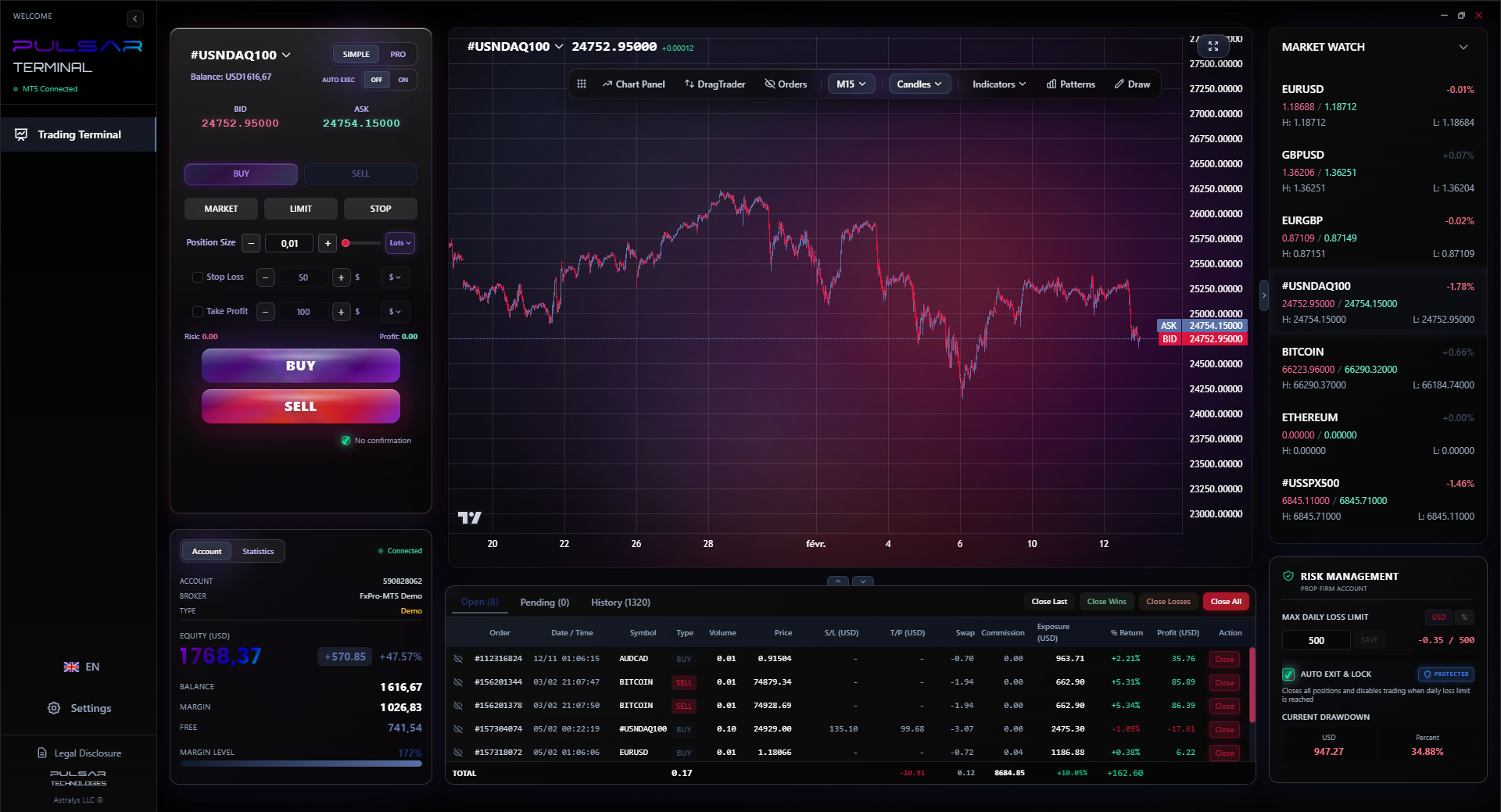
Managing trades across volatile session overlaps is stressful, but tools like Pulsar Terminal let you set multi-level take-profits and trailing stops directly on your MT5 chart, so you can bank profits automatically when the market moves.
Pulsar Terminal
The all-in-one MT5 companion: drag-and-drop orders, multi-TP/SL, trailing stop, grid trading, Volume Profile, and prop firm protection. Used by 1,000+ traders daily.
“Understanding the forex market hours clock is the ultimate form of risk management.”
Here's how a disciplined day might look for a part-time trader with a day job:
- 06:30 SAST: Wake up. Check charts briefly. The Tokyo session is active. No trading, just seeing if any planned levels from yesterday were hit. Maybe adjust a limit order.
- 10:00 - 12:00 SAST (London Morning): This is your first potential trading window. Look for setups that formed during the Asia session now reacting to London volume. Execute planned trades. Set stop-losses and take-profits.
- 12:00 - 15:00 SAST: Monitor. Maybe take a partial profit if a trade runs. Prepare for the New York open. Decide which positions, if any, you will hold through the volatility.
- 15:00 - 16:30 SAST (New York Open Storm): Be hyper-alert. This is often when I take profits. The initial burst of volatility is great for closing trades, dangerous for opening new ones unless you're very quick.
- After 17:00 SAST: Review. The market's character for the day is usually set. Either manage remaining swing trades or call it a day. Do not look for new, exciting setups after 19:00 SAST.
This plan respects the rhythm. It avoids the sleepy hours and the chaotic late New York session. It forces you to trade when the market offers the best conditions, not when you offer the most emotion.
, understanding the forex market hours clock is the ultimate form of risk management. It tells you when to be in the water and when to watch from the beach. Most blown accounts happen because traders ignore this simple, powerful truth. They trade when they're bored, not when the market is ready. Don't be that trader. Use your position size calculator, know your sessions, and let the clock work for you, not against you.
FAQ
Q1What is the most volatile time to trade forex in South Africa (SAST)?
Hands down, the London and New York session overlap from 15:00 to 19:00 SAST. This 4-hour window has the highest trading volume and the sharpest price movements. It's where you can make quick profits, but it's also where risk of loss is greatest. Always use strict stop-losses during this time.
Q2I have a day job. What is the best SAST time for me to trade?
The London morning session, from about 10:00 to 12:00 SAST, is your sweet spot. The market is active and directional, but not as manic as the New York open. You can plan trades before work and execute or manage them during a morning break. Avoid trying to trade in the evenings (after 19:00 SAST) as liquidity dries up.
Q3Should I trade when the forex market opens on Sunday night (00:00 SAST)?
Almost never. The Sunday open (Sydney session) is known for low liquidity, wide spreads, and unpredictable gaps. It's a professional's game to manage existing risk, not a retail trader's opportunity to find new trades. Wait at least until the Tokyo session is well underway (after 03:00 SAST).
Q4How do I know what session is currently active on my trading platform?
First, ensure your chart is set to SAST time. Then, look for session indicator tools (often available as free custom indicators for MT4/MT5) that shade the chart background. Alternatively, watch the trading volume bar indicator - it will visibly increase as London (10:00 SAST) and New York (15:00 SAST) open.
Q5Does the forex market hours clock change for South African Daylight Saving Time?
South Africa does not observe daylight saving time. Your SAST (GMT+2) remains constant throughout the year. However, sessions in other countries (like London and New York) do change. This means the London open will shift to 11:00 SAST during their summer (GMT+1), and the New York open to 16:00 SAST during their EDT period. Always double-check session times in March and November.
Q6Is it safe to leave trades open overnight in South Africa?
"Safe" is relative, but it carries specific risks. You'll incur swap fees. The main danger is the gap risk between the New York close (00:00 SAST) and the Tokyo/London open. News from Asia or Europe can cause the price to open significantly higher or lower, blowing through your stop-loss. If you must hold swings, use a smaller position size to account for this gap risk.
Prof. Winston's Lesson
Key Takeaways:
- ✓The 15:00-19:00 SAST overlap is peak danger and opportunity.
- ✓Sunday night (00:00 SAST) trading has 3-4 pip spreads on majors.
- ✓Set platform time to SAST to avoid analysis disasters.
- ✓Use the 10:00-12:00 SAST window for highest-probability setups.
How useful was this article?
Click a star to rate
Weekly Trading Insights
Free weekly analysis & strategies. No spam.
About the Author
David van der Merwe
Emerging Markets Trader
Johannesburg-based trader with 11 years in emerging market currencies. Specializes in ZAR pairs, FSCA-regulated trading, and South African market analysis.
Comments
Risk Disclaimer
Trading financial instruments carries significant risk and may not be suitable for all investors. Past performance does not guarantee future results. This content is for educational purposes only and should not be considered investment advice. Always conduct your own research before trading.
You Might Also Like

Cara Trading Forex Sukses: 7 Prinsip dari Trader Profesional
Cara trading forex sukses dengan 7 prinsip trader pro: manajemen modal, disiplin, journal trading, backtest. Data nyata, bukan janji profit palsu.
Jam Trading Forex Terbaik untuk Trader Indonesia: Panduan Lengkap dengan Tabel Waktu
Panduan jam trading forex untuk trader Indonesia. Tabel 4 sesi dunia, jam emas 20:00-00:00, sesi mana yang harus dihindari. Data akurat + tips dari trader berpengalaman.
Top 5 Sàn Forex Uy Tín Nhất 2026: Review Jujur dari Trader Indonesia
Top 5 sàn forex uy tín 2026 untuk trader Indonesia. Review jujur: spread, deposit, withdraw, dukungan lokal. Exness, XM, IC Markets & lebih.
Get Pulsar Terminal
All these calculators are built into Pulsar Terminal with real-time data from your MT5 account. One-click position sizing, automatic risk management, and instant calculations.
Get Pulsar Terminal