


Most forex strategy books are a complete waste of your Rand.

David van der Merwe
Emerging Markets Trader ·  South Africa
☕ 11 min read
What you'll learn:
- 1Why Most Forex Strategy Books Fail South African Traders
- 2The Books Actually Worth Your Time (And Money)
- 3Adapting Global Strategies to the South African Reality
- 4Building Your Own System From Book Concepts
- 5The Dark Side: 'Get Rich Quick' Scams Masquerading as Books
- 6From Reading to Execution: Your Action Plan
- 7The Final Word: Books Are Maps, Not the Territory
Most forex strategy books are a complete waste of your Rand. I've spent over R15,000 on them across 12 years, and 90% are either repackaged basics or dangerous fantasies. The real value isn't in finding a magic formula, it's in learning how to think. This guide will show you the handful of books worth reading, how to adapt their lessons to our unique market (hello, 30:1 use limits and ZAR pairs), and why the best strategy often comes from your own screen time, not someone else's pages.
Let's get this out of the way. The glossy cover promising 'Secrets of the Pros'? It's marketing. The problem isn't that the strategies inside are fake (though some are). The problem is context. A book written for a US trader with 50:1 use and 24/5 access to deep liquidity doesn't translate to a guy in Johannesburg trading after work with a 30:1 cap and dealing with local broker quirks.
I learned this the hard way. Early on, I bought a popular book on a 'foolproof' breakout strategy. It worked beautifully in the examples. I tried it on USD/ZAR. The spread was 50 pips during our session. The 'key level' breakout it described was eaten alive by slippage. I lost R800 in minutes trying to follow instructions written for EUR/USD's 0.9 pip spread.

Warning: Many strategy books use idealised, back-tested examples on major pairs like EUR/USD. They rarely account for the wider spreads, different volatility, and liquidity gaps you find with exotic pairs or when trading through local South African hours. Always test with a demo account that mimics your real broker's conditions.
The other big failure? Risk management. Books love to talk about 'risk 1-2% per trade.' Sounds simple. But they don't sit with you when you're down R5,000 for the month and that 2% feels like a joke. They don't factor in the psychological pressure of our high unemployment rate, where that trading capital might also be your safety net. Real strategy has to include mental management, and few books get into the gritty, emotional reality of losing real money.
A good forex strategy book should teach principles, not just paint-by-numbers setups. It should make you ask 'why' a setup works, so you can adapt the 'what' to your own situation.
After my library of disappointments, these are the few that earned a permanent spot on my desk. They're not about giving you a single strategy, but about building your trading brain.
1. 'Trading in the Zone' by Mark Douglas Forget indicators for a second. This is the most important book you'll ever read. It's about the psychology of probability. Douglas drills home that you can't control the market, only your reaction to it. This mindset is critical when trading ZAR pairs, which can be whipped around by local political news or SARB announcements. It taught me to stop blaming 'the book' or 'the broker' when a trade failed, and to look at my own decisions.
2. 'Market Wizards' Series by Jack D. Schwager This isn't a strategy book per se. It's interviews with legendary traders. The value is in seeing the diversity of successful approaches. One uses pure fundamentals, another only charts, another arbitrage. The lesson? There's no one right way. This helped me stop searching for the 'holy grail' and start developing my own edge, which eventually became a blend of price action and Volume Profile analysis.
3. 'The Daily Trading Coach' by Brett Steenbarger This is a practical workbook. 101 lessons about improving your performance. It's fantastic for the South African trader who might be isolated, without a mentor or trading community. It gives you structured exercises to work on discipline, focus, and overcoming fear - which is far more valuable than another indicator explanation.

Pro Tip: Don't buy these new. Check out Takealot's used section or look for PDFs. Save your capital for trading. The knowledge is what matters, not the pristine hardcover.
What about the classic 'technical analysis' tomes? Books like Murphy's Technical Analysis of the Financial Markets are good encyclopedias. Have one as a reference. But don't expect to read it and start printing money. It's a dictionary, not a novel.

💡 Winston's Tip
A book's strategy is a hypothesis. Your trading journal is the laboratory where you prove or disprove it. Never skip the experiment.
“Most forex strategy books are written for a market that doesn't exist on our shores.”
This is where the rubber meets the road. You read a great concept in a book. Now, how do you make it work here?
Factor 1: The FSCA's 30:1 use Cap
That book talking about 100:1 or 500:1 use? Throw that part away. Our 30:1 limit (for retail) changes position sizing dramatically. A common book formula might suggest a position size that, with high use, risks 5% of your account. At 30:1, that same trade might only risk 1.5%. You must recalculate everything using our use. Always use a position size calculator and input the correct use.
My Mistake: I once copied a carry trade strategy from a book. It relied on earning swap by holding a high-interest currency. The book's examples used massive use to amplify the small daily swap. At 30:1, the swap credit was a fraction of what was shown. It wasn't worth the market risk. The strategy was use-dependent and failed under our rules.
Factor 2: Trading ZAR Pairs (USD/ZAR, EUR/ZAR)
Books focus on majors. Trading USD/ZAR is a different beast.
- Spreads: Can be 10-50 pips vs. 0.8 for EUR/USD. A scalping strategy that requires 5-pip profits is dead on arrival. You need strategies that target 100+ pip moves.
- Volatility: Driven by local politics, commodity prices (platinum, gold), and SARB. A pure technical strategy from a book will get blindsided by a sudden MPC interest rate announcement.
- Liquidity: Thins out during certain hours. Your slick order book analysis from a book might not work as cleanly.
The Adaptation: Use the book's core idea - like trend following or mean reversion - but apply it to ZAR pairs with adjusted targets, wider stops, and a fundamental overlay. Check the economic calendar for SARB events religiously.
Factor 3: Broker Choice & Costs
Your broker's conditions are part of your strategy. That book's strategy might assume ECN-style execution with tiny spreads. If you're with a broker offering fixed spreads starting at 0.9 pips on majors (like some AvaTrade accounts), you need to factor that in. A strategy that scalps for 5 pips on EUR/USD is mathematically impossible if the spread eats most of that.
Compare brokers. For raw strategy implementation, an ECN broker like FP Markets or IC Markets with tight spreads might be better for active strategies. For beginners, a broker with a lower minimum deposit like XM or Exness lets you practice with less pressure.
Don't be a photocopier. Be a chef. Take ingredients from different books and create your own recipe.
Here's a simplified version of how I built mine:
- Foundation (From 'Trading in the Zone'): Accept that losses are part of the cost of doing business. My rule: No single trade can lose more than 1.5% of my account. Ever.
- Trend Identification (From various technical books): I use a simple 50 and 200-period EMA on the 4-hour chart to gauge the broader trend. I only take trades in the direction of the 4H trend. This filters out a lot of noise.
- Entry Signal (Adapted from price action books): I look for pullbacks to key support/resistance or the 20-period EMA on the 1-hour chart. My specific trigger is a rejection candle (pin bar or engulfing) at that level. This gave me a defined, testable entry.
- Risk Management (My own addition): Stop loss is placed just beyond the rejection candle. My take profit is set at a 1:2 risk-to-reward ratio minimum. I use a trailing stop after the price moves 1.5x my initial risk in profit.
The Backtesting Phase (Where Books Stop): I didn't trust it until I tested it. I went back over a year of USD/ZAR charts and manually logged what would have happened with 1.5% risk per trade. No fancy software, just a notebook. It showed a 55% win rate with an average winner being 2.2x the average loser. That was enough edge to try with real money.

Example: Starting with R10,000, risking 1.5% (R150) per trade. A losing trade = R9,850. A winning trade at 1:2 risk-reward = R10,330. After 10 trades with a 55% win rate, the math shows gradual growth. It's not glamorous, but it's sustainable.
This system isn't from one book. It's a fusion. Your job is to do the same: find concepts that resonate with your personality (are you patient? Then maybe swing trading from books). Test them ruthlessly on South African broker demo accounts.
💡 Winston's Tip
The most expensive book is the one that makes you overconfident. The cheapest lesson is the one learned from a small, controlled loss.
“Your unique strategy is waiting to be built, not bought.”
South Africa is a fertile ground for trading scams. They often start with a flashy 'free ebook' that leads to a 'mentorship' costing R20,000. Here's how to spot the garbage:
- Promises Specific, Crazy Returns: 'Make R5,000 daily with this simple method!' If it was that simple and reliable, the author would be on a private island, not selling ebooks for R500.
- Overly Complex Jargon: They invent fancy names for simple ideas to sound exclusive. 'Quantum Entanglement Trading'... it's probably just support and resistance.
- Requires Their Specific Broker or Software: Huge red flag. This is often a sign they're getting a kickback, or the broker is dodgy. A real strategy should work on any decent platform like MetaTrader.
- No Discussion of Risk or Losses: Every real trading book spends chapters on risk. Scam 'books' gloss over it. They'll show you charts of winning trades only.
I got sucked into one early on. The book was cheap, but the 'secret indicator' came only with a R1,500 monthly subscription to a signal service. The signals were late and terrible. I lost more on the following trades than I spent on the whole scam. It was a painful, but cheap, lesson compared to some who lose tens of thousands.
Stick to the established, critically-acclaimed authors. If a 'guru' is more active on Instagram showing off cars than discussing drawdown, run.
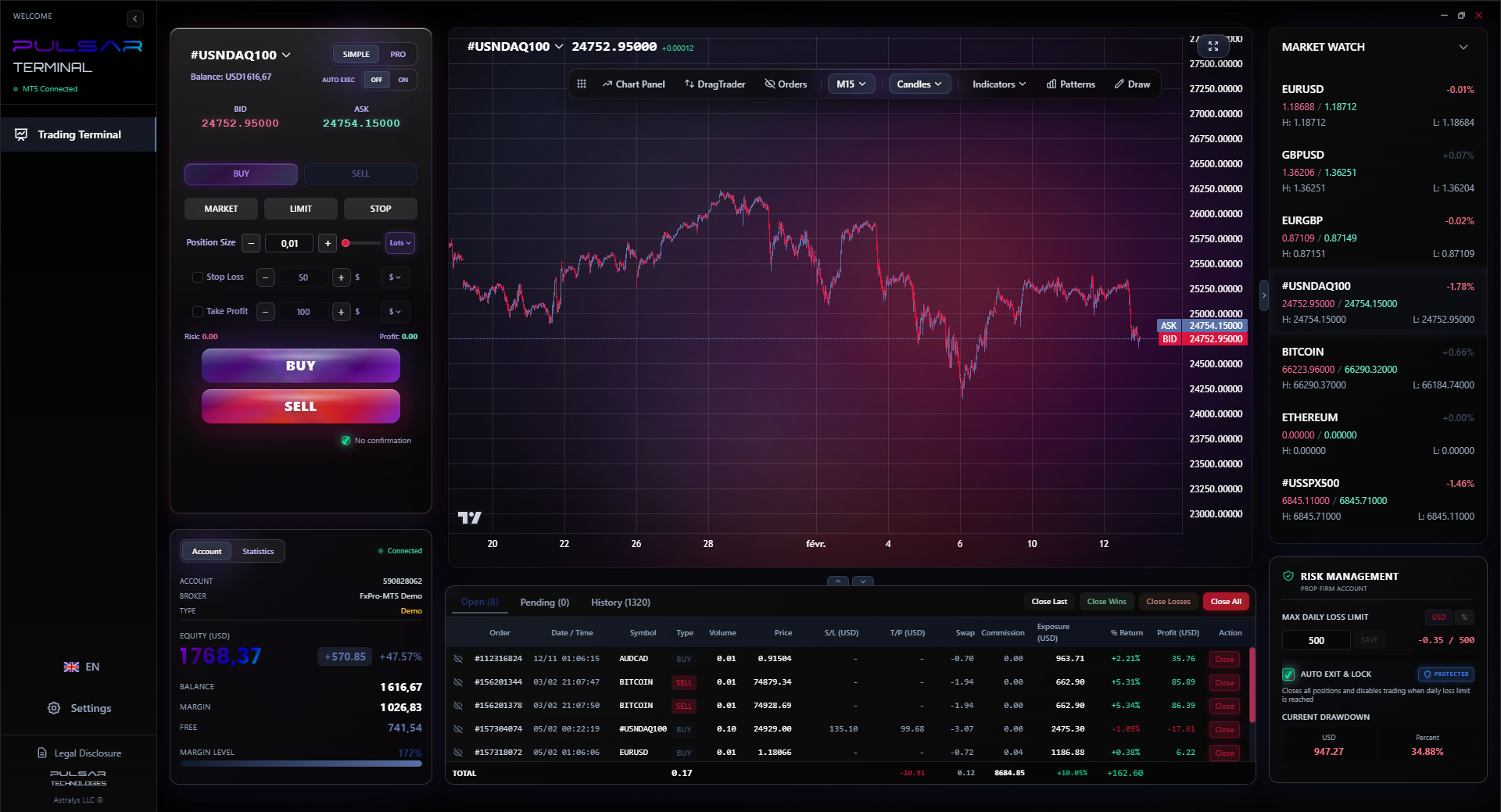
Manually testing and adjusting strategies from books is time-consuming; Pulsar Terminal's drag-and-drop order tools and automated trailing stops let you execute and manage those refined ideas on MT5 in seconds.
Pulsar Terminal
The all-in-one MT5 companion: drag-and-drop orders, multi-TP/SL, trailing stop, grid trading, Volume Profile, and prop firm protection. Used by 1,000+ traders daily.
Okay, you've got a good book. Now what?
- Read With a Highlighter & Notebook: Don't just read. Interact. Write down questions. 'How would this work on Gold?' 'Does this need high use?'
- Open a Demo Account Immediately: Pick a reputable broker that serves South Africa (like Pepperstone or IC Markets). Don't use unlimited fantasy money. Fund your demo with R20,000, a realistic starting amount.
- Isolate One Concept: Don't try the whole system at once. Just test the entry method for a week. Then just test the exit rules. Then combine them.
- Journal Religiously: For every demo trade, note: Date, Pair, Strategy Concept from Book, Entry, Stop Loss, Take Profit, Outcome, and most importantly - How You Felt. Did you panic and close early? This journal is your true education.
- Graduate to Small Live Capital: Once your demo journal shows consistency over 2-3 months (not just profit, but discipline), start small. Deposit R1,500-R5,000. Trade the smallest possible position size (0.01 lots). The goal here is not to make money, but to survive the emotional shift from demo to real. The spread, the slippage, the heart-pounding - it's all real now.
This process turns book theory into lived experience. It's slow. It's boring. It's the only way that works.
💡 Winston's Tip
If a strategy doesn't account for the spread, it's a theory, not a plan. Your broker's costs are part of your strategy's DNA.
“The map isn't the jungle. The live chart with your money on the line is the jungle.”
The best forex strategy books are like maps drawn by old explorers. They show you where the mountains and rivers might be, the general direction to travel. But the map isn't the jungle. The jungle is the live USD/ZAR chart at 3 PM when a news headline hits. Your sweat, your shaky hand, your decision to hold or fold - that's the territory.
Books gave me the concepts, but screen time gave me the instinct. They taught me what a MACD divergence was, but watching it fail 60% of the time taught me when to ignore it. They taught me to cut losses, but a real margin call on an over-leveraged gold trade (XAU/USD) taught me to fear use.
Invest in a few good books. Then invest ten times more in your own practice, your own journal, and your own emotional education. Your unique strategy - the one that fits your risk tolerance, your schedule, and the South African market - is waiting to be built, not bought.
FAQ
Q1What is the single best forex strategy book for a complete beginner in South Africa?
For a complete beginner, I'd recommend starting with 'A Beginner's Guide to Forex Trading' by Matthew Driver (it has a South African perspective) paired with 'Trading in the Zone' by Mark Douglas. The first gives you the local mechanics and rules, the second builds the essential mindset you'll need to survive. Don't jump into complex strategy books until you understand how a pip works and why psychology is 80% of the game.
Q2Are the strategies in books illegal under FSCA rules?
No, the strategies themselves aren't illegal. The FSCA regulates brokers and their conduct, not trading methodologies. However, applying a strategy might break FSCA rules if it requires use above the 30:1 retail limit. You are responsible for ensuring your trading complies with local use and tax laws. A book suggesting 400:1 use is giving advice illegal for you to follow as a South African retail client.
Q3How much money do I need to start testing strategies from books?
To test properly with real money? At least R1,500-R5,000 with a broker that allows micro or cent lots (0.01). This lets you experience real emotions and costs without catastrophic risk. For example, with R2,000, risking 1.5% is R30 per trade. On a 0.01 lot of USD/ZAR, a 30-pip stop loss equals about R3.00 risk per pip, so you'd set a 10-pip stop. It's tight, but it forces precision. Always use a demo account first for pure strategy testing.
Q4Can I make a living using strategies from books?
It's highly unlikely from one book alone. Making a living requires a strong, personalized system, immense discipline, and significant capital. The average income figures (R10k-R50k+ for experienced traders) are for those who've built their own edge over years. A book might give you a component of a system, but it won't give you the consistency, emotional control, or capital management needed for sustainable income. Treat it as learning a skill, not a ticket to quit your job.
Q5Do I need to buy the latest edition of a trading book?
Almost never. The core principles of psychology, risk, and technical analysis in the classics haven't changed. A 2005 edition of 'Market Wizards' is just as valid. What changes are regulations (like our 30:1 use, implemented in 2021) and market structure (like the rise of retail broker apps). You can learn the timeless principles from an old, cheap copy and then learn the current South African context from online FSCA resources and broker websites.
Q6How do I know if a strategy from a book will work on USD/ZAR?
You must forward-test it. Take the core rule (e.g., 'buy when the RSI crosses above 30 on the daily chart'). Apply that rule without modification to a year of past USD/ZAR data on your demo platform. Write down every signal and its result. Calculate the win rate and average win/loss. If the strategy requires a 10-pip stop loss but USD/ZAR's average daily range is 500 pips, it will fail. Adapt the parameters (wider stop, bigger target) and test again. The chart tells you the truth the book can't.
Prof. Winston's Lesson
Key Takeaways:
- ✓Test every book strategy with a 30:1 use cap in mind.
- ✓Spend 10x more time testing than reading.
- ✓Adapt ZAR pair targets for 100+ pip moves, not 10.
- ✓A R150 notebook for your journal is a better investment than a R1500 'secret' manual.
How useful was this article?
Click a star to rate
Weekly Trading Insights
Free weekly analysis & strategies. No spam.
About the Author
David van der Merwe
Emerging Markets Trader
Johannesburg-based trader with 11 years in emerging market currencies. Specializes in ZAR pairs, FSCA-regulated trading, and South African market analysis.
Comments
Risk Disclaimer
Trading financial instruments carries significant risk and may not be suitable for all investors. Past performance does not guarantee future results. This content is for educational purposes only and should not be considered investment advice. Always conduct your own research before trading.
You Might Also Like

Cara Trading Forex Sukses: 7 Prinsip dari Trader Profesional
Cara trading forex sukses dengan 7 prinsip trader pro: manajemen modal, disiplin, journal trading, backtest. Data nyata, bukan janji profit palsu.
Jam Trading Forex Terbaik untuk Trader Indonesia: Panduan Lengkap dengan Tabel Waktu
Panduan jam trading forex untuk trader Indonesia. Tabel 4 sesi dunia, jam emas 20:00-00:00, sesi mana yang harus dihindari. Data akurat + tips dari trader berpengalaman.
Top 5 Sàn Forex Uy Tín Nhất 2026: Review Jujur dari Trader Indonesia
Top 5 sàn forex uy tín 2026 untuk trader Indonesia. Review jujur: spread, deposit, withdraw, dukungan lokal. Exness, XM, IC Markets & lebih.
Get Pulsar Terminal
All these calculators are built into Pulsar Terminal with real-time data from your MT5 account. One-click position sizing, automatic risk management, and instant calculations.
Get Pulsar Terminal