


Let me be straight with you: 95% of the 'forex trading pdf' files you download are complete rubbish, especially for an Indian trader.

Rajesh Sharma
Senior Forex Analyst ·  India
India
☕ 11 min read
What you'll learn:
- 1The Indian Forex Reality Check: What You Can Actually Trade
- 2Why Most Forex PDFs Fail You (And What to Look For Instead)
- 3Brokers, Costs, and the Funding Maze
- 4Building Your Own Indian Trader Toolkit (Forget the PDF)
- 5From Theory to Practice: A Trade Walkthrough
- 6The Future of Forex Education in India
- 7Final Verdict: Your Action Plan
Let me be straight with you: 95% of the 'forex trading pdf' files you download are complete rubbish, especially for an Indian trader. They're either generic copy-paste jobs from 2010 or they completely ignore the legal minefield we have to walk through here. I've wasted more hours than I care to admit on PDFs promising 'secret strategies' that just blew up my account. This guide isn't another PDF. It's the real talk you need about what you can actually trade, how to find useful information in a sea of junk, and how to do it without getting on the wrong side of the RBI. I'll prove that the right knowledge, tailored to our market, beats any downloaded 'holy grail' system.
Before you even think about strategies or PDFs, you need to understand the playing field. It's not the wild west you see on YouTube. In India, forex trading is legal, but with handcuffs on. The Reserve Bank of India (RBI) and SEBI call the shots under the Foreign Exchange Management Act (FEMA).
Here’s the crucial bit most of those fancy PDFs forget to mention: as a retail trader, you're generally only allowed to trade currency pairs that involve the Indian Rupee (INR) on SEBI-regulated exchanges like the NSE or BSE. We're talking USD/INR, EUR/INR, GBP/INR, and JPY/INR. That's your main legal sandbox.
Now, you'll hear whispers about trading EUR/USD or GBP/USD. Some sources say it's allowed on Indian exchanges. The hard truth? Trading major pairs like EUR/USD through an offshore, international broker exists in a massive grey area. It's not explicitly endorsed, and using an unregulated platform is a surefire way to have your funds frozen. I learned this the hard way early on, trying to fund an obscure offshore account. The bank transfer was blocked, and I got a very uncomfortable call from my bank manager asking about 'international remittances for speculative purposes.' Not fun.

Warning: Downloading a 'forex trading pdf' that teaches you to trade AUD/JPY or USD/CAD is pointless for an Indian beginner. You might not even have a legal way to execute those trades. Always check the instrument first.
There is one legal loophole, and it's a big one: GIFT City. The RBI's Liberalised Remittance Scheme (LRS) lets you fund an account with a broker registered in the International Financial Services Centre (IFSC) at GIFT City. This is your ticket to legally trade global markets. It's the exception, not the rule, but it's a game-changer for serious traders wanting exposure beyond INR pairs.
“95% of the 'forex trading pdf' files you download are complete rubbish, especially for an Indian trader.”
So, why are most forex trading PDFs a waste of bandwidth? They suffer from three fatal flaws.
First, they're never location-specific. A PDF written for an American trader with access to 50+ pairs and 1:50 use is worse than useless for you. It sets completely wrong expectations about costs, available instruments, and even trading hours (our market depth for INR pairs has its own rhythms).
Second, they're obsessed with 'magic indicator' systems. You know the ones: "Just follow this one red line and become a millionaire!" I fell for this. I bought a PDF for $50 that was basically just a rehash of the RSI indicator with some arbitrary levels drawn on it. I followed it religiously on USD/INR futures, and it worked... until it didn't. A sudden RBI intervention news spike blew straight through my 'guaranteed' RSI level and triggered a nasty margin call. I lost about ₹40,000 in minutes learning that no PDF strategy accounts for real-world market shocks.
Third, they ignore psychology and money management. This is the biggest sin. The best PDF in the world won't help if you don't know how to size your positions. I never saw a single downloaded guide that included a proper position size calculator or talked about the emotional rollercoaster of a losing streak.
What a Useful Resource Actually Contains
A good guide, whether a PDF or an article, should do these things:
- Acknowledge your jurisdiction: It should start with the legal framework for your country.
- Focus on core principles: Price action, support/resistance, risk-reward ratios. Not secret formulas.
- Include real, local numbers: Talk about typical spreads on USD/INR (which can widen significantly around market opens and news), contract sizes on the NSE, and transaction costs.
- Teach process over prediction: How to plan a trade, where to place a stop-loss, how to review your mistakes. My own turn-around started when I stopped looking for the 'next trade' and started journaling my last ten.

Pro Tip: Instead of searching for 'forex trading pdf', search for 'USD/INR trading guide' or 'NSE currency derivatives tutorial'. You'll find material actually relevant to your accessible market. The EUR/USD guide on our site, for instance, explains core concepts that can be applied to any pair, but you must adapt the context to INR.

💡 Winston's Tip
A PDF is a snapshot of a market that no longer exists. Your education must be a flowing river, not a stagnant pond. Read yesterday's RBI bulletin before you look at today's chart.
“Your first job is to earn back the transfer and conversion fees before you see real profit.”
This is where theory meets your wallet. Your choice of broker and how you fund your account will eat into your profits before you even place a trade.
For trading the legal INR pairs (USD/INR, etc.), you'll use a SEBI-regulated domestic broker. Think Zerodha, Upstox, Angel One, ICICI Direct. They're solid, safe, and integrate seamlessly with your bank. The trading happens on Indian exchanges, so it's fully above board. The platforms might feel less flashy than MT5, but they're reliable.
If you're considering the global route (via GIFT City or, cautiously, through international brokers), the landscape changes. Here, brokers like IC Markets or Pepperstone are popular for their tight spreads on majors. But you must understand the costs.
Let's break down a real example from my trading last month. I took a swing trading position on XAU/USD (gold) through an international broker.
- Spread: 0.34 pips on entry. Seems low, right?
- Commission: $7 per lot, round turn. My 0.5 lot position cost $3.5 in commissions.
- Payment Fee: To fund the account, I used a transfer service. Even at a 'low' 1.6% fee, depositing $1000 cost me $16 just to get the money there.
- Hidden Cost: The currency conversion from INR to USD. The bank gave me a rate 0.8% worse than the mid-market rate. Another $8 gone.
So, before my trade could even move 1 pip, I was down about $27.5 (over ₹2,200) in combined costs. That trade needed to make 2.75% just to break even on costs alone. Most PDFs never mention this attrition.

Example: Funding $1000 to an international broker.
- Transfer fee (1.6%): $16
- Poor FX conversion (0.8%): $8
- Total immediate loss: $24 (₹2,000) Your first job is to earn this back before you see real profit.
Payment methods matter. UPI is king for domestic brokers - instant and free. For international, specialized RBI-licensed platforms can be cheaper than PayPal or Wise for larger amounts, but you need to shop around. Always factor these costs into your profitability calculations.
“Your first job is to earn back the transfer and conversion fees before you see real profit.”
Stop looking for a single document that has all the answers. Build your own toolkit from credible, ongoing sources.
- Regulatory Websites: Bookmark the SEBI and RBI FAQs on forex. This is your non-negotiable base layer of truth. Their warnings are boring but will save you from existential crises.
- Market Analysis Platforms: Use TradingView to chart USD/INR. Follow Indian financial news outlets like Moneycontrol or Economic Times for RBI policy announcements, which move the INR like nothing else. I once caught a 150-pip move in USD/INR simply because I was reading the RBI monetary policy statement as it was released.
- Broker Education Hubs: Reputable brokers like XM or Exness have extensive, free educational sections. These are often better than paid PDFs because they're updated and cover basics like platform navigation, order types, and fundamental analysis.
- A Solid Trading Journal (Not a PDF): This is your most important tool. Use a simple Google Sheet. Record every trade: entry/exit, reason based on your plan, emotional state, and a screenshot. My journal revealed I lost 70% of my trades taken after 10 PM IST - I was tired and impulsive. Fixing that one habit saved my account.
- Community with Caution: Find forums or groups focused on Indian trading. The discussions about tax implications (yes, your profits are taxable), funding issues, and broker experiences are gold. Avoid the global 'get rich quick' rooms.
The core of your strategy should be simple. Learn to identify key support and resistance on the USD/INR chart. Understand how to use a basic indicator like the MACD indicator for trend confirmation, not prediction. Start with a microscopic position size. The scalping strategy you read about might need serious adjustment for the sometimes-chunky spreads in our market.
💡 Winston's Tip
The most valuable number in your trading isn't your profit target. It's your calculated cost of doing business. If you don't know it to the paisa, you're not a trader, you're a gambler.
“No PDF gave me that exact setup. The principles of trend, support, and risk management did.”
Let's make this concrete. Here's a recent, real trade I took on USD/INR futures, not from a PDF, but from applying basic principles.
The Setup (Early March 2026): USD/INR had been in a steady uptrend (dollar strengthening). It pulled back to a clear support level that had previously acted as resistance (a classic 'role reversal' zone) around 83.20. The broader trend was still up.
My Plan:
- Entry: Buy limit order at 83.22, waiting for the pullback to reach support.
- Stop Loss: 83.07. This was below the recent swing low, giving the trade room to breathe. This risked 15 paise (pips).
- Take Profit: 83.45. This was near the previous high, offering a risk-reward ratio of roughly 1:1.5 (23 paise profit / 15 paise risk).
- Position Size: I used my position size calculator. With a ₹100,000 account and risking only 1% (₹1,000), and a stop-loss of 15 paise, I could buy 4 lots (since 1 paise move = ~₹0.50 per lot in the futures contract I was using).
The Execution: The price hit my entry. I was filled at 83.22. My stop and target were set immediately. I didn't sit and watch it. The trade took two days to play out. It wobbled a bit, came within 5 paise of my stop, then rallied and hit my take-profit at 83.45.
The Result:
- Profit: 23 paise.
- Value: 23 paise * ₹0.50 per paise per lot * 4 lots = ₹46.
- After brokerage and taxes (STT, etc.), net was about ₹41.
Not a fortune, right? But it was a professional trade. Planned, executed, and managed with zero emotion. That's the takeaway. No PDF gave me that exact setup. The principles of trend, support, and risk management did. I've had losses with the same process, but they're controlled and don't hurt the account. That's how you survive.
“No PDF gave me that exact setup. The principles of trend, support, and risk management did.”
Where do we go from here? The era of the static 'forex trading pdf' is ending, especially for regulated markets like ours. Education is becoming dynamic.
Look for interactive courses that include quizzes on FEMA regulations. Video tutorials that show the exact steps to place an order on the NSE platform or fund a GIFT City account are infinitely more valuable than a 100-page text doc. Webinars hosted by SEBI-registered analysts who discuss INR volatility around budget announcements or RBI meetings are the real 'insider' knowledge.
The tools are also evolving. It's not just about MT4 anymore. Advanced charting, trade automation, and risk management are getting integrated. Managing multiple take-profits and stop-losses on a fast-moving pair like EUR/INR can be clunky on a basic platform.
Pro Tip: Your education should be a living thing. Subscribe to a few quality market analysis feeds. Re-read the basics of risk management every six months. Your biggest enemy isn't a lack of a secret PDF; it's forgetting the fundamentals when you're on a winning or losing streak.
💡 Winston's Tip
Your first profitable trade is your most dangerous teacher. It makes you believe you've solved the market. Your 50th losing trade, analyzed without ego, is the one that might actually teach you something.
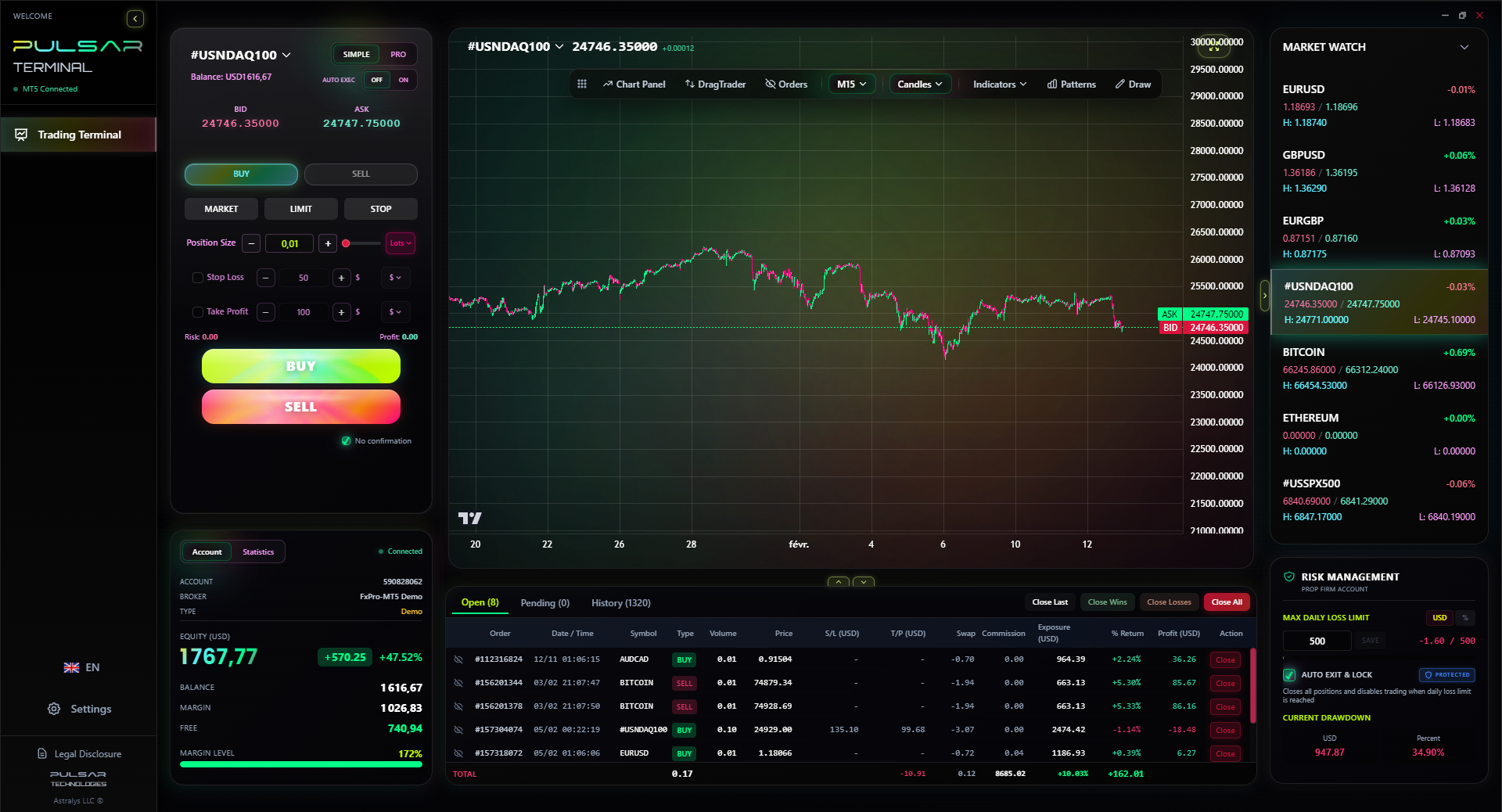
Executing a disciplined trade plan with multiple take-profit levels on USD/INR is complex, but tools like Pulsar Terminal simplify it with drag-and-drop order management directly on your MT5 chart.
Pulsar Terminal
The all-in-one MT5 companion: drag-and-drop orders, multi-TP/SL, trailing stop, grid trading, Volume Profile, and prop firm protection. Used by 1,000+ traders daily.
“The era of the static 'forex trading pdf' is ending. Education is becoming dynamic.”
So, should you download another forex trading pdf? Probably not. Here’s what you should do instead, today:
- Legal Audit: Decide your path. Will you trade only INR pairs domestically? Or explore GIFT City for global access? Choose one and research its rules thoroughly. This is step zero.
- Broker Setup: Open a demo account with a SEBI-regulated broker (for INR) and a reputable international broker (like IC Markets or XM) to compare platforms. Practice for at least three months. I don't care how smart you are, you need the screen time.
- Learn One Thing Deeply: Don't try to learn 10 strategies. Pick one concept - like trading pullbacks in a trend - and study only that for a month. Use your demo account to test it hundreds of times.
- Calculate Real Costs: Before going live, do a mock deposit. Calculate all the fees - transfer, conversion, spreads, commissions - and see how much your trade needs to make to be profitable. It's a sobering exercise.
- Start Absurdly Small: When you go live, trade with money you can afford to lose 100% of. Your goal for the first year is not to get rich. It's to not blow up. A 5% annual return while preserving capital is a massive success.
The PDFs sell a fantasy. The reality for an Indian trader is a disciplined, regulated, and often frustrating grind. But it's a real grind you can actually succeed in if you swap the search for secrets with a commitment to sound, localized practice. Now close those download tabs and go look at a USD/INR chart. That's where your real education begins.
FAQ
Q1Is it legal to download and use forex trading PDFs from international websites in India?
Yes, downloading educational material is perfectly legal. The problem isn't the PDF itself, but the advice inside. If it teaches you to trade instruments you can't legally access (like exotic pairs through unregulated brokers), following it could lead you to illegal activity. Always filter the information through the Indian regulatory lens.
Q2What is the single most important thing missing from most forex PDFs for Indian traders?
Local context. They never mention the Foreign Exchange Management Act (FEMA), the restricted list of INR pairs, the tax implications (like the 10% to 30% on capital gains), or the real cost of funding an international account. A strategy that works with 1:500 use on EUR/USD is a fantasy when your legal use on Indian exchanges is much lower or your funding costs are 2-4%.
Q3Can I use a strategy from a PDF for trading USD/INR?
You can use the core principles (like support/resistance, trend following), but you must adapt it. USD/INR is heavily influenced by RBI intervention, oil prices (India's imports), and domestic politics. Its volatility patterns and spread behavior are unique. A pure technical strategy from a PDF will fail if it doesn't account for these fundamental drivers specific to the INR.
Q4Are there any good, free PDFs or resources tailored for Indian forex traders?
The best free resources aren't PDFs. They are the investor education sections on SEBI's website and the knowledge centers of major Indian stockbrokers like Zerodha Varsity. These are tailored, updated, and legally sound. For global concepts, the educational hubs of major international brokers (like Pepperstone or FP Markets) are excellent, but remember to mentally 'translate' the examples to your Indian context.
Q5How much money do I realistically need to start forex trading in India?
For trading USD/INR futures on the NSE, the margin required can start from around ₹8,000-₹15,000 per lot. However, you should never start with just the minimum margin. Have at least ₹50,000-₹1,00,000 in your trading account to allow for proper position sizing and to withstand normal losses without immediate pressure. If using international/GIFT City route, brokers like XM allow starts at $5, but with fees, a realistic start is $200-$500 (₹16,000-₹40,000).
Q6What's a bigger risk: a bad strategy or a bad broker?
For an Indian trader, a bad broker is a catastrophic risk. A bad strategy will lose you money slowly. An unregulated or shady broker can lose you all your money instantly (via fraud, freezing withdrawals, or platform manipulation) and potentially get you into legal trouble with the RBI. Always, always prioritize a broker's regulatory status (SEBI for domestic, top-tier like ASIC/FCA for international) over slightly lower spreads or higher use.
Prof. Winston's Lesson
Key Takeaways:
- ✓Legal framework first: Know FEMA and SEBI rules.
- ✓Costs kill: Factor in every fee before trading.
- ✓Trade the chart you have (USD/INR), not the one you wish you had (EUR/USD).
- ✓Process over prediction: Journal every trade.
- ✓Start small. Survival year one is a victory.
How useful was this article?
Click a star to rate
Weekly Trading Insights
Free weekly analysis & strategies. No spam.
About the Author
Rajesh Sharma
Senior Forex Analyst
Trading Indian and South Asian markets for over 10 years. Started with NSE currency derivatives before moving to international forex. Specializes in USD/INR and emerging market pairs.
Comments
Risk Disclaimer
Trading financial instruments carries significant risk and may not be suitable for all investors. Past performance does not guarantee future results. This content is for educational purposes only and should not be considered investment advice. Always conduct your own research before trading.
You Might Also Like

Cara Trading Forex Sukses: 7 Prinsip dari Trader Profesional
Cara trading forex sukses dengan 7 prinsip trader pro: manajemen modal, disiplin, journal trading, backtest. Data nyata, bukan janji profit palsu.
Jam Trading Forex Terbaik untuk Trader Indonesia: Panduan Lengkap dengan Tabel Waktu
Panduan jam trading forex untuk trader Indonesia. Tabel 4 sesi dunia, jam emas 20:00-00:00, sesi mana yang harus dihindari. Data akurat + tips dari trader berpengalaman.
Top 5 Sàn Forex Uy Tín Nhất 2026: Review Jujur dari Trader Indonesia
Top 5 sàn forex uy tín 2026 untuk trader Indonesia. Review jujur: spread, deposit, withdraw, dukungan lokal. Exness, XM, IC Markets & lebih.
Get Pulsar Terminal
All these calculators are built into Pulsar Terminal with real-time data from your MT5 account. One-click position sizing, automatic risk management, and instant calculations.
Get Pulsar Terminal