


I lost $4,200 in a single morning back in 2015.
Sarah Collins
Trading Strategist ·  Australia
☕ 10 min read
What you'll learn:
- 1Why Trading Forex in Australia is a Different Beast
- 2The AUD Pairs Worth Your Time (And the Ones to Avoid)
- 3Building Your Core Australian Forex Trading Strategy
- 4Risk Management: The 30:1 use Reality Check
- 5The Nuts and Bolts: Brokers, Platforms, and the ATO
- 6Classic Aussie Trader Mistakes I've Made (So You Don't Have To)
- 7Putting It All Together: A Week in the Life

I lost $4,200 in a single morning back in 2015. It was a classic 'Aussie Battler' setup. The AUD/USD had been grinding higher on iron ore hype, and I went long just before the Chinese GDP data. The number missed, the pair tanked 80 pips in seconds, and my stop-loss got filled at a horrible price thanks to slippage. That's the reality of trading the Australian dollar from Australia. It's not just about charts, it's about understanding what moves our currency, trading around our timezone, and picking your fights. Let's talk about how to build a forex trading strategy in Australia that actually works.
Forget what you read about trading the London open or the New York session. If you're sitting in Sydney or Melbourne, your prime trading hours are different, and the instruments that matter are different. Your forex trading strategy in Australia needs to account for this from day one.
The Asian session is your home turf. Liquidity is decent from 7 am AEST, when Tokyo gets going, through to the afternoon when Europe starts to wake up. This is when AUD, JPY, and NZD pairs are most active. The big moves on EUR/USD often happen when you're having dinner or are asleep. Trying to chase them is a recipe for fatigue and bad decisions.
Then there's the 'Commodity Dollar' factor. The AUD isn't just a currency, it's a proxy trade on China's economy, iron ore, coal, and copper. A headline about Chinese factory data can move the AUD/USD faster than any RSI divergence. I've seen it wipe out careful technical setups in minutes. You have to be aware of the economic calendar for China and key commodity prices. It's non-negotiable.
Finally, our regulatory environment with ASIC is strong, which is good for safety, but it also means use is capped (30:1 for major pairs for retail clients). This changes your position size calculator math dramatically compared to traders in other jurisdictions. You can't just throw around huge use and hope for the best. Your strategy must be built on precision, not power.
“The Asian session is your home turf. The big moves on EUR/USD often happen when you're having dinner or are asleep.”
Not all AUD pairs are created equal. Some are liquid and predictable, others are widow-makers. Here’s my breakdown from over a decade of watching them.
The Majors: AUD/USD & AUD/JPY
AUD/USD is the main event. It's highly liquid, has tight spreads with good brokers like IC Markets, and reacts cleanly to data. It's your best canvas for any strategy. AUD/JPY is the 'risk sentiment' pair. When global markets are happy, it rallies. When fear hits, it drops like a stone. It's fantastic for swing trading based on broader market themes, but the spreads can be wider.
The Crosses: AUD/NZD & AUD/CAD
AUD/NZD is the 'trans-Tasman tussle'. It's often range-bound and can be great for mean-reversion strategies. You need to understand the subtle differences between the RBA and RBNZ. AUD/CAD is the 'commodity clash'. Both are resource-driven, so it often trends based on relative economic performance. It moves slower, which some traders prefer.
The Trap: EUR/AUD
I'm putting this here as a warning. EUR/AUD is volatile, often has wide spreads, and is influenced by two complex, divergent economies. It's a great way to lose money quickly if you're not an expert. I'd avoid it until you have significant experience.

Warning: Many new traders are drawn to exotic pairs like AUD/SGD or AUD/CNH for the 'big moves'. The spreads are enormous, liquidity is poor, and you'll get eaten alive by costs. Stick to the majors and common crosses.
Here’s a quick comparison table:
| Pair | Typical Spread (IC Markets) | Best For | Risk Level |
|---|---|---|---|
| AUD/USD | 0.1 - 0.3 pips | All strategies, news trading | Low |
| AUD/JPY | 0.5 - 1.2 pips | Swing trading, risk sentiment | Medium |
| AUD/NZD | 1.0 - 2.0 pips | Range trading, carry trade | Medium |
| EUR/AUD | 1.5 - 3.0 pips | Experienced trend traders only | High |

💡 Winston's Tip
The AUD doesn't care about your beautiful trendline. It cares about the price of the stuff we dig out of the ground. Always know the last close for iron ore.
“ASIC's 30:1 use limit is your best friend and your biggest constraint. It forces discipline.”
Your strategy needs to fit your life. Are you a full-time trader or doing this before your 9-5 job? Here are two frameworks that work for the Aussie context.
The Asian Session Momentum Strategy
This is my bread and butter. It fits the 7 am - 12 pm AEST window perfectly.
- Set Up: At 6:45 am AEST, I check the 1-hour and 15-minute charts for AUD/USD and AUD/JPY. I'm looking for clear support/resistance levels from the previous US session.
- Trigger: I wait for the first 30-60 minutes of the Tokyo session (7 am AEST) to see where price settles. A strong break of an Asian session high or low with increasing volume is my signal.
- Entry/Exit: I enter on a retest of the broken level. My stop-loss goes just on the other side. I aim for a 2:1 risk/reward ratio. For a 20-pip risk, I want 40 pips profit.
- Example: On March 15th, AUD/USD broke above 0.6660 in the first hour. It pulled back to 0.6657. I went long at 0.6658, SL at 0.6638, TP at 0.6698. It hit my target by 11 am AEST. A clean, 2-hour trade.
The End-of-Day Swing Setup
For those who can't watch screens all day. This uses the 4-hour and daily charts.
- Analysis Time: I do this after 5 pm AEST, once the European session is established and the US session is starting.
- The Filter: I only look for trades where there's alignment between a key daily support/resistance level and a 4-hour chart pattern (like a pin bar or a bullish/bearish engulfing candle).
- The Trade: I place a pending order to enter on a confirmation of the 4-hour pattern. The stop is wide (50-80 pips) because it's a swing trade, but my position size is much smaller. I'm aiming for 150-300 pip moves over several days.

Pro Tip: Whichever strategy you use, combine a trend indicator (like the MACD indicator on the 1-hour) with price action. If MACD is bullish and price is bouncing off support, your long trade has a much higher probability. Never rely on just one thing.

“ASIC's 30:1 use limit is your best friend and your biggest constraint. It forces discipline.”
ASIC's 30:1 use limit is your best friend and your biggest constraint. It forces discipline. Here’s how to manage risk in this environment.
First, your position size is everything. With lower use, you need to be more aggressive with your stop-loss placement to free up margin, but not so aggressive that you get stopped out by noise. It's a tightrope. I never risk more than 1% of my account on a single trade. On a $10,000 account, that's $100. If my stop-loss is 25 pips away on AUD/USD, my position size is $100 / (25 * $10 per pip) = 0.4 lots. Use a position size calculator every single time.
Second, understand margin call dynamics. With 30:1, your margin requirement is about 3.33%. If your trades go against you, you'll hit a margin call faster than you think if you're over-leveraged. Keep your total margin used below 50% of your account balance.
A personal lesson: In 2018, I got cocky. I had three concurrent swing trades open (AUD/USD, AUD/JPY, XAU/USD), each with a 1% risk. A sudden risk-off event hit all three. My total drawdown hit 2.8% in a day. It wasn't a disaster, but it was a stark reminder that correlated pairs can blow up your risk model. Now, I treat all AUD pairs as highly correlated and adjust my total exposure accordingly.
💡 Winston's Tip
Your first job at 7 am isn't to find a trade. It's to not lose money for the first hour. Let the market show its hand.

“The carry trade is a bonus, not a strategy. Never go long AUD/JPY just for the swap.”
The boring stuff that will save your bacon.
Choosing a Broker
You want an ASIC-regulated broker with tight spreads on AUD pairs and reliable execution. I've used most of them. Pepperstone and IC Markets are consistently excellent for raw spreads and Razor/MetaTrader 4/5 accounts. Exness is also solid, though their ASIC entity has the same use limits. Avoid offshore brokers offering 500:1 use. The temptation isn't worth the counterparty risk.
Trading Platform
MT4/MT5 is the standard for a reason. Every strategy, indicator, and expert advisor is built for it. If you're serious about developing a scalping strategy, you need the stability and customizability of MT5.
The ATO and Taxes
This is critical. The ATO views forex trading as either a business (if you're systematic and frequent) or an investment. Most active traders fall into the 'business' category.
- Profits are taxable as ordinary income. Losses are generally deductible.
- Keep careful records: Every trade confirmation, every deposit/withdrawal statement. Use your broker's trade history reports.
- Consider the 50% CGT discount. It may apply if you hold positions for over 12 months, but this is rare in forex. Talk to an accountant who understands trading. I pay for one annually, and it's the best $1,500 I spend.

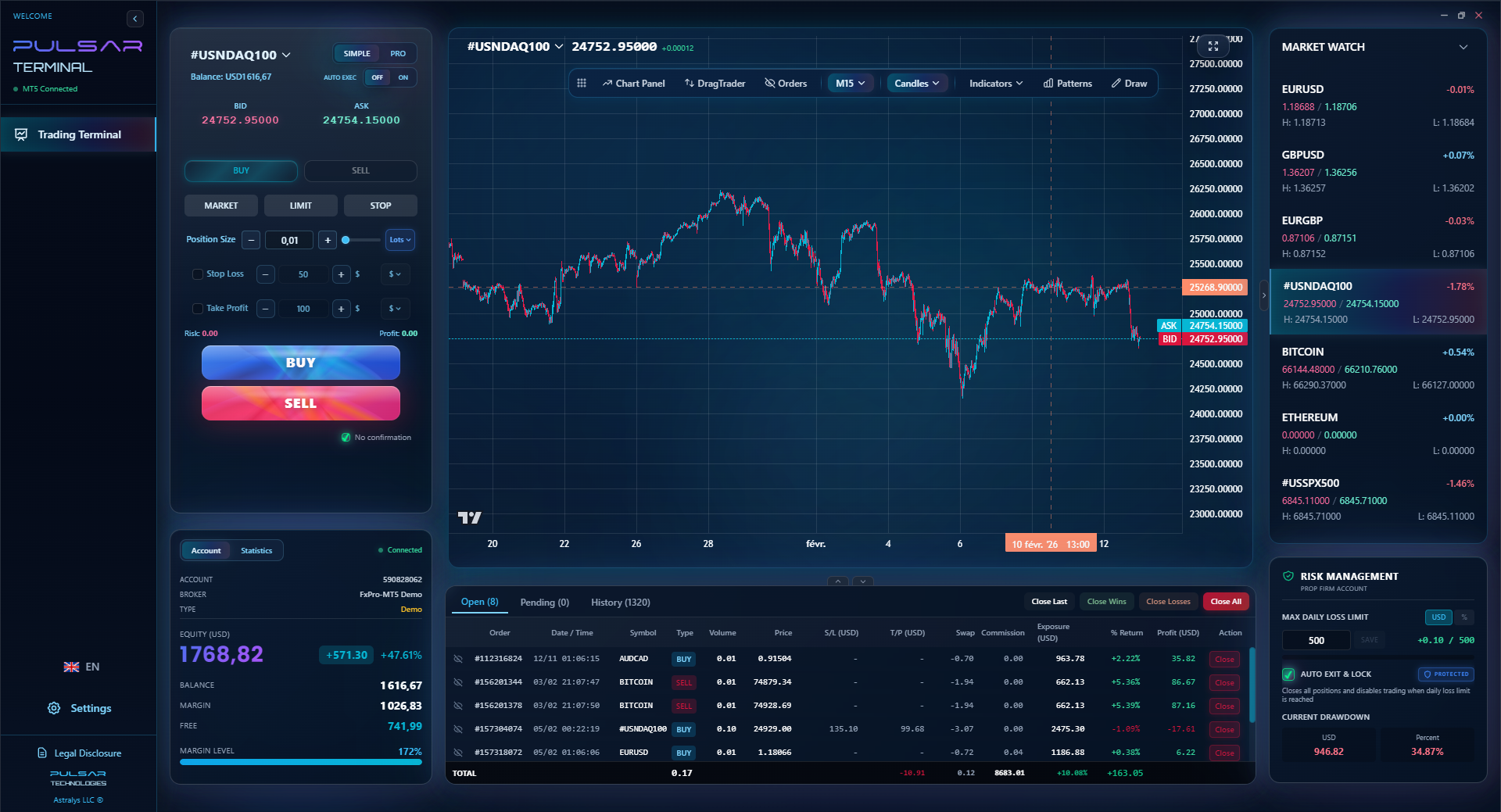
Managing multiple correlated AUD pairs and protecting your capital from sudden drawdowns is easier when you can visualize all your trades and set automated protections on one screen.
Pulsar Terminal
The all-in-one MT5 companion: drag-and-drop orders, multi-TP/SL, trailing stop, grid trading, Volume Profile, and prop firm protection. Used by 1,000+ traders daily.
“The carry trade is a bonus, not a strategy. Never go long AUD/JPY just for the swap.”
Let me save you some money and heartache.
1. Trading the RBA Announcement Blind: The actual rate decision is one thing. The statement and press conference are where the volatility really hits. I once went long AUD/USD on a 'hold' decision, only to see it crash 50 pips when the Governor mentioned concerns about household debt. Now, I don't trade the first 5 minutes. I read the statement, gauge the tone, then look for a technical entry.
2. Ignoring the 'Gap Risk' on Sundays: The forex market opens at 5 pm AEST on Sunday. If something big happened over the weekend (like a US bank failing), AUD pairs can gap open. I had a long AUD/JPY swing trade that gapped down 60 pips against me on a Sunday open. My stop was instantly triggered at a massive loss. Either close swing trades before Friday's NY close or use a broker with guaranteed stop-losses (which cost extra).
3. Chasing Yield in Carry Trades: Borrowing in low-yield JPY to buy high-yield AUD sounds great. Until a risk-off event hits and AUD/JPY collapses 500 pips in a week, wiping out years of swap income. The carry is a bonus, not a strategy.
4. Overcomplicating the Strategy: My first 'professional' system used 14 indicators. It was a mess of conflicting signals. I missed the 2016 AUD rally because my system was 'neutral'. Now, I use price action, one or two indicators like the RSI indicator for confluence, and volume. Keep it stupidly simple.
💡 Winston's Tip
If you wouldn't explain the trade to your accountant without sweating, don't take it. Clarity equals profitability.
“Your edge comes from focused, high-quality analysis during *your* optimal hours, not from screen burnout.”
Here’s how my typical week looks, applying this Australian forex trading strategy.
Sunday Evening (5-10 pm AEST): Review weekly charts. Note key levels. Check for any Sunday gaps. Plan the week ahead - know when Chinese data, AU employment, and the US CPI are due.
Monday - Friday (6:45 - 11 am AEST): Active trading window. I execute my Asian Session Momentum strategy. I'm looking for 1-2 high-probability setups. If nothing clear appears, I do nothing. No forced trades.
Afternoon (1-4 pm AEST): Review open positions. Do end-of-day analysis for potential swing trades. Place any pending orders for my swing setup. Update my journal with the morning's trades - what worked, what didn't, my emotional state.
Friday Afternoon: Review the week. Close any marginal swing positions to avoid weekend gap risk. Calculate my weekly P&L. This routine creates discipline. The market is open 24/5, but you shouldn't be. Your edge comes from focused, high-quality analysis during your optimal hours, not from screen burnout.

Example: Let's say you risk 1% per trade ($100 on a $10k account). A good week might be 3 trades: 2 winners (+40 pips each), 1 loser (-25 pips). Net +55 pips. On AUD/USD, that's about $550 on standard lots, or 5.5% weekly return. That's realistic with a 67% win rate and good risk management. The goal is consistency, not home runs.

FAQ
Q1What is the best time to trade forex in Australia?
The most active and predictable time is the Asian session, from around 7 am to 12 pm AEST (Tokyo open through to late morning). This is when AUD, JPY, and NZD pairs have the best liquidity and tightest spreads for Australian traders.
Q2Is forex trading taxable in Australia?
Yes. If you trade frequently and systematically, the ATO will likely consider it a business, with profits taxed as ordinary income. You can deduct losses and expenses. Always keep detailed records and consult a tax professional familiar with trading.
Q3Which AUD pair is easiest for beginners to trade?
AUD/USD, without a doubt. It has the tightest spreads, the most liquidity, and heaps of free analysis available. It reacts logically to major economic data from both Australia and the US, making it a good pair to learn fundamental and technical analysis on.
Q4Can I use high use with an Australian broker?
No, not as a retail client. ASIC regulations cap use at 30:1 for major currency pairs like AUD/USD, and 20:1 for minors. This is a protective measure. Professional clients may access higher use, but qualifying is strict.
Q5How much money do I need to start forex trading in Australia?
You can open an account with as little as $100 with some brokers. However, to trade comfortably with proper risk management under 30:1 use, I'd recommend a minimum of $2,000. This allows for sensible position sizes without being immediately vulnerable to a few losing trades.
Q6What's the biggest mistake new Australian forex traders make?
Trying to trade the London and New York sessions late at night. It leads to exhaustion, poor decisions, and missing the excellent opportunities in your own backyard during the Asian session. They also underestimate the impact of Chinese economic data on the AUD.
Prof. Winston's Lesson
Key Takeaways:
- ✓Trade the Asian session (7am-12pm AEST).
- ✓AUD/USD is your primary instrument.
- ✓Never risk more than 1% per trade.
- ✓Chinese data moves the AUD more than RSI.
- ✓Keep a detailed journal for the ATO.
How useful was this article?
Click a star to rate
Weekly Trading Insights
Free weekly analysis & strategies. No spam.
About the Author
Sarah Collins
Trading Strategist
London-based trading strategist with 12 years in financial markets. Former analyst at a City of London brokerage. Covers GBP pairs, European markets, and FCA-regulated trading.
Comments
Risk Disclaimer
Trading financial instruments carries significant risk and may not be suitable for all investors. Past performance does not guarantee future results. This content is for educational purposes only and should not be considered investment advice. Always conduct your own research before trading.
You Might Also Like

Cara Trading Forex Sukses: 7 Prinsip dari Trader Profesional
Cara trading forex sukses dengan 7 prinsip trader pro: manajemen modal, disiplin, journal trading, backtest. Data nyata, bukan janji profit palsu.
Jam Trading Forex Terbaik untuk Trader Indonesia: Panduan Lengkap dengan Tabel Waktu
Panduan jam trading forex untuk trader Indonesia. Tabel 4 sesi dunia, jam emas 20:00-00:00, sesi mana yang harus dihindari. Data akurat + tips dari trader berpengalaman.
Top 5 Sàn Forex Uy Tín Nhất 2026: Review Jujur dari Trader Indonesia
Top 5 sàn forex uy tín 2026 untuk trader Indonesia. Review jujur: spread, deposit, withdraw, dukungan lokal. Exness, XM, IC Markets & lebih.
Get Pulsar Terminal
All these calculators are built into Pulsar Terminal with real-time data from your MT5 account. One-click position sizing, automatic risk management, and instant calculations.
Get Pulsar Terminal