


Here's a brutal truth most trading gurus won't tell you: 95% of the strategies you backtest are garbage.

Olumide Adeyemi
West African Trading Pioneer ·  Nigeria
☕ 10 min read
What you'll learn:
- 1Why Backtest? And Why Start With Free Software?
- 2The OG: MetaTrader's Built-In Strategy Tester
- 3TradingView's Pine Script: Visual and Powerful
- 4The Hidden Gem: Freestockcharts.com
- 5The Silent Killer: Historical Data Quality
- 6The Ultimate Free Tool: Manual Backtesting
- 7The Harsh Limits: What Free Software Can't Do For You
- 8Your Nigerian Trader's Action Plan

Here's a brutal truth most trading gurus won't tell you: 95% of the strategies you backtest are garbage. You'll spend weeks, maybe months, optimizing a system that looks perfect on historical data, only to watch it blow up your live account in two days. The problem isn't always the strategy. It's often the tool you're using to test it. Let's cut through the noise and look at the actual free forex backtesting software available to you in Nigeria, what they're good for, and the massive pitfalls you must avoid.
Backtesting is like a flight simulator for traders. You wouldn't want your pilot's first flight to be with 300 passengers in a storm, right? Same logic. It lets you see how your trading idea would have performed without risking a single Naira. For Nigerian traders, starting with free software is a no-brainer. Your capital is precious. Spending $100 a month on fancy software before you even know if your edge works is a great way to stay broke. Free tools let you learn the process, make all the rookie mistakes (and you will), and prove to yourself that you can develop a logical approach before you invest further. I made my first 500+ backtests on completely free platforms. The discipline it taught me was worth more than any indicator.

Warning: Free does not mean easy. The most powerful free tools often have the steepest learning curves. Be prepared to get frustrated and push through it.
That said, free software has limits. The data might be spotty, the speed can be glacial, and the features are basic. But for figuring out if you have the patience and analytical mind for this, it's the only place to start. Think of it as your trading apprenticeship. You can learn a lot about swing trading concepts here before committing real money.
This is where most of us begin, and for good reason. If you trade with brokers like Exness, IC Markets, or XM, you already have it installed. The Strategy Tester in MT4 and MT5 is a workhorse.
How It Works (And Where It Hurts)
You code your strategy in MQL4/MQL5 (or use a free EA builder), select your currency pair, timeframe, and date range, and hit go. It replays every tick or bar based on your broker's historical data. The visual mode is great for watching your EA place and close trades in slow motion.
I'll give you a real example from my early days. I tested a simple moving average crossover on EUR/NGN (when it was more active). On 1-year of data, it showed a 65% win rate. I was ecstatic. I went live. Reality hit: the test used default spread data. Live spreads during Lagos market open were triple the size, turning all my tiny profit trades into losers. The tester didn't account for that reality. My first lesson: always test with variable spreads or the worst-case scenario.
The Naira-Specific Headache
Data quality for exotic pairs involving the Naira (like USD/NGN) can be terrible in these testers. Gaps, missing bars, and inaccurate pricing are common. For major pairs like EUR/USD, it's decent. For anything else, be deeply suspicious.

Pro Tip: Always run a 'forward test' or demo trade after a successful backtest. Let the EA run on a demo account for a month. It's the only way to see how it handles real-time data feeds and execution slippage, which a backtest can't fully replicate.

💡 Winston's Tip
A strategy that needs 15 parameters to work in a backtest is a house of cards. In the real world, it will collapse. Seek simple rules.

“Free backtesting software isn't to find a holy grail. It's to filter out the 19 bad ideas to find the 1 worth investing in.”
TradingView has democratized backtesting. Its Pine Script language is easier than MQL, and the platform is cloud-based - no downloading gigs of data. The visual output is beautiful, showing your equity curve and trade entries/exits right on the chart.
For a discretionary trader who wants to test a specific chart pattern or a simple indicator combo, it's fantastic. You can quickly ask, "What if I bought every time the RSI indicator went below 30 on the GBP/USD daily chart?" and get an answer in seconds.
But (there's always a but), the free plan has crippling limits. You're stuck with only 20 backtests per day. Let that sink in. If you're seriously developing a system, you'll burn through those in 10 minutes. The data is also limited in depth on the free tier. For a proper multi-year test on multiple timeframes, you'll hit a wall.
I used it to test a gold (XAU/USD) breakout strategy. The idea was solid, but after 5 backtests adjusting the stop-loss level, I was locked out for the day. It forces discipline, I guess, but it also severely hampers real development.
It's an excellent sketching pad, not a professional workshop.
This one flies under the radar, but it's a potent, 100% free web-based platform. It doesn't require any coding. You build strategies by dragging and dropping indicators and logic blocks. Want to test if MACD crossover plus volume spike leads to a rally? You can set that up in minutes.
Its biggest strength for us in Nigeria? It has decent data for a wide range of markets, including some forex pairs. The backtesting engine is surprisingly strong for a free tool, giving you all the key stats: net profit, max drawdown, win rate, profit factor.
The weakness is its focus. It's not purely a forex platform. The community and default setups lean towards stocks. You'll need to manually seek out and add the forex pairs you want to test. Also, being web-based, your strategy's security is a concern - don't test your million-dollar idea here.
I used it to prototype a scalping strategy concept using tick data simulations. It helped me realize the strategy required 1-second execution speeds, which my broker and internet connection in Lagos couldn't reliably provide. That saved me a lot of money. It's a fantastic reality-check machine.
“The most powerful free tools often have the steepest learning curves. Be prepared to get frustrated and push through it.”
This is the single most important section in this guide. Garbage in, garbage out. Your free forex backtesting software is only as good as the data you feed it.
Most free platforms provide data from a single source, often with:
- Missing bars (especially on weekends or holidays).
- Incorrect spreads. They use a fixed or averaged spread, not the real, variable, often-wider spreads you get during live trading. This alone kills more "profitable" backtests than anything else.
- No slippage modeling. Your market order won't always get filled at the exact price you see. In fast markets, you can get slipped several pips.
- Poor data for exotics. If you're testing USD/NGN, good luck finding clean, tick-by-tick historical data for free. It barely exists.
Here's my painful lesson. I developed a news-trading EA for the USD/JPY. Backtest over 3 years was phenomenal. I ran it live on a small account. The first NFP news hit. The EA placed the order perfectly in the backtest. In live markets, the latency meant my order was filled 15 pips worse. The trade that was a 20-pip winner in the test became a 5-pip loser. The tester's perfect world didn't account for latency and liquidity evaporation.

Example: Your test shows a 10-pip stop-loss. If the tester's data has a 1-pip spread, your real risk is 11 pips. If your live spread is 3 pips (common during volatility), your real risk is 13 pips. That's a 30% increase in risk per trade that your shiny backtest report completely ignored.
You must learn to adjust your tests for these factors. Assume worse spreads, add a pip of slippage, and be deeply skeptical of tests on low-liquidity pairs. Always use a position size calculator based on the worst-case scenario from your tests, not the best-case.
💡 Winston's Tip
If you wouldn't have the patience to manually execute the strategy for 100 trades, don't automate it. You'll shut it off at the first drawdown.

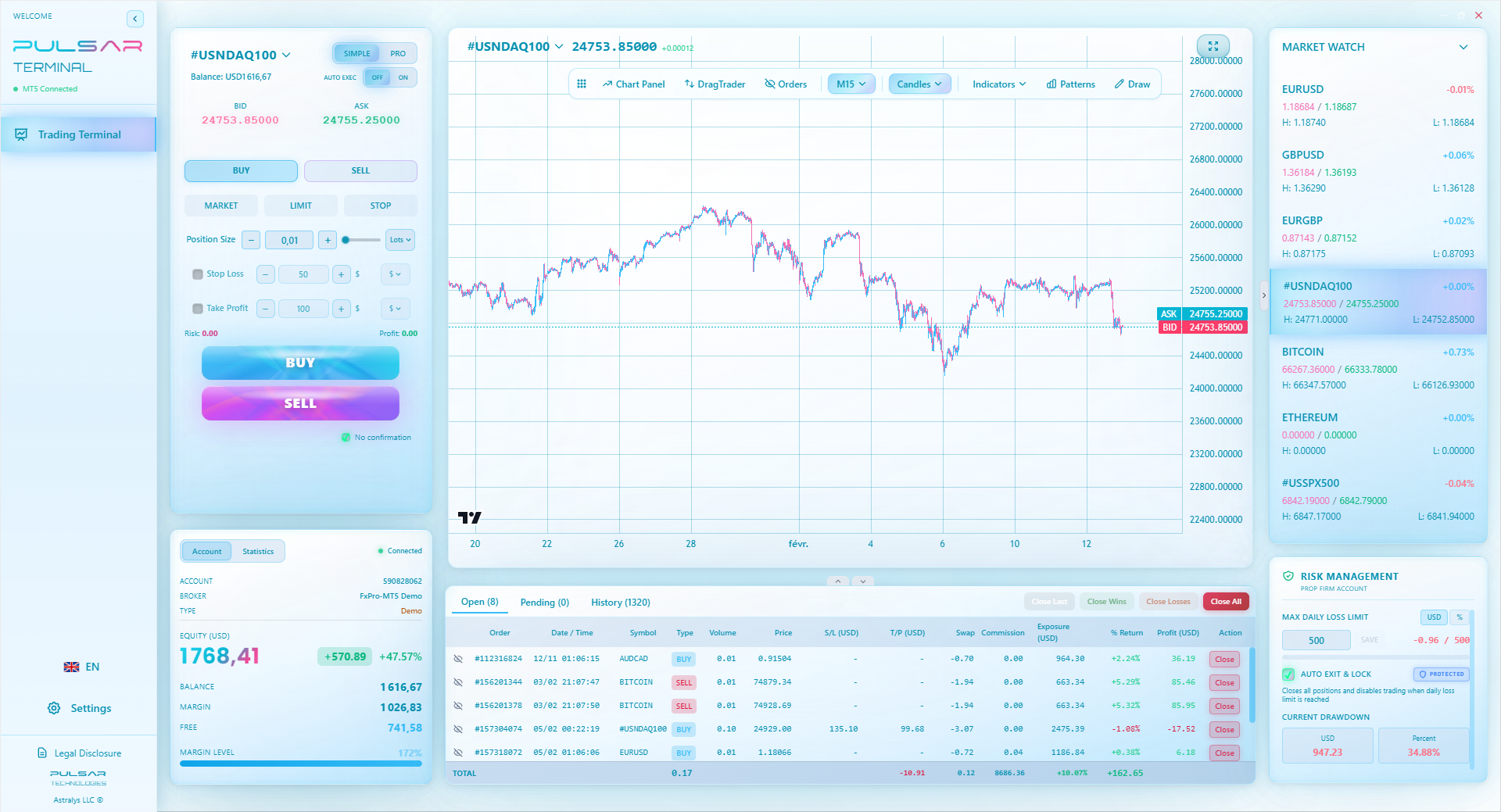
Once you have a strategy from backtesting, managing its execution and risk on MT5 is where Pulsar Terminal's drag-and-drop orders and multi-level take-profit tools become essential.
Pulsar Terminal
The all-in-one MT5 companion: drag-and-drop orders, multi-TP/SL, trailing stop, grid trading, Volume Profile, and prop firm protection. Used by 1,000+ traders daily.
Before you laugh, hear me out. Manual backtesting - scrolling through a chart, bar by bar, and asking "Would my rules have me enter here? Exit here?" - is the most educational process you will ever undertake. It forces you to internalize your strategy. You see every ambiguous situation, every fakeout, every time your emotions would have screamed at you to break your rules.
It's brutally slow. Testing one year of daily data can take a week. But you will learn more in that week than in 100 automated tests.
How to do it in TradingView or MT5 for free:
- Pick your chart and timeframe.
- Scroll all the way to the left, to the start of your test period.
- Hide all future price data (use a vertical line or just don't look).
- Move one bar forward. Apply your strategy rules. Log the hypothetical trade in a spreadsheet: Entry, Stop Loss, Take Profit.
- Keep moving forward bar-by-bar, managing the open trade until it hits SL or TP. Log the result.
You'll confront the boredom, the doubt, and the discipline required. When you finally automate it, you'll understand the soul of your system, not just the numbers. This process saved me from a terrible mean-reversion strategy I almost automated. Manually seeing 8 losing trades in a row on paper was enough to scrap it. The automated test, which just spat out a final P&L, had hidden that psychological torture.
“Your free forex backtesting software is only as good as the data you feed it. Garbage in, garbage out.”
Let's be clear about the ceiling so you don't bang your head against it.
| Free Software Limitation | Real-World Consequence |
|---|---|
| Single-threaded, slow testing | Testing a 10-year strategy across 28 pairs might take days. You can't quickly optimize parameters. |
| Basic or no Monte Carlo analysis | Your 5-year test is just one path history took. It can't simulate 10,000 different random sequences of those trades to see if your wins were just luck. |
| No walk-forward analysis | You can't automatically test optimization in one period and validate it in the next, which is the gold standard for strong strategy development. |
| Poor multi-timeframe/multi-asset testing | Testing a strategy that uses the 4H trend and 5M entry on 10 pairs simultaneously is often impossible. |
Free software gets you to the "this idea might have an edge" stage. It cannot get you to the "this edge is statistically strong and likely to survive future market changes" stage. That requires either serious investment in professional software (like Soft4FX, Forex Tester) or serious programming skills to build your own tools. Knowing when you've hit this limit is a key skill.
💡 Winston's Tip
Spend 80% of your backtesting time trying to break your strategy. Find the market conditions that destroy it. That's how you find its true limits.
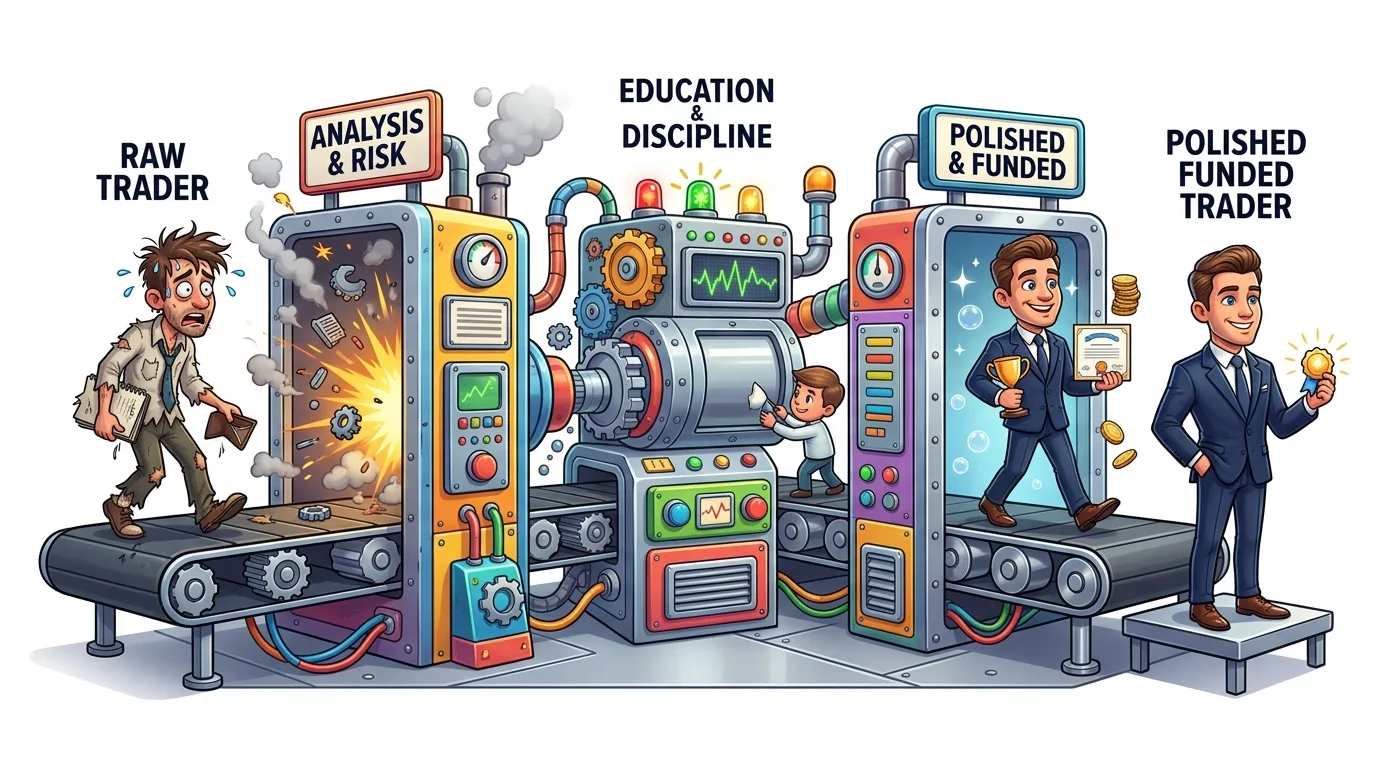
Stop downloading every free forex backtesting software you see. Here's a focused plan:
- Start with Manual: Pick one simple strategy idea. Take two weeks and manually backtest it on 2 years of data for one major pair. Use TradingView or MT5. The pain will teach you more than any video course.
- Automate the Basics: Once you have a rule set, code it in Pine Script (TradingView) or use an EA builder for MT5. Use the free Strategy Tester to run the broad test. Always set the spread to the maximum your broker charges.
- Stress Test for Nigeria:
- Test during known low-liquidity times (late Friday, Sunday opens).
- If using a Nigerian broker, test with their specific spread data if possible.
- Factor in potential internet downtime. What happens to your open trade if you lose connection for 5 minutes?
- Forward Test on Demo: This is non-negotiable. Run your EA or follow your rules manually on a demo account for at least 100 trades or 3 months, whichever is longer. This is where you see the real spread and execution.
- Graduate or Terminate: After the forward test, you have a decision. If the results hold up, you might need to invest in better software to refine it further. If they don't (and 80% won't), scrap the idea and go back to step 1. You've just saved your live account from a margin call.
The goal of free backtesting software isn't to find a holy grail. It's to develop your process and filter out the 19 bad ideas so you can find the 1 that's worth investing more time and money into. Now go test, fail, learn, and repeat.

FAQ
Q1Is there any completely free backtesting software that uses real tick data?
Truly free, high-quality tick data for backtesting is rare. Some platforms like Soft4FX offer a limited free version with tick data, but it's usually for a single pair or a short period. Most free tools use interpolated tick data or bar data. For serious tick-data testing, you'll likely need to pay for both the software and a quality data feed.
Q2Can I use these free tools to pass a prop firm challenge?
You can use them to develop a strategy, but be extremely careful. Prop firms have strict rules on drawdown and daily loss limits. Your free backtest must account for the worst-case spreads and slippage the prop firm's broker will have. Many traders fail because their backtest was done in ideal conditions. Always forward test your strategy under conditions that mimic the prop firm's server location and liquidity.
Q3Which is better for a beginner, MT5 Strategy Tester or TradingView?
For a total beginner, TradingView's Pine Script is easier to learn than MQL5. The visual feedback is better. However, the 20-test daily limit on the free plan is a huge blocker. If you're patient, start with TradingView to learn concepts. If you want to test more freely and plan to trade with an MT5 broker, grit your teeth and learn the MT5 tester. It's the more powerful long-term tool.
Q4How do I account for Naira volatility in my backtests?
This is a major issue. Reliable historical data for USD/NGN or EUR/NGN is hard to find for free. If you must test these pairs, be aware your results will be unreliable. Instead, consider testing your core strategy logic on a major pair with clean data (like EUR/USD) to see if the logic works. Then, apply it cautiously to the Naira pair with a much larger assumed spread and slippage buffer in your live trading.
Q5My backtest is profitable but my demo trading is not. Why?
This is the most common problem. It's almost always due to: 1) Unrealistic spreads/slippage in the backtest, 2) Psychological errors in live execution (hesitation, revenge trading), or 3) Over-optimization (your strategy is too perfectly fitted to past noise). Go back and re-test with triple the normal spread. If it's still profitable on paper, you need to work on your discipline. The strategy might be fine, but you aren't.
Q6What's the biggest mistake Nigerians make with free backtesting software?
Trusting the default settings. Not adjusting for the actual, wider spreads offered by local and international brokers during Lagos trading hours. They see a 70% win rate in the test, go live, and that rate plummets because every trade starts 2-3 pips in the hole instead of the 0.5 pip hole the test assumed.
Prof. Winston's Lesson
Key Takeaways:
- ✓Always backtest with the maximum spread your broker charges, not the average.
- ✓Manual backtesting for 20 hours teaches more than 100 automated tests.
- ✓If a strategy can't survive a 20% random slippage addition in tests, bin it.
- ✓Free tools are for validation of logic, not for proof of robustness.
How useful was this article?
Click a star to rate
Weekly Trading Insights
Free weekly analysis & strategies. No spam.
About the Author
Olumide Adeyemi
West African Trading Pioneer
One of Nigeria's most active forex trading educators. 8 years of experience trading from Lagos. Specializes in low-capital strategies and prop firm challenges for African traders.
Comments
Risk Disclaimer
Trading financial instruments carries significant risk and may not be suitable for all investors. Past performance does not guarantee future results. This content is for educational purposes only and should not be considered investment advice. Always conduct your own research before trading.
You Might Also Like

Cara Trading Forex Sukses: 7 Prinsip dari Trader Profesional
Cara trading forex sukses dengan 7 prinsip trader pro: manajemen modal, disiplin, journal trading, backtest. Data nyata, bukan janji profit palsu.
Jam Trading Forex Terbaik untuk Trader Indonesia: Panduan Lengkap dengan Tabel Waktu
Panduan jam trading forex untuk trader Indonesia. Tabel 4 sesi dunia, jam emas 20:00-00:00, sesi mana yang harus dihindari. Data akurat + tips dari trader berpengalaman.
Top 5 Sàn Forex Uy Tín Nhất 2026: Review Jujur dari Trader Indonesia
Top 5 sàn forex uy tín 2026 untuk trader Indonesia. Review jujur: spread, deposit, withdraw, dukungan lokal. Exness, XM, IC Markets & lebih.
Get Pulsar Terminal
All these calculators are built into Pulsar Terminal with real-time data from your MT5 account. One-click position sizing, automatic risk management, and instant calculations.
Get Pulsar Terminal