


I stared at the screen, my account balance flashing a sickly red: -$1,247.

James Mitchell
Senior Trading Analyst
☕ 10 min read
What you'll learn:
- 1What Exactly is FTUK? Breaking Down the Basics
- 2The Challenge Rules: Where Most Traders Get Caught
- 3My Strategy to Pass: A Real Trade Journal
- 4The Trading Platform & Execution: The Good and The Slippery
- 5Payouts, Scaling, and The Reality of Getting Paid
- 6How FTUK Stacks Up Against Other Prop Firms
- 7Who Should (and Shouldn't) Consider FTUK
- 8My Final Verdict and Hard-Won Lessons

I stared at the screen, my account balance flashing a sickly red: -$1,247. It was Day 8 of my FTUK prop firm evaluation, and a stubborn short on EUR/USD had just blown through my daily loss limit. The trade wasn't even a wild gamble, just a classic retest of a broken trendline that decided to keep going. That moment, watching the 'Account Terminated' message pop up, cost me $299. It was a harsh, expensive lesson in why not all prop firms are created equal, and what you really need to know before you hand over your cash for a chance to trade their capital.
FTUK, or Funding Traders UK, is a proprietary trading firm based in London. They operate on a now-familiar model: you pay a one-time fee to take a trading challenge. Pass it, and you get a funded account with their capital. Your profits are then split, typically 80/20 in your favor.
On the surface, it's straightforward. But the devil, as I learned, is in the specifics of their rules. They offer several account sizes, from a $5,000 starter account (challenge fee around $99) up to $200,000+ accounts (fees running into the thousands).
They pitch themselves as a trader-friendly firm with "realistic" rules. Compared to some of the ultra-restrictive outfits out there, their main selling points are no minimum trading days and what they call a "consistency rule" instead of a strict profit target. Sounds good, right? Well, let's break that down with real numbers from my experience.

Warning: The term 'prop firm' is used loosely here. You're not an employee. You're a client who has purchased an evaluation product. If you fail, you lose your fee. This is a crucial mindset shift.
This is where I failed the first time. You can't just skim the rules. You have to engineer your entire strategy around them. Here’s what matters most at FTUK.
The 5% Maximum Daily Loss
This isn't just a suggestion, it's a hard stop. If your equity drops 5% from the starting balance of the day, you're out. My $1,247 loss? That was on a $25,000 account challenge. 5% of $25,000 is $1,250. I hit $1,247. I was literally $3 away from the limit. It felt brutal. This rule forces hyper-aggressive risk management. You can't let a trade run against you hoping for a reversal. Your first loss must be your best loss.
The 10% Maximum Overall Loss
This is your safety net for the entire challenge. Your equity can never fall 10% below the account's starting balance. This one is easier to manage if you're careful with the daily rule, but it's a constant background threat.
The "Consistency" Rule (The Profit Target)
FTUK doesn't have a single profit target. Instead, you need to hit a profit that is greater than your largest daily profit during the challenge. Let's say your best day nets you $800. You need to make more than $800 in total profit by the end to pass. This encourages steady growth over one lucky trade. In practice, it means you shouldn't go for a huge, risky win early on, as it sets a very high bar for your total profit.
I used my position size calculator religiously during my second attempt. Knowing my exact risk per trade in dollars, relative to that 5% daily cliff, was the only thing that got me through.

💡 Winston's Tip
The 5% daily loss isn't a target to flirt with. Treat 2% as your real, mental maximum. The extra 3% is only for catastrophic, unforeseen gaps.

“The $299 I lost on my first failure was tuition. It taught me that my normal trading psychology wasn't calibrated for their specific brand of pressure.”
After my first failure, I scrapped my usual swing trading approach. It held trades too long and exposed me to overnight gaps. For FTUK, I needed precision and control. Here’s what I did on my successful $50,000 challenge (fee: $399).
I switched to a pure intraday price action strategy on the 15-minute and 1-hour charts of EUR/USD and XAU/USD. I only traded during the London and New York overlaps for maximum liquidity and tighter spreads.
Trade Example: The One That Built My Cushion
- Instrument: EUR/USD
- Setup: False breakout above a prior high, then a rejection candle on the 1-hour chart.
- Entry: 1.08745 (short)
- Stop Loss: 1.08955 (21 pips / $210 risk on my 1-lot position)
- Target 1: 1.08500 (24.5 pips) - Closed 50% of position for +$122.50
- Target 2: 1.08300 (44.5 pips) - Closed remaining 50% for +$222.50
- Total Profit: $345
That single trade, with a 2:1 risk-reward, gave me a 0.69% gain on the account. It was boring, mechanical, and exactly what the rules demanded. I never risked more than 0.5% of the account balance on any single trade. My daily goal was just 0.5%-1%. Slow and painfully steady.

Pro Tip: Your strategy for passing a prop challenge is often different from your strategy for growing a funded account. The goal here is not maximum profit, it's minimum violation of rules. Survival is everything.

FTUK uses MetaTrader 5 (MT5). This is a positive for most experienced traders. The platform is strong and familiar. I connected through IC Markets as their liquidity provider, and generally, execution was decent during high-volume periods.
However, I did notice some issues. During major news events (like NFP), the spreads on indices like the US30 widened considerably, sometimes 15-20 points. This can eat into your tight risk parameters quickly. I learned to avoid trading these instruments 5 minutes before and after high-impact news.
One thing they don't make obvious enough: you're trading in a simulated environment during the challenge. Your orders don't hit the real market. This is standard for prop evaluations, but it means slippage can sometimes feel a bit... convenient for the platform. I had a few stop losses filled slightly worse than my price during volatile spikes. Nothing egregious, but enough to make me tighten my stops even further.
If you're used to the raw speed of a broker like Pepperstone on a live account, the FTUK eval environment can feel a half-step slower. It's not a deal-breaker, but you need to account for it, especially if you're a scalping strategy enthusiast.
💡 Winston's Tip
Your best trading day during the challenge is your enemy. Once you have a sizable 'best day,' shift gears entirely to protecting profits, not chasing a higher high.

“You're not here to be a hero; you're here to pass a test.”
This is the whole point, right? You pass, you profit, you get paid. FTUK offers an 80% profit split, paid monthly. They promise first payouts within 5 business days of the request. Here's my real experience.
I passed my challenge in late November. My first profit period ended December 15th. I requested a withdrawal of $1,840 (my 80% share) on December 16th. The money hit my Skrill account on December 21st. So, roughly 5 business days. It worked as advertised.
The Scaling Plan This is a strong point for FTUK. If you hit a 10% profit target on your funded account over a minimum of 30 days, you can qualify for a 25% account increase. Do it again, another 25%. This is a realistic path to growing your capital with them. It rewards consistent performance, not lottery wins.
The Catch (There's Always One) Remember the 5% daily loss limit? It stays with you on the funded account. Blow it, and you lose the account. No second chances. The pressure doesn't go away; it just has a higher monetary reward. You also have a 10% maximum overall loss limit on the funded account. Hit that, and it's also game over. This makes risk management non-negotiable, forever.

Example: On a $100,000 funded account, your daily loss limit is $5,000. That sounds like a lot, but one bad trade with poor position sizing can get you there frighteningly fast. If your average stop loss is 20 pips, that's 250 pips of risk. Trade 5 lots on the NAS100? That's $25 per pip. A 200-pip move against you would trigger a margin call and blow your daily limit.

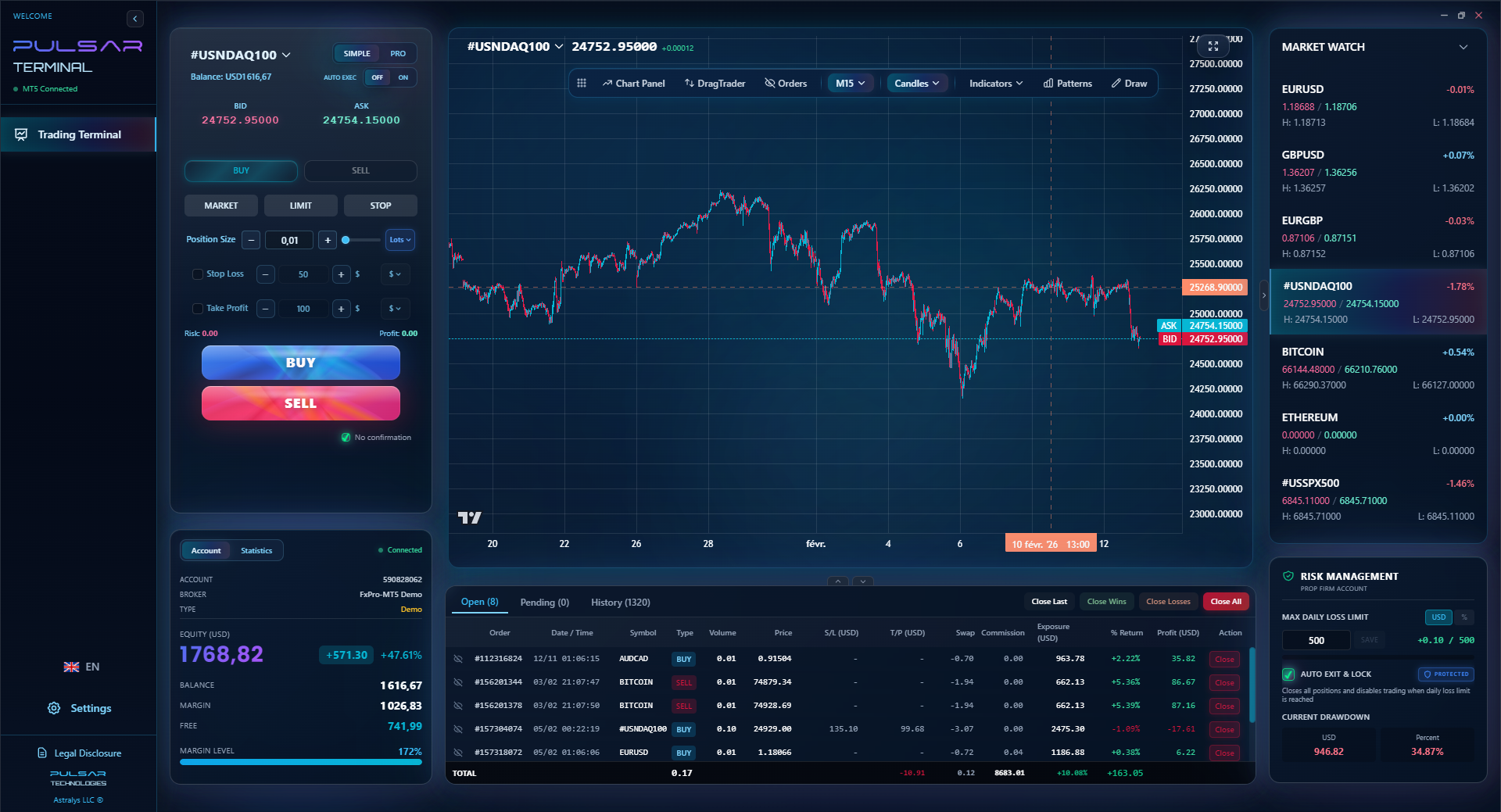
Managing the strict daily loss limits of an FTUK prop firm challenge is a constant pressure, but tools like Pulsar Terminal can automate stop-loss adjustments and partial closures directly on your MT5 chart, helping you protect profits and stay within the rules without emotional hesitation.
Pulsar Terminal
The all-in-one MT5 companion: drag-and-drop orders, multi-TP/SL, trailing stop, grid trading, Volume Profile, and prop firm protection. Used by 1,000+ traders daily.
Is FTUK the best? No. Is it the worst? Far from it. It occupies a solid middle ground. Let's compare it to two common alternatives.
| Feature | FTUK | Firm A (Ultra-Strict) | Firm B (More Flexible) |
|---|---|---|---|
| Min. Trading Days | None | 5-10 Days | None |
| Profit Target | Consistency Rule | 10% Fixed | 8-10% Fixed |
| Daily Loss | 5% (Hard) | 5% (Hard) | 5% (Trailing) |
| Max Loss | 10% (Hard) | 10% (Hard) | 12-15% (Trailing) |
| Platform | MT5 | MT4/MT5 | MT5, cTrader |
| Payout Speed | ~5 Days | 7-14 Days | 2-5 Days |
The Verdict: FTUK is less rigid than the old-school firms with minimum day rules, but stricter than the new generation that uses trailing drawdowns. A trailing drawdown, where your loss limit rises with your profits, is objectively more trader-friendly. FTUK's static limits mean your risk buffer never increases, even when you're up.
If you are a disciplined, risk-averse intraday trader, FTUK's model can work. If you're a swing trader who needs room to breathe, or if you want the safety net of a trailing threshold, you might prefer a firm like the ones reviewed at XM or Exness for their prop offerings.
“FTUK's static limits mean your risk buffer never increases, even when you're up.”
Based on my two attempts and funded experience, here's my blunt assessment.
FTUK might be a good fit if you:
- Are a disciplined intraday or scalping trader.
- Have a proven strategy with a high win rate and tight stop losses.
- Understand risk management on a dollar-and-cent level, not just a percentage level.
- Prefer the MT5 platform and don't need cTrader or other options.
- Value a clear, if strict, set of rules with no hidden tricks.
Avoid FTUK if you:
- Are a swing trader who holds positions for days. Overnight gaps are your enemy here.
- Rely on high-risk, high-reward strategies where many trades are small losses and a few are big wins. The consistency rule punishes this.
- Can't emotionally handle a hard daily loss limit. The pressure is real and constant.
- Want the most modern, flexible rule set (like trailing drawdowns).
- Are new to trading. This is not a learning environment. This is a performance arena for seasoned traders. Losing a $399 challenge fee hurts a lot more when you're just figuring out what a pip definition is.
💡 Winston's Tip
Withdraw your first profit share as soon as you're eligible. It does two things: proves the process works and removes the 'play money' psychology from the funded account.

So, is the FTUK prop firm worth it? Cautiously, yes – but with massive caveats.
It's a legitimate firm that pays out. The platform is stable, and the rules, while tough, are transparent. I'm currently trading a funded account with them. But I wouldn't recommend them as your first or only prop firm attempt.
The $299 I lost on my first failure was tuition. It taught me that my normal trading psychology wasn't calibrated for their specific brand of pressure. I had to become a different, more robotic trader to pass.
If you decide to go for it, here is my non-negotiable advice:
- Paper trade their rules first. Simulate the 5% daily and 10% overall loss limits on a demo account for a full month. Don't even think about paying the fee until you can do this consistently.
- Size for survival, not glory. Your position size should be so small that you can withstand a string of losses without ever nearing the daily limit. Use a calculator.
- Have a daily loss cut-off. Mine was 2%. If I lost 2% of the account in a day, I stopped trading. No questions, no revenge trades. This kept me far from the 5% cliff.
- Choose your battles. Trade only the most liquid pairs during the most liquid times. Avoid news. You're not here to be a hero; you're here to pass a test.
The FTUK prop firm offers a real opportunity, but it's a narrow path. Walk it carefully, with your eyes wide open to the very real stakes. For me, it was a brutal but valuable lesson in trading discipline under fire.
FAQ
Q1How long does the FTUK challenge take?
There's no official time limit to hit the profit target, but you must avoid hitting the maximum loss limits (5% daily, 10% overall). Most traders aim to complete it within 1-3 months. There are no minimum trading days, so you could theoretically pass it in a week if you're very successful and active.
Q2What is the FTUK consistency rule?
It's their profit target. You must achieve a total net profit that is greater than the profit of your single best trading day during the evaluation. For example, if your best day made $500, your total profit at the end must be more than $500. This discourages relying on one lucky trade.
Q3Does FTUK allow expert advisors (EAs) or copy trading?
Yes, FTUK generally allows the use of expert advisors and copy trading, provided they comply with all other challenge rules (like the daily loss limit). However, you are fully responsible for the EA's actions. If it triggers a rule violation, your account will be failed.
Q4How often does FTUK pay out profits?
Profit splits are processed monthly. You can request a payout once per calendar month after your first 30 days on a funded account. They state processing takes up to 5 business days, which aligned with my experience.
Q5What happens if I hit the 5% daily loss limit?
Your challenge or funded account is immediately and automatically terminated. There is no warning, grace period, or reset option. You lose the account and, if in the challenge phase, your evaluation fee.
Q6Can I retake the FTUK challenge if I fail?
Yes, but you must purchase a new challenge package. FTUK sometimes offers discounted "second chance" fees, but there is no free retry. This is why paper trading their rules first is so critical.
Q7What instruments can I trade with FTUK?
You have access to a wide range: Forex majors/minors, global stock indices (like US30, NAS100), commodities (Gold, Oil), and cryptocurrencies. Always check the specific contract sizes and trading hours for each instrument on their website.
Prof. Winston's Lesson
Key Takeaways:
- ✓The 5% daily loss is a hard stop, not a suggestion.
- ✓Size positions for survival, not for glory.
- ✓The consistency rule punishes a single lucky trade.
- ✓Paper trade their exact rules for a month before paying.
- ✓Withdraw your first profit to confirm the process.
How useful was this article?
Click a star to rate
Weekly Trading Insights
Free weekly analysis & strategies. No spam.
About the Author
James Mitchell
Senior Trading Analyst
Based in New York with over 9 years of trading experience. Focuses on major USD pairs, prop firm challenges, and the US regulatory landscape.
Comments
Risk Disclaimer
Trading financial instruments carries significant risk and may not be suitable for all investors. Past performance does not guarantee future results. This content is for educational purposes only and should not be considered investment advice. Always conduct your own research before trading.
You Might Also Like

Cara Trading Forex Sukses: 7 Prinsip dari Trader Profesional
Cara trading forex sukses dengan 7 prinsip trader pro: manajemen modal, disiplin, journal trading, backtest. Data nyata, bukan janji profit palsu.
Jam Trading Forex Terbaik untuk Trader Indonesia: Panduan Lengkap dengan Tabel Waktu
Panduan jam trading forex untuk trader Indonesia. Tabel 4 sesi dunia, jam emas 20:00-00:00, sesi mana yang harus dihindari. Data akurat + tips dari trader berpengalaman.
Top 5 Sàn Forex Uy Tín Nhất 2026: Review Jujur dari Trader Indonesia
Top 5 sàn forex uy tín 2026 untuk trader Indonesia. Review jujur: spread, deposit, withdraw, dukungan lokal. Exness, XM, IC Markets & lebih.
Get Pulsar Terminal
All these calculators are built into Pulsar Terminal with real-time data from your MT5 account. One-click position sizing, automatic risk management, and instant calculations.
Get Pulsar Terminal