


My screen was a sea of red.

David van der Merwe
Emerging Markets Trader ·  South Africa
☕ 10 min read
What you'll learn:
My screen was a sea of red. It was October 2022, and the GBP/USD had just ripped through a key support level I’d bet my own R15,000 on. The loss stung, but the real frustration was knowing my trade idea was right - just underfunded. I couldn't scale it. That moment pushed me to seriously look at the 'get funded forex' scene. Prop trading isn't a magic money tree, but for a disciplined South African trader, it's a legitimate path to trading capital that isn't yours. Let's cut through the hype and look at how it really works here, from the rand conversions to the regulatory gray areas.
Let's be clear: when you 'get funded forex' with a prop firm, you're not getting a loan. You're not being given R1 million to go wild with. You're being evaluated for your ability to manage risk and generate consistent profits, usually on a simulated account. If you pass, the firm may give you a live account with their capital, and you split the profits. The key word is 'may' - many operate on a 'shadow trading' model where your trades are copied to their live books.
Why does this exist? Simple. Firms make money from the evaluation fees paid by the 90-95% who fail, and from a cut of the profits from the 5-10% who succeed. It's a business model, not a charity. For you, it's a chance to trade size you couldn't afford personally. I once turned a $50,000 funded account into a $57,500 account (a 15% gain). My 80% cut was $6,000. After converting to rands and fees, it landed as about R102,000. Trading my own capital, that would have taken me years.

Warning: Don't confuse prop firms with bucket-shop brokers. A proper prop firm's goal is for you to succeed and make them money long-term. Their rules, while strict, are designed to find sustainable traders, not to trick you into blowing up.
“Prop trading isn't a magic money tree, but for a disciplined South African trader, it's a legitimate path to trading capital that isn't yours.”
This is the part most glossed over. The regulatory stance here is, politely, confusing. The FSCA regulates brokers, but many prop firms operate as 'educational services' in a gray area. A National Treasury note even says individual forex trading isn't allowed under old exchange control laws. Yet, thousands of us do it every day through international brokers.
The practical reality? Many top global prop firms accept South African traders. You're trading their capital on international markets, not directly speculating against the ZAR on a local, unlicensed platform. Your protection comes from the firm's own reputation and terms, not necessarily FSCA oversight. Always check if they partner with a known, regulated broker for execution.
Now, the costs. You need to think in USD or EUR, not rands.
The Evaluation Fee
This is your ticket to the challenge. It's a one-time fee, often refunded on your first payout. Examples:
- FTMO: About €155 (roughly R3,100) for a $10,000 account challenge.
- A local firm like GoatFundedTrader: $49-$399 (R900 - R7,300) depending on account size.
You must see this as the cost of a business opportunity, not a trade. If you're not consistently profitable on a demo account first, you're just donating this fee.
The Profit Targets & Drawdowns
This is where they separate the gamblers from the traders. Typical two-phase challenge rules:
| Rule | Phase 1 | Phase 2 |
|---|---|---|
| Profit Target | 8-10% | 5% |
| Daily Drawdown | 5% | 5% |
| Max Drawdown | 10% | 10% |
Hitting a 10% target sounds easy until you realize you can only lose 5% in a day. One bad trade can end it. I failed my first two challenges because I treated the 10% target as a sprint. I'd gain 8% in two days, get greedy, take an oversized position, and get stopped out by the daily drawdown. Poof. Fee gone.

Example: You start a $100,000 challenge. Your daily loss limit is $5,000 (5%). If you're down $4,900 by 3 PM, you MUST stop. One more losing trade could breach the limit and fail you, even if your overall account is still up. This teaches brutal discipline.
Your success hinges entirely on your position size calculator and risk management. A 1% risk per trade is often too high here.

💡 Winston's Tip
The evaluation fee is the price of a ticket. Don't buy it until you've proven you can win the game for free on a demo account for at least three months.
“Hitting a 10% target sounds easy until you realize you can only lose 5% in a day. One bad trade can end it.”
Forget the shiny ads promising '1:1000 use!' Look at these factors instead:
1. The Payout Process & Speed: This is critical. How do you get your money to South Africa? Many offer crypto payouts (USDT), which is often fastest and cheapest. If it's a SWIFT transfer, ask about fees. I've had a $2,000 profit whittled down by R800 in SWIFT fees and another R120 in currency conversion by my local bank. It can also take 5-9 business days.
2. Trading Rules: Are they realistic? A 5% daily drawdown is standard. A 2% daily drawdown is extremely tight. Also, check the weekend holding rules and news trading restrictions.
3. Platform & Tools: Most use MT4/MT5 or cTrader. Can you use the tools you rely on? If you're a serious scalping strategy trader, check their stated spread definition on majors during your session. Some firms like ThinkCapital (launched 2024) tout 'institutional execution' which matters for slippage.
4. Growth Plan: What happens when you're profitable? Can you scale up from $50,000 to $200,000? Firms like FundedNext have clear scaling plans.
5. Community & Support: A good firm has responsive support. Join their Telegram or Discord and see how they handle questions.
Based on my experience and what I see in trading circles, firms like FTMO, The5ers, and FundedNext have established track records. Newer firms like ThinkCapital (backed by a regulated broker) and BrightFunded are gaining traction. Always, always read the full terms and conditions.
“Hitting a 10% target sounds easy until you realize you can only lose 5% in a day. One bad trade can end it.”
Trading a prop challenge is a different game from trading your own account. The goal isn't maximum profit. It's passing within the rules. Your strategy must adapt.
Phase 1: The Grind. Your goal is the profit target (e.g., 10%) with zero regard for making more. Be a robot. I used a simple swing trading approach on the XAU/USD guide during this phase. I'd risk 0.5% per trade, aiming for 1.5% returns (a 1:3 risk/reward). It took 14 trades over three weeks to hit 10.2%. Boring. Effective.
Phase 2: The Consistency Test. Here the profit target is lower (5%), but the real test is not breaking rules over a longer period. This is where overtrading kills people. You've passed Phase 1, excitement is high, and you want to 'get to the real money.' I've seen traders blow Phase 2 in two days by doubling their position size.
The Mental Shift: You must internalize the drawdown limits. A tool that can automate a hard daily stop-loss is useful. I now use one that cuts all positions if my daily loss hits 4%, leaving a 1% buffer. This peace of mind is worth more than any indicator.

Pro Tip: In your practice runs, track your 'daily drawdown' metric religiously. It's a more important number than your balance. If your strategy regularly has drawdowns over 3% in a day, it's too risky for most challenges.
Don't try to be clever. Use a strategy you know inside out. Whether it's based on the RSI indicator or MACD indicator, consistency is king. The evaluation is not the place for experimentation.
💡 Winston's Tip
Your daily drawdown limit is your most important number. Treat a 4% daily loss as a full stop. That last 1% buffer is for market noise, not for one more 'sure thing' trade.
“The goal isn't maximum profit. It's passing within the rules. Your strategy must adapt.”
Let's talk about what happens when you win.
Withdrawals: You'll likely request a payout in USD. The firm will process it, often within a few days. Then it hits the international banking system. If you use crypto, you'll get USDT in your wallet in hours. Convert to ZAR on a local exchange like Luno, then EFT to your bank. This is usually the cheapest and fastest route.
If it's a bank transfer, your South African bank will convert it to ZAR at their rate and charge you. You might get an SMS: "We've received USD 1,800. We credit you with R32,400 after fees." That conversion fee and the SWIFT charge are your cost. Factor this into your profit calculations.
Taxes: This is not financial advice, but here's the common understanding. Profits from trading are generally considered income in South Africa, not capital gains, because SARS views it as revenue from your trading 'business.' You are responsible for declaring this income to SARS. Keep careful records of all your withdrawals (in ZAR value on the day you receive it) and all your expenses (evaluation fees, software subscriptions, internet costs). A good accountant who understands trading is worth every cent. The foreign investment allowance (up to R1 million discretionary, R10 million with clearance) is more for investing in offshore stocks, not typically for trading profits flowing back.
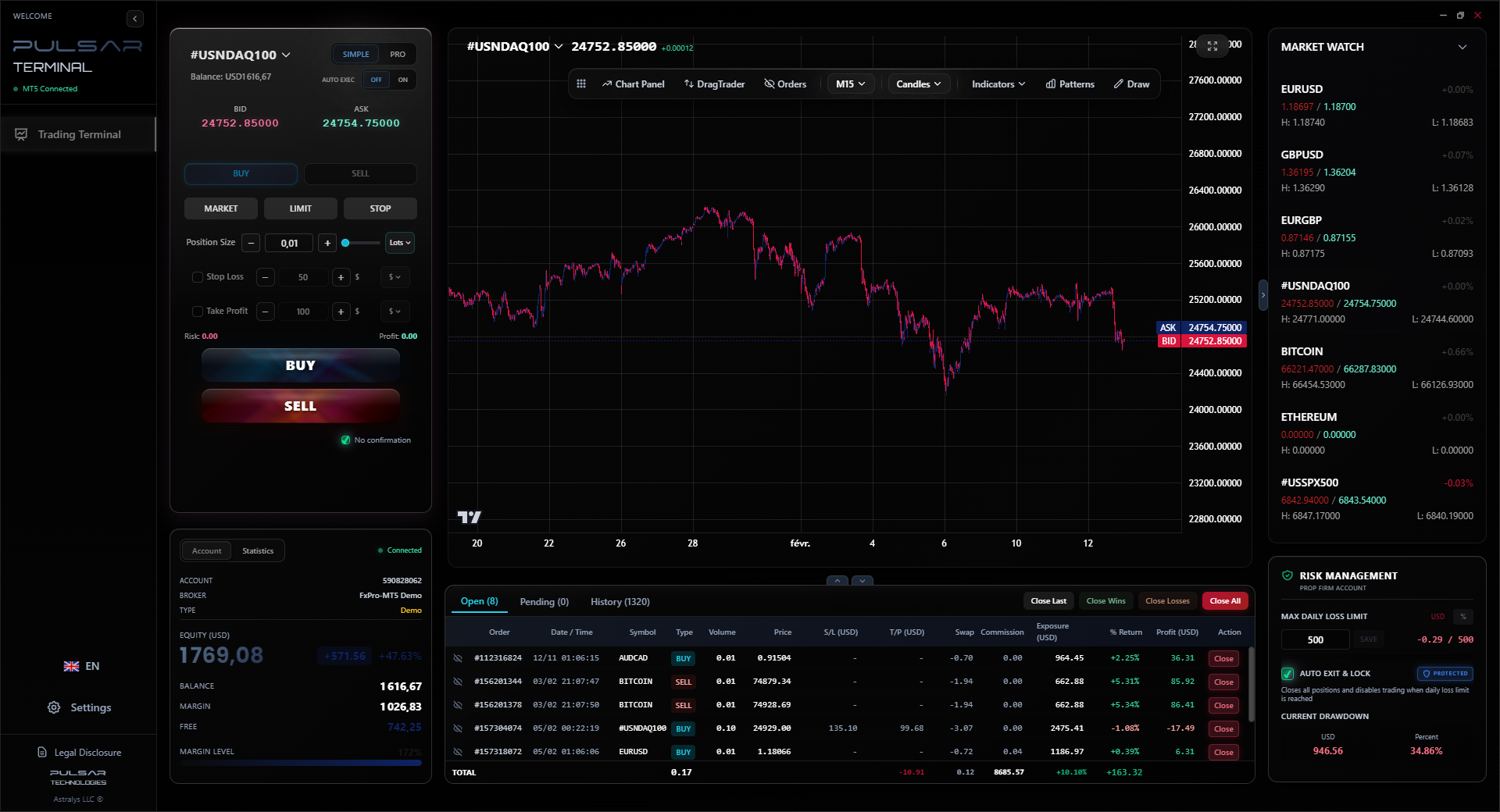
Managing the strict daily loss limits of a prop firm challenge is stressful; Pulsar Terminal can automate hard daily stop-losses directly on your MT5 chart, protecting you from a rule-breaking lapse in judgment.
Pulsar Terminal
The all-in-one MT5 companion: drag-and-drop orders, multi-TP/SL, trailing stop, grid trading, Volume Profile, and prop firm protection. Used by 1,000+ traders daily.
“The goal isn't maximum profit. It's passing within the rules. Your strategy must adapt.”
I've made these mistakes so you don't have to.
1. Chasing Losses After a Bad Day. You're down 3.5% on the day. The urge to 'get it back before midnight' is overwhelming. This is how you hit the 5% daily limit and fail. Just walk away. The challenge gives you 30 days; use them.
2. Ignoring the 'Maximum Drawdown' Rule. This is a trailing limit from your starting balance or your highest balance, whichever is higher. If you start at $100,000 and grow to $108,000, your max drawdown might now be $98,000 (10% below $108k), not $90,000. But if you then drop to $102,000, that new high-water mark resets. It's tricky. Always know your exact breach point.
3. Underestimating Psychology. Trading a demo with a $100,000 balance feels like a game. When that same $100,000 is a funded account that could pay out $80,000 in profits, the pressure warps your judgment. The only cure is experience and treating every trade, even in evaluation, as real.
4. Picking the Wrong Account Size. Starting with a $200,000 account because the profit potential is bigger is a trap. The drawdown in rands is terrifying (5% daily = $10,000 = ~R180,000). Start small. Prove yourself on a $10k or $25k account, then scale up through the firm's program. The goal is a long-term partnership, not a lottery ticket.
Remember, the firm's rules are designed to trigger a margin call on your psychology long before your account hits zero. Your job is to manage your own head.
💡 Winston's Tip
If a prop firm's main selling point is 'high use,' walk away. You're looking for a capital partner, not a casino. Sustainable growth is built on risk management, not use.
“Your protection comes from the firm's own reputation and terms, not necessarily FSCA oversight.”
So, should you try to get funded forex? Ask yourself these questions honestly:
- Are you consistently profitable over 3-6 months on a demo/live account? Not just lucky, but with a clear edge and journal to prove it. If not, you're not ready. Save your money.
- Can you follow a trading plan with robotic discipline, even when a 5% daily loss is staring you down? This is the core skill being tested.
- Are you treating this as a business? That means budgeting for evaluation fees as a business cost, keeping records for tax, and being patient.
If you answered yes, then it's a viable path. It gave me access to capital I didn't have and forced a level of discipline I resisted for years. It's not easy. That 5-10% pass rate is real. But for a skilled South African trader looking to move beyond the limitations of their own bank balance, it's one of the most direct routes available. Start small, respect the rules, and focus on survival first. The profits will follow.
FAQ
Q1Is forex prop trading legal in South Africa?
It operates in a regulatory gray area. You're not trading with a locally licensed broker in most cases; you're being evaluated by an international firm. The key is that these firms are generally not regulated by the FSCA as traditional brokers are. It's legal for you to participate, but your consumer protections come from the firm's own terms, not South African financial laws. Always do your due diligence on the firm's reputation.
Q2How much does it cost to start with a prop firm?
You'll pay a one-time evaluation fee, which is often refundable. This can range from about $49 (roughly R900) for a small account challenge to over $500 (R9,000+) for larger accounts. Remember, this is a fee for the chance to be evaluated, not a deposit to trade with. You should only risk money you can afford to lose on this fee.
Q3What's the best prop firm for South Africans?
There's no single 'best' firm. Look for ones with clear, fair rules, a reliable payout process (crypto options are a big plus to avoid bank fees), and good support. Firms like FTMO, The5ers, and FundedNext are popular globally. Newer entrants like ThinkCapital also offer strong technology. Your choice should depend on your trading style, preferred platform (like MT5), and account size goals.
Q4How are profits from prop firms taxed in SA?
Profits are generally considered taxable income by SARS. You need to declare the ZAR value of your withdrawals as income when you file your tax return. Keep all records of your payouts and any related expenses (fees, software, data). It's highly recommended to consult with a tax professional who understands trading income.
Q5Can I use my own trading strategy?
Absolutely, as long as it fits within the firm's rules. The most common reasons for failure are violating drawdown limits, not the strategy itself. Whether you're a scalper or a swing trader, your strategy must be compatible with strict daily and maximum loss limits. A high-frequency strategy that risks large drawdowns will likely fail.
Q6What happens if I fail the challenge?
Your evaluation ends, and you lose the fee you paid. Most firms offer a free retry or a discount on a future challenge if you fail near the target. The key is to review your trades, understand if you failed due to strategy or rule-breaking, and only try again once you've fixed the issue in a demo environment.
Prof. Winston's Lesson
Key Takeaways:
- ✓Treat the evaluation fee as a business cost, not a trade.
- ✓Daily drawdown is your primary metric, not account balance.
- ✓Start with the smallest account size you can scale from.
- ✓Use crypto payouts (USDT) to save on bank fees and time.
- ✓Only 5-10% pass because of psychology, not lack of strategy.
How useful was this article?
Click a star to rate
Weekly Trading Insights
Free weekly analysis & strategies. No spam.
About the Author
David van der Merwe
Emerging Markets Trader
Johannesburg-based trader with 11 years in emerging market currencies. Specializes in ZAR pairs, FSCA-regulated trading, and South African market analysis.
Comments
Risk Disclaimer
Trading financial instruments carries significant risk and may not be suitable for all investors. Past performance does not guarantee future results. This content is for educational purposes only and should not be considered investment advice. Always conduct your own research before trading.
You Might Also Like

Cara Trading Forex Sukses: 7 Prinsip dari Trader Profesional
Cara trading forex sukses dengan 7 prinsip trader pro: manajemen modal, disiplin, journal trading, backtest. Data nyata, bukan janji profit palsu.
Jam Trading Forex Terbaik untuk Trader Indonesia: Panduan Lengkap dengan Tabel Waktu
Panduan jam trading forex untuk trader Indonesia. Tabel 4 sesi dunia, jam emas 20:00-00:00, sesi mana yang harus dihindari. Data akurat + tips dari trader berpengalaman.
Top 5 Sàn Forex Uy Tín Nhất 2026: Review Jujur dari Trader Indonesia
Top 5 sàn forex uy tín 2026 untuk trader Indonesia. Review jujur: spread, deposit, withdraw, dukungan lokal. Exness, XM, IC Markets & lebih.
Get Pulsar Terminal
All these calculators are built into Pulsar Terminal with real-time data from your MT5 account. One-click position sizing, automatic risk management, and instant calculations.
Get Pulsar Terminal