


Here's a number that should make you pause: Nigeria's monthly forex market turnover jumped over 56% to $8.6 billion in 2025.

Olumide Adeyemi
West African Trading Pioneer ·  Nigeria
☕ 10 min read
What you'll learn:
Here's a number that should make you pause: Nigeria's monthly forex market turnover jumped over 56% to $8.6 billion in 2025. That's a tidal wave of money changing hands, and a lot of regular people are trying to ride it. If you're thinking about how to go forex from Lagos, Abuja, or Port Harcourt, you need to know it's not just about charts and pips. It's about navigating bank restrictions, a 10% tax on your profits, and brokers that operate in a regulatory grey area. I've traded through multiple Naira devaluations and policy shifts. Let's talk about what it really takes.
When someone in Nigeria says they want to 'go forex,' they're usually talking about retail speculative trading on global currency pairs like EUR/USD or GBP/USD through an online broker. It's not about the official CBN window or Bureau de Change trading (that's a whole different, often messier, game).
This is you, on your phone or laptop, using use to try and profit from tiny price movements. The appeal is obvious, especially in an economy with high inflation and a volatile Naira. The dream is to earn in a stable foreign currency. The reality is a minefield of practical hurdles.
The first major hurdle is funding. The CBN prohibits using official foreign exchange to fund trading accounts. Many Nigerian banks have also limited international transactions on Naira cards. I've had deposits to my broker rejected more times than I can count. You often need to use alternative payment processors or crypto transfers, which adds another layer of cost and complexity. Understanding this operational reality is step one before you even look at a chart.

Warning: Don't confuse retail forex trading with trying to arbitrage the official vs. parallel market rates. That's a fast track to getting your account frozen or facing legal issues. We're talking about trading the established global markets through a licensed intermediary.
“The CBN prohibits using official foreign exchange to fund trading accounts. Many Nigerian banks have also limited international transactions on Naira cards.”
Let's get the boring but critical stuff out of the way. Yes, it's legal for you to trade forex with your personal funds. No, Nigeria doesn't have a strong local regulatory framework for the brokers you'll likely use. The SEC and CBN's rules are still catching up. This means you're almost certainly going to be using an international broker that accepts Nigerian clients under a foreign license (from places like Cyprus, Seychelles, or South Africa).
Your protection comes from that broker's home regulator, not from Abuja. That's why picking a well-regulated broker is non-negotiable. I learned this the hard way early on with a flashy 'offshore' broker that vanished with a few hundred dollars of my deposit. Poof. Gone.
The 10% Tax Man
This is the big one everyone forgets. The Federal Inland Revenue Service (FIRS) considers forex trading profits as capital gains. That means you owe a 10% tax on your gross profits. It doesn't matter if your broker is in Seychelles or your money is in a USD account. If you're a Nigerian resident, you're liable.
I keep a separate spreadsheet just for tax calculations. For example, if you make a net profit of 500,000 Naira in a year, you need to set aside 50,000 Naira for FIRS. They are getting more sophisticated at tracking these flows. Ignoring this is an audit waiting to happen. Factor this 10% hit into your profit targets from day one. A trade that nets you 100,000 Naira only nets you 90,000 after tax. Plan accordingly.

Pro Tip: Open a separate savings account or wallet specifically for your tax liability. Every time you withdraw profits, immediately move 10% into that account. Don't let it mix with your spending money.

💡 Winston's Tip
Your first profitable month is the most dangerous. It convinces you you're a genius. Withdraw half those profits immediately. It grounds you and proves the process works.
“A trade that nets you 100,000 Naira only nets you 90,000 after tax. Plan accordingly.”
This is your most important decision. A bad broker will make you lose money even when your analysis is right. You need to check three boxes: solid international regulation, reliable deposit/withdrawal methods for Nigeria, and reasonable costs.
Based on my experience and constant monitoring, here are the types you'll encounter:
| Broker Type | What It Means For You | Example |
|---|---|---|
| Global, Top-Tier Regulated | Highest safety, but sometimes trickier deposits/withdrawals for Naira. Often lower use. | Think brokers under UK FCA or Australian ASIC rules. |
| International, Reputable | Good safety, often better Naira payment options. The sweet spot for most Nigerian traders. | Brokers like IC Markets review (ASIC regulated) or Pepperstone review. |
| Local or 'Naira-Friendly' Focused | Easy deposits, Naira accounts. Crucial: Check their international regulation closely. | Exness review (FSA Seychelles) is popular here for this reason. XM review also has strong local support. |
My personal criteria: I need a broker regulated by at least one top authority (ASIC, FCA, CySEC, FSCA). I need to see proof that deposits and withdrawals with methods like Sticpay, Perfect Money, or crypto work smoothly for Nigerian users. And I need tight spreads, because costs eat profits fast.
For instance, I use a broker that offers raw spreads from 0.0 pips on EUR/USD for a $3.50 commission per lot. On a standard 100,000 unit trade, that's a total cost of just $3.50, versus a broker with a 1.5 pip spread costing me $15 on the same trade. Over 100 trades, that's $1,150 saved. It matters.
Always start with a small deposit to test the withdrawal process before you commit serious capital. I cannot stress this enough.
“A trade that nets you 100,000 Naira only nets you 90,000 after tax. Plan accordingly.”
Money management is universal, but in Nigeria, you have to think about the value of your capital in Naira terms, not just USD. Your 100,000 Naira starter account could be worth significantly less in dollar terms if the Naira weakens, even if your trade balance stays flat.
The use Trap
Brokers here offer insane use - up to 1:2000 in some cases. That's a death sentence for a new trader. At 1:1000, a 0.1% move against you wipes your account. I made this mistake in 2019. I put $100 on a USD/JPY trade with 1:500 use. The price moved 20 pips against me (a tiny fluctuation), and I got a margin call. $100 gone in minutes.
My rule now? I never use more than 1:10 use on my core positions. It forces me to be more selective and use proper position size calculator. On a $1,000 account, 1:10 use means I'm controlling a $10,000 position. That's more than enough to make meaningful profits without sleepless nights.
Position Sizing with Volatility
The Naira's volatility affects your psychology. When you see the parallel market rate spike, the urge to 'make up the difference' through forex can lead to oversized, reckless trades. You must divorce your trading from the local economic noise. Your position size should be based on the volatility of the currency pair you're trading (like EUR/USD), not the USD/NGN rate.
A good practice is to risk no more than 1-2% of your account on any single trade. On a 500,000 Naira account, that's 5,000 to 10,000 Naira risk per trade. If you hit a losing streak of 10 trades (it happens), you've only lost 10-20% of your capital and can still recover.
💡 Winston's Tip
If you can't explain your trade setup in one simple sentence ('price bounced off the weekly support line'), you don't have a trade. You have a hope.
“At 1:1000 use, a 0.1% move against you wipes your account.”
Nigeria's internet can be unreliable. Power outages happen. You need strategies that don't require you to stare at the screen all day. High-frequency scalping strategy during a blackout is a recipe for disaster.
I focus on two main approaches:
1. Swing Trading: This is my bread and butter. I hold trades for days or weeks, catching larger market moves. It fits a normal job schedule. I might analyze the market for an hour in the evening, set my orders, and check in once a day. This strategy relies heavily on understanding longer-term trends and key support/resistance levels. You can learn more about this patient approach in our guide on swing trading.
Example Trade: In early 2024, I saw GBP/USD bouncing off a major support level that had held for months. I bought at 1.2600. I set a stop loss at 1.2550 (risking 50 pips) and a target at 1.2750 (aiming for 150 pips). I walked away. The trade hit my target three days later. Risk:Reward was 1:3. I used a simple RSI indicator to confirm the momentum wasn't oversold, but the core idea was the price level.
2. End-of-Day Analysis: I use the daily and 4-hour charts. After the London/New York sessions close, I spend 30 minutes analyzing the 'market story' for the day. Did it break a key level? Is there a clear pin bar or engulfing candle? I then place orders for the next day. This method is slow, deliberate, and avoids the noise of minute-to-minute price action.
Indicators? Keep it simple. I use a MACD indicator for trend momentum and moving averages for dynamic support/resistance. More than five indicators on a chart, and you're just decorating, not analyzing.
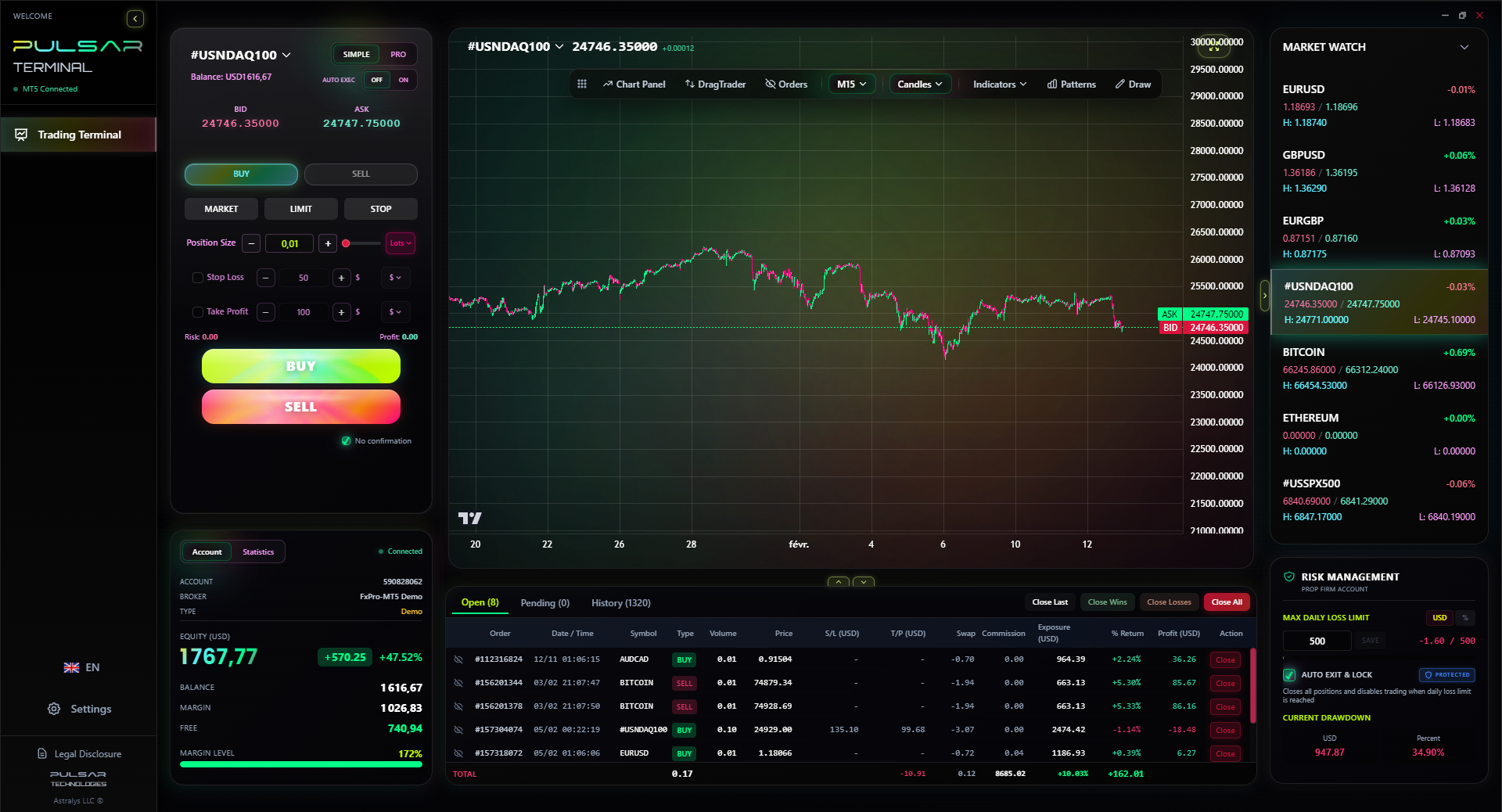
When trading volatile pairs like GBP/USD from Nigeria, having a tool that lets you set multiple take-profit levels and a trailing stop in one click is a game-saver, especially if your internet drops.
Pulsar Terminal
The all-in-one MT5 companion: drag-and-drop orders, multi-TP/SL, trailing stop, grid trading, Volume Profile, and prop firm protection. Used by 1,000+ traders daily.
“At 1:1000 use, a 0.1% move against you wipes your account.”
This might be the most important section. Trading psychology is hard everywhere, but being a Nigerian trader adds unique pressures.
The 'Get-Rich-Quick' Pressure: With economic hardship, there's a desperate need for a win. This leads to forcing trades, ignoring risk, and blowing up accounts. You have to accept that forex is a skill, not a lottery. It might take 2 years of consistent learning and small losses before you see steady profits. Are you prepared for that marathon?
The Isolation: You might be the only one in your circle doing this. You can't easily bounce ideas off someone. This is where online communities (choose wisely, avoid 'signal seller' groups) and journaling become vital. I write down the reason for every trade. When I lose, I review why my reasoning was wrong. This feedback loop is your real teacher.
The Withdrawal Temptation: Your first big win? Maybe 200,000 Naira. The urge to withdraw it all and buy the latest phone is huge. But if that win was 20% of your account, withdrawing it cripples your ability to compound. Have a structured withdrawal plan. Maybe you only withdraw 50% of your net profits each quarter, leaving the rest to grow your trading capital.
I lost my first three accounts entirely. Not because I didn't know about trends, but because my psychology was a mess - impatient, greedy, and fearful. Fix your mind, and the charts start to make more sense.
💡 Winston's Tip
Track your results in Naira, not just dollars. A 10% USD gain means nothing if the Naira devalued 15% in the same period. Know your real purchasing power.
“You have to accept that forex is a skill, not a lottery. It might take 2 years of consistent learning and small losses before you see steady profits.”
Ready to actually start? Don't just jump in. Follow this order:
- Education First, Money Later: Spend a month on a demo account. Trade the demo like it's real money. Get a feel for how orders work, what a pip definition costs, and how the spread definition affects your entries. Practice the EUR/USD guide strategies, as it's the most liquid pair.
- Broker Due Diligence: Pick 2-3 brokers from the reputable categories. Open a demo with each. Test their platform, then deposit the minimum possible amount (like $10 or $50) into a live account. Immediately request a withdrawal to test the process. Only then fund it properly.
- Define Your Strategy: Will you be a swing trader? A day trader? Pick one time frame and one or two pairs to specialize in. Don't chase gold, oil, and 30 currencies at once. Maybe start with EUR/USD and XAU/USD guide (gold).
- Write Your Rules: Before your first real trade, write down your risk management rules. "I will only risk 1% per trade. I will always use a stop loss. I will not trade during major Nigerian news announcements if my power is unstable." Sign it. Stick to it.
- Start Microscopically: Your first live trades should be with 0.01 lots (a micro lot). The goal is not to make money, but to execute your plan perfectly under real emotional pressure. The profit or loss is irrelevant at this stage.
Going forex in Nigeria is a viable path, but it's a tough one. It requires discipline, patience, and a ruthless focus on reality over hype. Manage your risks, respect the taxman, and protect your capital like the lifeline it is. Good luck.
FAQ
Q1Is forex trading illegal in Nigeria?
No, it's not illegal. Trading forex with your personal funds through international brokers is legal for Nigerian residents. However, using official CBN-sourced forex to fund your account is prohibited. The activity operates in a bit of a grey area, as local regulations for retail brokers are still developing, which is why using a broker with strong international regulation is critical.
Q2How do I fund my forex trading account from Nigeria?
Direct bank card deposits are often blocked. The most common ways are through third-party payment processors like Sticpay, Perfect Money, or crypto transfers (USDT, Bitcoin). Some brokers with a strong local presence, like Exness, offer direct Naira deposits. Always test the deposit and, more importantly, the withdrawal process with a small amount first.
Q3How much money do I need to start forex trading in Nigeria?
You can start with very little. Some brokers like XM or Exness allow you to open an account with $5-$10. However, I strongly advise starting with at least $100 (about 150,000 Naira at the time of writing). This gives you enough buffer to trade micro lots (0.01) and practice proper risk management without being wiped out by a single small loss. Your first investment should be in education, not capital.
Q4Do I really have to pay 10% tax on my forex profits?
Yes. The FIRS considers it a capital gain. You are legally required to declare and pay 10% tax on your gross trading profits annually. It's your responsibility to keep records of your trades and profits. Ignoring this can lead to penalties and back taxes if you're ever audited.
Q5What's the best time to trade forex in Nigeria?
The most liquid and volatile market sessions are the London session (1 PM - 10 PM Nigerian time) and the overlap with the New York session (3 PM - 10 PM Nigerian time). This is when spreads are tightest and major moves can happen. Avoid trading during the Asian session (late night/early morning Nigerian time) unless you have a specific strategy for it, as markets can be slow and prone to false breaks.
Q6Can I trade forex on my phone in Nigeria?
Absolutely. Most brokers offer full-featured mobile apps for MT4 or MT5. Trading on your phone is actually a smart adaptation to our frequent power and internet issues - you can use mobile data. Just make sure your strategy is suited to a smaller screen and that you're not tempted to trade impulsively because the app is always in your pocket.
Q7What is the biggest mistake new Nigerian forex traders make?
Using excessive use. Seeing offers of 1:500 or 1:1000 and thinking it's 'free money' to amplify wins. In reality, it amplifies losses just as fast and is the number one reason for blown accounts. The second biggest mistake is not accounting for the 10% tax, which turns a seemingly good profit into a break-even or losing endeavor.
Prof. Winston's Lesson
Key Takeaways:
- ✓Fund with crypto or e-wallets, not your bank card.
- ✓Always factor in the 10% capital gains tax.
- ✓Never use use above 1:20 as a beginner.
- ✓Swing trade; don't scalp with unreliable power.
- ✓Test broker withdrawals before large deposits.
How useful was this article?
Click a star to rate
Weekly Trading Insights
Free weekly analysis & strategies. No spam.
About the Author
Olumide Adeyemi
West African Trading Pioneer
One of Nigeria's most active forex trading educators. 8 years of experience trading from Lagos. Specializes in low-capital strategies and prop firm challenges for African traders.
Comments
Risk Disclaimer
Trading financial instruments carries significant risk and may not be suitable for all investors. Past performance does not guarantee future results. This content is for educational purposes only and should not be considered investment advice. Always conduct your own research before trading.
You Might Also Like

Cara Trading Forex Sukses: 7 Prinsip dari Trader Profesional
Cara trading forex sukses dengan 7 prinsip trader pro: manajemen modal, disiplin, journal trading, backtest. Data nyata, bukan janji profit palsu.
Jam Trading Forex Terbaik untuk Trader Indonesia: Panduan Lengkap dengan Tabel Waktu
Panduan jam trading forex untuk trader Indonesia. Tabel 4 sesi dunia, jam emas 20:00-00:00, sesi mana yang harus dihindari. Data akurat + tips dari trader berpengalaman.
Top 5 Sàn Forex Uy Tín Nhất 2026: Review Jujur dari Trader Indonesia
Top 5 sàn forex uy tín 2026 untuk trader Indonesia. Review jujur: spread, deposit, withdraw, dukungan lokal. Exness, XM, IC Markets & lebih.
Get Pulsar Terminal
All these calculators are built into Pulsar Terminal with real-time data from your MT5 account. One-click position sizing, automatic risk management, and instant calculations.
Get Pulsar Terminal