


Here's a brutal truth: the moving average is the first indicator 95% of Nigerian traders learn, and it's the primary reason 80% of them lose money within six months.

Olumide Adeyemi
West African Trading Pioneer ·  Nigeria
☕ 10 min read
What you'll learn:
- 1What a Moving Average Actually Is (And Why It's Always Late to the Party)
- 2Choosing Your MA Periods: Why 50 & 200 Are Not Holy Grails
- 3Two Moving Average Strategies That Don't Suck
- 4Making the MA Useful: Pair It With These Indicators
- 5The 3 Biggest MA Mistakes Nigerian Traders Make
- 6Adapting MA Use for Nigerian Market Realities
- 7How to Practice Without Losing Money
Here's a brutal truth: the moving average is the first indicator 95% of Nigerian traders learn, and it's the primary reason 80% of them lose money within six months. They slap a 50-period SMA on their chart, see the price above it, and go all-in on a buy trade, convinced they've cracked the code. What they've actually done is guarantee they'll buy at the top of every move. The moving average isn't a magic line; it's a lagging confirmation tool, and using it wrong is a fast track to blowing up your account. I've been there - I lost over ₦450,000 in 2015 by blindly following crossovers during a choppy Naira pair session. Let me show you how to actually use this tool without setting your money on fire.
A moving average (MA) is just a smoothed-out line of past prices. That's it. It doesn't predict anything. It tells you what the average price has been over a specific number of periods. The most common mistake is treating it like a crystal ball.
Think of it like looking in your car's rearview mirror to decide where to turn next. It shows you where you've been, not what's ahead. This "lag" is built into its design. A 50-period Simple Moving Average (SMA) adds up the last 50 closing prices and divides by 50. By the time it curves up to signal an uptrend, a significant portion of that move has already happened.

Warning: If your trading signal is the price simply touching or crossing a single moving average, you are trading a lagging confirmation as if it were a leading signal. This is the most common recipe for getting stopped out repeatedly.
There are two main types you need to know:
- Simple Moving Average (SMA): The basic average. Every price point in the period gets equal weight. It's smoother but slower to react.
- Exponential Moving Average (EMA): This one gives more weight to recent prices. It reacts faster to new price action, which can be good and bad - you get earlier signals, but also more false ones.
For Nigerian traders, this lag has specific consequences. Our market often reacts sharply to local liquidity events or CBN announcements. A slow MA will completely miss the initial spike, only telling you to buy after everyone else already has.
You'll see everyone talking about the 50, 100, and 200-period MAs. These are standard for a reason on major pairs like EUR/USD, but blindly applying them to all instruments is lazy. The "right" period depends entirely on your trading style and the instrument's volatility.
For Different Trading Styles
- Scalping (5-min to 15-min charts): You need speed. A 9 or 20-period EMA is common. It hugs the price closely, giving frequent signals. Remember, more signals mean more noise. You need a tight scalping strategy and razor-sharp execution.
- Swing Trading (1-hour to Daily charts): This is where the classics shine. I use a combination of a 21-period EMA (for dynamic support/resistance) and a 55-period SMA (for trend bias) for my swing trading setups. It's a good balance between responsiveness and filtering out market noise.
- Long-Term Trend Following (Weekly charts): The 100 and 200-period SMAs are your friends. They define the macro trend. If price is above the 200 SMA, you only look for buys. It's that simple.
The Nigerian Pair Quirk
Naira pairs (like USD/NGN in CFD form) can be incredibly volatile and prone to gaps. Using a very short MA (like a 10-period) will whip you around. I learned this the hard way trading USD/NGN on a broker like Exness during a liquidity squeeze. The 10 EMA flipped direction 8 times in two hours, triggering awful signals. I switched to a 34-period EMA, which filtered out the worst of the noise and kept me in the actual directional move.

Example: On a 4-hour chart of GBP/NGN, a 20 SMA might be broken 3-4 times a week. A 50 SMA might be tested once. Which one gives a higher-probability trend signal? The 50. Fewer signals, but more meaningful ones.

💡 Winston's Tip
A moving average's only job is to tell you if the market is open for business in a given direction. It's the 'Open' sign on the shop door, not the product you're buying.
“The moving average isn't a magic line; it's a lagging confirmation tool, and using it wrong is a fast track to blowing up your account.”
Forget the "price above MA = buy" rule. It's worthless alone. Here are two methods that incorporate the MA's lagging nature instead of fighting it.
1. The Moving Average Dynamic Support & Resistance
This is my bread and butter. In a strong uptrend, price will often pull back to a key moving average (like the 21 EMA or 50 SMA) and then bounce, using it as dynamic support. The trade isn't when price is above the MA, but when it retreats to the MA and shows signs of rejecting it.
How I play it: On the daily chart of XAU/USD (Gold), I wait for a clear uptrend (higher highs, higher lows). When price pulls back to the rising 21-day EMA, I look for a bullish price action signal - a pin bar, a bullish engulfing candle, or a consolidation - right on that EMA line. That's my entry cue. The MA isn't the signal; it's the venue. The price action is the signal.
2. The Dual Moving Average Crossover (With a Filter)
The classic "Golden Cross" (short MA crosses above long MA) and "Death Cross." Used raw, it's terrible. It gives late signals and fails miserably in ranging markets. You must add a filter.
My filter: I only take crossover signals when they occur in the direction of the higher timeframe trend. If the 50 SMA is above the 200 SMA on the weekly chart (a major uptrend), I will only look for buy signals from a 9/21 EMA crossover on the daily chart. I ignore all bearish crossovers. This one rule saved me from countless fakeouts.
I once took a Death Cross sell signal on USD/JPY in a strong macro bull market. The 9 EMA crossed below the 21. I was stopped out for a 2% loss in a day. The crossover was correct on the 1-hour chart, but it was just a pullback within a massive daily uptrend. I was fighting the tide.
A moving average alone is a one-legged stool. You need to combine it with other tools to build a context. Here’s what works.
Moving Average + Momentum Oscillator (RSI or MACD) This is about convergence. Look for the price to pull back to your key MA (like the 50 SMA) and for the RSI to drop into oversold territory (below 30) during an uptrend. When both conditions align, you have a stronger case for a bounce. The MA shows where, the RSI shows potential exhaustion. Similarly, the MACD indicator showing a bullish crossover while price is at a key MA support adds confluence.
Moving Average + Volume (or Volume Profile) This is advanced but powerful. If price approaches a major moving average (like the 200 SMA) and you see a surge in buying volume rejecting that level, that's a high-odds support hold. Without volume, it's just a line on a chart. Tools that show Volume Profile can reveal if the MA aligns with a high-volume trading node, making it more significant.
Moving Average + Horizontal Support/Resistance This is where magic happens. When a key horizontal level (a previous swing high/low) coincides with a moving average, you have a powerful confluence zone. For example, if the price drops to a level that was previous resistance (now support) and that level is also where the 100-day SMA sits, the probability of a bounce is much higher. Always mark your major horizontal levels; don't just rely on the moving lines.
“Your moving average is not your stop-loss level. It's your entry zone. Your stop-loss should be based on price structure.”
I see these errors every single day in trading groups. Avoid these like the plague.
1. Using One MA on a Low Timeframe. This is suicide. A single 50 SMA on a 5-minute chart will produce dozens of meaningless crossovers with price. You'll be chopped to pieces. MAs need higher timeframes to smooth out effectively, or they need to be used in pairs/groups.
2. Ignoring the Overall Trend. This is the killer. Taking every Golden Cross signal in a bear market, or every Death Cross in a bull market. The longer-term moving averages (like the 200 SMA on the daily chart) define the trend's path of least resistance. Trading against it is a low-probability game. Always know if you're in a trend or a range before applying your MA strategy.
3. No Risk Management Around MA Signals. Just because you enter at a moving average doesn't mean your stop-loss should be right below it. You need to give the trade room to breathe. If you're using the 50 SMA as support, place your stop-loss below the next significant support level or below the recent swing low. Using a proper position size calculator is non-negotiable here. A tight stop just below the MA will get hunted and taken out before the trend resumes.

Pro Tip: Your moving average is not your stop-loss level. It's your entry zone. Your stop-loss should be based on price structure (swing lows/highs), not the indicator. This one mental shift will improve your win rate immediately.
💡 Winston's Tip
If you find yourself constantly adjusting your MA periods after every loss, you're curve-fitting history, not analyzing the market. Pick a setting, test it for 100 trades, and accept its flaws.
Trading from Nigeria isn't the same as trading from London. Our context changes how we apply these tools.
Internet & Power Instability: A moving average crossover strategy that requires you to watch the screen constantly is a bad fit. If your power goes out for 6 hours, you could miss your entire exit signal. This makes slower, higher-timeframe MA strategies (like daily chart swing trades using the 50/200 SMA) more practical than 5-minute scalping.
Funding & Withdrawals: The stress of moving money via domiciliary accounts or e-wallets can lead to overtrading. You might feel pressure to "make the trade count" after finally funding your account with a broker like IC Markets or XM. This leads to ignoring clear MA signals and forcing trades. Stick to your plan.
Local Volatility: Around CBN MPC announcements or FAAC allocations, Naira pairs can gap. A moving average will have a "gap" in its calculation. Don't trust its reading immediately after a major news gap. Let the market settle for a few candles first.
Regulatory Mindset: With the new SEC rules, the environment is formalizing. This is good. It means we need to be more disciplined, not less. A solid, rule-based MA strategy fits a regulated mindset better than gambling on hunches. Document your MA rules as part of your trading journal.
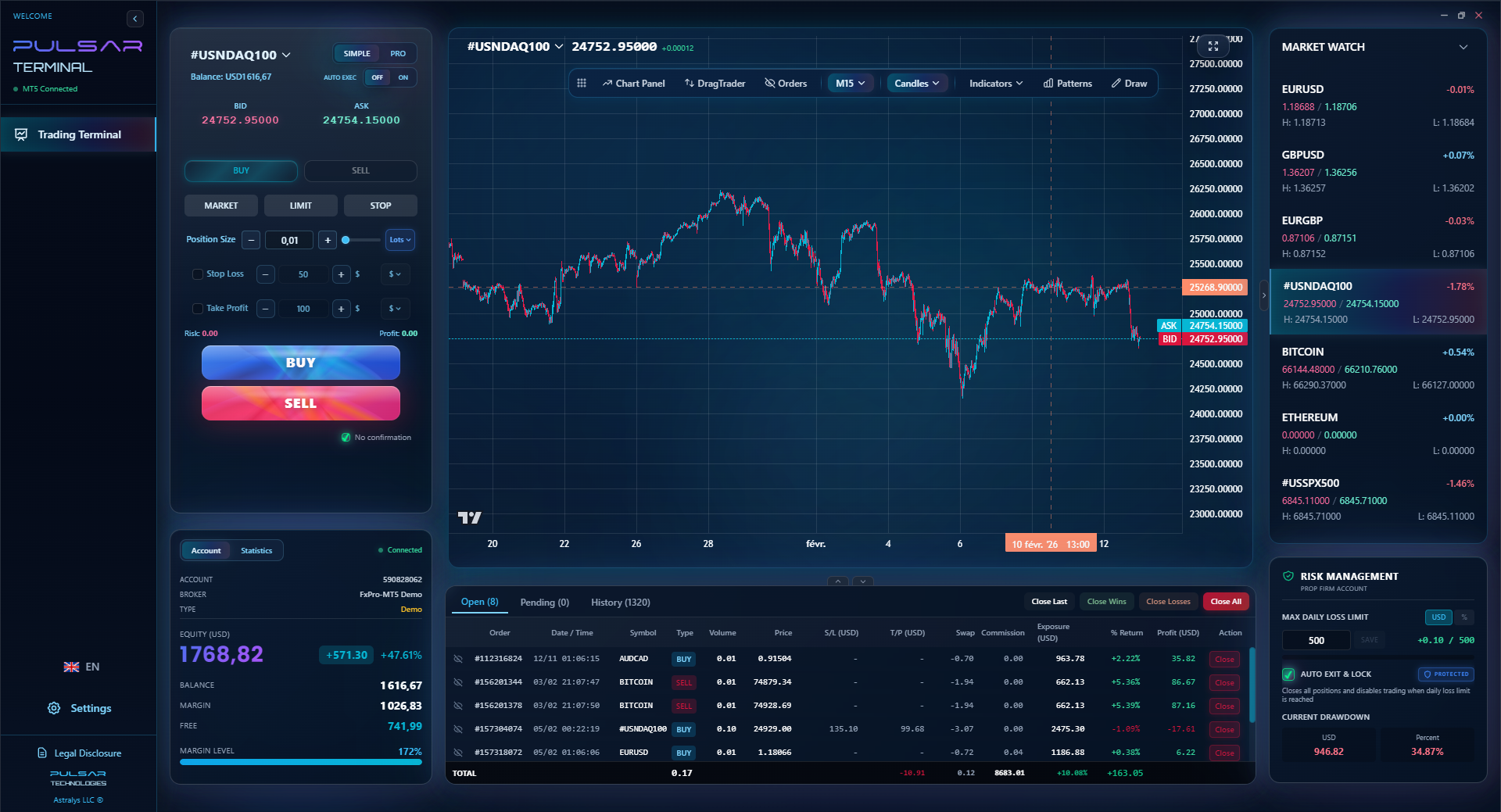
Backtesting your moving average strategy across multiple instruments and timeframes is tedious, but Pulsar Terminal's advanced charting and replay tools let you simulate years of market conditions in minutes directly within MT5.
Pulsar Terminal
The all-in-one MT5 companion: drag-and-drop orders, multi-TP/SL, trailing stop, grid trading, Volume Profile, and prop firm protection. Used by 1,000+ traders daily.
“A moving average crossover strategy that requires you to watch the screen constantly is a bad fit for a market with power instability.”
You wouldn't perform surgery after just reading a textbook. Don't trade with real money until you've tested your MA approach.
1. Start with a Trading Journal Template. For every potential trade, note: the pair, timeframe, MA periods used, the signal (e.g., "price bounce at 21 EMA"), and the outcome. Do this for 50-100 trades on a demo account.
2. Backtest on Specific Conditions. Don't just scroll back randomly. Ask specific questions: "How did the 50/200 SMA crossover perform on GBP/USD daily charts during trending months in 2023?" "How often did price respect the 100 SMA as support in a clear EUR/NGN uptrend?" Use the bar replay function in your platform.
3. Focus on Your Losses. When a trade based on an MA fails, go back and analyze why. Was the market ranging? Was there a major news event? Did price slice through the MA without slowing down? This analysis is worth more than 100 winning trades.
I backtested a simple 21 EMA bounce strategy on USD/CAD over 6 months. The raw win rate was 45% - losing. But when I added a filter (only taking trades in the direction of the 200-period SMA trend), the win rate jumped to 62%. The filter was the key, not the MA itself. You only find this through testing.
Finally, remember that indicators are just tools. The moving average is a hammer. You can use it to build a house or smash your thumb. Your psychology, risk management (always know what a margin call level is), and discipline determine which one happens.
FAQ
Q1Which is better for forex trading, SMA or EMA?
There's no universal "better." EMAs react faster to price changes, so they're preferred for shorter-term trading and getting earlier entries/exits. SMAs are smoother and better for identifying long-term, stable trends and key support/resistance levels. Many traders use a combination, like a fast EMA for signals and a slow SMA for trend context.
Q2What is the best moving average setting for day trading?
For day trading (1-hour charts and below), common settings are the 9, 20, or 21-period EMA for entry signals and the 50 or 100-period SMA to gauge the intraday trend direction. A popular combo is the 9 and 21 EMA crossover. However, 'best' is subjective - you must backtest on your chosen pairs to see what fits the volatility.
Q3How do you use moving averages for scalping?
Use very short-period EMAs (like 5, 9, or 12) on low timeframes (1-min, 5-min). The price will constantly cross them, so the signal isn't the crossover itself. Instead, use the angle of the MA (steeply up/down) to confirm a strong micro-trend, and then look to enter on a pullback to the MA line with a tight stop. It's high-speed and requires intense focus.
Q4Can moving averages predict future price movements?
No. Absolutely not. Moving averages are lagging indicators. They only show the average of past prices. They cannot predict the future. They can only help confirm that a trend is in place or identify potential areas where price might find support or resistance based on recent historical behavior.
Q5What does a moving average crossover mean?
A crossover occurs when a shorter-period moving average crosses above or below a longer-period one. A cross above (e.g., 50 SMA crossing above 200 SMA) is called a Golden Cross and suggests a potential shift to an uptrend. A cross below is a Death Cross, suggesting a potential downtrend. It's a confirmation signal, not an entry signal on its own.
Q6How many moving averages should I use on one chart?
Rarely more than three. More lines create confusion and analysis paralysis. A common effective setup is two: a faster one (e.g., 21 EMA) for dynamic S/R and a slower one (e.g., 55 or 200 SMA) for the primary trend bias. A third can sometimes be added for an intermediate timeframe. If your chart looks like a rainbow, you're overdoing it.
Q7Why does the price always seem to bounce off the 200 moving average?
The 200-period MA (especially on a daily chart) is watched by millions of traders, fund managers, and algorithms globally. It's a key benchmark for the long-term trend. This collective attention creates a self-fulfilling prophecy: because everyone sees it as important, they place orders around it, which makes price react there. It's a classic example of technical analysis in action.
Prof. Winston's Lesson
Key Takeaways:
- ✓MAs are lagging, never predictive.
- ✓Use MAs to find the trend, not the entry.
- ✓Combine MAs with price action for signals.
- ✓Always filter signals with a higher timeframe.
- ✓Backtest any MA strategy for 50+ trades first.
How useful was this article?
Click a star to rate
Weekly Trading Insights
Free weekly analysis & strategies. No spam.
About the Author
Olumide Adeyemi
West African Trading Pioneer
One of Nigeria's most active forex trading educators. 8 years of experience trading from Lagos. Specializes in low-capital strategies and prop firm challenges for African traders.
Comments
Risk Disclaimer
Trading financial instruments carries significant risk and may not be suitable for all investors. Past performance does not guarantee future results. This content is for educational purposes only and should not be considered investment advice. Always conduct your own research before trading.
You Might Also Like

Cara Trading Forex Sukses: 7 Prinsip dari Trader Profesional
Cara trading forex sukses dengan 7 prinsip trader pro: manajemen modal, disiplin, journal trading, backtest. Data nyata, bukan janji profit palsu.
Jam Trading Forex Terbaik untuk Trader Indonesia: Panduan Lengkap dengan Tabel Waktu
Panduan jam trading forex untuk trader Indonesia. Tabel 4 sesi dunia, jam emas 20:00-00:00, sesi mana yang harus dihindari. Data akurat + tips dari trader berpengalaman.
Top 5 Sàn Forex Uy Tín Nhất 2026: Review Jujur dari Trader Indonesia
Top 5 sàn forex uy tín 2026 untuk trader Indonesia. Review jujur: spread, deposit, withdraw, dukungan lokal. Exness, XM, IC Markets & lebih.
Get Pulsar Terminal
All these calculators are built into Pulsar Terminal with real-time data from your MT5 account. One-click position sizing, automatic risk management, and instant calculations.
Get Pulsar Terminal