


Most of what you hear about trading is noise.

Olumide Adeyemi
West African Trading Pioneer ·  Nigeria
☕ 12 min read
What you'll learn:
- 1What Are Key Levels? (It's Not What You Think)
- 2How to Find Them on Your Chart (The Practical Method)
- 3Trading Key Levels from Nigeria: The Local Realities
- 4Entry & Exit Strategies: Turning Levels into Profit
- 5Psychology & Round Numbers: The Invisible Force
- 6Common Mistakes Nigerian Traders Make (I've Made Them All)
- 7Tools & Broker Setup for Trading Levels in Nigeria
- 8Putting It All Together: A Live Trade Example
Most of what you hear about trading is noise. Indicators, news, guru predictions - it's mostly a distraction. The truth is, price only cares about a few specific places on a chart. If you learn to spot these key levels in forex, you strip away 90% of the confusion. I've traded through Naira crashes, liquidity droughts, and every broker hiccup you can imagine from Lagos to Port Harcourt. This guide isn't theory. It's a map of where the real battles between buyers and sellers are fought, tailored for the realities of trading from Nigeria.
Forget the textbook definitions for a second. In the real world, a key level is simply a price where enough traders remember what happened last time. It's collective memory on a chart. When price approaches these zones, people who missed a move the first time jump in, and those who got burned before panic out. That concentration of orders is what creates support and resistance.
There are four main types you need to know:
Support: A price zone where buying interest is strong enough to overcome selling pressure, halting a downtrend. Think of it as a floor. Resistance: The opposite. A price zone where selling pressure overcomes buying, stopping an uptrend. The ceiling. Psychological Levels: These are the big, round numbers. EUR/USD at 1.1000. GBP/USD at 1.2500. USD/NGN at 1500 (though good luck seeing that again). They matter because human brains like round numbers for placing orders. Pivot Points: Calculated levels based on the previous day's high, low, and close. They give you a framework for potential support and resistance for the current session. Handy for day traders.

Warning: A level is not a laser line. It's a zone. Price will almost always probe a few pips above or below a drawn line. If you treat it like an exact price, you'll get stopped out constantly. Give it room to breathe.
The real skill isn't just drawing the line. It's understanding why that line might hold or break, which is where your position size calculator becomes your best friend for managing the risk when you test these areas.
You don't need 10 indicators. All you need is a clean chart and the ability to look left. Here’s my simple, three-step process I’ve used for over a decade.
Step 1: Switch to a Higher Timeframe
Start on the Daily or 4-Hour chart. The bigger the timeframe, the more significant the level. A level on the weekly chart carries more weight than one on the 15-minute chart. I always mark my main levels from the Daily chart first.
Step 2: Look for Price Reactions
Scroll back in time. You're looking for places where price:
- Clearly reversed direction (a swing high or low).
- Stalled and consolidated for a long time.
- Spiked into and then rejected from an area. Draw a horizontal line across the closes of those candles, not just the wicks. The body of the candle often tells the truer story of where the battle was won or lost.
Step 3: Confirm with Touch Count
A level touched and respected 2-3 times is interesting. A level touched 5+ times becomes a major battleground. But be careful - the more times a level is tested, the more likely it is to eventually break. It's like a door being kicked repeatedly; it weakens.

Example: Let's say you're looking at GBP/USD. You see it rallied to 1.2850 in January, got rejected. Tried again in March, failed. Came back in May, failed again. That 1.2850 area is now a confirmed, multi-touch resistance zone. That's a high-probability level to watch for a sell setup.
This process works on any pair, whether you're scalping EUR/USD or trying to catch swings on XAU/USD. The principles are universal.

💡 Winston's Tip
A level is only 'key' if other traders see it. The most obvious levels - previous major highs/lows and big round numbers - are often the most reliable because everyone is watching them.
“The truth is, price only cares about a few specific places on a chart.”
Trading these concepts from Nigeria adds unique layers. Our internet can be shaky, the Naira is its own rollercoaster, and broker choice is critical. You have to adapt the classic rules.
First, mind the spread. When you're trading a bounce off a key level, your entry precision matters. If your broker's spread on EUR/USD is 1.8 pips (looking at you, some local offerings), that's a huge chunk of your potential profit on a short-term play. This is why I lean towards international brokers with tighter spreads for this style. I've used IC Markets and Pepperstone for years because their raw spreads mean my entry at a key level isn't immediately handicapped by 2-3 pips of cost.
Second, Naira pairs are a different beast. USD/NGN doesn't trade on your standard MT4/MT5 with retail brokers. The "key levels" there are often dictated by CBN policy announcements and parallel market sentiment, not pure technicals. Don't try to apply this guide directly to the Naira. Use these skills on major and minor forex pairs instead.
Third, use is a trap at key levels. Nigerian traders are often offered insane use like 1:1000. Here's a painful lesson from my book: In 2020, I identified a perfect support on AUD/USD at 0.6680. I was right on the level. Price bounced. But I used 1:500 use on a $500 account. A tiny 15-pip probe below the level triggered my stop and wiped out 30% of my account. The level held, and price rocketed up without me. The level was right, my risk management was idiotic. High use turns a correct analysis into a losing trade. Use a position size calculator religiously.
Finally, choose your session. If you're trading London or New York sessions, ensure your internet and power backup are solid. There's nothing worse than seeing your key level get hit and your generator choosing that moment to sputter.
Spotting the level is 50% of the job. The other 50% is having a plan to trade it. Here are the two main approaches.
1. The Bounce (Reversal) Trade: This is trading the assumption that the level will hold. You buy at support or sell at resistance.
- Entry: Don't market order right at the line. Wait for price to touch the zone and show a rejection candle (like a pin bar or a bullish engulfing at support). Place your entry just after that candle closes.
- Stop Loss: Place your stop loss beyond the key level. If it's support at 1.0850, maybe put your stop at 1.0830. You need to give the level room to be tested.
- Take Profit: Aim for the next key level in the opposite direction. If you buy at support, your first target is the nearest resistance above.
2. The Breakout Trade: This is trading the assumption that the level will fail, and a new trend will start.
- Entry: This is trickier. Don't buy the first spike through. That's often a false break. Wait for price to close convincingly beyond the level (on your chosen timeframe), then pull back to retest the level from the other side. That retest is your entry. If 1.0850 was resistance and price breaks above, wait for it to come back and touch 1.0850 (now acting as support) and bounce. That's your buy signal.
- Stop Loss: For a breakout, your stop goes back on the original side of the level. If buying a breakout above resistance, your stop goes below the old resistance zone.

Pro Tip: Confluence is king. A key level is good. A key level that aligns with a 50% Fibonacci retracement, or a moving average, or a previous daily close, is much better. The more reasons price has to react at a certain point, the higher your probability.
These strategies form the core of patient swing trading. They're about waiting for the high-probability setup, not chasing every pip.
“High use turns a correct analysis into a losing trade.”
This might be the most important section. Key levels work because of trader psychology, and nothing exemplifies this better than round numbers.
Why does EUR/USD constantly struggle at 1.1000, 1.1100, etc.? Because that's where the masses place their orders. Big banks know this. They'll often run stops clustered just beyond these numbers. You've probably seen it: price flies toward 1.1000, taps it, and reverses 20 pips. Or it bursts through, hits 1.1005, and then collapses.
I learned this the hard way early on. I had a short order resting at 1.1050 on GBP/USD. Price hit 1.1049.7 and reversed sharply. I missed the entire 80-pip drop by 0.3 pips. Why? Because the real selling pressure was at 1.1050, not 1.1049. Now, I place my limit orders a few pips away from the big round number to try and catch the early move.
For Nigerian traders, this psychology is double-edged. We're often trading to preserve dollar value against the Naira. That emotional drive can make us jump at round numbers without confirmation. Breathe. Let the price action at the level show its hand first. Use an indicator like RSI or MACD to look for divergence as price approaches these big levels - it can warn you of weakening momentum.
💡 Winston's Tip
If you're unsure whether to trade a bounce or a breakout, do nothing. The market will tell you. Waiting for confirmation might mean a slightly worse entry price, but it dramatically increases your chance of success.
Let's get honest. We all blow up accounts learning. Here are the classic errors to avoid with key levels.
1. Overcomplicating the Chart: You don't need 15 horizontal lines. If your chart looks like a cage, you've lost the plot. Focus on 2-3 major levels on your trading timeframe. Clarity beats complexity.
2. Ignoring the Higher Timeframe Trend: Trading a bounce off support on the 1-hour chart is suicidal if the daily chart is in a crushing downtrend and price is just stalling before a breakdown. Always trade in the direction of the higher timeframe trend when at a key level. It stacks the odds in your favor.
3. No Confirmation: This is the big one. You see price approaching support and you jump in with a market order. Then it slices right through. Always wait for a price action signal - a rejection candle, a slowdown in momentum. Let the market prove the level is holding before you commit your capital.
4. Forgetting About the Spread: I mentioned this earlier, but it's worth repeating. If your stop loss is 10 pips away and your broker's spread is 2 pips, you're already down 20% on the trade before it even moves. This is critical for scalping strategies around levels. Choose your broker wisely. Reviews for Exness and XM often highlight their spread structures, which is info you need.
5. Moving Your Stop Loss to Breakeven Too Early: You get a nice bounce from support, and as soon as you're 5 pips in profit, you drag your stop to breakeven. Then price pulls back to retest the level (a normal thing), hits your breakeven stop, and then rockets to your target. You've turned a winning trade into a scratch because you were scared. Let the trade breathe. Set your stop and leave it until price reaches a logical area where your original level thesis is invalidated.
“Your stop should be placed where the key level is clearly broken, not where your fear is triggered.”
Your toolkit can make or break you. Here’s my recommended setup, factoring in Nigerian constraints.
Trading Platform: MetaTrader 4 or 5 is the standard for a reason. It's reliable, even on slower connections, and the drawing tools are all you need. Most international brokers offer it.
Broker Selection Criteria:
- Regulation: Since local regulation is light, prioritize brokers under strong international jurisdictions like FCA, ASIC, or FSCA. It's your first line of defense. Check our Pepperstone review for an example of a well-regulated option.
- Spreads: For trading key levels, low, stable spreads are non-negotiable. Look for EUR/USD spreads under 1.0 pip on standard accounts, or raw spreads with a small commission.
- Deposit/Withdrawal: Can you fund with your Nigerian debit card or bank transfer? How long do withdrawals take? This is practical daily life stuff. Many brokers now support local bank transfers.
- use Options: Have the discipline to use low use (1:30 or less for this style), but it's good if the broker offers higher options for other strategies.
Essential Tools:
- A simple horizontal line tool.
- The session high/low indicator (to see where London/New York opened).
- A basic position size calculator (don't trade without it).
You don't need expensive software. The edge is in your discipline and your eye, not in a flashy indicator you bought online.
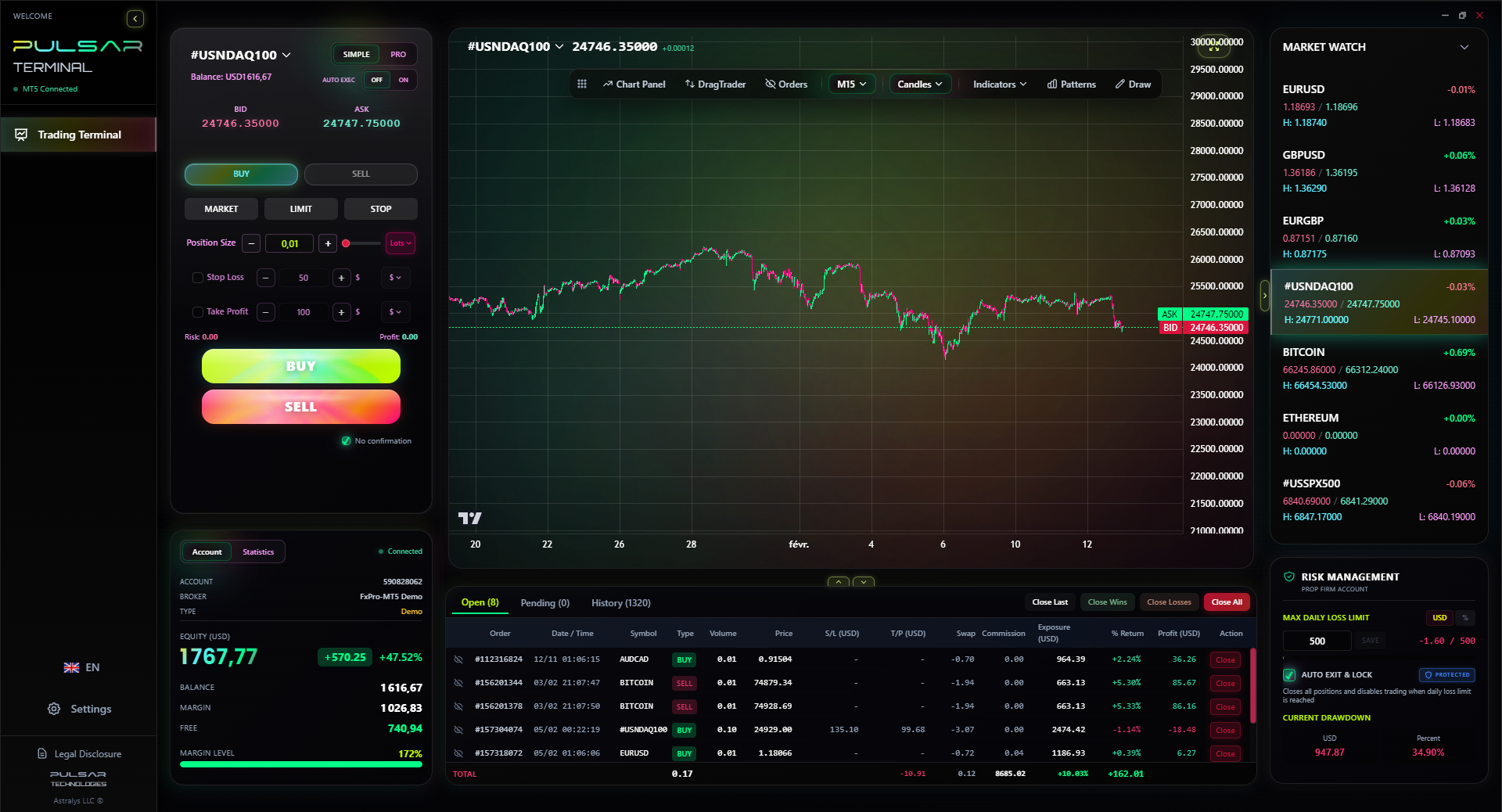
Managing partial profits and stop losses on trades from key levels is a mental game, which is why automating that process with a tool like Pulsar Terminal directly on MT5 can remove emotion and lock in gains systematically.
Pulsar Terminal
The all-in-one MT5 companion: drag-and-drop orders, multi-TP/SL, trailing stop, grid trading, Volume Profile, and prop firm protection. Used by 1,000+ traders daily.
Let's walk through a real trade I took last quarter, warts and all, to see how this connects.
The Setup: EUR/USD, Daily Chart. Price was in a broader uptrend but had pulled back. A major previous resistance-turned-support level sat at 1.0720. This level had acted as support in May and resistance back in April (a classic role reversal). It also aligned roughly with the 50% Fibonacci retracement of the prior swing up.
The Plan: Wait for price to approach 1.0720 and look for a bullish rejection candle on the 4-hour chart to signal a long entry for a bounce back toward 1.0850.
The Execution: Price drifted down and hit the zone. On the 4-hour chart, it formed a clear bullish pin bar with a long lower wick, closing well above the 1.0720 zone. That was my signal.
- Entry: 1.0735 (a few pips above the close of the pin bar).
- Stop Loss: 1.0690 (placed below the low of the pin bar and the key level zone).
- Take Profit 1: 1.0820 (a minor resistance area).
- Take Profit 2: 1.0850 (the next major swing high).
The Result: Price moved up, hit my first TP at 1.0820, and I closed half my position. It then stalled just shy of 1.0850, showed weakness, and I exited the remainder at 1.0835. Not a perfect capture of the full move, but a solid 85-pip gain on the first half and 100 pips on the second.
What I Did Wrong: I got nervous after the first target was hit and moved my stop on the remaining position too tightly, getting stopped out on a minor pullback before it made one final push. I broke my own rule about letting trades breathe. The lesson? Have a plan for partial profits, but don't micromanage the runner. A tool that automates this process would have saved me from myself.
This is the grind. Find the level, wait for confirmation, manage your risk, and control your emotions. That's the entire game.
FAQ
Q1Is forex trading legal in Nigeria?
Yes, forex trading is legal for individuals in Nigeria. However, the online retail broker space isn't heavily regulated locally yet. Most Nigerian traders use international brokers regulated by bodies like the FSCA, ASIC, or FCA. Remember, you're legally required to pay a 10% capital gains tax on your profits.
Q2What's the best timeframe to find key levels?
Start with the big picture. The Daily and 4-Hour charts show you the most significant, widely watched levels. Once you've marked those, you can drop down to the 1-Hour or 15-minute charts to fine-tune your entry. Never trade a level on a small timeframe that goes against a major level on the Daily chart.
Q3How many pips should I give a key level for my stop loss?
There's no magic number. Your stop should be placed where the key level is clearly broken. If support is at 1.0850, don't put your stop at 1.0849. Price will often probe 5-15 pips beyond a level before reversing. Place your stop on the other side of the level's zone, considering recent volatility. Always use a position size calculator so the potential loss fits your risk tolerance (e.g., 1-2% of your account).
Q4Why does price sometimes blow straight through a key level?
Because no level holds forever. Key levels represent areas of order concentration. If the fundamental pressure is strong enough (like a major central bank announcement), or if the level has been tested too many times, the orders get eaten up. That's why we wait for confirmation before trading and always use a stop loss. A breakout is just a different type of trade opportunity.
Q5Can I use key levels for scalping?
Absolutely, but you need to be extra careful. On lower timeframes like the 1 or 5-minute chart, levels are less reliable and spreads become a much bigger percentage of your profit target. It's a higher-skill, higher-stress approach. I'd recommend mastering levels on the 1-hour and 4-hour charts for swing trading before attempting to scalp them.
Q6What broker features are most important for trading key levels from Nigeria?
Low, stable spreads are number one. Slippage and wide spreads can ruin a precise level trade. Reliable execution during volatile times (like London open) is crucial. Finally, easy and affordable deposit/withdrawal methods for Naira are a practical necessity for your daily trading life.
Prof. Winston's Lesson
Key Takeaways:
- ✓Key levels are zones, not exact lines. Give them 5-15 pips of breathing room.
- ✓Always find your levels from a higher timeframe (Daily or 4-Hour) first.
- ✓Never trade a level without a price action confirmation candle.
- ✓Your broker's spread is a direct tax on your key level trading edge.
How useful was this article?
Click a star to rate
Weekly Trading Insights
Free weekly analysis & strategies. No spam.
About the Author
Olumide Adeyemi
West African Trading Pioneer
One of Nigeria's most active forex trading educators. 8 years of experience trading from Lagos. Specializes in low-capital strategies and prop firm challenges for African traders.
Comments
Risk Disclaimer
Trading financial instruments carries significant risk and may not be suitable for all investors. Past performance does not guarantee future results. This content is for educational purposes only and should not be considered investment advice. Always conduct your own research before trading.
You Might Also Like

Cara Trading Forex Sukses: 7 Prinsip dari Trader Profesional
Cara trading forex sukses dengan 7 prinsip trader pro: manajemen modal, disiplin, journal trading, backtest. Data nyata, bukan janji profit palsu.
Jam Trading Forex Terbaik untuk Trader Indonesia: Panduan Lengkap dengan Tabel Waktu
Panduan jam trading forex untuk trader Indonesia. Tabel 4 sesi dunia, jam emas 20:00-00:00, sesi mana yang harus dihindari. Data akurat + tips dari trader berpengalaman.
Top 5 Sàn Forex Uy Tín Nhất 2026: Review Jujur dari Trader Indonesia
Top 5 sàn forex uy tín 2026 untuk trader Indonesia. Review jujur: spread, deposit, withdraw, dukungan lokal. Exness, XM, IC Markets & lebih.
Get Pulsar Terminal
All these calculators are built into Pulsar Terminal with real-time data from your MT5 account. One-click position sizing, automatic risk management, and instant calculations.
Get Pulsar Terminal