


Everyone tells you to 'trade the trend' on Nifty.

Rajesh Sharma
Senior Forex Analyst ·  India
India
☕ 11 min read
What you'll learn:
Everyone tells you to 'trade the trend' on Nifty. It's the most repeated, useless piece of advice I've ever heard. I followed it blindly in 2023, chasing breakouts that reversed, and it cost me ₹2.8 lakh in six months. The real game isn't about spotting trends, it's about navigating SEBI's ever-changing rulebook and a tax structure that's actively working against retail traders. This guide isn't theory. It's a breakdown of what works now, after the 2026 STT hike and the new lot sizes, written from the trenches of the NSE.
If you're still using strategies from 2022, you're trading a market that doesn't exist anymore. SEBI hasn't just tweaked the rules, they've fundamentally changed the economics of trading Nifty futures and options (F&O).
Let's start with the brutal math. The STT hike in April 2026 was a gut punch. Selling a Nifty futures contract now costs 0.05% in tax, up from 0.02%. That's a 150% increase. For options, it's 0.15% on the premium. I ran the numbers on a trade last week: Nifty at 22,845, lot size of 75. My total cost to enter and exit? ₹837. Before the hike, it was about ₹392.

Warning: Your old breakeven points are wrong. That futures trade now needs Nifty to move nearly 13 points in my favour just to cover costs, up from 6 points. If your nifty trading strategy doesn't account for this, you're starting every trade in a hole.
The second earthquake was the lot size increase. Nifty futures moved from 25 to 75 units. Your capital requirement just tripled overnight for the same notional exposure. A ₹5 lakh account that could comfortably handle 2 lots now strains to manage one. This wasn't a minor adjustment. It was a deliberate move to push out the undercapitalized.
Then there's the upfront premium rule. Since February 2025, if you buy an option, your broker collects the full premium immediately. No more free intraday use on long options. It kills a lot of speculative, lottery-ticket style trading. Honestly? It's a good rule. It forced me to be more selective, but it also means you need more cash in your account just to place the trade.
Here's my first-person reality: In October 2024, I was short a Bank Nifty strangle. My margin requirement was about ₹1.3 lakh. I tried the same setup in February 2025 after the new margin rules. The same strangle required ₹2.2 lakh. My strategy was sound, but my account size wasn't. I had to scale down dramatically. The lesson? Your position size calculator is your most important tool now. Not your indicator suite.
“Your old breakeven points are wrong. That futures trade now needs Nifty to move nearly 13 points in my favour just to cover costs.”
Strategy comes second. Your capital management plan comes first. With higher costs and margins, the penalty for being wrong is exponentially higher.
The Minimum Viable Account
Forget the old ₹25,000 fantasy. To trade Nifty options with any sanity post-2026, you need at least ₹1 lakh. And that's for basic option buying. If you want to sell options (which I prefer for its probabilistic edge), you're looking at ₹3-5 lakh minimum due to the hefty margin requirements. For futures, with one lot requiring over ₹1.5 lakh in margin, a ₹5 lakh account is the bare minimum to handle a single trade and its margin call buffer.
I learned this the hard way. I funded an account with ₹80,000 in early 2025, thinking I was being conservative. One bad Nifty futures trade with a 50-point stop loss wiped out over 12% of my account. The position size was simply too large for the capital. Now, I never risk more than 1% per trade. On a ₹5 lakh account, that's ₹5,000. It sounds small, but it keeps you in the game.
Choosing Your Weapon: Futures vs. Options
This decision defines everything.
Futures are straightforward but merciless. Your profit/loss is virtually 1:1 with the index. With the new lot size of 75, each point is worth ₹75. A 100-point move is ₹7,500. The margin is high, and the spread is tight. It's pure directional betting.
Options are where the complexity and opportunity lie. Buying options is a decaying asset play - you're fighting time. Selling options is a volatility play - you're collecting premium. With the new upfront premium rule, buying options requires the full cash outlay, which reduces use. Selling options requires huge margin, but you collect premium upfront.
My personal shift? I've moved almost entirely to defined-risk option spreads. Instead of selling a naked put (huge margin), I sell a put spread. It caps my risk for a lower margin. It's less profitable per trade, but my sleep is better.

Pro Tip: Don't chase exotic strategies. Master one or two. A simple Put Credit Spread in a bullish market, or a Call Credit Spread in a bearish one, executed consistently, will beat a trader jumping between ten complex strategies every week.

💡 Winston's Tip
The market's primary job is to transfer money from the impatient to the patient. The new STT and lot sizes just raised the admission fee for impatience.
“Strategy comes second. Your capital management plan comes first.”
Let's get specific. These are the frameworks I use, adjusted for the new normal.
The Momentum-Following Framework (My Daily Bread)
This isn't about chasing. It's about confirming. I use a simple confluence:
- Price Action: Is Nifty making higher highs and higher lows on the 30-minute chart? I'm only interested in the structure.
- EMA Ribbon: A cluster of EMAs (9, 21, 50) acting as dynamic support/resistance. I don't need them in a perfect order, just as a zone.
- Volume: Is the move happening on increasing volume? The NSE's volume data is decent, but watch for expiry-day distortions.
Here's a real trade from March 2026: Nifty was consolidating around 22,200. It broke above 22,280 on the 30-min chart with volume. The EMA cluster (21,50) was just below at 22,240. I entered a Bull Call Spread: Bought 22,300 CE, Sold 22,400 CE. Cost: ₹4,200 per spread. Max risk: that ₹4,200. I didn't buy a future because the required margin (₹1.6 lakh+) would have tied up too much capital. The spread required about ₹35,000 in margin. The index rallied to 22,450, and I closed the spread for ₹7,100. A 69% return on risk. Not a home run, but a clean, manageable single.
The Mean Reversion Play (For Ranging Markets)
Nifty spends a lot of time in ranges, especially around expiry. When the RSI indicator on the hourly chart hits 70+ and price is at a known resistance (like a previous day's high), I look for a pullback.
I never short blindly. I use a Bear Put Spread. Example: Nifty at 22,800, RSI at 72. I buy a 22,700 Put and sell a 22,600 Put. I'm betting on a 50-100 point drop, not a crash. This defined-risk approach is crucial because catching a falling knife in a trending market is a surefire way to blow up.
Integrating News and Events
Budget days, RBI policy, global cues from the US Fed. These are not times for clever strategies. They are times for reduced position size or staying out. I got hammered on an RBI policy day in December 2025. I was in a futures long, and the governor's hawkish tone caused a 180-point gap down at open. My stop was useless. Now, I either close positions before major events or use options where my risk is predefined.
Finding a good broker with fast execution is non-negotiable for this style. Slippage on entry or exit can turn a good trade bad instantly.
“Revenge trading is financial suicide. After two losing trades, my rule is now to shut down the terminal for the day.”
I keep this simple. Complexity is the enemy of execution.
Charts: I use TradingView for analysis, but execute through my broker's terminal (I use a platform with strong charting, similar to what you'd find with IC Markets or Pepperstone for international markets, but with my local Indian broker).
Timeframes:
- Daily Chart: For trend bias. I just need to know if we're broadly above or below the 20-day SMA.
- 30-Minute Chart: My primary execution chart. It smooths out the 5-minute noise but is sensitive enough for intraday moves.
- 5-Minute Chart: For fine-tuning entry and exit. I rarely initiate a trade here.
Indicators (The Few That Matter):
- Moving Averages: 9, 21, and 50 EMA on the 30-minute chart. I watch for price reactions at these levels.
- RSI (14): For overbought/oversold clues within the trend. On the 30-minute, an RSI reading above 70 in a downtrend is a stronger sell signal than in an uptrend.
- Volume: The native volume bar. I look for climax volume on breakouts or reversals.
- VWAP: Especially for the first 2 hours. It's a magnet. I like fading extreme deviations from VWAP early in the session.
I've abandoned lagging indicators like the MACD indicator for Nifty intraday. By the time it gives a crossover, the move is often half done. Price and volume are my lead actors; everything else is supporting cast.

Example: On April 5th, 2026, Nifty opened gap up. By 10:15 AM, it was 40 points above the 30-min VWAP on low volume. The structure was bullish, but this was a fade opportunity. I waited for a 5-minute bearish candle and entered a small put spread for a pullback to VWAP. It worked for a 25-point gain. Not a trend trade, but a high-probability, low-risk mean reversion play.
💡 Winston's Tip
Your trading plan isn't complete until it has a clause titled 'What I Will Do When I Am Wrong.' Most plans only describe victory.
“Revenge trading is financial suicide. After two losing trades, my rule is now to shut down the terminal for the day.”
This is the most important section. SEBI's changes and the STT hike are designed to reduce speculative volume. They are making it harder for you. You will have losing streaks. The 89% loss statistic for F&O traders is real. Your job is to be in the 11%.
My ₹2.8 lakh loss taught me two things:
- Revenge trading is financial suicide. After two losing trades, my rule is now to shut down the terminal for the day. No exceptions. I go for a walk. The urge to 'make it back' is a primal, account-destroying force.
- You must love the process, not the payout. If you're excited about a potential ₹20,000 profit, you're doomed. You need to be satisfied by a well-executed trade plan, even if it results in a ₹2,000 loss that was within your risk parameters.
The new higher costs add a psychological tax. Every time you see that STT deduction, it stings. You have to accept it as the cost of doing business, like a shopkeeper pays rent. If you resent it, you'll overtrade to 'cover the cost,' which leads to more mistakes.
Journal every trade. Not just entry and exit. Write down your emotional state. I found that 80% of my biggest losses happened when I was tired, distracted, or emotionally charged from a previous trade. Now, if I'm not calm and focused, I don't trade. It's that simple.
Managing trades is harder than entering them. Knowing when to move a stop to breakeven, or when to take partial profits, is an art. This is where discipline from a clear plan saves you.
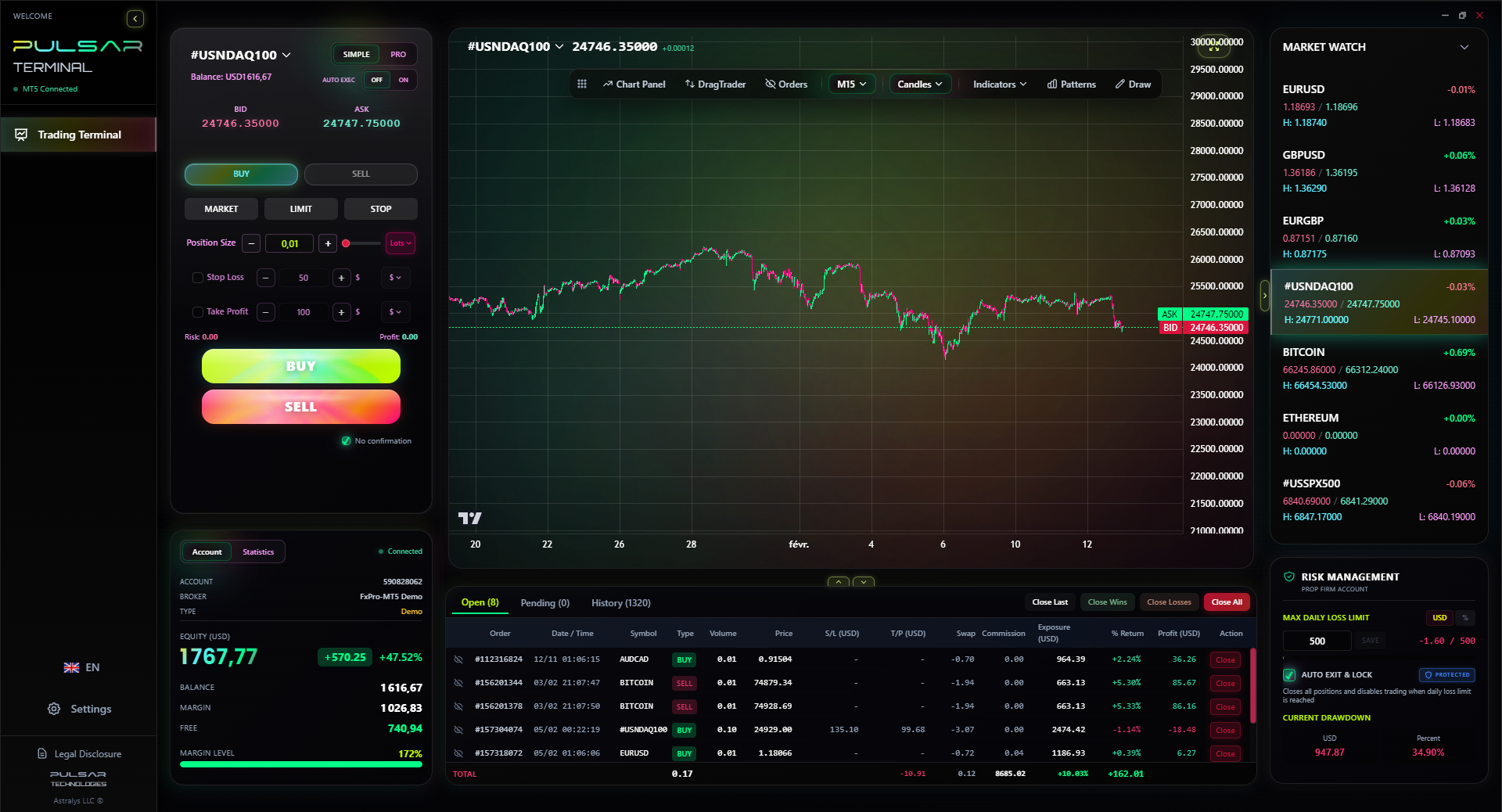
Managing the psychology of loss is easier when your trade management is automated, letting you stick to your plan without emotional interference.
Pulsar Terminal
The all-in-one MT5 companion: drag-and-drop orders, multi-TP/SL, trailing stop, grid trading, Volume Profile, and prop firm protection. Used by 1,000+ traders daily.
“You must love the process, not the payout.”
Your broker, your platform, your internet connection. These are not trivial.
Broker Selection: You need two things: low, predictable costs and reliable execution. I use a discount broker with a flat ₹20 per order fee for F&O. The fancy research reports from full-service brokers are worthless to me. I need my orders filled at the price I see. Test your broker's platform during high volatility (like at 9:15 AM open). Does it freeze? If yes, find a new one. Many traders I know have had good experiences with the stability of platforms like XM for global markets, but for Nifty, stick with a top-tier domestic provider.
Funding & Withdrawal: UPI is a godsend. Instant, free transfers. I fund my account via UPI at 9:10 AM if I need to. Withdrawals usually hit my bank in 2-3 hours. This liquidity is crucial.
Taxation (Consult a CA!): This is not advice, but what I do. I maintain a detailed P&L in an Excel sheet. For F&O, all trades are considered business income, so you can deduct expenses (internet, platform fees, etc.). The STT you pay is deductible from your business income. With the hike, this deduction is more valuable. Please, hire a chartered accountant who understands trading. The ₹10,000 fee is worth every rupee.
The Daily Routine:
- 8:55 AM: Check global markets (US futures, SGX Nifty), news headlines.
- 9:15 - 9:45 AM: I often do nothing. The opening volatility is a graveyard for careful plans. I watch.
- 10:00 AM Onwards: Look for my setups on the 30-minute chart. I might take 1-2 trades max per day.
- 3:00 PM: Start winding down. No new entries after 3:15 PM unless it's a slam-dunk setup.
This structure prevents scalping madness, which is nearly impossible with the new costs, and keeps me aligned with a swing trading mindset on an intraday timeframe.
💡 Winston's Tip
A strategy that doesn't survive a 20% increase in transaction costs was never a strategy. It was a lucky guess dressed in complexity.
FAQ
Q1What is the minimum amount needed to start trading Nifty in 2026?
Forget the old numbers. To trade Nifty options with any sensible risk management, you need at least ₹1 lakh. For futures, where one lot margin can be over ₹1.5 lakh, a minimum of ₹5 lakh is realistic to handle a single trade and survive volatility. Starting with less under the new lot size and STT rules is a fast track to getting wiped out.
Q2How has the STT hike changed my strategy?
It forces you to be more selective and aim for larger moves. Your breakeven point is higher. A strategy that targeted 10-point profits is now dead. You need to filter for trades with a 20-30 point minimum target to make the costs worthwhile. It also makes high-frequency trading virtually impossible for retail.
Q3Is option buying or selling better now?
There's no 'better,' only what suits your capital and psychology. Option buying requires full premium upfront, so you need cash and are fighting time decay. Option selling offers a probabilistic edge (most options expire worthless) but requires huge margins due to SEBI's rules. Most retail traders are better off with defined-risk spreads (like credit spreads) which limit margin and cap risk.
Q4What's the biggest mistake new Nifty traders make?
Trading without a capital plan. They pick a strategy first, then realize their account is too small to execute it properly after accounting for the new lot sizes and margins. They over-use, one bad trade cripples them, and they start revenge trading. Define your risk per trade (I use 1% of capital) before you even look at a chart.
Q5Can I still trade Bank Nifty weekly options?
No. SEBI's rule from November 2024 limits weekly expiries to only one benchmark index. The NSE chose Nifty 50. So, Bank Nifty now only has monthly and other longer-dated expiry options. This reduced liquidity and increased the importance of monthly expiry cycles for Bank Nifty.
Q6How do I manage risk with the new higher margins?
Use a position size calculator religiously. Before every trade, calculate the maximum loss if your stop loss is hit. That figure must be a tiny fraction of your total capital (e.g., 1%). If the margin required for that trade forces your risk above that threshold, the trade is too big. Either find a strategy with lower margin (like spreads) or pass on the trade.
Q7Should I use use from my broker?
Absolutely not. With SEBI's increased margins and intraday monitoring, use is a double-edged sword that's now even sharper. The market's inherent volatility, combined with higher costs, means using extra use is the quickest way to trigger a margin call and a forced square-off. Trade only with the capital you have.
Prof. Winston's Lesson
Key Takeaways:
- ✓Triple-check your breakeven: STT added 7 points of friction.
- ✓₹1 lakh is the new minimum for serious options trading.
- ✓Trade defined-risk spreads, not naked positions.
- ✓Your first loss is your smallest loss. Never average down.
- ✓Journal your mood. 80% of big losses are emotional.
How useful was this article?
Click a star to rate
Weekly Trading Insights
Free weekly analysis & strategies. No spam.
About the Author
Rajesh Sharma
Senior Forex Analyst
Trading Indian and South Asian markets for over 10 years. Started with NSE currency derivatives before moving to international forex. Specializes in USD/INR and emerging market pairs.
Comments
Risk Disclaimer
Trading financial instruments carries significant risk and may not be suitable for all investors. Past performance does not guarantee future results. This content is for educational purposes only and should not be considered investment advice. Always conduct your own research before trading.
You Might Also Like

Cara Trading Forex Sukses: 7 Prinsip dari Trader Profesional
Cara trading forex sukses dengan 7 prinsip trader pro: manajemen modal, disiplin, journal trading, backtest. Data nyata, bukan janji profit palsu.
Jam Trading Forex Terbaik untuk Trader Indonesia: Panduan Lengkap dengan Tabel Waktu
Panduan jam trading forex untuk trader Indonesia. Tabel 4 sesi dunia, jam emas 20:00-00:00, sesi mana yang harus dihindari. Data akurat + tips dari trader berpengalaman.
Top 5 Sàn Forex Uy Tín Nhất 2026: Review Jujur dari Trader Indonesia
Top 5 sàn forex uy tín 2026 untuk trader Indonesia. Review jujur: spread, deposit, withdraw, dukungan lokal. Exness, XM, IC Markets & lebih.
Get Pulsar Terminal
All these calculators are built into Pulsar Terminal with real-time data from your MT5 account. One-click position sizing, automatic risk management, and instant calculations.
Get Pulsar Terminal