


You're probably searching for the 'number 1 forex broker in the world,' hoping to find the one perfect answer.

David van der Merwe
Emerging Markets Trader ·  South Africa
☕ 9 min read
What you'll learn:
You're probably searching for the 'number 1 forex broker in the world,' hoping to find the one perfect answer. I get it. When I started trading from Johannesburg 13 years ago, I wanted that same magic bullet. Here's the honest truth you won't hear in most ads: there is no single 'best' broker for everyone. The real question is: which broker is the number one fit for you, your strategy, and your life here in South Africa? Let's cut through the hype and look at what actually matters.
The idea of a single champion broker is a marketing fantasy. What makes a broker perfect for a London-based hedge fund scalping the EUR/USD guide makes it terrible for a Cape Town teacher doing weekly swings on gold. Your 'number 1' depends entirely on your profile.
A prop firm trader needs ultra-low latency and direct market access. A part-time swing trader needs reliable platforms and good customer support during SA business hours. Someone starting with R5,000 needs a low minimum deposit, not the broker with the absolute tightest spreads. I learned this the hard way. Early on, I chased the broker with the cheapest commissions, only to get destroyed by slippage during our local load-shedding periods when their servers lagged. The 'best' price became the most expensive mistake.
Think of it like buying a car. Asking for the 'number 1 car in the world' is meaningless without context. Are you driving on the N1 or through the Drakensberg? Do you need fuel efficiency or off-road capability? Your trading needs are just as specific.

Warning: Any site or person that definitively names one global 'number 1' broker is likely getting paid to say so. They're selling you a dream, not giving you practical advice.
If you take one thing from this guide, let it be this: only trade with a broker regulated by the Financial Sector Conduct Authority (FSCA). This is your first and most important filter. Trading with an unregulated offshore broker is like playing poker with a stranger who's also dealing the cards.
The FSCA (which took over from the FSB) enforces rules that protect you. They mandate client fund segregation, meaning your money is held in separate accounts from the broker's operating funds. If the broker goes under, your capital isn't part of their bankruptcy estate. This alone has saved countless South African traders over the years.
The use Cap: 1:30
Since 2021, the FSCA has capped use for retail traders at 1:30 on major forex pairs. This aligns with Europe's ESMA rules. You'll see brokers advertising 1:500 or 1:1000 – those are for their global entities, not their FSCA-licensed ones. While lower use feels limiting, it's a protective measure. It forces better risk management. I used to blow accounts regularly with 1:100 use. The 1:30 cap forced me to size positions correctly, and my consistency improved dramatically. You can check your potential risk with a position size calculator to see the difference use makes.
A broker holding an FSCA license (look for a valid FSP number) also needs a local presence, a compliance officer, and must adhere to South African financial laws. If you have a dispute, you have a local authority to turn to. Don't trade this away for a few extra pips.

💡 Winston's Tip
The broker is just the venue. Your edge comes from your strategy and discipline, not their platform. Don't blame your tools for a bad trade you chose to take.
“Trading with an unregulated offshore broker is like playing poker with a stranger who's also dealing the cards.”
Forget the advertised 'from 0.0 pips' headline. You need to understand the total cost of trading, which includes spreads, commissions, and bank charges.
Spreads & Commissions: For a major pair like EUR/USD, you'll generally see two account types. A 'Standard' account might have a spread of 0.8 to 1.6 pips with no commission. A 'Raw' or 'ECN' account might have a spread from 0.0 pips but charge a commission, typically $3-$10 per standard lot (100k units) per side. Do the math: A 0.8 pip spread equals $8 per lot. A 0.1 pip spread plus a $5 commission is $6 per lot. The raw account is cheaper, but only if you're trading decent sizes.
The Hidden Killer: Bank Fees. This is the uniquely South African cost. Funding your account isn't free. If you deposit $1,000 via an international wire transfer, your bank (like Standard Bank or FNB) will charge a fee, often around R250 for an outgoing payment. The receiving broker's bank might also take a cut ($15-$25). Then, when you withdraw profits, you pay again. I once made a $300 profit, only to net R2,800 after all the conversion and fees – a 15% haircut.

Example:
- Profit on trade: $300 (≈ R5,550)
- Outgoing wire fee (to broker): R250
- Incoming wire fee (to you): R350 (Capitec 2025 fee example)
- Broker's processing fee: $25 (≈ R462) Total Fees: ~R1,062 Net Profit in Rands: R5,550 - R1,062 = R4,488
Look for brokers that offer local deposit methods like Ozow, Instant EFT, or SID Instant EFT to avoid these international fees. It makes a massive difference to your bottom line.
Finally, don't forget about swap fees (overnight financing) if you hold trades for more than a day. These can eat into a long-term swing trading position.
Here’s a look at some well-known brokers with a strong presence in South Africa. This isn't a ranking, but a snapshot to show how they differ. Remember, the 'best' is the one that fits your needs.
| Broker | FSCA Licensed? | Key Feature for SAs | Typical EUR/USD Cost (per lot) | Min. Deposit | Good For... |
|---|---|---|---|---|---|
| IC Markets | Yes (via IC Financial Services) | Raw spreads, great for ECN | 0.1 pips + $7 commission ($8 total) | $200 (≈R3,700) | Active traders, scalpers wanting tight spread definition. IC Markets review. |
| Exness | Yes | Local ZAR deposits/withdrawals | 0.8 - 1.2 pips (no commission) | R0 (Zero min) | Beginners, those wanting easy local funding. Exness review. |
| Pepperstone | Yes | Award-winning platforms & support | 0.0 pips + $7 commission ($7 total) | $200 (≈R3,700) | Traders who value tech & analysis tools. Pepperstone review. |
| XM | Yes (via Trading Point SA) | Large bonus offers, many webinars | 1.7 pips (no commission) | $5 (≈R93) | New traders wanting education and small starts. XM review. |
My personal journey? I started with XM for their low barrier to entry. I then moved to IC Markets as my volume increased and I needed lower costs for my scalping strategy. Now, I use a combination for different strategies. Your broker can (and should) change as you evolve.
💡 Winston's Tip
Test a broker's execution with a small trade during high volatility. If they consistently slip your orders or requote you, walk away. Cost isn't just the spread; it's the fill.
“The search for the 'number 1 forex broker' is really the search for the right partner for *this* stage of your journey.”
A broker's platform is your office. If it's clunky, unreliable, or lacks the tools you need, you're fighting with one hand tied behind your back.
MetaTrader 4/5 (MT4/MT5) are the industry standards in South Africa. Most local traders use them. They're reliable, have thousands of custom indicators (like the RSI indicator or MACD indicator), and support automated trading. If a broker doesn't offer MT4/5, I'd be very cautious.
Execution Quality is where the rubber meets the road. This is the speed and accuracy of your trade fills. You want a broker with No Dealing Desk (NDD) execution, meaning they pass your order directly to liquidity providers (big banks). This minimizes conflict of interest and reduces slippage. Always check a broker's policy on requotes and slippage. A bad experience I had: during a major news event, my stop-loss was slipped by 15 pips on the XAU/USD guide with a broker known for poor execution. That cost me R2,200 on a single trade.
Additional Tools: Does the broker offer advanced charting, economic calendars, or sentiment tools? For example, having a reliable Volume Profile tool can be a game-changer for identifying key support and resistance levels. Some brokers integrate these natively, while others don't.

Pro Tip: Before depositing real money, open a demo account and trade it during volatile periods (like when the JSE opens or during US data releases). Test the execution, see if the platform freezes, and get a feel for it. A demo is free, but a bad platform with real money is an expensive lesson.
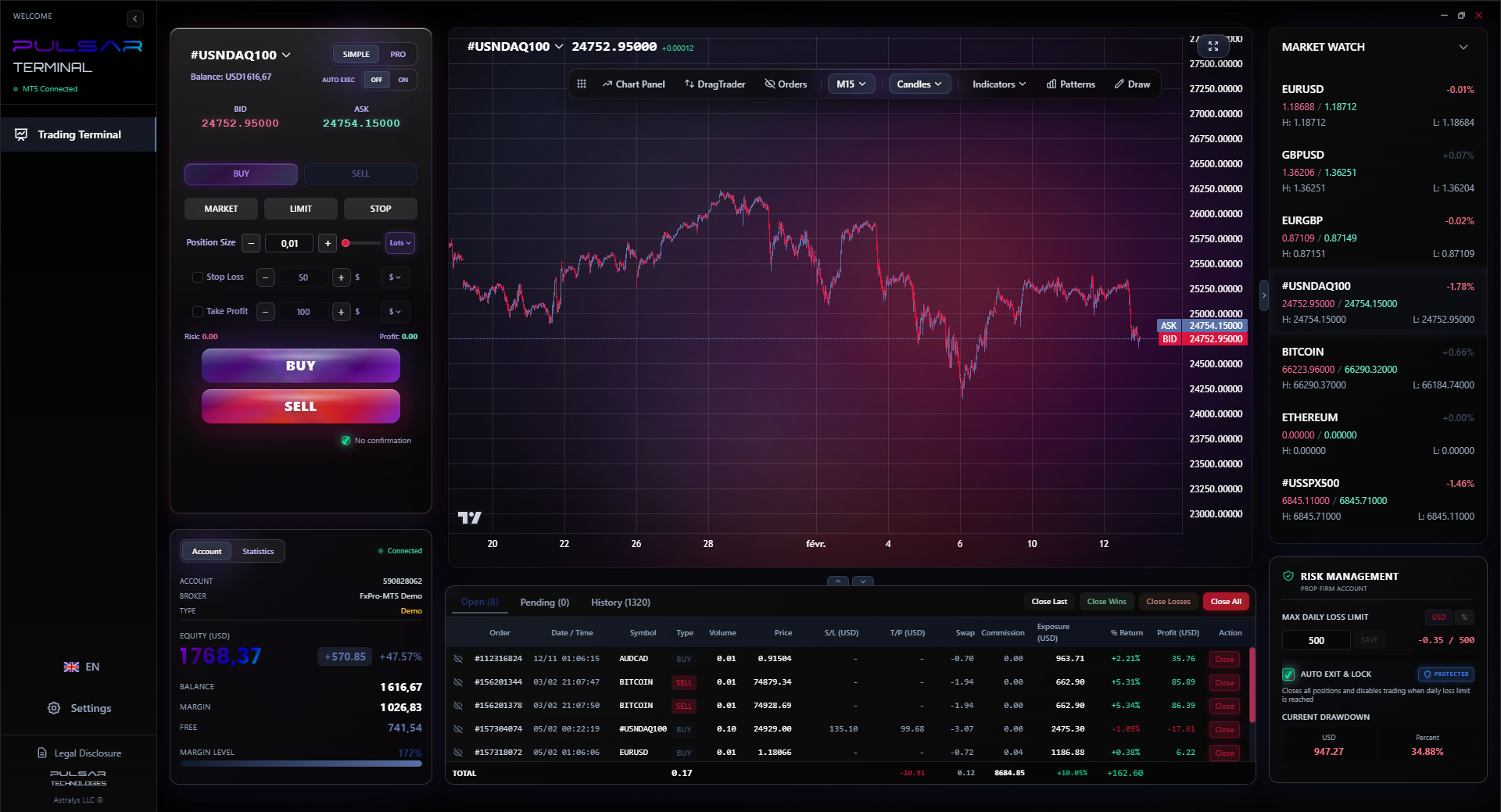
Managing complex trades and risk across multiple positions is easier with tools that automate partial closures and advanced order types directly on your MT5 platform.
Pulsar Terminal
The all-in-one MT5 companion: drag-and-drop orders, multi-TP/SL, trailing stop, grid trading, Volume Profile, and prop firm protection. Used by 1,000+ traders daily.
So, how do you decide? Work through this list honestly.
- Regulation: Is the entity you're signing up with FSCA regulated? Verify the FSP number on the FSCA website.
- Cost Structure: Does your typical trade size favour a raw spread + commission account or a wider spread-only account? Calculate the break-even point.
- Funding & Withdrawals: What local deposit/withdrawal options do they offer? What are the fees, and how long does it take to get your money? This is critical for South Africans.
- Platform & Tools: Do they offer MT4/5? Do they have the specific tools you rely on? If you're a visual trader, can you draw on the charts easily?
- Customer Support: Call or live-chat their support. Ask a technical question. Are they responsive during South African hours? I once had a critical withdrawal issue at 8 PM; a broker with 24/5 support solved it in minutes.
- Your Strategy Fit: Are you a high-volume scalper? Then ultra-low costs and fast execution are your priority. Are you a long-term position trader? Then swap rates and platform stability matter more.
There's no perfect score. You might have to compromise. Maybe you accept slightly higher costs for flawless local banking. That's okay. The goal is to find the broker whose strengths match your needs and whose weaknesses don't cripple your strategy.
Remember, you can always switch. The search for the 'number 1 forex broker in the world' is really the search for the right partner for this stage of your trading journey. Start with safety (FSCA), then optimize for cost and convenience. That's how you build a sustainable trading business from right here in South Africa.
💡 Winston's Tip
Your first broker should be the one that lets you learn without high costs or complexity. You can always upgrade later. Don't start with a Formula 1 car on your learner's permit.
FAQ
Q1Is forex trading legal in South Africa?
Yes, absolutely. It's legal and regulated by the Financial Sector Conduct Authority (FSCA). The key is to only use brokers that are licensed by the FSCA to ensure your funds are protected under South African law.
Q2What is the maximum use I can get in South Africa?
For retail traders, the FSCA has capped maximum use at 1:30 on major currency pairs. This is a protective rule. Any broker offering you more than 1:30 on their FSCA-licensed entity is breaking the rules. You might see higher use on their international sites, but you lose FSCA protection.
Q3How are my forex trading profits taxed in South Africa?
Profits from forex trading are considered taxable income by SARS. You must declare them on your annual tax return. It's wise to keep detailed records of all your trades, deposits, and withdrawals. Speak to a tax consultant familiar with trading income for specific advice.
Q4What's better, a Standard account or a Raw/ECN account?
It depends on your trade size. Standard accounts have wider spreads but no commission. Raw/ECN accounts have tiny spreads but charge a commission per lot. As a rough guide: if you're trading mini or micro lots (under 0.5 standard lots), a Standard account is often simpler and cheaper. If you're trading 1 standard lot or more frequently, the Raw/ECN account usually offers lower total costs. You have to do the math for your own trading.
Q5Can I use international brokers like Interactive Brokers?
You can, but there's a big catch. While platforms like Interactive Brokers are top-tier, they are not regulated by the FSCA for forex/CFDs offered to South African retail clients. This means if you have a dispute, the FSCA can't help you. You'll also face higher international bank fees to fund the account. For most South African retail forex traders, an FSCA-regulated broker is the safer, more practical choice.
Q6What happens if my broker goes bankrupt?
This is why FSCA regulation is non-negotiable. Regulated brokers must keep client funds in segregated accounts at reputable banks. This means your money is legally separate from the broker's company money. If the broker fails, your funds should be safe and returned to you. This protection does not exist with unregulated brokers.
Prof. Winston's Lesson
Key Takeaways:
- ✓FSCA regulation is your first and most important filter.
- ✓Calculate total cost: spread + commission + bank fees.
- ✓Match the broker's strengths to your specific trading style.
- ✓Use a demo account to test execution during SA market hours.
- ✓You can and should change brokers as your needs evolve.
How useful was this article?
Click a star to rate
Weekly Trading Insights
Free weekly analysis & strategies. No spam.
About the Author
David van der Merwe
Emerging Markets Trader
Johannesburg-based trader with 11 years in emerging market currencies. Specializes in ZAR pairs, FSCA-regulated trading, and South African market analysis.
Comments
Risk Disclaimer
Trading financial instruments carries significant risk and may not be suitable for all investors. Past performance does not guarantee future results. This content is for educational purposes only and should not be considered investment advice. Always conduct your own research before trading.
You Might Also Like

Cara Trading Forex Sukses: 7 Prinsip dari Trader Profesional
Cara trading forex sukses dengan 7 prinsip trader pro: manajemen modal, disiplin, journal trading, backtest. Data nyata, bukan janji profit palsu.
Jam Trading Forex Terbaik untuk Trader Indonesia: Panduan Lengkap dengan Tabel Waktu
Panduan jam trading forex untuk trader Indonesia. Tabel 4 sesi dunia, jam emas 20:00-00:00, sesi mana yang harus dihindari. Data akurat + tips dari trader berpengalaman.
Top 5 Sàn Forex Uy Tín Nhất 2026: Review Jujur dari Trader Indonesia
Top 5 sàn forex uy tín 2026 untuk trader Indonesia. Review jujur: spread, deposit, withdraw, dukungan lokal. Exness, XM, IC Markets & lebih.
Get Pulsar Terminal
All these calculators are built into Pulsar Terminal with real-time data from your MT5 account. One-click position sizing, automatic risk management, and instant calculations.
Get Pulsar Terminal