


I lost R8,000 in 2021 to a slick operation that called itself a 'premium trading group.' They promised mentorship, signals, and access to a 'private liquidity pool.' The website looked professional, the testimonials were glowing, and the person on the phone sounded like he knew his stuff from Sandton.

David van der Merwe
Emerging Markets Trader ·  South Africa
☕ 9 min read
What you'll learn:
- 1The Phantom Firm: What 'Platinum Forex Group' Really Means
- 2Your Financial Bodyguard: Understanding FSCA Regulation
- 3Cutting Through the Hype: Real Broker Costs & Numbers
- 4The 5-Minute FSCA Check: Don't Skip This
- 5Depositing Your Rands: Local Practices That Make Sense
- 6Spotting the Scam: Lessons from My R8,000 Mistake
- 7Forget 'Groups': Build Your Own Trading Framework

I lost R8,000 in 2021 to a slick operation that called itself a 'premium trading group.' They promised mentorship, signals, and access to a 'private liquidity pool.' The website looked professional, the testimonials were glowing, and the person on the phone sounded like he knew his stuff from Sandton. After my first deposit, the signals were late, the 'mentor' was never available, and my account was bled dry by massive spreads and hidden fees on a platform I couldn't even withdraw from. That experience, which I now see had all the hallmarks of a scam operation not unlike what a 'Platinum Forex Group' might represent, taught me the most expensive lesson of my career: in South Africa, the regulator's stamp isn't just paperwork, it's your lifeline.
Let's be brutally honest. After digging through FSCA registers, broker review sites, and trader forums, I found zero evidence of a legitimate, regulated South African broker called 'Platinum Forex Group.' That's a massive red flag. In our context, a name like that typically points to one of three things: a completely unregulated offshore bucket shop using a fancy name to attract deposits, a signal-selling or 'education' scam masking as a brokerage, or a cloned entity impersonating a real firm.
These operations often target new traders with the allure of exclusivity and premium service. They'll talk about 'platinum-tier liquidity' or 'group trading power,' but it's just marketing fluff designed to separate you from your money. I learned this the hard way. A real broker doesn't need to invent a prestigious-sounding name; their FSCA license number is their credibility.

Warning: If you're contacted by a 'Platinum Forex Group' promising guaranteed returns or secret strategies, run. No legitimate FSCA-regulated broker operates that way. Your first step should always be to check the FSP number on the FSCA's official website.

💡 Winston's Tip
A fancy name is the cheapest thing a company can buy. An FSP number is expensive to get and maintain. Always bet on the latter.

Trading with an FSCA-licensed broker isn't a suggestion, it's your primary line of defense. The Financial Sector Conduct Authority is the only body that can legally authorize a firm to offer forex trading services to South Africans. Here’s what that license actually means for your money.
What FSCA Regulation Actually Does
When you deposit funds with an FSCA-regulated broker, like those we've reviewed such as Exness or IC Markets, they are legally required to segregate client money. This means your Rands are held in separate bank accounts from the company's operational funds. If the broker goes under (which happens), your capital isn't part of their bankruptcy estate. An unregulated 'Platinum Forex Group' has no such obligation. Your deposit is just income to them.
The use Cap: It's There to Save You
A key rule many traders grumble about is the use cap for retail clients. While it can change, it's often around 1:30 for major pairs. Yes, it limits your potential buying power. But remember my R8,000 lesson? That loss was magnified by 1:500 use offered by an unregulated entity. The FSCA's cap forces discipline. It makes blowing up your account in minutes much harder, which is why scammers hate it - they want you to blow up fast so you'll deposit again.
Dispute Resolution You Can Use
If you have a legitimate issue with a regulated broker - say, a withdrawal problem - you have a formal path through the FSCA's dispute resolution mechanisms. With an unregulated group, your only recourse is a costly lawyer or, more likely, shouting into the void. That formal path is a cornerstone of real market integrity.

“In South Africa, the regulator's stamp isn't just paperwork, it's your lifeline.”
Forget the 'zero spread' fantasies promised by phantom groups. Let's talk real numbers from actual regulated brokers accessible in South Africa. This is where you separate the sustainable business model from the scam.
Typical Costs with a Regulated SA Broker:
| Cost Type | What It Is | Real-World Example (Major Pairs) |
|---|---|---|
| Spread | Difference between buy/sell price | EUR/USD: 0.7 - 1.5 pips |
| Commission | Fee per lot traded (on RAW/ECN accounts) | $3.50 per 100,000 (round turn) |
| Swap Fee | Cost/credit for holding overnight | Varies daily with interest rates |
| Funding Fee | Deposit/Withdrawal (often free) | Local EFT: R0 - R80 |
A 'Platinum Forex Group' type operation will often have hidden fees: huge markups on spreads (I've seen 5+ pips on EUR/USD), mandatory 'subscription fees,' or punitive withdrawal charges. Their business isn't your trading success; it's extracting fees.

Example: Let's do a quick calculation. On a standard lot (100,000 units) of EUR/USD:
- Regulated Broker: 1.2 pip spread = $12 cost + maybe a $7 commission = ~$19 total.
- Unregulated 'Group': 4 pip spread with no commission = $40 cost. That's over double the cost before you're even in profit. Over 100 trades, that's $2,100 extra you're giving away.
Minimum deposits also tell a story. A reputable broker might let you start with R500 or R2,000 to test their platform. A scam operation will often demand a large 'minimum investment' of R10,000 or more to make the theft worthwhile. Always use a position size calculator to understand your true risk, regardless of the minimum.

This is the single most important habit you can develop. It takes less time than making a coffee.
- Get the FSP Number: Any legitimate broker targeting South Africans will display their Financial Service Provider (FSP) number prominently on their website, usually in the footer. It looks something like 'FSP No. 12345'.
- Go to the Source: Navigate to the FSCA's official website. Use their 'Search for an authorised Financial Service Provider' function.
- Punch in the Number: Enter the FSP number. Not the company name - clone firms copy names. The number is unique.
- Verify the Details: The search result must match exactly: the company's registered name, the service category (should include 'Discretionary & Non-discretionary Forex Investments'), and the status must be 'Authorised'.
If there's no FSP number, or if the details don't match, treat it as a scam. Full stop. I wish I had done this in 2021. This check would have saved me R8,000 and a lot of frustration. Many reputable international brokers like Pepperstone or XM have specific FSCA-licensed entities for South African clients.
💡 Winston's Tip
Your first call with a broker shouldn't be about bonuses. It should be you asking for their FSP number and their client money segregation policy. Their reaction will tell you everything.
“Your strategy gets you into trades. Your risk management keeps you in the game.”
A legitimate broker makes it easy and cheap to get your money in and out. The local practices tell you if they're serious about the South African market.
Payment Methods You Should Expect:
- Local EFT/Bank Transfer: This is the standard. Processing is usually within 24 hours, and fees are low or absorbed by the broker.
- Credit/Debit Cards: Instant funding, but check if your bank allows international forex transactions.
- E-Wallets: Skrill, Neteller, and others. Fast, but sometimes have higher fees on the wallet side.
If a 'broker' only accepts cryptocurrency deposits or international wire transfers to an obscure bank in another country, that's a major warning sign. It's a tactic to make tracing and recovering funds nearly impossible.
Platforms Are Non-Negotiable: You want MetaTrader 4 or MetaTrader 5. Period. These are industry-standard platforms with proven reliability, deep charting tools, and support for automated trading. Any broker offering only a proprietary, web-based platform with limited functionality is limiting your ability to analyze the market properly. A good platform is your workshop. Don't settle for a toy.

Pro Tip: Before depositing real money, open a demo account on the broker's MT4/MT5 platform. Check the latency, the spreads during volatile news events (like SA CPI data releases), and the ease of placing and managing orders. If the demo feels clunky or 'off,' the live trading will be worse.
Looking back, the signs were so obvious. Here’s what a fraudulent operation, whether it's called Platinum Forex Group or anything else, will do:
- Guaranteed Profits: They promise weekly returns or 'low-risk, high-reward' setups. Forex is inherently risky. Anyone guaranteeing profits is lying.
- Pressure to Deposit: Urgent calls or emails about a 'limited-time bonus' or a 'can't-miss trade.' Legitimate brokers don't need to pressure you.
- Vague or Copy-Paste Strategy: Their 'analysis' is generic stuff you can read for free online. They can't explain their edge in a clear, logical way.
- Withdrawal Problems: The first withdrawal is always the hardest. They'll delay, ask for more 'verification fees,' or blame technical issues. This is where they truly reveal themselves.
- No Clear FSP Details: As discussed, this is the biggest red flag of all.
My failed trade wasn't a market mistake; it was a due diligence failure. I was so eager to start making money that I ignored the basic checks. The trade itself was a small loss, but the platform fees and the eventual inability to withdraw the remainder is where the real 'cost' was. That's the scam model: death by a thousand fees and blocks.
💡 Winston's Tip
If you wouldn't walk into a physical office and hand them R10,000 in cash, don't do it online. Apply the same visceral caution.

“The goal is to become self-sufficient, not dependent on any group.”
Chasing a mythical 'platinum' group won't make you a profitable trader. Building a disciplined, personal framework will. Here’s where to focus your energy instead.
Start with a Strategy You Understand
Don't buy a signal service. Learn a simple strategy and test it relentlessly on demo. Could be a basic MACD and moving average crossover, or price action around key support and resistance. I started making consistent progress only when I dropped the complex 10-indicator systems and focused on pure price action and the RSI indicator for divergence. Master one timeframe and one or two pairs, like EUR/USD or XAU/USD.
Risk Management is Your Real Edge
Your strategy gets you into trades. Your risk management keeps you in the game. Decide your risk-per-trade (1-2% of capital is standard) and stick to it with a stop-loss on every single trade. This is non-negotiable. A margin call is a failure of risk management, not bad luck.
Choose Your Style Wisely
Are you at your screen all day? Scalping might seem appealing, but it's brutally hard and costs pile up with spreads. Most South African traders with day jobs find more success with swing trading, holding trades for days or weeks based on higher-timeframe analysis. It's less stressful and more compatible with a normal life.
The goal is to become self-sufficient, not dependent on any group. That independence is the most valuable asset you'll ever develop in trading.

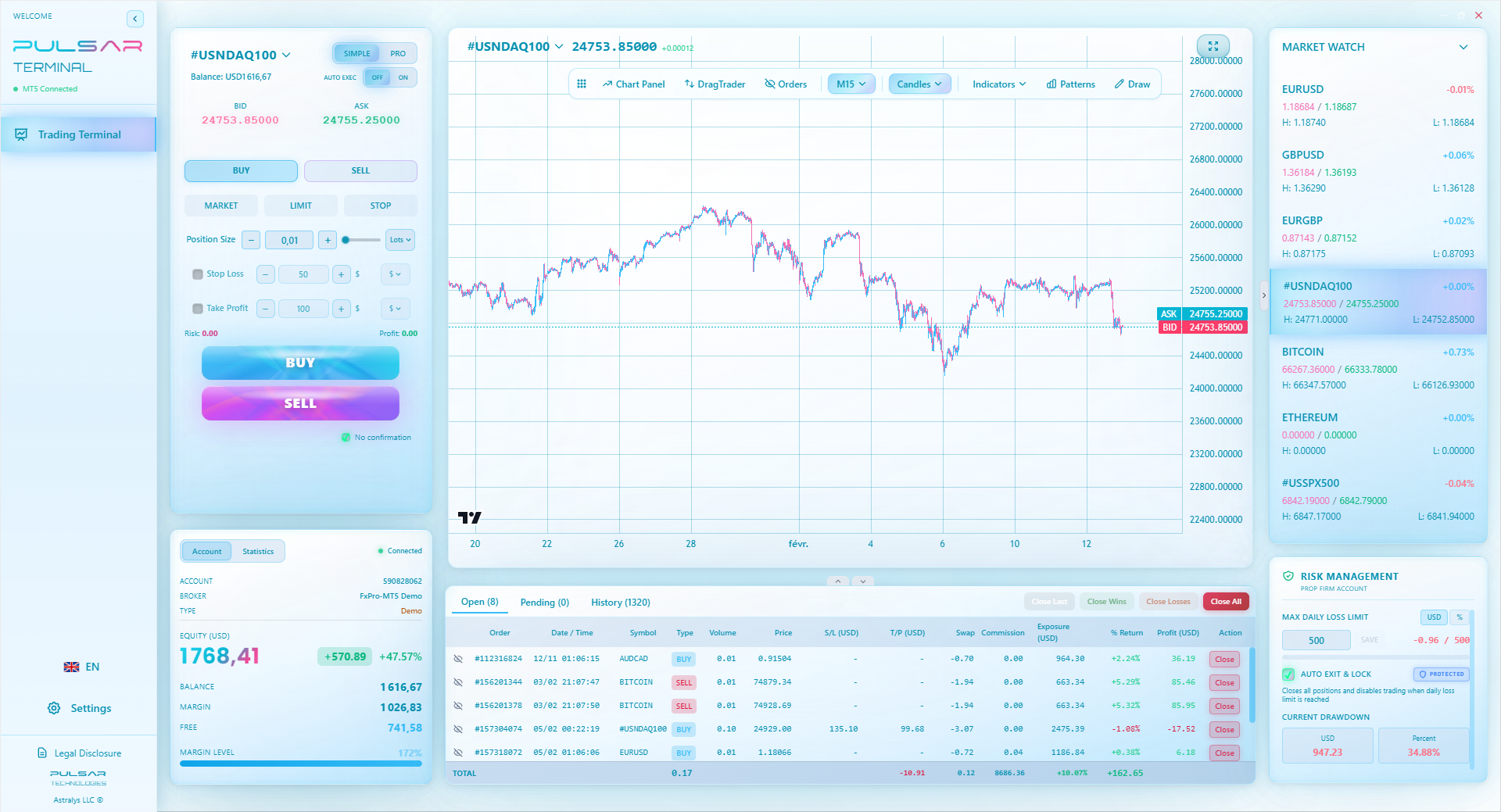
Building a disciplined framework means having precise control over your trades, which is where tools like Pulsar Terminal's drag-and-drop orders and multi-TP/SL management on MT5 become indispensable.
Pulsar Terminal
The all-in-one MT5 companion: drag-and-drop orders, multi-TP/SL, trailing stop, grid trading, Volume Profile, and prop firm protection. Used by 1,000+ traders daily.
FAQ
Q1Is Platinum Forex Group a regulated broker in South Africa?
No. There is no record of a broker called 'Platinum Forex Group' being licensed by the Financial Sector Conduct Authority (FSCA) in South Africa. Any entity using this name to offer forex trading services to South Africans is operating illegally and should be avoided.
Q2What is the safest way to fund a forex trading account in South Africa?
The safest method is a direct EFT (Electronic Funds Transfer) from your South African bank account to the FSCA-regulated broker's local bank account (often held with a major SA bank). This creates a clear audit trail. Always avoid brokers that only accept crypto or wire transfers to foreign banks.
Q3What use can I get from an FSCA-regulated broker?
For retail clients, the FSCA imposes use limits to protect traders. While specific numbers can be adjusted, you can typically expect maximum use between 1:30 and 1:100 for major forex pairs. This is significantly lower than the 1:500 or 1:1000 often advertised by unregulated offshore entities.
Q4I was contacted by Platinum Forex Group. What should I do?
Do not engage, do not deposit any money, and do not provide personal documents. Cease all communication. You can report the approach to the FSCA to help them track these types of scams. Then, focus your search on verified, regulated brokers from the FSCA's official register.
Q5Can I use international brokers like IG or Saxo Bank in South Africa?
Yes, but only if they have a specific entity that is licensed by the FSCA to offer services in South Africa. Many large international brands have a dedicated South African subsidiary that holds an FSP license. You must ensure you are opening an account with their FSCA-licensed entity, not their global or UK-based company.
Q6What's the minimum deposit for a real forex account in SA?
It varies by broker. Reputable, regulated brokers often have low barriers to entry, with minimum deposits ranging from R500 to R2,000 for a standard account. Be very wary of any firm demanding a large minimum deposit (e.g., R10,000+) as a requirement to start trading.
Prof. Winston's Lesson
Key Takeaways:
- ✓Verify the FSP number, not the company name.
- ✓Expect 1:30 to 1:100 use from regulated brokers.
- ✓Local EFT funding is safest for audit trails.
- ✓MT4/MT5 platforms are the industry standard.
- ✓Guaranteed profits are a guaranteed lie.
How useful was this article?
Click a star to rate
Weekly Trading Insights
Free weekly analysis & strategies. No spam.
About the Author
David van der Merwe
Emerging Markets Trader
Johannesburg-based trader with 11 years in emerging market currencies. Specializes in ZAR pairs, FSCA-regulated trading, and South African market analysis.
Comments
Risk Disclaimer
Trading financial instruments carries significant risk and may not be suitable for all investors. Past performance does not guarantee future results. This content is for educational purposes only and should not be considered investment advice. Always conduct your own research before trading.
You Might Also Like

Cara Trading Forex Sukses: 7 Prinsip dari Trader Profesional
Cara trading forex sukses dengan 7 prinsip trader pro: manajemen modal, disiplin, journal trading, backtest. Data nyata, bukan janji profit palsu.
Jam Trading Forex Terbaik untuk Trader Indonesia: Panduan Lengkap dengan Tabel Waktu
Panduan jam trading forex untuk trader Indonesia. Tabel 4 sesi dunia, jam emas 20:00-00:00, sesi mana yang harus dihindari. Data akurat + tips dari trader berpengalaman.
Top 5 Sàn Forex Uy Tín Nhất 2026: Review Jujur dari Trader Indonesia
Top 5 sàn forex uy tín 2026 untuk trader Indonesia. Review jujur: spread, deposit, withdraw, dukungan lokal. Exness, XM, IC Markets & lebih.
Get Pulsar Terminal
All these calculators are built into Pulsar Terminal with real-time data from your MT5 account. One-click position sizing, automatic risk management, and instant calculations.
Get Pulsar Terminal