


I lost ₹1.2 lakh in a single week back in 2018.

Rajesh Sharma
Senior Forex Analyst ·  India
India
☕ 10 min read
What you'll learn:

I lost ₹1.2 lakh in a single week back in 2018. It wasn't a bad trade that did it. I was using an offshore broker to trade EUR/USD, thinking I was being smart with their 500:1 use. The trade was fine. The problem came when my bank froze my account. The RBI had flagged the international transfer. I spent the next three months providing statements, explaining the 'investment,' and facing questions from my bank's compliance officer. The financial loss was one thing. The stress, the fear of legal letters, and the threat to my credit history were the real punishment. That experience taught me more about the rules than any winning trade ever could.
This is the single most important thing to get right. Most confusion and risk comes from not understanding this line.
Legal forex trading in India has one, very specific definition. You are only allowed to trade INR-based currency pairs as futures and options contracts on Indian exchanges like the NSE or BSE. That's it. Full stop.
The approved list is short and sweet:
- USD/INR
- EUR/INR
- GBP/INR
- JPY/INR
You do this through a SEBI-registered Indian broker like Zerodha, Angel One, or ICICI Direct. The platform will be their own or something like NOW or Kite. You are not trading the global spot forex market. You're trading a standardized derivative contract based on that currency's value.
Now, here's where everyone gets tempted and gets into trouble. Trading any other pair - like EUR/USD, GBP/JPY, or even gold (XAU/USD) - is illegal for an Indian resident if done on an international platform. This includes all those MetaTrader 4/5 brokers you see advertised. The RBI made this crystal clear back in 2011: remitting money abroad for speculative forex trading is not allowed under FEMA.

Warning: A common misconception is using the Liberalised Remittance Scheme (LRS) to fund an overseas trading account. Don't. The RBI has explicitly stated the LRS is not for speculative forex trading. Using it for that purpose is a direct violation.
So, if it's all so restricted, why do international brokers still accept Indian clients? They operate in a regulatory grey area from their end, but for you, the Indian resident, it's black and white: it's not permitted. The risk and the punishment for forex trading in India on these platforms falls entirely on you, not the broker.

💡 Winston's Tip
The market's greatest use is patience traded within the rules. A 10:1 margin on a legal trade you understand is infinitely more powerful than 1000:1 on a bet that could end your career.
“The financial loss from a bad trade is one thing. The stress, the fear of legal letters, and the threat to your credit history are the real punishment.”
Let's talk numbers, because the penalties aren't abstract warnings. They're specific, financial, and life-altering. Under the Foreign Exchange Management Act (FEMA), the authorities have serious teeth.
Financial Penalties That Hurt
The fines are designed to be punitive, not just a slap on the wrist. You could be fined up to three times the amount involved in the illegal transaction. Let that sink in. If you sent $10,000 abroad to trade, you could face a fine of up to $30,000 (converted to INR). There's also a provision for a penalty of up to ₹5 lakh.
And it gets worse. If you continue the violation, they can hit you with a daily penalty of ₹10,000 for every single day the violation persists. This can bankrupt you fast.
The Threat of Imprisonment
For serious, wilful violations, Section 13(1C) of FEMA allows for imprisonment for up to five years. This isn't for the small-time guy trying his luck with $500. This is for large, repeated, or money-laundering-linked operations. But the threat is on the books, and it shapes the entire enforcement approach.
The Silent Killers: Asset Freezing and Blacklisting
This is what happened to me, and it's more common than jail. The Enforcement Directorate (ED) or your bank can freeze your bank accounts and seize assets linked to the illegal activity. Your money is stuck. You can't pay EMIs, rent, or bills. The psychological and practical damage is immense.
You may also be blacklisted by banks and brokers. Getting a loan, a credit card, or even opening a simple savings account can become a nightmare. Your financial identity gets a permanent red flag.

Example: Imagine you profit $5,000 trading GBP/USD on an offshore platform. You win! But to bring it back, you receive it in your INR account. The bank's system flags an unusual foreign credit. Now you're explaining the source. If deemed illegal, you could face a fine of up to $15,000 (3x the amount), have the $5,000 profit confiscated, and get your account frozen during the investigation. Your "winning" trade just cost you at least $20,000 and months of hassle.
“Trying to move money for unauthorized forex trading has become financially painful and very, very visible to authorities.”
Okay, let's say you navigate the legal minefield. You trade USD/INR futures legally on the NSE. You make a profit. Congratulations! Now comes the taxman.
Profits from trading currency derivatives are treated as business income or speculative business income if that's your primary activity. This means they get added to your total income and taxed at your applicable slab rate. You can deduct related expenses (brokerage, platform fees, internet), but you must maintain proper books of account if your turnover is high.
Here's the critical part: you must report these profits in your ITR. Not reporting income from legal trading is tax evasion. Not reporting income from illegal trading is a double whammy - you're breaking FEMA and tax laws.
The New TCS Rule (A Big Deal for LRS Users)
Pay close attention. From April 1, 2025, if you use the LRS for any non-education, non-medical purpose (like investing in overseas stocks, which is legal), a 20% Tax Collected at Source (TCS) applies on amounts exceeding ₹10 lakh in a financial year. Your bank will deduct this tax before sending the money.
Why does this matter for forex? Because if someone tries to misuse the LRS to fund a forex account, this 20% TCS is an immediate, upfront cost. It makes an already illegal activity even more expensive. For legal LRS uses, remember you can claim credit for this TCS when you file your annual tax return.
The bottom line: The tax system is now intricately linked to cross-border flows. Trying to move money for unauthorized forex trading has become financially painful and very, very visible to authorities.
💡 Winston's Tip
Your first calculation before any trade should be 'What is the cost of being wrong?' In India, that cost isn't just a lost pip; it can be a frozen asset or a legal fee that dwarfs your account size.

“The conservative use on Indian exchanges isn't a limitation; it's a forced education in risk management.”
So, is all forex trading dead for Indians? Absolutely not. The legal route is just different. It's more structured, less speculative (in the eyes of the regulator), and honestly, a good training ground for risk management.
Step 1: Choose a SEBI-Registered Broker
This is non-negotiable. Open an account with a reputable domestic broker. I've used Zerodha for years for my equity and currency derivative trading. Their Kite platform is solid. Other excellent choices include Angel One, Upstox, and ICICI Direct. These brokers are members of the NSE, BSE, and MCX-SX.
Step 2: Understand the Product
You'll be trading currency futures (obligation to buy/sell at a future date) and options (right, but not obligation). The contract sizes are standardized. For example, one USD/INR futures contract is typically for $1000. Your profit or loss is the difference between your entry and exit price, multiplied by the contract size.
use is offered by the broker but is far more conservative than offshore outfits. You might get 10:1 or 20:1 margin, not 500:1. This is a good thing. It prevents you from blowing up your account in seconds. You need to learn proper position size calculator techniques from the start.
Step 3: Develop a Strategy for This Market
The dynamics of trading USD/INR futures can be different from spot EUR/USD. It's heavily influenced by RBI intervention, domestic dollar demand, and oil prices. You need to watch economic data and news. Technical analysis still works beautifully. I often use the RSI indicator and MACD indicator on these charts just like any other.
Because the market is exchange-traded, it has defined hours (9 AM to 5 PM IST typically). This makes it suitable for swing trading based on daily charts rather than 24-hour scalping.

Pro Tip: Start with paper trading. Most Indian broker platforms offer a virtual mode. Get a feel for the contract sizes, spread definition, and price movements without risking a rupee. It's the best way to learn the legal product.

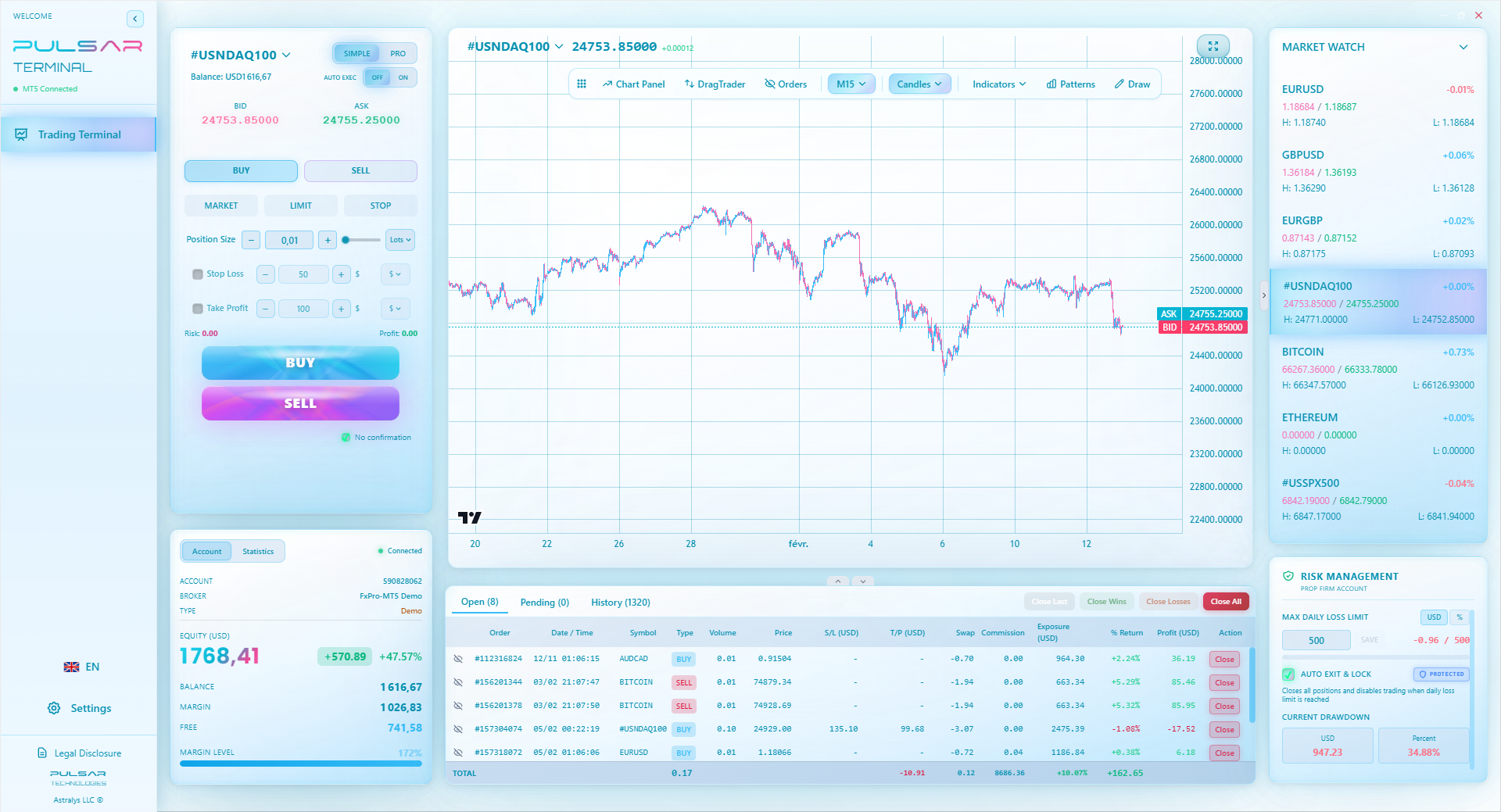
When trading USD/INR futures, managing multiple targets and a trailing stop is key, and Pulsar Terminal brings that advanced order functionality directly to your MT5 platform.
Pulsar Terminal
The all-in-one MT5 companion: drag-and-drop orders, multi-TP/SL, trailing stop, grid trading, Volume Profile, and prop firm protection. Used by 1,000+ traders daily.
“The conservative use on Indian exchanges isn't a limitation; it's a forced education in risk management.”
I need to be brutally honest about this, because I see so many new traders seduced by the ads. Yes, brokers like Exness, XM, and IC Markets accept Indian clients. They might even offer you local deposit methods like UPI. Their platforms like MT5 are fantastic, offering tools you won't find on basic Indian broker terminals.
But here's the reality check. They do this because they are regulated in other countries (Cyprus, Seychelles, etc.), not because it's legal for you. They are not regulated by SEBI for offering spot forex to Indians. The moment you hit deposit, you are assuming 100% of the legal risk.
Let's compare what they offer versus the reality:
| Feature | Offshore Broker Offer | The Indian Reality |
|---|---|---|
| Pairs | 50+ including EUR/USD, Gold | Illegal for you to trade |
| use | Up to 1000:1 | Massive risk, illegal, can cause a margin call instantly |
| Platform | MT4/MT5 with advanced tools | The tool is legal, the activity on it is not |
| Deposit | Easy UPI/Bank Transfer | The transfer trail is the evidence against you |
I made this mistake. The allure of trading the real EUR/USD with tight spreads was strong. I used a well-known broker reviewed on Exness review sites. The trading experience was smooth. The withdrawal back to my bank account is what triggered the alarm bells. The system is designed to catch cross-border flows for speculation.
The promise of high use is a trap. It lets you control a large position with little capital, which sounds great until the market moves 0.5% against you and wipes out your deposit. The conservative use on Indian exchanges forces discipline.
If you absolutely want access to global markets, the only legal way is through the LRS to invest in overseas stocks or ETFs. You cannot use it for forex CFDs or spot trading. Full stop.
💡 Winston's Tip
A strategy that depends on regulatory arbitrage is not a trading strategy. It's a gamble on the efficiency of enforcement. Build your edge on price action and psychology, not loopholes.

“The legal market is your training ground. Use it.”
If you're new to trading, I beg you: start with the legal Indian system. I wish I had. Here’s why.
First, it forces you to learn the fundamentals. You have to understand what a futures contract is, how expiry works, what margin is. This knowledge is timeless and transfers to any market in the world later if you choose to move abroad.
Second, the lower use saves you from yourself. When I started offshore, I put $1000 on a trade with 100:1 use. A 1% move meant I doubled my money or lost it all. It was gambling, not trading. On the Indian exchanges, the margin requirements mean your positions are sized more appropriately for your capital. It teaches you real position size calculator skills.
Third, you sleep at night. There is zero fear of a legal notice, a frozen account, or a knock on the door. That peace of mind lets you focus on your analysis, your emotions, and improving your strategy. The mental capital you preserve is huge.
Build your skill and track record legally. Trade USD/INR futures. Learn to read order flow, understand how RBI policies move the rupee. Once you are consistently profitable in this challenging environment, you have a real skill. Then, if you ever have the opportunity to trade in a jurisdiction where it's legal, you'll be miles ahead.
Trying to skip this step by going offshore is like trying to run before you can walk, on a path littered with legal bear traps. The potential punishment for forex trading in India the illegal way isn't just a fine; it's derailing your entire financial future and causing immense stress. It's just not worth it. The legal market is your training ground. Use it.

FAQ
Q1Can I go to jail for forex trading in India?
Yes, in severe cases. Under FEMA, wilful and large-scale violations of forex regulations can lead to imprisonment for up to five years. While more common for large operations, the threat exists for any illegal activity.
Q2Is Forex trading legal with international brokers like Exness or XM?
No. For an Indian resident, trading non-INR pairs (like EUR/USD) on international platforms is not permitted under RBI rules, regardless of the broker's global reputation. You assume all legal risk. Check our Exness review or XM review for details on their offerings, but remember the activity itself is illegal for you.
Q3What is the fine for illegal forex trading?
Fines can be up to three times the amount involved in the illegal transaction or ₹5 lakh, whichever is applicable. Continuing violations can attract a daily penalty of ₹10,000 per day.
Q4Can I use the Liberalised Remittance Scheme (LRS) for forex trading?
No. The RBI has explicitly clarified that the LRS cannot be used for remittances towards speculative forex trading on overseas platforms. Using it for this purpose is a violation.
Q5What forex pairs can I legally trade in India?
You can only trade INR-based currency derivatives (futures & options) on Indian exchanges. The allowed pairs are USD/INR, EUR/INR, GBP/INR, and JPY/INR.
Q6Are profits from legal currency trading taxable?
Yes. Profits are treated as business income and taxed at your applicable income tax slab rate. You must report them in your Income Tax Return (ITR).
Q7My bank account was frozen for forex trading. What should I do?
Cooperate fully with the bank and any authorities. Provide all requested transaction statements and explanations. Consult a lawyer who specializes in FEMA matters immediately. Do not ignore the notices.
Prof. Winston's Lesson
Key Takeaways:
- ✓Trade only INR pairs: USD/INR, EUR/INR, GBP/INR, JPY/INR.
- ✓Fines can be 3x the transaction amount or ₹5 lakh.
- ✓Imprisonment up to 5 years is possible for severe violations.
- ✓Use SEBI brokers: Zerodha, Angel One, Upstox.
- ✓Never use LRS for forex trading.
How useful was this article?
Click a star to rate
Weekly Trading Insights
Free weekly analysis & strategies. No spam.
About the Author
Rajesh Sharma
Senior Forex Analyst
Trading Indian and South Asian markets for over 10 years. Started with NSE currency derivatives before moving to international forex. Specializes in USD/INR and emerging market pairs.
Comments
Risk Disclaimer
Trading financial instruments carries significant risk and may not be suitable for all investors. Past performance does not guarantee future results. This content is for educational purposes only and should not be considered investment advice. Always conduct your own research before trading.
You Might Also Like

Cara Trading Forex Sukses: 7 Prinsip dari Trader Profesional
Cara trading forex sukses dengan 7 prinsip trader pro: manajemen modal, disiplin, journal trading, backtest. Data nyata, bukan janji profit palsu.
Jam Trading Forex Terbaik untuk Trader Indonesia: Panduan Lengkap dengan Tabel Waktu
Panduan jam trading forex untuk trader Indonesia. Tabel 4 sesi dunia, jam emas 20:00-00:00, sesi mana yang harus dihindari. Data akurat + tips dari trader berpengalaman.
Top 5 Sàn Forex Uy Tín Nhất 2026: Review Jujur dari Trader Indonesia
Top 5 sàn forex uy tín 2026 untuk trader Indonesia. Review jujur: spread, deposit, withdraw, dukungan lokal. Exness, XM, IC Markets & lebih.
Get Pulsar Terminal
All these calculators are built into Pulsar Terminal with real-time data from your MT5 account. One-click position sizing, automatic risk management, and instant calculations.
Get Pulsar Terminal