


Here's a brutal truth: 90% of the time, the market is either trending or correcting.

Olumide Adeyemi
West African Trading Pioneer ·  Nigeria
☕ 11 min read
What you'll learn:
- 1What is a Retracement? (It's Not a Reversal)
- 2Why Retracements Happen (Especially in Our Market)
- 3How to Spot a Retracement: Fibonacci, Moving Averages & Price Action
- 4A Simple Retracement Trading Strategy (With Real Numbers)
- 5Risk Management: The Only Thing That Saves You
- 6Common Mistakes Nigerian Traders Make with Retracements
- 7Retracement Trading vs. Scalping: Which Suits You?
- 8Putting It All Together: Your Retracement Checklist

Here's a brutal truth: 90% of the time, the market is either trending or correcting. Most traders lose money in the corrections. They see a strong move on USD/NGN or GBP/NGN, jump in late, and get stopped out by the inevitable pullback. They call it a 'fakeout' or blame their broker. Really, they just don't understand retracement forex. It's not a mysterious force. It's simple auction market physics, and if you learn to read it, you stop fighting the market and start getting paid by it.
A retracement is a temporary price move against the prevailing trend. Think of it as the market taking a breath. It's a pullback, a correction. In Nigeria, you see it all the time. Maybe the CBN makes an announcement, USD/NGN spikes 200 pips, then pulls back 80 pips before continuing higher. That 80-pip move is the retracement.
The critical mistake is confusing it with a reversal. A reversal changes the trend's direction. A retracement is just a pause. Most blown accounts I've seen come from traders who see a pullback, assume the trend is over, and go all-in against it. They get run over when the original trend resumes.

Warning: The most expensive lesson in trading is learning that a deep pullback doesn't mean the trend is dead. It often means it's gathering strength for the next leg.
How do you tell the difference? Structure. In a retracement within an uptrend, the price will make lower highs and lower lows... but it won't break the last significant swing low that started the trend move. Once that level breaks, you're likely looking at a reversal, not a retracement. This is where tools like the MACD indicator or simple support/resistance levels become your best friend for context.

Retracements aren't random. They're caused by real market mechanics, and in Nigeria's forex scene, a few factors amplify them.
First, profit-taking. Big players (banks, institutions) who got in early on a trend will close some positions to bank profit. This selling in an uptreet (or buying in a downtrend) creates a temporary counter-move. When USD/NGN has a big run, local corporates needing dollars might have placed orders that get filled, causing a brief dip.
Second, liquidity gaps. Our market can be thin, especially on cross pairs or outside London/NYC overlap. A few large orders can push price further in a retracement than you'd see in EUR/USD. This is why using a broker with deep liquidity, like IC Markets or Pepperstone, matters - their retracements can be cleaner, less prone to wild spikes.
Third, news and sentiment. A minor piece of news contrary to the trend can trigger a knee-jerk reaction. The key is to see if the price action after the news respects the broader trend structure. Often, it doesn't. I remember trading GBP/NGN during a BoE announcement. Price spiked down 150 pips on the headline, but it held above the previous week's low. I waited, saw the buying pressure return, and entered on the confirmation. That retracement was pure noise.
The Psychology of the Pullback
Retracements exist to shake you out. They trigger stop-losses of late trend followers and lure in counter-trend gamblers. Your job is to sit tight, or better yet, use the pullback as a chance to join the trend at a better price. This requires patience most traders in Lagos, staring at their screens all day, simply don't have.

💡 Winston's Tip
Retracements are like bus stops in a trend. You don't chase the bus after it leaves. You wait calmly for the next one.
“Retracements exist to shake you out. Your job is to sit tight, or use the pullback as a chance to join the trend at a better price.”
You don't need fancy software. Three tools work best.
1. Fibonacci Retracement Levels This is the classic. You draw from the start of a swing to its end (e.g., low to high in an uptrend). The key levels are 38.2%, 50%, and 61.8%. In a healthy trend, price will often retrace to one of these levels and find support/resistance. Don't treat them as magic lines where price must reverse. Treat them as high-probability zones to watch for other confirmation.
2. Moving Averages A simple 20 or 50-period Exponential Moving Average (EMA) acts as a dynamic support/resistance line. In a strong uptrend, price will often retrace to or just through the EMA before bouncing. If it slices through like a hot knife through butter, that's a warning sign.
3. Pure Price Action & Volume This is the most reliable. Look for signs of selling/buying exhaustion in the retracement. In an uptrend retracement, you want to see the down moves start getting smaller (lower momentum), or see a bullish candlestick pattern (like a hammer or engulfing) at a logical support level. A drop in volume during the retracement can also signal it's just a correction, not fresh momentum.
| Tool | Best For | The Trap to Avoid |
|---|---|---|
| Fibonacci | Identifying potential reversal zones. | Blindly entering at every 61.8% level without other signals. |
| Moving Averages | Dynamic support in a clean trend. | Using them in a choppy, range-bound market where they get whipsawed. |
| Price Action | Timing your entry with precision. | Over-analyzing every tiny candle; analysis paralysis. |

Pro Tip: Combine them. The sweet spot is often where a 50% or 61.8% Fib level aligns with a key moving average AND a bullish/bearish price action signal. That's a high-conviction retracement entry.

Let's get concrete. Here's a method I've used for years. It's boring. It works.
Step 1: Identify the Trend. Use a higher timeframe. Daily or 4-hour chart for direction. Is USD/NGN making higher highs and higher lows? That's your uptrend. Only look for long retracement entries. No counter-trade nonsense.
Step 2: Wait for the Pullback. Switch to the 1-hour chart. Wait for price to pull back against the daily trend. Draw your Fib tool from the recent swing low to high.
Step 3: Find Confluence. Watch the 50-period EMA and the Fib levels (38.2%, 50%). Does price slow down there? Look for a reversal candlestick pattern. Maybe a RSI indicator is showing oversold in an uptrend retracement.
Step 4: Enter on Confirmation. Don't buy the low. Buy the first candle that closes back in the direction of the main trend after hitting your confluence zone. Place your stop-loss just below the low of the retracement (for a long).
Real Trade Example: I did this on XAU/USD (Gold) last quarter. Daily trend was up. It pulled back on the 1-hour. Hit the 61.8% Fib and the 50 EMA. A bullish engulfing candle formed. I entered at $1984. Stop at $1976 (8 pips risk). First target was the recent high at $1998. I used a position size calculator to risk 0.5% of my account. Price hit $1998, I closed half, moved stop to breakeven. The rest ran to $2010. A 26-pip gain on the second half. Not a jackpot, but clean, controlled risk.
The opposite scenario is where I've lost money: getting impatient and entering before the confirmation candle, only to watch price dip another 10 pips to hit my stop, then reverse perfectly without me.
💡 Winston's Tip
The 61.8% Fibonacci level isn't a magic bullet. It's a welcome sign that says 'High-Probability Zone Ahead.' You still need to check for oncoming traffic (confirmation) before you turn in.
“Missed trades are part of the business. Let them go. Chasing a missed retracement is a sure way to enter at the worst possible price.”
Retracement trading looks easy on a chart. In real time, it's gut-wrenching. You're buying when everyone else is panicking and selling. Your risk management is your anchor.
1. Position Size is Everything. You must know your exact risk in naira before you enter. If your stop-loss is 15 pips away, and you're trading USD/NGN where a pip might be worth ₦50 on your lot size, your risk is ₦750. Is that 1% of your account? 0.5%? Use a calculator. Every time. I blew a $2,000 account early on by risking ₦5,000 per trade on retracements that went slightly deeper than I expected. Three losses in a row and I was done.
2. Stop-Loss Placement. Your stop must be placed where the retracement thesis is proven wrong. That's usually beyond the recent swing low/high of the pullback. If you place it too tight, you'll get stopped out by normal market noise. This is where a tool with advanced order types helps immensely.
3. Have an Exit Plan. Will you scale out? Take profit at the previous high? Use a trailing stop? Decide before you enter. Greed kills retracement trades. You get a nice 20-pip bounce and then hold for 100, only to see it retrace again and turn your winner into a loser. Consider taking partial profits and moving your stop to breakeven to guarantee no loss. This is a core principle of disciplined swing trading.
Warning: The most common retracement failure is a "false pop." Price bounces from your level, you get in, it moves 5 pips in your favor, then reverses and smashes through your stop. This is why confirmation and a properly sized stop are non-negotiable.
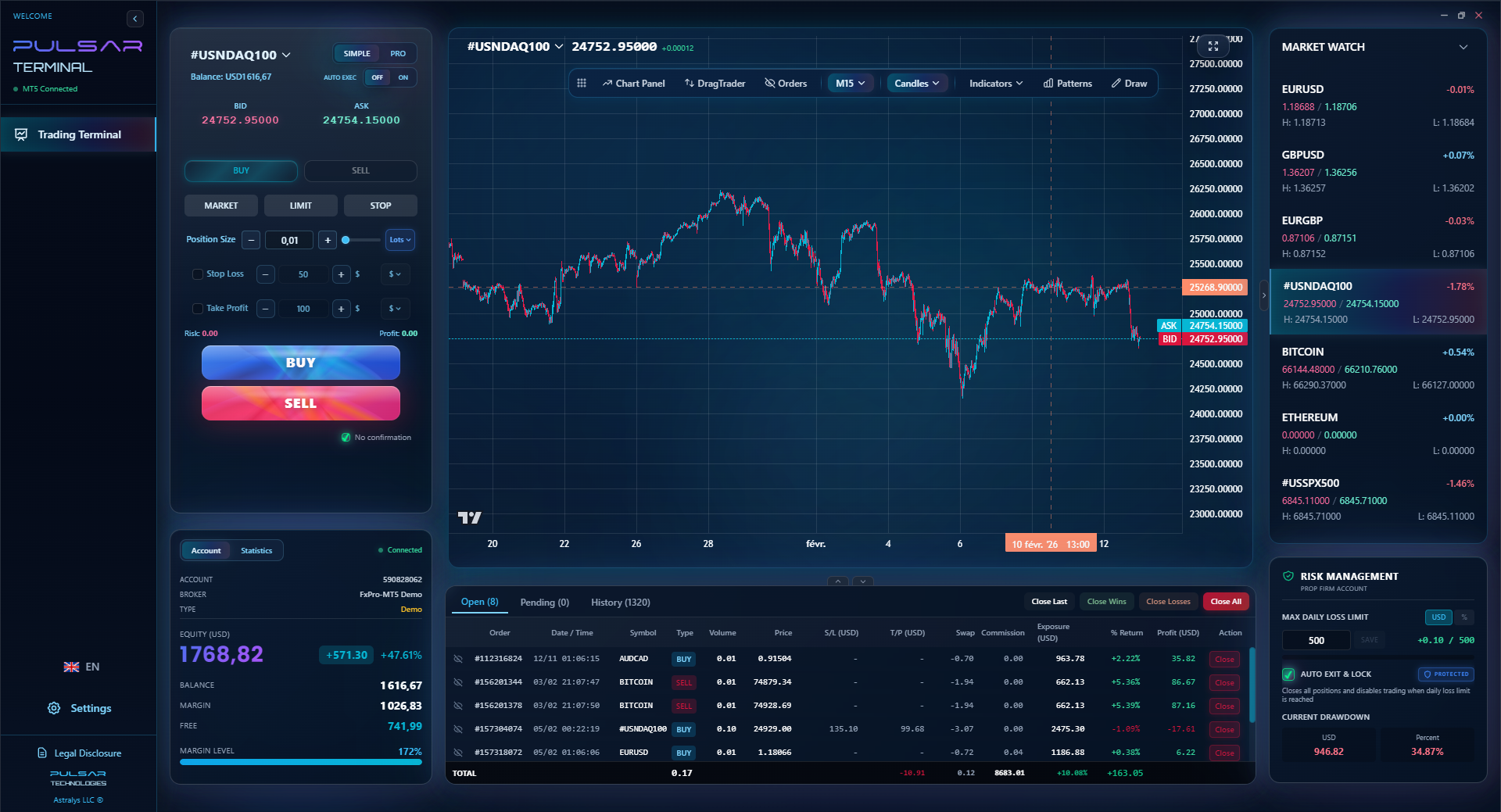
Managing multiple take-profit levels and moving stops to breakeven on retracement trades is manual and stressful, but Pulsar Terminal automates it all with one-click order templates directly on your MT5 chart.
Pulsar Terminal
The all-in-one MT5 companion: drag-and-drop orders, multi-TP/SL, trailing stop, grid trading, Volume Profile, and prop firm protection. Used by 1,000+ traders daily.
I've mentored dozens of traders here. The same errors keep appearing.
Mistake 1: Trading Retracements in a Range. If the market is choppy, moving sideways between clear support and resistance, it's not trending. There is no retracement to trade, only a range. Using Fib tools here is pointless. You'll get chopped up. Save your retracement strategy for clear, established trends.
Mistake 2: Ignoring the Higher Timeframe. The 15-minute chart might show a beautiful retracement to the 50% Fib. But the daily chart shows price is actually at a massive resistance level. That "retracement" is likely a reversal in disguise. Always align with the bigger picture.
Mistake 3: Revenge Trading After a Miss. You miss a perfect retracement entry. Price rockets away. The worst thing you can do is chase it. You'll end up entering at the end of the next retracement, with terrible risk/reward. Missed trades are part of the business. Let them go.
Mistake 4: Over-leveraging the "Sure Thing." A retracement to a key level feels like a high-probability setup. It is. But it's not a guarantee. Doubling your lot size because you're "sure" this is the bounce is a direct path to a margin call. Treat every trade like it could lose.
My own painful lesson: On EUR/USD, I saw a perfect retracement to the 61.8% Fib and 200 EMA on the 1-hour chart. I was so confident I used 5x my normal position. A surprise news headline hit, price spiked 5 pips through my level, triggered my stop, and instantly reversed. I lost a week's profits in seconds because of arrogance, not bad analysis.
💡 Winston's Tip
Your first profit target on a retracement trade should be at least 1.5 times your risk. If the market can't give you that, the trend isn't strong enough to bother with.
“Retracement trading isn't a secret technique. It's a framework for patience and discipline.”
In Nigeria's fast-moving environment, many are drawn to scalping strategy for quick naira. But retracement trading is a different beast.
Scalping is about speed, tiny profits (5-10 pips), and high frequency. It's intense, requires constant screen time, and is heavily impacted by spread costs. A 2-pip spread on USD/NGN eats a huge chunk of a 5-pip target.
Retracement Trading is about patience. You might only take 1-2 setups a day, or even a week. You're aiming for larger moves (30-100+ pips) as the trend resumes. It's less stressful, but it requires the discipline to wait, sometimes for hours, for your setup to mature.
Which is better? It depends on your personality and schedule. If you have a day job and can't watch charts all day, retracement trading on higher timeframes (4H, Daily) is far more sustainable. If you thrive on adrenaline and can sit for hours focused, scalping might appeal, but the odds are tougher. Most successful traders I know here start with mastering retracements in trends before even considering scalping.
Before you take any retracement trade, run down this list. If you can't check every box, walk away.
- Trend: Is there a clear, higher-timeframe trend? (Higher highs/higher lows or vice versa).
- Pullback: Is the price currently moving against that trend on my entry timeframe?
- Confluence: Is price approaching a key Fib level (38.2, 50, 61.8) AND/OR a dynamic MA (like the 20 or 50 EMA)?
- Signal: Do I see a price action reversal signal (pin bar, engulfing, inside bar break) at that zone?
- Risk: Have I calculated my position size so my stop-loss represents 0.5-1% of my account? Is my stop placed beyond the retracement's extreme?
- Plan: Do I know where I will take profit (e.g., previous swing high) and will I scale out or trail my stop?
This process turns a hopeful guess into a planned business transaction. It removes emotion. That's the real goal. Retracement forex isn't a secret technique. It's a framework for patience and discipline. The market will always offer pullbacks. Your job is to be prepared, well-capitalized, and calm enough to act only when your edge is present. Everything else is just noise and gambling.
Start by practicing this on a demo account with a broker like XM or Exness to get a feel for the spreads and execution. Mark up 50 retracement setups without trading them. Then, paper trade 20. Only then, with a proven track record of simulated success, should you consider risking real naira. The market isn't going anywhere. But your capital can disappear in a heartbeat if you're not ready.
FAQ
Q1What is the best Fibonacci level for a retracement entry?
There's no single "best" level. The 50% and 61.8% levels are generally considered stronger potential reversal zones than 38.2%. However, the key is confluence. A 38.2% retracement that also aligns with a strong horizontal support level and a moving average is often better than a deep 61.8% retracement with no other signals.
Q2How deep is too deep for a retracement?
A retracement beyond the 78.6% Fibonacci level starts to blur the line with a reversal. More importantly, if price breaks the most recent major swing point that defined the trend (e.g., the last significant low in an uptrend), the move is likely no longer a retracement. Your trading thesis should be re-evaluated.
Q3Can I use retracement trading on cryptocurrency pairs?
Absolutely. The principles are the same, but volatility is much higher. Your stop-loss distances will need to be wider to account for this, which means your position size must be smaller to maintain the same risk level. A 5% retracement in Bitcoin is normal; in EUR/USD, it's a major move.
Q4Is retracement trading suitable for beginners in Nigeria?
It's one of the more beginner-friendly concepts because it's based on clear visual structure (trends, pullbacks). However, beginners often fail at the execution - impatience, poor risk management, and lack of confirmation. Start on demo, master the checklist, and treat it as a skill to be learned over months, not days.
Q5What timeframes are best for retracement trading?
Use multiple timeframes. Determine the trend on the Daily or 4-Hour chart. Then, zoom into the 1-Hour or 4-Hour chart to identify and time your entry into the retracement. This 'top-down' analysis keeps you aligned with the dominant market flow.
Q6How do I handle a retracement that goes against me immediately?
If you entered with a confirmed signal and a proper stop-loss, you take the loss. That's the cost of doing business. Do not move your stop further away hoping the market will turn. A good retracement trade should show you a profit relatively quickly. If it doesn't, and price heads straight for your stop, your analysis was probably wrong. Accept it and move on.
Prof. Winston's Lesson
Key Takeaways:
- ✓Trade retracements only in the direction of the higher timeframe trend.
- ✓Always seek confluence: Fib levels + Moving Average + Price Action signal.
- ✓Risk a maximum of 1% per trade, calculated before entry.
- ✓Place your stop-loss where the retracement thesis is invalidated.
- ✓Take partial profits to lock in gains and move stop to breakeven.
How useful was this article?
Click a star to rate
Weekly Trading Insights
Free weekly analysis & strategies. No spam.
About the Author
Olumide Adeyemi
West African Trading Pioneer
One of Nigeria's most active forex trading educators. 8 years of experience trading from Lagos. Specializes in low-capital strategies and prop firm challenges for African traders.
Comments
Risk Disclaimer
Trading financial instruments carries significant risk and may not be suitable for all investors. Past performance does not guarantee future results. This content is for educational purposes only and should not be considered investment advice. Always conduct your own research before trading.
You Might Also Like

Cara Trading Forex Sukses: 7 Prinsip dari Trader Profesional
Cara trading forex sukses dengan 7 prinsip trader pro: manajemen modal, disiplin, journal trading, backtest. Data nyata, bukan janji profit palsu.
Jam Trading Forex Terbaik untuk Trader Indonesia: Panduan Lengkap dengan Tabel Waktu
Panduan jam trading forex untuk trader Indonesia. Tabel 4 sesi dunia, jam emas 20:00-00:00, sesi mana yang harus dihindari. Data akurat + tips dari trader berpengalaman.
Top 5 Sàn Forex Uy Tín Nhất 2026: Review Jujur dari Trader Indonesia
Top 5 sàn forex uy tín 2026 untuk trader Indonesia. Review jujur: spread, deposit, withdraw, dukungan lokal. Exness, XM, IC Markets & lebih.
Get Pulsar Terminal
All these calculators are built into Pulsar Terminal with real-time data from your MT5 account. One-click position sizing, automatic risk management, and instant calculations.
Get Pulsar Terminal