


Here's a fact that might surprise you: most new traders in Nigeria only know how to buy low and sell high.

Olumide Adeyemi
West African Trading Pioneer ·  Nigeria
☕ 13 min read
What you'll learn:
- 1What Exactly is a Sell Limit Order? (Plain English)
- 2When Should a Nigerian Trader Use a Sell Limit?
- 3Step-by-Step: Placing a Sell Limit on MT4/MT5
- 4Real Costs & Risks for the Nigerian Trader
- 5Choosing a Broker & The NGN Account Advantage
- 6Leveling Up: Advanced Sell Limit Strategies
- 7Mistakes I've Made (So You Don't Have To)
- 8Your Sell Limit Forex Questions, Answered
Here's a fact that might surprise you: most new traders in Nigeria only know how to buy low and sell high. They're missing half the game. A sell limit forex order lets you do the opposite - sell high first, then buy back lower. It's a tool for profiting from a predicted drop, and when used right, it can be far more precise than clicking 'Sell' in a panic. But get it wrong, and you'll be selling into a rally that never stops. Let's break down exactly how this order works for us here, with the Naira in mind and the reality of our market.
Think of it as setting a trap above the market. You're telling your broker, "If the price climbs up to this specific level, open a sell trade for me automatically."
The key is the word above. A sell limit is always placed above the current market price. You use it when you believe the price will rise to a resistance area, hit a ceiling, and then reverse down. Your goal is to catch that move down from the very top.
It's the opposite of a buy limit, which is placed below the price. And it's completely different from a stop-loss, which closes a trade. A sell limit opens a new short position. I messed this up early on, placing a sell limit below the price expecting a drop. The order just never triggered because the price never went up to my level. The market tanked without me.

Warning: A common confusion. A 'Sell Limit' opens a new short trade. A 'Stop Loss' closes an existing long trade. Mixing these up can blow up your account.
Why bother? Because it takes the emotion out. Instead of staring at the screen waiting for the perfect moment to click sell, you set your level based on your analysis and walk away. The platform does the work. This is crucial for a strategy like swing trading, where you're targeting bigger moves over days or weeks.
You don't use this order on a whim. It's a strategic move for specific market conditions.
At Clear Resistance Levels
This is the classic setup. You spot a price level where the market has reversed multiple times before - a horizontal line on your chart. Price is currently below it, but showing strength. You place your sell limit a few pips below that resistance line (so it triggers before the actual bounce).
After a Bullish Retracement in a Downtrend
This is my bread and butter. The overall trend is down, but price is taking a temporary breather and moving up (a retracement). You anticipate this bounce will fail at a key level, like a moving average or a Fibonacci retracement level (say, the 61.8% level). Your sell limit sits right at that failure point, ready to catch the next leg down.
Before High-Impact News (The Risky Play)
Let's say the US Non-Farm Payrolls report is coming. The EUR/USD has been grinding higher into the news. You believe any positive US data will smash the pair lower. You could place a sell limit above the current price, anticipating a 'sell the news' spike. I've done this. Sometimes it works like magic. Other times, the spike is so violent it blows straight through my limit, fills my order, and then reverses again, stopping me out instantly. It's high-risk.

Pro Tip: Combine your sell limit with an indicator for confluence. For example, if your sell limit is at a resistance level that also lines up with an overbought reading on the RSI indicator, your probability of success improves. Don't rely on a single signal.

💡 Winston's Tip
A sell limit is a hypothesis, not a prophecy. The market doesn't owe you a reversal. Always have a clear invalidation point - if price closes solidly above your limit level, your hypothesis is wrong. Cancel the order and reassess.
“The #1 risk with a sell limit is that you're shorting a breakout, turning a smart entry into a catastrophic one.”
Let's get practical. I'll use MetaTrader, since that's what most of us run.
- Right-click on your chart where you want the order to execute. Choose "Trading" and then "New Order."
- In the order window, change the Type from "Market Execution" to "Pending Order."
- In the new dropdown, select "Sell Limit."
- Price: This auto-fills with the chart price you clicked. You must adjust this to be ABOVE the current Ask price. If EUR/USD is at 1.0850, your sell limit price needs to be something like 1.0880.
- Stop Loss (SL): Set this ABOVE your entry price. If selling at 1.0880, your SL might be at 1.0920. This limits your loss if the price keeps rising.
- Take Profit (TP): Set this BELOW your entry price. Your target for the down move. Maybe 1.0800.
- Volume: Choose your lot size. Please, use a position size calculator. Don't guess.
- Click "Place." You'll see a horizontal line on your chart at your entry price.
A Real Trade Example: On February 15th, GBP/USD was in a downtrend but retracing up. It was at 1.2570. I placed a sell limit at 1.2610, near the 50-day moving average. Stop loss at 1.2650 (40 pips risk). Take profit at 1.2530 (80 pips target). The price hit 1.2612 two days later, opened my trade, and fell to my target within 24 hours. Net gain: 80 pips, minus the spread.
The spread matters here. If your broker's spread on GBP/USD is 1.5 pips, your order triggers when the Bid price hits your level. Your actual entry is slightly worse. Always account for that.
Trading isn't free, and our context adds layers. Let's talk numbers.
Spreads & Commissions: This is your main cost. When your sell limit triggers, you pay the spread instantly. With a broker like Exness on a Standard account, you might pay 1.3 pips on EUR/USD. On a raw spread account from someone like IC Markets, you might pay 0.1 pips plus a $7 commission per lot. You need to know your broker's model.
Taxes: The FIRS wants 10% of your net annual trading profits as Capital Gains Tax. Keep a simple spreadsheet. If you make ₦500,000 profit in a year, set aside ₦50,000.
The Big Risk: The Breakout. The #1 risk with a sell limit forex order is that you're betting on a reversal. What if the price hits your level and just... keeps going? That's a breakout. Your sell limit becomes the worst possible entry - shorting right as a bullish rally takes off. Your stop loss will save you, but the loss is guaranteed.
use Trap: Nigerian traders are often offered crazy use like 1:1000 or 1:2000. With a sell limit, this is extra dangerous. You might think, "It's just a small pending order," but when it triggers, that full leveraged position opens. A 20-pip move against you with too much size can trigger a margin call. I learned this the hard way with a sell limit on Gold (XAU/USD) using 1:500 use. The trigger was fine, but a sudden $10 spike hit my stop loss and wiped 15% of my account. The use magnified the damage.
Slippage: During high volatility (like news events), the price might jump from 1.0880 to 1.0895 instantly. Your sell limit at 1.0880 gets filled at 1.0895, a 15-pip worse entry. This can ruin your risk/reward ratio.
💡 Winston's Tip
Your first sell limit trade should be with a lot size so small you can laugh off the loss. The goal is to learn the mechanics and psychology of the entry, not to make money. I paper-traded them for three months before risking real cash.
“In Nigeria, an NGN-denominated account turns abstract pip calculations into clear Naira profits and losses.”
Since Nigeria's SEC doesn't specifically regulate online forex brokers, we rely on international regulators. Your broker's credibility is everything.
Look for brokers regulated by bodies like the FCA (UK), CySEC (Cyprus), or ASIC (Australia). Many popular brokers here, like XM or Pepperstone, hold these licenses. They offer client fund protection, which matters when you're placing orders that will execute later.
Now, the game-changer for us: NGN-denominated accounts.
Brokers like HFM and FXTM offer them. Why does this matter for your sell limit?
- No Currency Conversion Fees: You deposit and withdraw in Naira. Your profit and loss are also in Naira. When you set a stop loss of 40 pips on EUR/USD, you can calculate the exact Naira risk immediately, without worrying about USD/NGN fluctuations.
- Psychological Comfort: You think in Naira. Seeing a ₦25,000 profit is clearer than a $50 profit that you then have to convert.
- Faster Local Transfers: Funding your account to place those pending orders is quicker.
Here's a quick comparison of brokers accessible in Nigeria:
| Broker | Min. Deposit (Approx.) | Key Feature for Sell Limits | Good For |
|---|---|---|---|
| Exness | $10 / ₦~15k | Very high use (1:2000+) | Traders wanting max use for small accounts |
| HFM | ₦4,000 (via processor) | NGN Account, good local support | Nigerian traders wanting Naira settlement |
| OctaFX | $25 / ₦30,000 | Low spreads from 0.7 pips | Cost-conscious traders targeting precise entries |
| FP Markets | $100 | Raw spreads (0.0 pips + commission) | Serious traders who scalp and need ultra-low costs |
Remember, high use is a tool, not a goal. For executing precise sell limit orders, I'd prioritize tight spreads and reliable execution over the highest use offer.
Once you're comfortable with the basics, you can get creative. These strategies involve more risk and require practice.
The Sell Limit Grid
This is a mean reversion strategy. In a ranging market, you place multiple sell limit orders at progressively higher levels within the range. Each order is a small position. The idea is that price will oscillate, hitting your sells at the top and your buy limits at the bottom. It can grind out profits in a sideways market. But if a strong trend breaks the range, all your sell limits will trigger and you'll be massively short in a rising market - a disaster. Proper tools that manage multiple orders are almost mandatory here.
Sell Limit with Partial Closure
You place one sell limit order, but plan to take profit in stages. Example: Sell limit at 1.0880. Close half the position at 1.0830 (50 pips profit), move stop loss to breakeven on the remainder, and let the rest run to 1.0780. This books some profit early and lets you ride a trend. Doing this manually is stressful. You need to babysit the trade or use a tool that automates it.
Combining with Other Orders (OCO)
OCO means "One Cancels the Other." You can set a sell limit at a resistance level AND a buy stop order just above the same resistance (in case of a breakout). Whichever triggers first cancels the other. This is a smart way to trade a key level without predicting the direction. Not all platforms offer this natively, but advanced trading tools add this functionality.
These methods move beyond simple order placement into trade management. They highlight why just knowing what a sell limit is isn't enough. You need a plan for what happens after it fills.
💡 Winston's Tip
The most powerful sell limit setups combine three things: a technical resistance level, a confluence from an indicator like the [MACD indicator](/en/indicators/macd) showing divergence, and a fundamental reason (like an overbought condition before a central bank speech). One signal is a guess. Three is a plan.
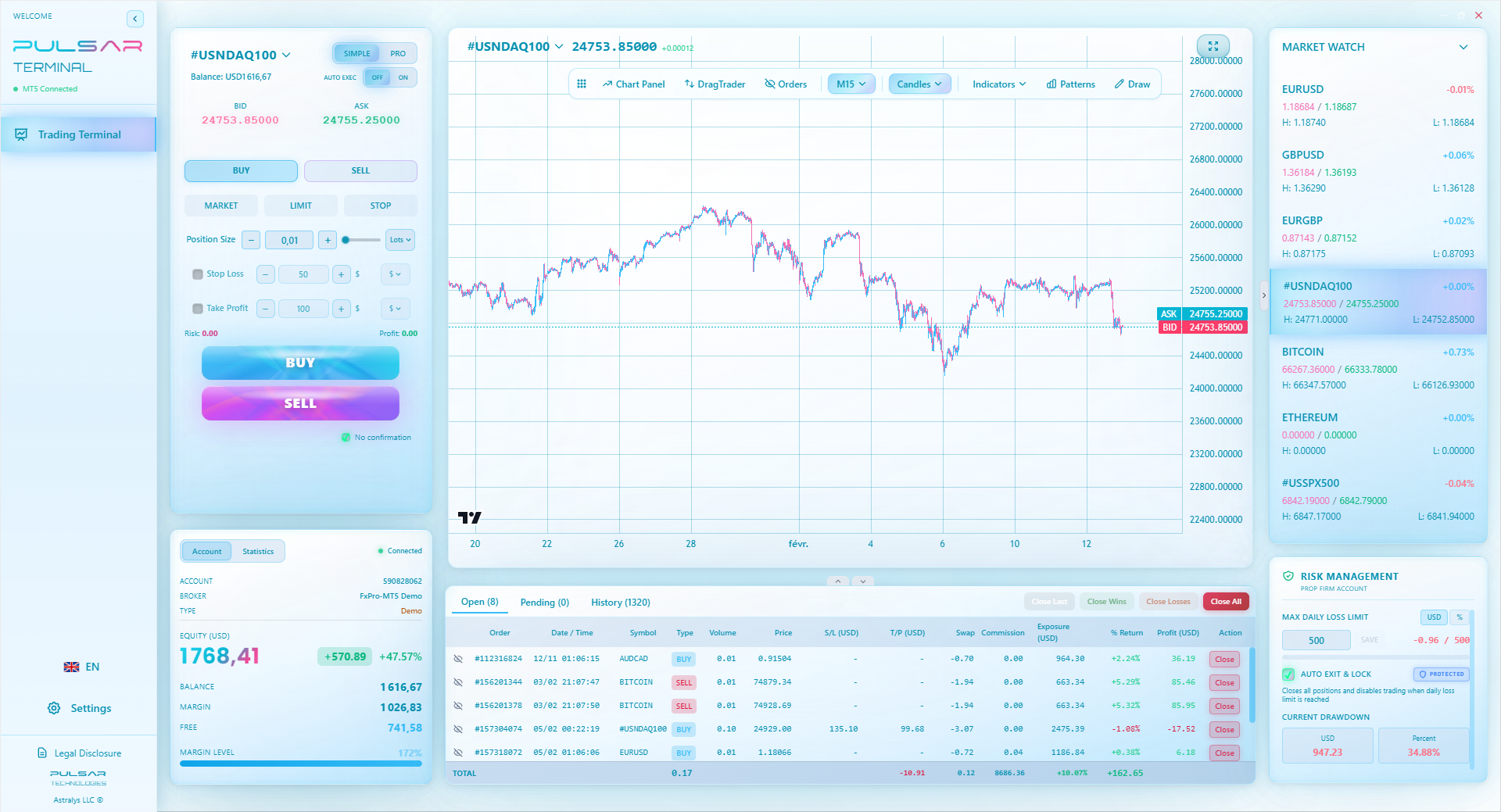
Advanced strategies like grid trading or multi-take profit plans are complex to manage manually, but tools like Pulsar Terminal automate these directly on your MT5 platform.
Pulsar Terminal
The all-in-one MT5 companion: drag-and-drop orders, multi-TP/SL, trailing stop, grid trading, Volume Profile, and prop firm protection. Used by 1,000+ traders daily.
“High use on a pending order is a silent threat - it feels harmless until it triggers.”
Let me save you some money and frustration.
1. Placing it at a round number because it looks nice. Resistance is often at round numbers like 1.0900, but smart money knows this. They often run stops just above or below. I've placed sell limits at 1.0900 only to see price spike to 1.0905, trigger my order, and reverse. Now I place them a few pips away from the obvious number.
2. Forgetting about weekend gaps. You place a perfect sell limit on Friday before close. Over the weekend, major news hits. The market opens Sunday night above your sell limit. Your order triggers immediately at the open at a terrible price, far from your planned level. Always check the economic calendar and consider canceling pending orders before major risk events.
3. Setting and forgetting... forever. A sell limit isn't a "set it and forget it for months" tool. Market context changes. If the fundamental reason for your trade (e.g., a key resistance level) is invalidated by a new price structure, cancel the order. I left a sell limit on EUR/USD from a month-old analysis. It triggered recently in a completely different, bullish market context. Lost 2% of my account on an outdated idea.
4. Risking too much per trade. Because the order is pending, it feels less "real" than an open trade. You might size it too large. When it triggers, the shock of seeing a large position open can lead to panic. Always use your position size calculator for the pending order as if it were live.

Example: You have a ₦200,000 account. You're willing to risk 1% (₦2,000) on a sell limit trade. Your stop loss is 40 pips away. The pip value for your lot size must be: ₦2,000 / 40 pips = ₦50 per pip. Work backwards from that to find your correct lot size.
Q: Can I modify or cancel a sell limit order after placing it? A: Absolutely, and you should. Right-click the order line on your chart and select "Modify or Delete Order." You can change the price, SL, TP, or cancel it entirely before it's triggered.
Q: How long does a sell limit order stay active? A: By default, in MT4/MT5, it's "Good 'til Canceled" (GTC). It stays active until you cancel it, it triggers, or your broker's server resets (usually on weekends). You can also set an expiry date/time when placing it.
Q: Is a sell limit the same as a stop-loss on a buy trade? A: No! A stop-loss on a buy trade is a sell stop order. It's placed below the current price to close a long trade at a loss. A sell limit is placed above the price to open a new short trade. Confusing them is a classic, expensive error.
Q: What's the difference between a Sell Limit and a Sell Stop? A: This is crucial. A Sell Limit is placed ABOVE the current price to sell at a better (higher) price. A Sell Stop is placed BELOW the current price to sell at a worse (lower) price. Sell Limits are for reversals. Sell Stops are for breakouts to the downside or stop-losses.
Q: My sell limit was triggered, but my entry price was different from my set price. Why? A: Slippage. During fast markets, your order gets filled at the next available price. Also, remember you sell at the Bid price. If your limit was 1.0880 and the spread is 1.0 pip, the Ask price was 1.0881 when your order triggered. The fill is still correct.
Q: Are there limits to how many pending orders I can place? A: Most brokers have a limit, often around 200-500 total pending orders per account. For retail traders, this is rarely an issue unless you're running complex grid strategies.
FAQ
Q1Can I use a sell limit order for scalping?
You can, but it's tricky. Scalping requires ultra-fast execution. A sell limit works if you've identified a very precise, short-term resistance level on a lower time frame (like 1-minute or 5-minute). The spread becomes a huge factor here. For a scalping strategy, you need a broker with razor-thin spreads, otherwise, the cost can eat your tiny profit. I find market orders often work better for scalping due to the speed.
Q2Do I need a lot of money to start using sell limit orders?
Not at all. With brokers like Exness offering a $10 minimum or HFM allowing deposits from around ₦4,000, you can start practicing. The key is to trade a micro lot (0.01) so your risk is measured in hundreds of Naira, not thousands. The order type itself doesn't require capital; your position size does.
Q3How do I calculate my profit or loss on a triggered sell limit?
Profit = (Sell Price - Buy-back Price) x Lot Size x Pip Value. In Naira: If you sold 0.1 lots of EUR/USD at 1.0880 and bought back at 1.0830 (50 pips profit), and your pip value is ₦100 per pip for 0.1 lots, your profit is 50 x ₦100 = ₦5,000. Remember to subtract the spread cost from your profit.
Q4What happens if the price gaps past my sell limit price?
If the market opens or moves so fast that the price jumps from below your limit to above it without trading at your price, your order may not be filled, or it may be filled at the first available price beyond your limit (often worse). This is common after weekend news or during extreme volatility.
Q5Should I use sell limits on exotic currency pairs involving NGN?
I'd be cautious. Pairs like USD/NGN or EUR/NGN offered by some brokers often have extremely wide spreads (hundreds of pips) and low liquidity. Placing a precise sell limit order on these is difficult, and slippage can be massive. It's better to stick to major pairs like EUR/USD or GBP/USD and use an NGN account for funding and accounting.
Q6Is a sell limit order free?
Placing the pending order is free. However, the moment it triggers and becomes a market order, you immediately pay the spread. If you're on a commission-based account, you also pay the commission. So no upfront fee, but standard trading costs apply upon execution.
Prof. Winston's Lesson
Key Takeaways:
- ✓Sell Limits open shorts ABOVE price for anticipated reversals.
- ✓Always pair with a Stop Loss ABOVE your entry price.
- ✓NGN accounts simplify risk calculation for Nigerian traders.
- ✓Avoid exotic pairs; stick to majors for precise order execution.
How useful was this article?
Click a star to rate
Weekly Trading Insights
Free weekly analysis & strategies. No spam.
About the Author
Olumide Adeyemi
West African Trading Pioneer
One of Nigeria's most active forex trading educators. 8 years of experience trading from Lagos. Specializes in low-capital strategies and prop firm challenges for African traders.
Comments
Risk Disclaimer
Trading financial instruments carries significant risk and may not be suitable for all investors. Past performance does not guarantee future results. This content is for educational purposes only and should not be considered investment advice. Always conduct your own research before trading.
You Might Also Like

Cara Trading Forex Sukses: 7 Prinsip dari Trader Profesional
Cara trading forex sukses dengan 7 prinsip trader pro: manajemen modal, disiplin, journal trading, backtest. Data nyata, bukan janji profit palsu.
Jam Trading Forex Terbaik untuk Trader Indonesia: Panduan Lengkap dengan Tabel Waktu
Panduan jam trading forex untuk trader Indonesia. Tabel 4 sesi dunia, jam emas 20:00-00:00, sesi mana yang harus dihindari. Data akurat + tips dari trader berpengalaman.
Top 5 Sàn Forex Uy Tín Nhất 2026: Review Jujur dari Trader Indonesia
Top 5 sàn forex uy tín 2026 untuk trader Indonesia. Review jujur: spread, deposit, withdraw, dukungan lokal. Exness, XM, IC Markets & lebih.
Get Pulsar Terminal
All these calculators are built into Pulsar Terminal with real-time data from your MT5 account. One-click position sizing, automatic risk management, and instant calculations.
Get Pulsar Terminal