


You're ready to trade, you've got your strategy, and you're looking for a broker.

David van der Merwe
Emerging Markets Trader ·  South Africa
☕ 11 min read
What you'll learn:
- 1The Basics: Market Makers (The Dealer Desk)
- 2ECN & STP: The 'No Dealing Desk' Model
- 3The Local vs. International Broker Dilemma
- 4Matching a Broker to Your Trading Style
- 5The Dark Side: Bucket Shops & CFD Focus
- 6The Only Thing That Matters: Regulation & Safety of Funds
- 7Pulling the Trigger: How to Make Your Final Choice
You're ready to trade, you've got your strategy, and you're looking for a broker. But the choice is overwhelming. Market maker, ECN, STP... what does it all mean, and more importantly, which type of broker is actually going to help you make money instead of just taking your deposit? I've traded with them all over the last twelve years, from the slick internationals to the local guys. Let's cut through the marketing fluff and talk about what really matters.
This is where most South Africans start, often without even knowing it. A market maker, or dealing desk broker, is your direct counterparty. When you buy, they sell to you. When you sell, they buy from you. They create their own market, setting their own buy and sell prices (the spread).
It sounds shady, but it's not inherently evil. It's a model. For a new trader with a small account (think under R20,000), it's often the only viable option because they offer micro and cent accounts. The spreads are fixed, which can be comforting when news hits. I made my first real profit with a market maker back in 2013, scalping EUR/USD for 5-10 pips at a time.
The big catch? Conflict of interest. If you lose, they profit. This has led to some notoriously bad behavior in the past - requotes, slippage only when it hurts you, and platforms that mysteriously freeze. Not all are like this, but the temptation is built into the model. Your job is to find one that's regulated enough to keep them honest. The FSCA in South Africa is your first line of defence here.

Warning: If a market maker broker is offering you insane use like 1:2000 and a "guaranteed" bonus on deposit, run. That's not a trading opportunity; it's a liquidation machine waiting for your account.
I learned this the hard way. In my early days, I deposited R5,000 with a flashy, unregulated offshore market maker offering 1:1000 use. I was up R1,800 in two days. When I tried to withdraw, it was a nightmare of "verification" delays. I eventually got my initial deposit back after a month of emails, but the profit? Gone. They cited a "bonus clause" I'd accidentally ticked. Consider that tuition paid.
This is the model most serious retail traders gravitate towards. Here, the broker isn't your counterparty; they're a conduit, passing your order directly to other participants in the market.
STP (Straight Through Processing): Your order is sent directly to the broker's liquidity providers (big banks like Barclays, HSBC, etc.). The broker makes money from a small markup on the spread (the commission is often built in). It's more transparent than a pure market maker.
ECN (Electronic Communication Network): This is the gold standard for transparency. Your order is placed into a network with orders from other banks, hedge funds, and retail traders. You see the raw, real-time market depth. You pay a clear, upfront commission per lot, but you get razor-thin, variable spreads. At 3 AM when liquidity is low, that spread on the EUR/USD guide can widen, but during London open, it can be virtually zero.
The Real Cost of Trading
With a market maker, your cost is the spread. With an ECN, it's spread + commission. You need to do the math. A market maker might offer EUR/USD at a 1.8 pip fixed spread. An ECN might offer a 0.2 pip variable spread plus a $7 commission per standard lot (100k units).
| Trade Size | Market Maker Cost (1.8 pips) | ECN Cost (0.2 pip + $7) |
|---|---|---|
| 1 Mini Lot (10k) | $1.80 | $0.20 + $0.70 = $0.90 |
| 1 Standard Lot (100k) | $18.00 | $2.00 + $7.00 = $9.00 |
As you can see, for larger volumes, the ECN is cheaper. For tiny, sub-mini-lot trades, the market maker's all-in cost might be simpler. I switched to an ECN model (specifically IC Markets review) once my average position size grew. The transparency during high volatility was worth every cent in commission.

💡 Winston's Tip
Your broker's customer service speed at 3 PM is irrelevant. Test them at 9 PM on a Sunday. That's when you'll really need them.
“Your first tool for risk management isn't a stop-loss; it's choosing a legitimate broker.”
This is a huge one for us in South Africa. Do you go with a locally headquartered, FSCA-regulated broker, or an international giant regulated by ASIC (Australia), CySEC (Cyprus), or the FCA (UK)?
Local Brokers (FSCA Regulated): Pros are obvious. You can walk into an office (sometimes). Deposits/withdrawals are instant via EFT. You can phone a guy. Your funds are held in a South African bank account. The cons? Often, they are market makers or hybrid models with higher costs. Their platform and tool offerings can be years behind the international players.
International Brokers: They offer the latest tech, raw spreads, and often better regulatory protection (FCA client money rules are top-tier). But, your money is offshore. Withdrawals take 2-5 business days. You might face currency conversion fees. And crucially, since 2021, many top-tier regulators (FCA, EU) have banned offering services to South African residents. So, the international broker you're using likely has you onboarded under their global entity, which may be regulated in a less stringent jurisdiction.
My approach? I keep two accounts. One with a reputable local broker for quick access to ZAR and testing new strategies with smaller capital. My main trading capital is with a top-tier international ECN broker. It's a hassle, but it's the balance between convenience and optimal trading conditions. Always check which entity of the broker you are actually signing up with. That XM review or Pepperstone review might be for their Australian entity, but you'll be signed up with their global one.
Not all types of forex brokers are suited to all styles. Picking the wrong one is like trying to win a Formula 1 race in a bakkie.
Scalpers: You need an ECN or true STP broker with ultra-low latency, tiny spreads, and a clear commission structure. Requotes or wide fixed spreads will kill your edge. I tried scalping strategy on a market maker platform years ago; the three requotes in a row on a key entry taught me this lesson permanently. Your broker must allow it in their terms, too. Some prohibit pure scalping.
Swing Traders & Position Traders: You have more flexibility. Your holding periods are days to weeks, so the spread cost is less critical per trade. You might prioritize other features: swap rates (if you hold overnight), reliability, and the quality of research tools. A market maker with a stable platform could work, but watch for overnight financing costs. For swing trading gold, I prefer an ECN for the transparent execution on XAU/USD guide, even if I'm in the trade for a week.
News Traders: You absolutely must have an STP/ECN broker. Market makers will widen spreads to unmanageable levels or simply not let you trade during major news events. The volatility is where you make money; you can't have your broker gatekeeping it.

Pro Tip: Before funding any account, open a demo and test it during a high-impact news event like the US Non-Farm Payrolls. See if orders execute, how much the slippage is, and if the platform crashes. This test saved me from two terrible broker choices.
“The ultimate test of a broker isn't the deposit process; it's the first withdrawal.”
We need to talk about the elephant in the room. South Africa has a history with what old-school traders call "bucket shops." These are unregulated or poorly regulated outfits that take your trade but never hedge it in the real market. They just bet against you, and often use unethical practices to ensure you lose. Thankfully, the FSCA has cleaned up a lot, but they still exist online, targeting new traders with promises of easy money.
A more modern, legal version of this is the pure CFD (Contract for Difference) broker. While CFDs are a legitimate product, some brokers structure their entire business around them as a derivative, not direct market access. The risks here are immense: you can lose more than your deposit, and the costs (overnight financing, wide spreads) are designed to erode your capital over time. They often offer a dizzying array of markets - stocks, crypto, commodities - all as CFDs, which is a red flag if forex is your game.
The line can be blurry. Many good brokers offer CFDs on indices alongside forex. The key is transparency. Are they clear about execution? Are they regulated by a serious body? If their main marketing angle is "trade 500+ markets!" instead of "we offer transparent pricing," be very, very cautious. Your first tool for risk management isn't a stop-loss; it's choosing a legitimate broker. Understanding your margin call risk is ten times more critical with these operators.
💡 Winston's Tip
If a broker's website has more promotions about deposit bonuses than it does about execution statistics, you're not the customer. You're the product.
All this talk about types of forex brokers is useless if your money isn't safe. Regulation is everything. Here’s the hierarchy for a South African trader:
- Top Tier (But Hard to Access): FCA (UK), ASIC (Australia), MAS (Singapore). These offer strong client money protection (segregated accounts) and dispute resolution. Due to regulatory changes, most no longer onboard SA clients directly.
- The Practical Standard: FSCA (South Africa). This is your baseline. It means the broker has a local presence, adheres to some financial standards, and you have a local recourse. Check their FSP number on the FSCA website.
- Common Offshore Regulators: CySEC (Cyprus), FSC (Mauritius), FSA (Seychelles). Many international brokers use these for their global entities. The protection is weaker than tier 1, but it's better than nothing. It means they have some rules to follow.
- The Red Flag Zone: Any regulator you've never heard of. Vanuatu, St. Vincent, etc. Often just a registration for a postal address. No meaningful client protection.
Warning: A broker being "regulated" in an offshore jurisdiction does NOT mean your funds are safe or segregated in a major bank. Always ask: "In which bank and in which country are client funds held?" If they won't answer clearly, walk away.
Your funds should be in segregated client accounts at a reputable bank. This means if the broker goes bankrupt, your money isn't part of their assets to be claimed by creditors. This is non-negotiable. I don't care about their trading platform if my capital isn't protected. Use the FSCA's website to verify the license of any local broker, and for international ones, dig into their group structure to see who actually regulates the entity you're dealing with.
“You don't fall in love with your pipes. You focus on what flows through them: your trading edge.”
So, you've waded through the types of forex brokers. How do you pick one? Make a checklist.
For a South African trader in 2024, my checklist looks like this:
- Regulation: FSCA, or a reputable offshore regulator (CySEC, FSC Mauritius) for an international broker. Verified.
- Execution Model: STP or ECN for my main account. I'm done with market makers for serious trading.
- Trading Costs: I calculate the all-in cost (spread + commission) for my typical trade size on my main pairs. I use a position size calculator that includes commission to see the real impact.
- Platform & Tools: MT4/MT5 is standard. But what about tools for analysis? Can I easily set a trailing stop or multiple take-profit levels? This is where add-ons become critical.
- Deposits/Withdrawals: For a local broker, EFT is a must. For international, what are the fees and timelines? I factor the cost of a SWIFT transfer into my planning.
- Customer Service: I test it. I call them. I email a technical question. If they take days to respond on a demo, imagine a live account issue.
Start small. No matter how good they look, deposit the minimum. Place a few live trades, then make a withdrawal. If that process is smooth, you can add more capital. This is the ultimate test. I've had brokers pass every demo test with flying colors, only to show their true colors when real money was on the line. Your first withdrawal is the final exam.
Remember, the broker is a utility. It's the pipes that connect you to the market. You want the pipes to be clean, reliable, and cheap. You don't fall in love with your pipes. You focus on what flows through them: your trading edge.
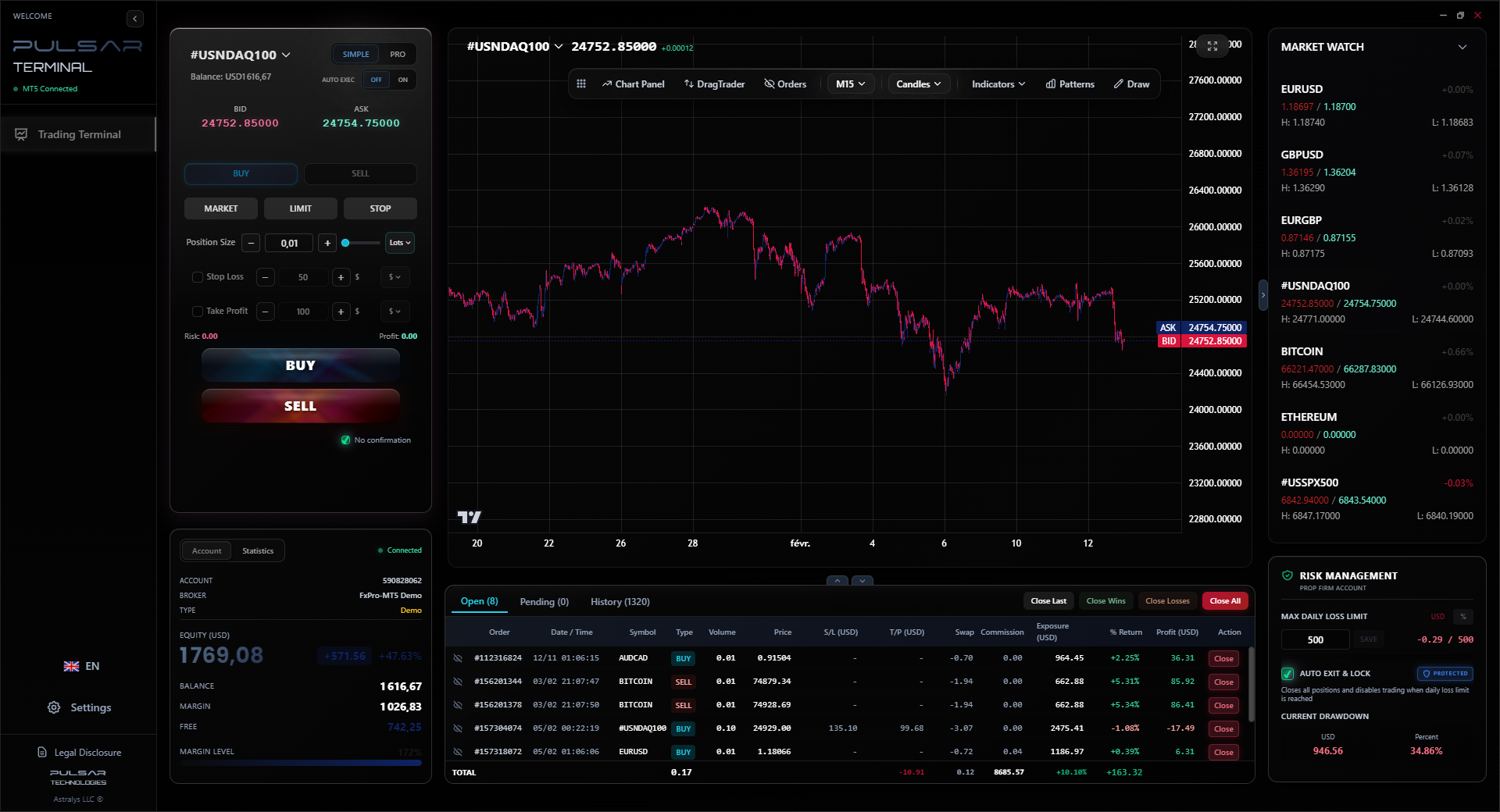
Once you've chosen a broker with MT5, tools like Pulsar Terminal give you the advanced order management and chart profiling that separates a utility from a professional trading station.
Pulsar Terminal
The all-in-one MT5 companion: drag-and-drop orders, multi-TP/SL, trailing stop, grid trading, Volume Profile, and prop firm protection. Used by 1,000+ traders daily.
FAQ
Q1What is the most common type of forex broker in South Africa?
Most local South African brokers operate as market makers or hybrid models (STP with a dealing desk for some orders). This is because it supports smaller account sizes and simpler pricing for beginners. However, many serious traders use internationally-based ECN/STP brokers for better conditions.
Q2Is an ECN broker always better than a market maker?
Not always. For a beginner with a very small account (under R10,000), the fixed costs and simplicity of a market maker can be easier to manage. An ECN's variable spreads and commissions are better for larger volumes, scalping, and transparency, but can be overkill and more complex for a novice.
Q3Can I use international brokers like IC Markets or Pepperstone from South Africa?
Yes, but with a caveat. Due to restrictions from top regulators like the FCA, you will likely be onboarded under the broker's global entity, regulated in a place like Cyprus, Mauritius, or the Seychelles. Your client protection will be under that regulator's rules, not the FCA's or ASIC's stricter ones.
Q4What's the biggest risk with an unregulated broker?
Total loss of funds. Beyond unethical practices like stop-hunting, the risk is that the broker simply disappears with your money. There is no ombudsman or compensation scheme to help you. It's not just about bad trades; it's about your deposit vanishing.
Q5As a swing trader, does my broker type matter as much?
It matters less than for a scalper, but it still matters. You'll care more about swap rates (overnight financing), platform stability for holding trades for days, and the quality of charting tools. A market maker might suffice, but watch their rollover costs and ensure they don't have a history of platform issues during volatile periods.
Q6How do I verify a broker's FSCA license?
Go to the FSCA's official website (www.fsca.co.za) and use their "Search for an FSP" function. Enter the broker's company name or FSP number. The listing will show their license status, authorized services, and any regulatory actions against them. Never rely on a logo on the broker's own site.
Prof. Winston's Lesson
Key Takeaways:
- ✓Market makers suit small accounts (<R20k) but watch for conflicts.
- ✓ECN/STP brokers are cheaper for standard lots (100k units).
- ✓Always verify FSCA registration on the official website.
- ✓Test withdrawals with minimum deposit first.
How useful was this article?
Click a star to rate
Weekly Trading Insights
Free weekly analysis & strategies. No spam.
About the Author
David van der Merwe
Emerging Markets Trader
Johannesburg-based trader with 11 years in emerging market currencies. Specializes in ZAR pairs, FSCA-regulated trading, and South African market analysis.
Comments
Risk Disclaimer
Trading financial instruments carries significant risk and may not be suitable for all investors. Past performance does not guarantee future results. This content is for educational purposes only and should not be considered investment advice. Always conduct your own research before trading.
You Might Also Like

Cara Trading Forex Sukses: 7 Prinsip dari Trader Profesional
Cara trading forex sukses dengan 7 prinsip trader pro: manajemen modal, disiplin, journal trading, backtest. Data nyata, bukan janji profit palsu.
Jam Trading Forex Terbaik untuk Trader Indonesia: Panduan Lengkap dengan Tabel Waktu
Panduan jam trading forex untuk trader Indonesia. Tabel 4 sesi dunia, jam emas 20:00-00:00, sesi mana yang harus dihindari. Data akurat + tips dari trader berpengalaman.
Top 5 Sàn Forex Uy Tín Nhất 2026: Review Jujur dari Trader Indonesia
Top 5 sàn forex uy tín 2026 untuk trader Indonesia. Review jujur: spread, deposit, withdraw, dukungan lokal. Exness, XM, IC Markets & lebih.
Get Pulsar Terminal
All these calculators are built into Pulsar Terminal with real-time data from your MT5 account. One-click position sizing, automatic risk management, and instant calculations.
Get Pulsar Terminal