


You've probably heard the stat: between 51% and 89% of retail forex traders lose money.

David van der Merwe
Emerging Markets Trader ·  South Africa
☕ 13 min read
What you'll learn:
- 1The Myth vs. The Reality of a 'Wealthy' Trader
- 2The South African Context: Regulations, Tax, and Real Costs
- 3The Core Habits: What Wealthy Traders Do Every Day
- 4Strategies That Actually Scale With Capital
- 5The Psychology of Preservation, Not Get-Rich-Quick
- 6The Path to Scaling: From Savings to Prop Firms
- 7Pitfalls That Keep Most Traders Poor (And How to Avoid Them)
You've probably heard the stat: between 51% and 89% of retail forex traders lose money. Yet, in South Africa, we have a daily trading volume pushing R400 billion. Someone's making money. The real question isn't if wealthy forex traders exist here - it's how they've managed to swim against that brutal tide of failure. I've been in the trenches for over a decade, and I can tell you it has nothing to do with Lamborghinis or get-rich-quick signals. It's a grind built on specific, repeatable habits that most people find too boring or too disciplined to follow.
Let's clear the air first. The Instagram trader with the sports car and the rented penthouse? That's marketing, not trading. Real wealthy forex traders in South Africa look more like your cautious uncle who manages a pension fund than a Wall Street wolf.
I learned this the hard way early on. I had a R50,000 account and, after a few lucky wins, thought I was the next big thing. I started dreaming in pips. Then, in one week of overconfidence, I blew 40% of it chasing losses on USD/ZAR. That R20,000 lesson cost me more than money; it cost me my ego. A truly wealthy trader's mindset is defined by preservation, not explosion.
So, what's the reality?
Wealth is Measured in Consistency, Not Single Trades. They aren't hunting for 1000-pip home runs. They're building a track record of small, consistent gains. Their goal is a positive expectancy system - one where, over 100 trades, the math works in their favor. Think of it like a casino: the house edge is small on any single bet, but over thousands of bets, it's unbeatable.
Their 'Luxury' is Financial Security, Not Flashy Cars. The real wealth is in the freedom and the compound growth. That R300,000 monthly profit you hear about? A large portion of that gets reinvested or parked in income-generating assets. The lifestyle is often quiet. The flashy stuff usually means they're spending their capital, not growing it.
They Are Masters of One, Not Jacks of All Trades. You won't find a top trader who's equally expert on EUR/USD, Bitcoin, and the JSE Top 40. They find their edge in a specific market condition or a handful of pairs - often including the ZAR crosses - and they become specialists. They know the personality of their chosen instrument inside out.

Warning: If a 'guru' focuses more on their lifestyle than their trading journal, run. Real wealth in forex is built in the quiet hours of analysis, not in the spotlight.

💡 Winston's Tip
A wealthy trader's edge isn't a secret indicator. It's their unwavering commitment to a written trading plan. The plan is the boss; you're just the employee executing it.
“Real wealth in forex is built in the quiet hours of analysis, not in the spotlight.”
You can't talk about building wealth here without understanding the playing field. South Africa isn't the wild west; it's a regulated market, and that's a good thing for those who want longevity.
The FSCA is Your Friend. The Financial Sector Conduct Authority (FSCA) is the main regulator. Trading with an FSCA-licensed broker means you have a recourse if things go south. The 30:1 use cap they introduced might feel limiting if you come from offshore brokers offering 500:1, but trust me, it's a lifesaver. It forces sane position size calculator use. I've seen too many accounts blown to bits because of insane use.
The Taxman Cometh (SARS). This is non-negotiable. Profits from forex trading are taxable income. You need to keep careful records of every trade - entry, exit, profit, loss. I use a simple spreadsheet, but dedicated software is better. The wealthy traders I know have a relationship with an accountant who understands trading. Trying to hide this from SARS is a surefire way to turn paper wealth into real debt.
The Real Cost of Trading. It's not just the spread. To understand if your strategy works, you must factor in all costs.
| Cost Factor | What It Is & Impact |
|---|---|
| The Spread | The difference between buy/sell price. On EUR/USD, a 0.8 pip spread vs. a 0.1 pip spread makes a huge difference over 100 trades. |
| Commission | On raw/ECN accounts, you pay $3-$10 per lot. This is often cheaper than wide spreads for active traders. |
| Swap Rates | The interest paid or earned for holding a position overnight. Can erode profits on long-term swing trading positions if you're on the wrong side. |
Funding Your Account. Sending money offshore? Remember the exchange control rules. You have an annual discretionary allowance of R1 million. For amounts over R10 million, you need approval. Most wealthy traders I know keep their operational trading capital with a reputable international broker like IC Markets or Pepperstone (both have FSCA licensing too) for better execution, and then repatriate profits periodically.
“They risk a fixed percentage of their capital per trade - usually between 0.5% and 2%. No exceptions. Not even if they're "sure."”
This is where the rubber meets the road. Talent is secondary. Discipline is everything. Here’s the unsexy daily routine.
Ritualistic Market Analysis
They don't check charts on a whim. They have a pre-market routine. For me, that's 90 minutes before the London open. I review the economic calendar, check for major news overnight, and analyze the daily and 4-hour charts for my three main pairs. I'm not looking for trades yet; I'm understanding the context. Is the market trending or ranging? Where are the key support and resistance levels? This process removes emotion from the initial decision.
Risk Management is Their Religion
This is the single biggest differentiator. Every trade has a predetermined stop-loss and take-profit before the order is placed. They risk a fixed percentage of their capital per trade - usually between 0.5% and 2%. No exceptions. Not even if they're "sure."
Let me give you a real example from last year. I was bullish on Gold (XAU/USD). My analysis said buy at $1815 with a stop at $1805. That was a 10-point risk. My rule is to risk 1% of my account per trade. With a R100,000 account, that's R1,000. So, my position size calculator told me to buy 1 mini lot (10,000 units). The trade went against me and hit the stop. Loss: R1,000. It stung, but it was planned. The account survived to trade another day. That's the mentality.
They Keep a Trading Journal
Not just a list of trades. A proper journal includes:
- The chart screenshot with entry/exit marked.
- The reason for taking the trade (e.g., "Daily trend support confluence with bullish RSI indicator divergence").
- The emotional state ("Felt impatient, entered 5 pips early").
- The outcome and lessons.
Reviewing this journal weekly is how you improve. You spot your repetitive mistakes. I found I was consistently losing on trades I took after 3 PM South African time when liquidity dropped. I just stopped trading after that hour. Problem solved.

Pro Tip: Your trading plan is your business plan. Write it down. It should cover your strategy, risk parameters, working hours, and review process. A wealthy trader doesn't deviate from their written plan.
“They risk a fixed percentage of their capital per trade - usually between 0.5% and 2%. No exceptions. Not even if they're "sure."”
The strategy you use with R10,000 won't work the same with R1,000,000. Liquidity and slippage become real enemies. Wealthy traders use strategies that are strong and can handle larger order sizes.
1. Trend Following on Higher Timeframes. This is a cornerstone. They identify the primary trend on the daily or weekly chart using simple tools like moving averages or trendline breaks. They then wait for a pullback on the 4-hour or 1-hour chart to enter in the direction of the trend. This provides a better risk/reward ratio. The MACD indicator can be useful here for confirming momentum. The key is patience - sometimes waiting days for the right setup.
2. Supply & Demand / Order Flow Analysis. This moves beyond basic support and resistance. It's about identifying zones where big banks and institutions have placed large orders. These zones, once broken, become new support or resistance. Understanding this helps you trade with the smart money, not against it. This strategy requires deep chart study but is less reliant on lagging indicators.
3. Algorithmic & Semi-Automated Trading. Many successful traders I know graduate to building or using simple algorithms. This isn't about a black-box robot that makes millions. It's about automating the execution of a very specific, proven strategy to remove emotional interference. For example, an algo that places a grid of orders around a key pivot point with tight stops.
What They Avoid: High-frequency scalping strategy on a 1-minute chart becomes nearly impossible with large capital due to spread costs and market impact. Overtrading - the need to be constantly in the market - is the amateur's disease.

Example: A trend-following trade on USD/ZAR. Daily chart shows a strong uptrend. Price pulls back to a key Fibonacci 61.8% level on the 4H chart, which also aligns with a previous resistance-turned-support zone. Entry: R18.50, Stop-loss: R18.35 (15 cents), Take-profit: R18.80 (30 cents). Risk/Reward = 1:2. The size is calculated based on your 1% risk rule. This is a structured, repeatable approach.
💡 Winston's Tip
Your trading journal is your most valuable tool. A loss reviewed is a lesson learned. A win reviewed is a pattern identified. A trade not journaled is a waste of time and money.
“A winning streak is more dangerous than a losing streak. That's when you start to believe you're infallible.”
This is the hardest part to teach. The market is designed to exploit every psychological weakness you have. Greed, fear, hope, regret - they're all account killers.
Embracing Losses. Wealthy traders don't just tolerate losses; they expect them. They know that a 60% win rate is exceptional. That means 4 out of every 10 trades will lose. The goal is to make the winning trades bigger than the losing ones. If your average win is R1,500 and your average loss is R1,000, you're profitable even if you lose more often than you win. I had to reframe a stopped-out trade not as a failure, but as the cost of doing business. It's like an insurance premium.
The Danger of Overconfidence. A winning streak is more dangerous than a losing streak. After 5 wins in a row, you start to believe you're infallible. You increase your position size, you widen your stops "just this once." This is when the market humbles you. My rule: after 3 consecutive wins, I deliberately reduce my position size by 25% for the next two trades to force myself back into a cautious mindset.
Dealing with Drawdown. Every account has periods of decline - drawdowns. A 10-20% drawdown is normal. The wealthy trader's response isn't to revenge trade or change their system. It's to stick to the plan, sometimes even reducing size further until they regain their footing. They have the emotional resilience to weather the storm because they've planned for it. They know their max historical drawdown, and they ensure their account size can withstand it without a margin call.
This mental fortitude is why tools that automate discipline are so valuable. Setting a trade and then letting a system manage partial closures or trail stops removes the temptation to meddle.
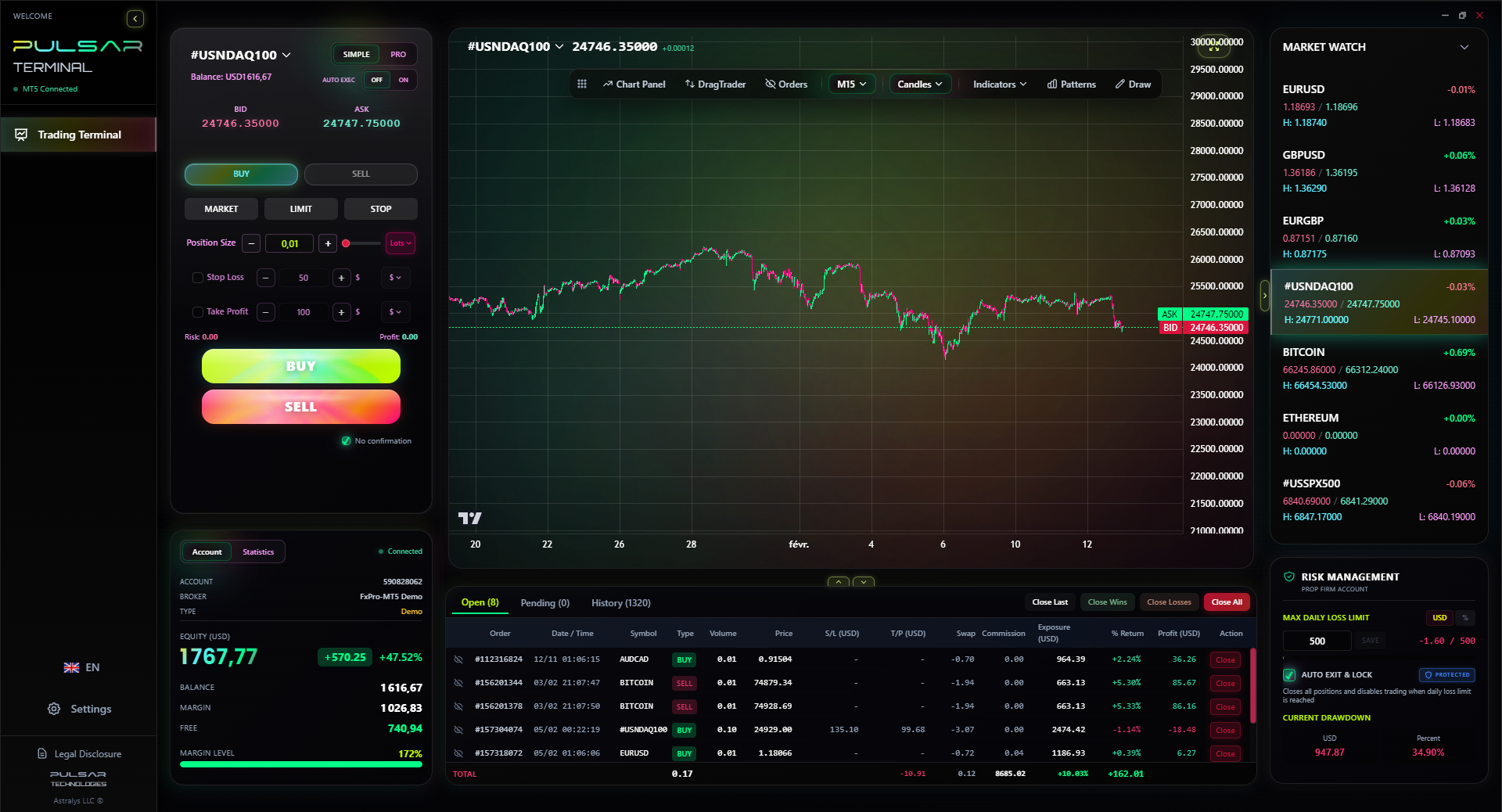
Managing the strict rules of a prop firm challenge or your own risk parameters requires automated discipline, which is where a tool like Pulsar Terminal excels on your MT5 platform.
Pulsar Terminal
The all-in-one MT5 companion: drag-and-drop orders, multi-TP/SL, trailing stop, grid trading, Volume Profile, and prop firm protection. Used by 1,000+ traders daily.
“A winning streak is more dangerous than a losing streak. That's when you start to believe you're infallible.”
How do you go from R10,000 to serious capital? You don't do it by compounding R10,000 at 10% a month (though that's the dream). The path is more structured.
Phase 1: Proof of Concept (R5,000 - R50,000). This is where you prove your strategy and psychology. Your goal isn't to make a living. It's to achieve 6-12 months of consistent, documented profitability. You're trading micro or mini lots. If you can't grow a R10,000 account here, you have no business with more money.
Phase 2: Scaling Your Own Capital (R50,000 - R500,000). Once you have a proven track record, you can confidently add more of your own savings or investment capital. Your risk per trade in Rands gets larger, but the percentage stays the same. This is where execution quality from a broker like Exness or XM on raw accounts matters, as the spread definition costs add up.
Phase 3: The Prop Firm Route. This is a game-changer for many aspiring wealthy forex traders. Instead of risking your own half-a-million, you take a challenge from a proprietary trading firm. You pass their evaluation (usually by hitting a profit target without breaching a daily or max loss limit), and they give you a large simulated account to trade - often $50,000, $100,000, or more. You keep 70-90% of the profits.
I passed a $100,000 challenge in 2022. The key? Treating their rules as sacred. Their daily loss limit is your new, non-negotiable stop-loss for the entire day. The pressure is immense, but it forces professional discipline. The capital access is incredible. However, the strategies must be adapted - you often can't hold trades over the weekend or trade around high-impact news, which rules out some swing trading approaches.
Phase 4: Managing External Capital. The ultimate step. This could be managing a pool for a small group of investors or, if you're exceptionally successful, starting your own fund. This brings a whole new layer of compliance, reporting, and responsibility. Few reach here, but it's the pinnacle of a trading career.
💡 Winston's Tip
The 30:1 use cap in South Africa isn't a limitation, it's a governor on your own worst impulses. The real wealthy traders I know rarely use more than 10:1.
“The prop firm route is a game-changer: instead of risking your own half-a-million, you trade theirs for a share of the profits.”
Let's end with the brutal truths. I've fallen into most of these. Learn from my Rands.
Pitfall 1: Chasing the 'Holy Grail' System. You buy a system, it fails. You find a new indicator, it lags. You jump from strategy to strategy, never mastering one. You become a permanent student, never a profitable trader. The Fix: Pick one simple, logical strategy. Back-test it. Trade it on demo for a month. Then trade it live with tiny size for 3 months. Only tweak it based on empirical data from your journal, not on a feeling.
Pitfall 2: Underestimating the Time Commitment. This isn't a side hustle you check on your phone during lunch. To get good, you need to treat it like a part-time job at minimum. 15-20 hours a week of focused screen time, analysis, and education. The wealthy traders I know treat it as their primary business.
Pitfall 3: Incorrect Position Sizing. This is the silent killer. Using a fixed lot size (e.g., always 1 standard lot) is suicidal. As your account grows and shrinks, your risk changes wildly. You must recalculate your position size for every single trade based on your current account balance and your fixed risk percentage. Not using a position size calculator is pure negligence.
Pitfall 4: Ignoring Total Costs. You see a 5-pip win and think you made money. But if the spread was 3 pips and you paid a commission, your real gain is 1 pip. You must know your break-even point after all costs. Trade with brokers that offer transparent, low costs, especially on the pairs you trade most.
Pitfall 5: Going It Alone. The market is humbling. Having a mentor or a small, serious mastermind group to review trades and hold you accountable is useful. It stops you from disappearing down your own biased rabbit hole. Just avoid the 'guru' echo chambers that promise the moon.
FAQ
Q1How much do wealthy forex traders in South Africa really make per month?
It varies wildly based on capital and skill. A consistently profitable professional with a R500,000+ account might realistically target 5-10% per month, which is R25,000 to R50,000. The top tier, often using prop firm capital or managing millions, can clear R200,000 to R500,000+. The key is the percentage return, not the rand amount. Chasing huge rand figures with a small account leads to reckless risk-taking.
Q2What is the minimum amount I need to start trading forex in South Africa?
Technically, you can start with R70 at some brokers. But realistically, you need enough to trade properly and survive losses. I recommend at least R3,500 to R7,000 as a starting point. This allows you to trade micro lots (1,000 units) and practice real risk management without being wiped out by a few bad trades or the costs. Think of it as tuition fees for your market education.
Q3Is forex trading taxable by SARS?
Yes, absolutely. Profits from forex trading are considered income from a business or speculative activity and are fully taxable. You must declare your net profit (total profits minus total losses and allowable expenses) on your annual tax return. Keep detailed records of every trade. Failure to do so can result in penalties, interest, and audits.
Q4Should I use an FSCA-regulated broker or an international one?
For beginners, an FSCA-regulated broker provides crucial local recourse and ensures compliance with SA use limits (30:1), which is a good safety net. As you gain experience, many traders also use top-tier international brokers (like ASIC or FCA-regulated ones) for better pricing and technology. Many reputable brokers, like IC Markets or Pepperstone, hold both FSCA and international licenses. Always verify regulation first.
Q5What's the fastest way to trade with large capital?
For most, the fastest and least risky path is through proprietary trading firm challenges. Instead of saving R1 million yourself, you can pass a evaluation for a fraction of the cost (often a few hundred dollars) and get access to a $100,000 or $200,000 account. It requires extreme discipline to pass their rules, but it bypasses the slow capital accumulation phase. Just ensure the prop firm is reputable.
Q6What's the one piece of advice you'd give to a new trader in SA?
Focus on risk management before profit. Learn to use a stop-loss on every trade without exception. Risk no more than 1-2% of your account per trade. If you can master this single habit - protecting your capital at all costs - you'll survive long enough to learn how to be profitable. The market will always be there; your capital won't if you don't guard it.
Prof. Winston's Lesson
Key Takeaways:
- ✓Risk 1-2% max per trade, always.
- ✓Wealth is built on consistency, not lottery tickets.
- ✓Master one strategy, not ten indicators.
- ✓Your trading journal is non-negotiable.
- ✓Taxes (SARS) and regulation (FSCA) are part of the business.
How useful was this article?
Click a star to rate
Weekly Trading Insights
Free weekly analysis & strategies. No spam.
About the Author
David van der Merwe
Emerging Markets Trader
Johannesburg-based trader with 11 years in emerging market currencies. Specializes in ZAR pairs, FSCA-regulated trading, and South African market analysis.
Comments
Risk Disclaimer
Trading financial instruments carries significant risk and may not be suitable for all investors. Past performance does not guarantee future results. This content is for educational purposes only and should not be considered investment advice. Always conduct your own research before trading.
You Might Also Like

Cara Trading Forex Sukses: 7 Prinsip dari Trader Profesional
Cara trading forex sukses dengan 7 prinsip trader pro: manajemen modal, disiplin, journal trading, backtest. Data nyata, bukan janji profit palsu.
Jam Trading Forex Terbaik untuk Trader Indonesia: Panduan Lengkap dengan Tabel Waktu
Panduan jam trading forex untuk trader Indonesia. Tabel 4 sesi dunia, jam emas 20:00-00:00, sesi mana yang harus dihindari. Data akurat + tips dari trader berpengalaman.
Top 5 Sàn Forex Uy Tín Nhất 2026: Review Jujur dari Trader Indonesia
Top 5 sàn forex uy tín 2026 untuk trader Indonesia. Review jujur: spread, deposit, withdraw, dukungan lokal. Exness, XM, IC Markets & lebih.
Get Pulsar Terminal
All these calculators are built into Pulsar Terminal with real-time data from your MT5 account. One-click position sizing, automatic risk management, and instant calculations.
Get Pulsar Terminal