


I remember staring at my screen in late 2024, watching the GBP/NGN pair slam into 1,850.

Olumide Adeyemi
West African Trading Pioneer ·  Nigeria
☕ 10 min read
What you'll learn:
I remember staring at my screen in late 2024, watching the GBP/NGN pair slam into 1,850. It wasn't just any number. That was the exact price where it had reversed three times in the previous six months. The market hesitated, churned for a few hours, and then sold off hard. That's the power of a key level. It's not magic, it's just collective memory. For traders in Nigeria, understanding what key levels in forex are is the difference between guessing and having a plan. It's about finding the price zones where everyone else is looking, and positioning yourself accordingly.
Let's cut through the jargon. A key level in forex is simply a price on the chart where something important happened before. It's a spot where buyers and sellers previously had a big fight, and the outcome of that fight gives us clues about what might happen next. Think of it like a battlefield. If an army defended a hill successfully twice, they'll probably try to defend it a third time. The market works the same way.
These levels aren't invisible lines drawn by gurus. They are formed by real money changing hands. When a price drops to a certain point and then rockets back up repeatedly, that's a signal. It tells you that at that price, enough people decided it was cheap and worth buying. That's a support level. The opposite is resistance: a price that acts like a ceiling, where selling pressure consistently overwhelms buying.
For us trading from Nigeria, this is crucial. Our market hours, internet stability, and the sheer noise on social media (looking at you, WhatsApp groups) mean we need anchors. Key levels provide that. They give you objective places to set your stop-loss, take profit, or decide if a trend is still valid. It's the foundation of technical analysis. Without it, you're just watching colorful candles bounce around with no context.

Example: Let's say EUR/USD hits 1.0850 and reverses down five separate times over two months. That 1.0850 price is a confirmed resistance level. The next time price approaches 1.0845, you're not guessing; you're anticipating a potential rejection. Your trade plan writes itself: look for sell signals near that level, with a stop-loss placed just above 1.0860.
“A key level is a spot where buyers and sellers previously had a big fight, and the outcome gives us clues about the next one.”
Traders love to complicate things. They'll show you charts with 50 lines and call it analysis. Forget that. You only need to master four types of key levels. I've traded through bull markets, crashes, and everything in between, and these are the ones that consistently matter.
Static Support and Resistance
These are your horizontal lines. You draw them at clear swing highs and lows where the price has clearly reversed. The more times price touches that level and reacts, the stronger it becomes. A level that held firm in 2023 and again in 2024 is far more significant than one that formed last week. This is the bread and butter of swing trading.
Psychological Levels
These are the round numbers. EUR/USD at 1.1000. GBP/NGN at 2,000. USD/JPY at 150.00. They matter because human brains like round numbers. Big institutional orders, profit targets, and stop-losses often cluster around them. I've seen price speed up as it approaches a big round number, only to stall and reverse right at it. Don't ignore them.
Dynamic Support and Resistance
This is where moving averages come in. A strong trend will often use a key moving average, like the 50-period or 200-period, as a dynamic support (in an uptrend) or resistance (in a downtrend). It's a moving level, not a static one. The price will bounce off it, break through it on a pullback, and then use it as support again. Tools like the MACD indicator can help confirm momentum at these dynamic zones.
Previous Week's High/Low & Daily Opens
This is a pro's secret. The high and low from the previous trading week often act as key zones in the current week. Similarly, the opening price of the London or New York session can set the tone. It's where the day's initial balance is established. I always mark these on my chart at the start of a new session.
Here’s a quick comparison of when to use each:
| Level Type | Best Timeframe | Best For | Reliability |
|---|---|---|---|
| Static S&R | H4, Daily, Weekly | Swing trades, position entries | High (if well-tested) |
| Psychological | All, but especially M15-H1 | Scalping targets, quick reversals | Medium-High |
| Dynamic (MAs) | H1, H4 | Trend-following, re-entries | Medium (in a strong trend) |
| Previous Week H/L | Daily, H4 | Weekly bias, breakout setups | Medium |

💡 Winston's Tip
The market's memory is longer than yours. A level from six months ago is still in play until it's conclusively broken. Always check the monthly and weekly charts before you commit.
“Finding key levels is a process of observation, not a special indicator.”
Finding key levels isn't about having a special indicator. It's a process of observation. Here’s exactly how I do it, every Sunday night before the market opens.
Step 1: Zoom Out. Start on the weekly chart. I'm looking for the most obvious swing points over the last 1-2 years. Where did major trends start and end? Those are your primary levels. Draw a horizontal line there.
Step 2: Move to the Daily. Now, look for significant highs and lows from the past 3-6 months. These are your secondary levels. They are more active and will be where most of your trading happens. A level on the daily that also aligns with a weekly level? That's gold. That's a confluence zone.
Step 3: Confirm with Price Action. Don't just draw a line because price touched it once. Look for at least two clear touches, preferably with a strong rejection candle (a long wick or a big engulfing bar). The space between the touches should be significant - weeks or months, not hours.
Step 4: Keep It Clean. This is where most Nigerians fail. They turn their chart into spaghetti. You don't need 20 levels. You need 3-5 clear, relevant levels for the current price action. Anything more is noise. I learned this the hard way after a losing streak where I had so many lines I couldn't see the candles.

Warning: A broken level changes its role. A strong support level, once broken decisively, often becomes new resistance. And vice versa. If price slices through your key support like a hot knife through butter, that level is now dead. Re-draw it as future resistance. This concept is critical to avoid chasing breakouts that fail.
“If you place your stop-loss right at the key level, you'll get taken out by the noise. Markets probe levels.”
Trading theory is one thing. Applying it from Lagos, Port Harcourt, or Abuja is another. You have to factor in our unique context.
First, market hours. The most volatile sessions (London and New York overlap) are in our afternoon and evening. That's when key levels are most likely to be tested and broken. If you're a day trader, this is your window. I structure my life around it. Miss that window, and you're trading the dead Asian session where levels get ping-ponged without conviction.
Second, broker selection. You need a broker with reliable execution and tight spreads, especially around these key levels. Slippage can kill a good trade. I've had good experiences with brokers like Exness and IC Markets for their consistency during high volatility. Always check the spread on the pairs you trade most.
Third, risk management is non-negotiable. Our regulatory environment is evolving. The SEC's new rules under the ISA 2025 mean the landscape is shifting towards more oversight. This is good for the long-term health of the market, but it means you are your own first line of defense. Using a position size calculator before every trade is not a suggestion; it's a rule. I once risked 5% on a "sure thing" bounce off support. The level broke, I didn't have a stop, and I lost two weeks of profits in an hour. Never again.
Finally, remember the 10% capital gains tax. When you're calculating your profit from a successful trade off a key level, factor that in. Your net gain is what you keep.
💡 Winston's Tip
If you can't immediately see at least two clear key levels on a daily chart without drawing anything, the market is likely in a strong, clean trend. Don't fight it. Trade the pullbacks to dynamic support/resistance instead.
“If you place your stop-loss right at the key level, you'll get taken out by the noise. Markets probe levels.”
Let's get real. I've blown up accounts. Everyone who's been in this game long enough has a horror story. Here are the specific mistakes I made with key levels.
Mistake 1: Trading Every Touch. Just because price hits a level doesn't mean you trade. I used to jump in at the first sign of a bounce. You need a confirmation signal - a bullish engulfing pattern, a hidden divergence on the RSI indicator, a rejection wick. Wait for the market to show its hand. Patience saves money.
Mistake 2: Placing Stops Too Tight. If you place your stop-loss right at the key level, you'll get taken out by the noise. Markets probe levels. They will often dip 5-10 pips below support or above resistance before reversing. Give your trade room to breathe. Place your stop a sensible distance beyond the level, factoring in the pair's average volatility. This alone saved my XAU/USD trades multiple times.
Mistake 3: Ignoring Higher Timeframes. I was scalping the M5 chart and getting chopped up. Why? Because I was trading into a major daily resistance level that I couldn't even see on my tiny chart. Always know what the higher timeframe structure is. A key level on the H4 chart will overpower any signal on the M15.
Mistake 4: Forgetting About Confluence. A key level is good. A key level that also lines up with a 50% Fibonacci retracement and a moving average is great. A key level all by itself in no-man's-land is risky. Always look for reasons for other traders to be interested in the same spot. That's where the big moves happen.
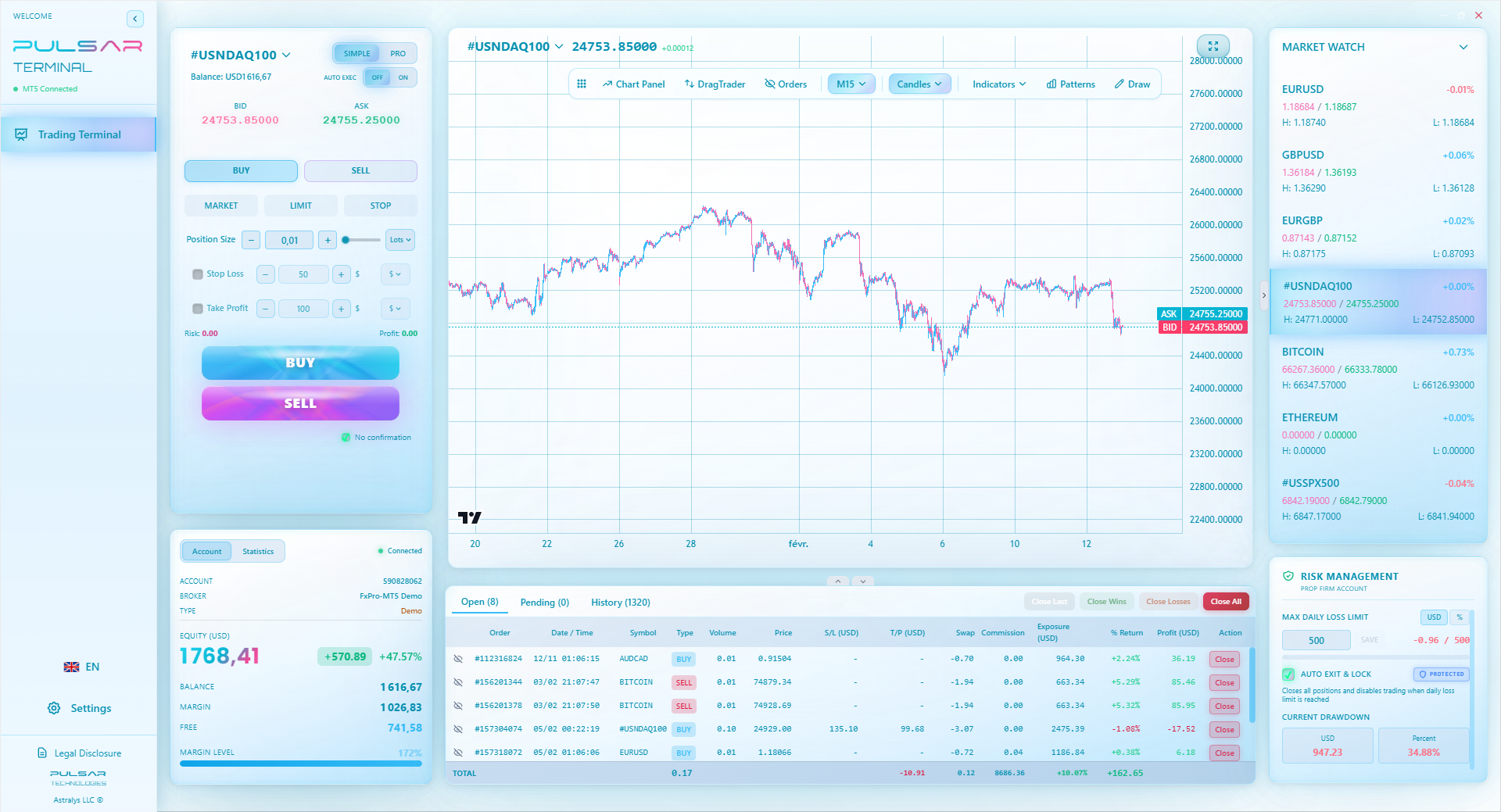
Manually drawing and managing trades at key levels is time-consuming; Pulsar Terminal automates order placement and advanced risk management like trailing stops directly on your MT5 charts.
Pulsar Terminal
The all-in-one MT5 companion: drag-and-drop orders, multi-TP/SL, trailing stop, grid trading, Volume Profile, and prop firm protection. Used by 1,000+ traders daily.
“The goal isn't to be right on every trade. The goal is to have a logical, repeatable process.”
Here's a practical routine you can start this Sunday. This is what separates the consistent trader from the gambler.
- Weekly Analysis (Sunday Evening): Open your trading platform. Look at the weekly and daily charts for your 2-3 favorite pairs. Identify the 3 most obvious support and resistance levels currently in play. Draw them. Note any major round number psychological levels nearby.
- Session Plan (Before London Open): Check where price is relative to those levels. Is it approaching one? Is it stuck between two? Form a bias: "If price reaches resistance at X, I will look for sell signals." But don't force it. If price is in the middle of nowhere, sometimes the best trade is no trade.
- Trade Execution: When price enters your pre-defined zone, wait. Watch the price action. Look for your confirmation. Then, and only then, enter. Set your stop-loss beyond the level. Set your take-profit at the next key level in the opposite direction. Use your position size calculator.
- Review (Friday Evening): Look at your trades. Did you respect the levels? Did your stops get hit by a tiny wick? Adjust for next week. This review process is how you improve.
This discipline turns the abstract concept of 'what are key levels in forex' into a concrete, actionable edge. It won't win every time, but it will keep you on the right side of the market more often than not. Remember, the goal isn't to be right on every trade. The goal is to have a logical, repeatable process that makes money over a series of trades. Key levels are the cornerstone of that process.
FAQ
Q1Are key levels in forex always exact prices?
No, and this is a critical point. Think of them as zones, not laser lines. Price will often react a few pips above or below a drawn level. This is due to market noise and pending orders. A key level is more like a "decision zone" where the battle between buyers and sellers intensifies.
Q2How many times does a price need to touch a level for it to be 'key'?
At least two clear, separated touches are the minimum. The more touches over a longer period, the stronger the level. A level tested five times over a year is far more significant than one tested twice in a week. The strength comes from repeated confirmation.
Q3Can I use key levels for scalping as a Nigerian trader?
Absolutely, but you need to adjust your timeframes. For scalping, focus on key levels on the M15 and H1 charts, and pay extra attention to psychological levels and the previous day's high/low. Just be aware that during off-peak hours (like late night Nigeria time), liquidity is lower and breaks/ bounces can be less reliable.
Q4Do key levels work on all currency pairs?
They work on any liquid pair, but they are clearest on major pairs like EUR/USD or GBP/USD that have high volume and less erratic movement. On exotic pairs involving the Naira or other low-liquidity currencies, levels can be more prone to false breaks due to wider spreads and sudden gaps.
Q5What's the biggest mistake beginners make with key levels?
They trade the first touch without confirmation, and they place their stop-loss orders directly on the level. This gets them stopped out on market noise. Always wait for price action confirmation (like a pin bar or engulfing candle) and place your stop a safe distance beyond the level.
Q6How do new SEC regulations affect how I use key levels?
The regulations (like the ISA 2025) don't change the technicals. They change the environment. With a push towards more regulated platforms, you need to ensure your broker is stable and reliable. A key level breakout is useless if your broker's platform freezes or rejects your order. Choose reputable, well-regulated brokers that serve the Nigerian market effectively.
Prof. Winston's Lesson
Key Takeaways:
- ✓Key levels are price zones of historical buying/selling interest.
- ✓Always seek confluence (level + indicator + trend) for high-probability trades.
- ✓Place stops beyond the level, not on it, to avoid market noise.
- ✓The weekly and daily charts hold your most important levels.
How useful was this article?
Click a star to rate
Weekly Trading Insights
Free weekly analysis & strategies. No spam.
About the Author
Olumide Adeyemi
West African Trading Pioneer
One of Nigeria's most active forex trading educators. 8 years of experience trading from Lagos. Specializes in low-capital strategies and prop firm challenges for African traders.
Comments
Risk Disclaimer
Trading financial instruments carries significant risk and may not be suitable for all investors. Past performance does not guarantee future results. This content is for educational purposes only and should not be considered investment advice. Always conduct your own research before trading.
You Might Also Like

Cara Trading Forex Sukses: 7 Prinsip dari Trader Profesional
Cara trading forex sukses dengan 7 prinsip trader pro: manajemen modal, disiplin, journal trading, backtest. Data nyata, bukan janji profit palsu.
Jam Trading Forex Terbaik untuk Trader Indonesia: Panduan Lengkap dengan Tabel Waktu
Panduan jam trading forex untuk trader Indonesia. Tabel 4 sesi dunia, jam emas 20:00-00:00, sesi mana yang harus dihindari. Data akurat + tips dari trader berpengalaman.
Top 5 Sàn Forex Uy Tín Nhất 2026: Review Jujur dari Trader Indonesia
Top 5 sàn forex uy tín 2026 untuk trader Indonesia. Review jujur: spread, deposit, withdraw, dukungan lokal. Exness, XM, IC Markets & lebih.
Get Pulsar Terminal
All these calculators are built into Pulsar Terminal with real-time data from your MT5 account. One-click position sizing, automatic risk management, and instant calculations.
Get Pulsar Terminal