


I remember staring at my screen in 2021, watching the Nasdaq 100 CFD bleed.

David van der Merwe
Emerging Markets Trader ·  South Africa
☕ 11 min read
What you'll learn:
- 1It's Not a Share, It's a CFD on an Index
- 2Trading Legally in SA: The FSCA Rules
- 3The Real Costs: Spreads, Swaps, and the ZAR Factor
- 4Getting Started: Choosing a Broker and Platform
- 5Trading It: Strategies for the Nasdaq's Wild Moves
- 6Pitfalls I've Stepped In (So You Don't Have To)
- 7Nasdaq vs. Gold vs. EUR/USD: What's the Difference?
I remember staring at my screen in 2021, watching the Nasdaq 100 CFD bleed. I was long at 15,800 points, convinced the post-pandemic tech rally had more juice. I didn't. It reversed hard on Fed taper talk, and I watched a R4,500 paper profit turn into a R2,100 loss because I got greedy and ignored my stop. That trade taught me a brutal lesson: trading 'the Nasdaq' in forex isn't about buying Apple stock. It's a different beast entirely, with its own rules, costs, and psychology. Let's break down exactly what is Nasdaq in forex for us trading from SA.
When you hear another trader at the V&A Waterfront coffee shop say they're 'trading the Nasdaq,' they're almost certainly talking about a Contract for Difference (CFD) on the Nasdaq 100 index. This is the core of what is Nasdaq in forex. You're not buying a piece of Microsoft or Tesla. Instead, you're entering a contract with your broker to exchange the difference in the index's value from when you open the trade to when you close it.
The Nasdaq 100 itself is just a number, a basket of the 100 largest non-financial companies listed on the Nasdaq exchange. Think Apple, Amazon, Meta, Nvidia. When that basket's value goes up, the index price goes up. Your CFD tracks that price.
Why does this matter? Because a CFD gives you use. With a regulated broker like those under the FSCA, you can control a large position with a relatively small deposit. But that use is a double-edged sword – it magnifies both profits and losses, which is exactly what caught me out. You also never own the underlying asset, which changes your tax implications and your relationship to the trade. It's pure speculation on price movement.

Warning: Trading Nasdaq CFDs is not 'investing in tech.' It's short-term speculation. Don't confuse the two. The holding costs and use make it unsuitable for a buy-and-hold 'investment' mindset.
The symbol you'll see varies by broker: NAS100, US100, USTEC, or US Tech 100. They all refer to the same underlying index. Getting familiar with your platform's specific naming is step one. I once spent 10 minutes confused because I was looking for 'NDX' on my MT5 when my broker, Exness, called it 'USTEC.c' on their servers.

💡 Winston's Tip
The Nasdaq doesn't trade on hope or potential. It trades on delivered earnings and concrete guidance. Always wait for the market's reaction to news, not your reaction to the headline.
“Trading 'the Nasdaq' in forex isn't about buying Apple stock. It's a different beast entirely.”
You can't talk about trading anything in South Africa without mentioning the regulators. It's not the wild west. For forex and CFDs, the main sheriff in town is the Financial Sector Conduct Authority (FSCA).
The 30:1 use Cap
This is the big one for retail traders like you and me. Since 2021, the FSCA has capped maximum use at 30:1 for major indices. That means for every R1,000 in your account, you can control a position worth R30,000. Some brokers, like HF Markets, might advertise higher use (like 1:200) on international sites, but for South African resident clients under FSCA rules, 30:1 is the legal maximum. Don't get tempted by offshore offers that bypass this; your funds likely won't have the same protection.
Broker Licensing and Your Money
Always, and I mean always, check your broker's FSP number on the FSCA website. A legit broker like AvaTrade (FSP 45984) or XM will have it clearly displayed. This license means they must follow strict rules: segregating client funds (your money is kept separate from the company's operating money), enforcing AML checks, and providing clear risk disclosures. The South African Reserve Bank (SARB) also has a say, especially for larger cross-border transactions, but for daily trading, the FSCA is your point of contact.
Using an FSCA-regulated broker is your first and best line of defense. I learned this the hard way early in my career with an unregulated outfit. Withdrawal took weeks and came with 'fees' that weren't in the terms. Never again.
“A 2-pip spread means you're down R9 the moment you enter a 1-mini-lot trade.”
This is where many new traders get a nasty surprise. The ticket price isn't the only cost. Let's talk rands and cents.
Spreads Vary Wildly
The spread is the difference between the buy and sell price, and it's how many brokers make their money. For the Nasdaq 100, this isn't a fixed cost. Check this comparison:
| Broker | Typical Nasdaq 100 Spread (in points/pips) | Account Type Note |
|---|---|---|
| Plus500 | ~1.9 pips | Standard CFD account |
| Tickmill | ~1.93 pips | Commission-based account often has tighter spreads |
| HF Markets | ~2.03 pips | Can vary by account |
| XM | ~3 pips | Commission-free model |
| Exness Zero Acc | ~5.7 pips | But charges a commission per lot |

Example: A 2-pip spread on the Nasdaq (where 1 pip is usually $0.25 per mini lot) means you're down $0.50 (about R9) on a 1-mini-lot trade the moment you enter. The trade needs to move in your favour by that amount just to break even.
The Silent Killer: Swap Fees
If you hold a position overnight (past the broker's rollover time, usually 10pm SAST), you'll pay or receive a swap fee. For Nasdaq CFDs, these can be significant, especially if you're long. I once held a long swing trade for a week, and the overnight fees ate up nearly 15% of my eventual profit. Always check the swap rates in your platform's specification window. A swing trading strategy needs to account for this.
The Rand Dollar Dance
Here's a uniquely South African cost: if your trading account is in ZAR but the asset (Nasdaq) is priced in USD, your profit and loss will be converted. If the rand weakens (USD/ZAR goes up), your USD profits are worth more in rands. Sounds good, right? But it works both ways. A stronger rand can shrink your ZAR returns even on a winning USD trade. Some local brokers like Khwezi Trade offer ZAR-denominated accounts to remove this variable, which is worth considering for simpler accounting.
“A 2-pip spread means you're down R9 the moment you enter a 1-mini-lot trade.”
Right, you're convinced. How do you actually start?
Minimum Deposits and Realistic Capital
You'll see ads for 'Trade with just $10!' That's technically true with brokers like Exness. But let's be real. Trading the Nasdaq with $10 (about R185) at 30:1 use gives you $300 in buying power. One bad move of 30 points (which happens in minutes) and you're looking at a margin call.
From my experience, you need a buffer. A minimum of R5,000 is a sensible starting point for active trading. It allows for proper position size calculator use and lets you survive a few losses without blowing up. For serious capital, R20,000+ is where you can start implementing strategies with less psychological pressure.
The Platform: MT4/MT5 is King
In South Africa, MetaTrader 4 and MetaTrader 5 are the undisputed champions. Almost every major FSCA broker supports them. They're reliable, have countless indicators (like the RSI indicator or MACD indicator), and a huge community. While brokers like Plus500 have slick proprietary apps, MT4/MT5's depth is unmatched for analysis.
Funding Your Account
Local is lekker here. Use a broker that supports instant EFTs or deposits via local banks like Standard Bank or Capitec. It's faster and cheaper than international wire transfers, which can incur fees from both your bank and the broker's. Withdrawals should be just as smooth. If a broker makes withdrawing your money difficult, that's a massive red flag.
💡 Winston's Tip
Your biggest risk trading the Nasdaq isn't a single bad trade. It's correlation risk - when all your 'different' tech positions move as one herd. Diversify your watchlist beyond just tech.
“The Nasdaq often leads the broader market. If it's breaking highs while the S&P lags, pay attention.”
The Nasdaq isn't for the faint-hearted. It's more volatile than the S&P 500. Here’s how I approach it.
Embrace the News, Especially US Data
This index lives and dies on US tech earnings, Fed interest rate decisions, and inflation data (CPI). A bad earnings report from a top-10 component like Amazon can drag the whole index down 1-2% in a day. I have a calendar marked with major earnings dates and Fed announcements. On those days, I either stay out or trade with half my usual position size. The volatility is an opportunity, but only if you're prepared.
Time Your Sessions
The Nasdaq's main trading hours are during the US session (3:30 PM to 10:00 PM SAST). That's when you get the biggest moves and the most liquidity. The European morning (8 AM - 3 PM SAST) can be slow and range-bound. I made the mistake of trying to scalping strategy during the Asian session. The spreads were wider, the moves were tiny, and I just gave back profits in commissions. Now, I focus my active trading on the US open and the first few hours after.
A Simple Trend-Following Tactic
Here's one that's worked for me on the 4-hour chart. The Nasdaq trends beautifully. I wait for price to pull back to the 50-period Exponential Moving Average (EMA) in a strong uptrend. If the RSI indicator is above 40 (showing the pullback isn't too severe) and starts curling up, I'll look for a long entry. My stop goes below the recent swing low. It's not fancy, but it catches a lot of the continued momentum moves. The key is patience – waiting for the setup, not forcing trades.

Pro Tip: The Nasdaq often leads the broader market. If it's breaking to new highs while the S&P 500 is lagging, it can be a leading indicator of general market risk-on sentiment. Watch for this divergence.
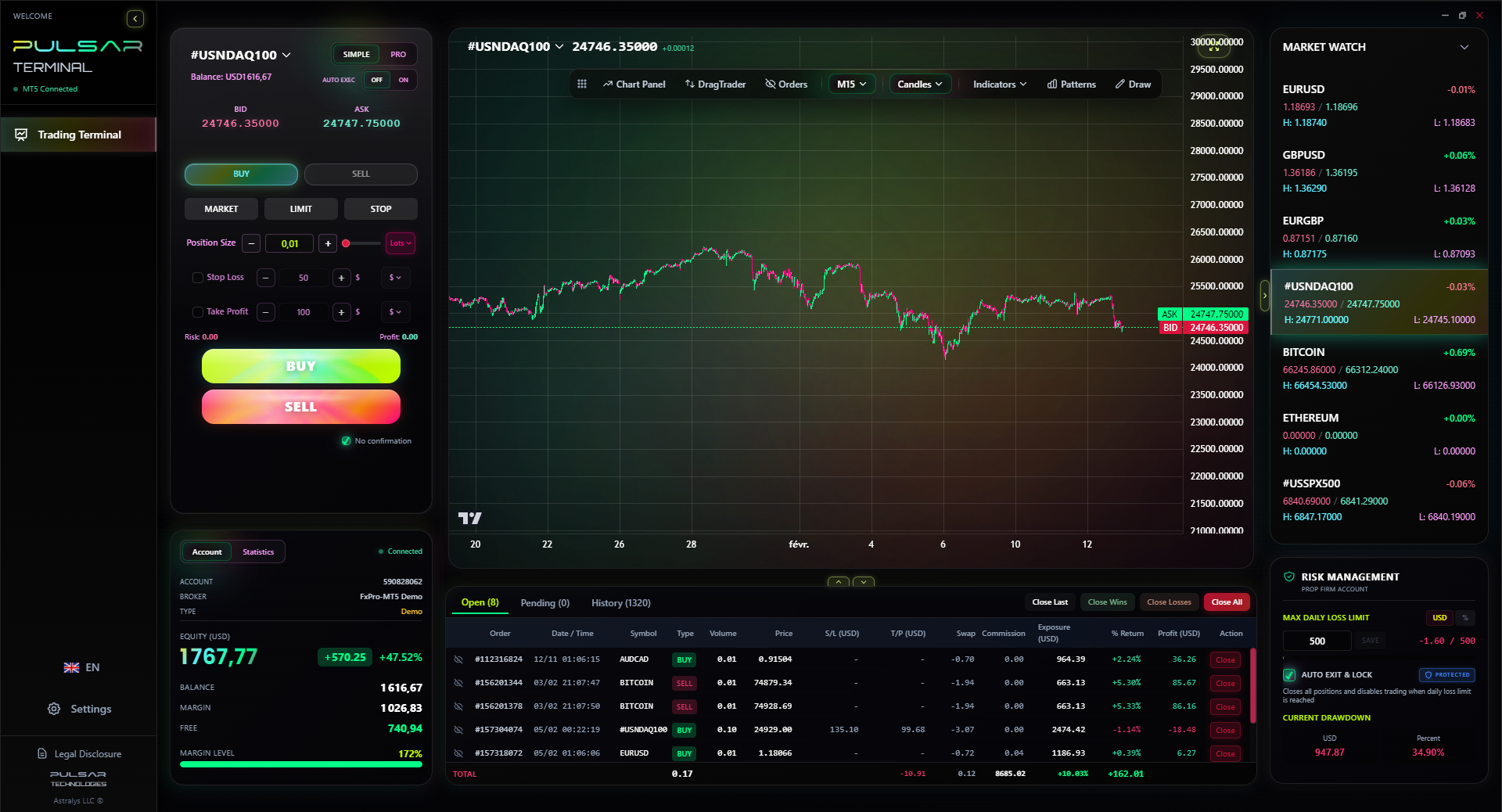
Managing multiple targets and trailing stops on a volatile instrument like the Nasdaq is much easier with a tool that lets you set them all visually before you enter the trade.
Pulsar Terminal
The all-in-one MT5 companion: drag-and-drop orders, multi-TP/SL, trailing stop, grid trading, Volume Profile, and prop firm protection. Used by 1,000+ traders daily.
“The Nasdaq often leads the broader market. If it's breaking highs while the S&P lags, pay attention.”
Let me save you some money and frustration by sharing my blunders.
Over-leveraging on 'Sure Things': This is my intro story. A strong trend does not mean an invincible trend. I used my full 30:1 use on what seemed like a guaranteed continuation. A single piece of unexpected news reversed it, and the use magnified my loss. Now, I rarely use more than 10:1 on a single Nasdaq trade, no matter how confident I am.
Ignoring Correlation: The Nasdaq and the S&P 500 (SPX) are highly correlated. So are many of the big tech stocks within the Nasdaq. I once thought I was 'hedged' by being long Nasdaq and short a tech stock. When the sector sold off, both positions went against me. They were correlated, not inversely correlated. Understand what's in your basket.
Chasing the Gap: The Nasdaq often gaps up or down at the open, especially after-hours earnings news. The instinct is to jump in and chase the move. Nine times out of ten, you're entering at the worst possible price. I've been burned more often by chasing gaps than by patiently waiting for the first 30 minutes of price action to settle and show a direction.
Forgetting It's a CFD: This is mental. You need to treat it with the discipline of a forex pair, not the emotional attachment of a share you 'believe in.' I held a losing Nasdaq CFD position for weeks because 'tech is the future.' The future was right, but my timing was horribly wrong, and the swap fees crippled me. Set your stop, respect it, and move on.
💡 Winston's Tip
If you can't articulate the fundamental reason (earnings, Fed, sector rotation) for the move you're trying to catch, you're just gambling on noise. Know your 'why.'
“Don't trade the Nasdaq with the same rules or position sizes as your forex pairs.”
As a forex trader, you might be used to pairs like EUR/USD. Trading the Nasdaq CFD is a different animal. Let's compare.
Vs. EUR/USD (a Major Forex Pair):
- Volatility: Nasdaq is generally more volatile. A 1% daily move for Nasdaq is common; for EUR/USD, it's a big day.
- Drivers: EUR/USD is driven by macroeconomics (ECB vs. Fed policy, GDP). Nasdaq is driven by corporate earnings, tech sector sentiment, and US growth expectations.
- Trading Hours: EUR/USD has 24-hour liquidity, but key moves happen in London and NY overlap. Nasdaq is most active strictly during US hours.
- Costs: Spreads on EUR/USD are often tighter (around 1.2 pips on average). Nasdaq spreads are wider, as you saw in the table above.
Vs. Gold (XAU/USD):
- Sentiment: Gold is a safe-haven, anti-fiat asset. Nasdaq is the ultimate 'risk-on' growth asset. They often (but not always) move inversely. When markets panic, money flows out of Nasdaq and into gold.
- Correlation: This inverse relationship is useful. If I have a strong long bias on Nasdaq, I'll glance at the XAU/USD guide chart. If gold is also screaming higher, it signals broad market fear, and I might reconsider my bullish Nasdaq stance.
The key takeaway? Don't trade the Nasdaq with the same rules, position sizes, or expectations as your forex pairs. It requires its own dedicated strategy and respect for its unique rhythm.
FAQ
Q1Is trading Nasdaq CFDs legal in South Africa?
Yes, absolutely. It's legal and regulated by the Financial Sector Conduct Authority (FSCA). You must use an FSCA-licensed broker to ensure your funds are protected under South African law.
Q2What's the minimum deposit to trade Nasdaq 100 CFDs in SA?
You can find brokers like Exness with a $10 (≈R185) minimum. However, for practical and responsible trading that can withstand normal volatility, a minimum of R5,000 is a much more realistic starting point.
Q3Why does the price on my broker's platform differ from the actual Nasdaq 100 index?
You're likely looking at a CFD price, not the live cash index. The CFD price tracks the underlying index futures (like the E-mini Nasdaq 100), which trade almost 24/7. There will always be a slight difference (the 'basis'), and it includes the broker's spread.
Q4Can I trade the Nasdaq 100 in South African Rands (ZAR)?
Yes, some South African-owned brokers like Khwezi Trade offer ZAR-denominated accounts. With international brokers, your account is usually in USD, so your profit/loss in ZAR will fluctuate with the USD/ZAR exchange rate.
Q5What's more volatile, Nasdaq or S&P 500?
The Nasdaq 100 is significantly more volatile. It's concentrated in high-growth tech stocks, which are more sensitive to interest rates and earnings surprises than the broader, more diversified S&P 500.
Q6Do I pay tax on profits from trading Nasdaq CFDs in SA?
Yes. Profits from CFD trading are generally considered revenue (trading income) by SARS and are taxable as part of your normal income. It's crucial to keep detailed records of all your trades for tax purposes. Speak to a tax professional familiar with trading.
Prof. Winston's Lesson
Key Takeaways:
- ✓Nasdaq in forex means a CFD, not direct ownership.
- ✓FSCA caps use at 30:1 for retail traders.
- ✓Spreads vary from 1.9 to 5+ pips depending on broker.
- ✓Start with at least R5,000 for realistic trading.
- ✓Major moves happen during US session (3:30-10pm SAST).
How useful was this article?
Click a star to rate
Weekly Trading Insights
Free weekly analysis & strategies. No spam.
About the Author
David van der Merwe
Emerging Markets Trader
Johannesburg-based trader with 11 years in emerging market currencies. Specializes in ZAR pairs, FSCA-regulated trading, and South African market analysis.
Comments
Risk Disclaimer
Trading financial instruments carries significant risk and may not be suitable for all investors. Past performance does not guarantee future results. This content is for educational purposes only and should not be considered investment advice. Always conduct your own research before trading.
You Might Also Like

Cara Trading Forex Sukses: 7 Prinsip dari Trader Profesional
Cara trading forex sukses dengan 7 prinsip trader pro: manajemen modal, disiplin, journal trading, backtest. Data nyata, bukan janji profit palsu.
Jam Trading Forex Terbaik untuk Trader Indonesia: Panduan Lengkap dengan Tabel Waktu
Panduan jam trading forex untuk trader Indonesia. Tabel 4 sesi dunia, jam emas 20:00-00:00, sesi mana yang harus dihindari. Data akurat + tips dari trader berpengalaman.
Top 5 Sàn Forex Uy Tín Nhất 2026: Review Jujur dari Trader Indonesia
Top 5 sàn forex uy tín 2026 untuk trader Indonesia. Review jujur: spread, deposit, withdraw, dukungan lokal. Exness, XM, IC Markets & lebih.
Get Pulsar Terminal
All these calculators are built into Pulsar Terminal with real-time data from your MT5 account. One-click position sizing, automatic risk management, and instant calculations.
Get Pulsar Terminal