


Here's a brutal truth: over 90% of retail traders lose money.

Olumide Adeyemi
West African Trading Pioneer ·  Nigeria
☕ 11 min read
What you'll learn:
- 1What Technical Analysis Actually Is (And Isn't)
- 2The Core Building Blocks: Price, Time, and Volume
- 3Charts, Indicators, and Tools: Your Toolkit
- 4Reading the Market's Mind: Common Chart Patterns
- 5Putting It All Together: A Simple Framework
- 6The Limits and Common Pitfalls
- 7How to Start (Without Blowing Up)

Here's a brutal truth: over 90% of retail traders lose money. The single biggest reason isn't a lack of signals or a bad broker. It's a fundamental misunderstanding of what technical analysis in forex actually is. Most people treat it like a fortune-telling tool, searching for the one magical indicator that predicts the future. That's a surefire way to blow up your account. Real technical analysis is something far more practical and far less mystical. It's the study of past price action to gauge market psychology and identify probable future movements, all while managing your risk so you survive to trade another day.
Let's cut through the noise. Technical analysis in forex is not about predicting the future. Anyone who tells you they can do that is selling something, probably a dodgy signal service. What it is is a framework for understanding the market's current state and identifying high-probability trading opportunities based on historical patterns.
At its core, it operates on three basic principles:
- Price discounts everything: All known information - news, economic data, market sentiment - is already reflected in the current price. The chart tells the whole story.
- Price moves in trends: Markets have a tendency to move in a particular direction (up, down, or sideways) for extended periods. The old trader's saying is true: 'The trend is your friend.'
- History tends to repeat itself: Market psychology is cyclical. Patterns of greed and fear manifest in recognizable chart formations and price action.
Think of it like this: you're not a prophet. You're a detective. You're looking at the evidence left on the chart - the footprints of all the buyers and sellers - to make an educated guess about what might happen next. The goal isn't to be right every time. The goal is to have a statistical edge and manage your losses so that your winners outweigh your losers over many trades. This is where a solid position size calculator becomes non-negotiable.

Warning: The biggest mistake new traders make is using technical analysis to confirm their bias. They want to buy GBP/USD, so they hunt for a bullish indicator while ignoring all the bearish signs. Your job is to read what the market is telling you, not tell the market what you want to hear.

💡 Winston's Tip
The chart doesn't lie, but it also doesn't tell the whole truth. It shows you what *did* happen, not what *will* happen. Trade the probability, not the prophecy.
“Real technical analysis is the study of past price action to gauge market psychology, not a magic prediction system.”
All technical analysis is built on just a few raw ingredients. You don't need 20 indicators flashing on your screen. You need to understand these fundamentals first.
Price Action: This is the most important data you have. It's the pure movement of the currency pair's price over time, represented by candlesticks or bars. Each candlestick tells a mini-story of the battle between bulls and bears during that period. Learning to read basic candlestick patterns - like dojis, hammers, and engulfing bars - is your first real step into technical analysis.
Support and Resistance: These are the foundational concepts. Support is a price level where buying interest is strong enough to overcome selling pressure, causing the price to bounce back up. Resistance is the opposite - a level where selling pressure overcomes buying, pushing the price down. These aren't magic lines; they are zones where the market has made decisions before.
Trends: Identifying the trend is job number one. Is the market making higher highs and higher lows (uptrend)? Lower highs and lower lows (downtrend)? Or is it chopping sideways in a range? Your entire trading bias should align with the trend. Trying to scalping strategy against a strong trend is like swimming against a tidal wave.
Volume: In forex, we use tick volume (the number of price changes) as a proxy for real volume. It helps confirm the strength of a move. A breakout from resistance on high volume is more convincing than one on low volume. While not as precise as stock market volume, it's a useful secondary tool.
I learned this the hard way early on. I was obsessed with a complex MACD indicator divergence setup on EUR/JPY, completely ignoring that price was slamming into a massive, multi-week resistance zone. I took the trade, got stopped out for a 2% loss, and watched the pair reverse exactly from that zone. The price action and horizontal level were screaming at me; I was just too busy listening to my indicator.
“You're not a prophet. You're a detective looking at the evidence left on the chart.”
This is where people get lost in the weeds. You have your raw data (price), now you need ways to organize and interpret it.
Types of Charts
- Line Charts: Simple, just connects closing prices. Good for a clean view of the overall trend.
- Bar Charts: Shows open, high, low, and close (OHLC) for each period.
- Candlestick Charts: The trader's standard. Visually intuitive, showing the same OHLC data but making the battle between bulls and bears immediately apparent. The body and wicks give you instant information.
Categories of Technical Indicators
Indicators are just mathematical calculations applied to price and/or volume. They are derivatives, not the source of truth.
| Category | Purpose | Common Examples | The Reality Check |
|---|---|---|---|
| Trend-Following | Identify and confirm the direction of a trend. | Moving Averages, MACD, Parabolic SAR | Lagging. They tell you what has happened. Great in strong trends, terrible in choppy markets. |
| Momentum | Gauge the speed or strength of a price move. | RSI indicator, Stochastic Oscillator | Can signal overbought/oversold conditions and potential reversions. Can stay extreme for a long time in a powerful trend. |
| Volatility | Measure the rate of price movements. | Bollinger Bands, Average True Range (ATR) | Crucial for setting stop-loss distances. Bollinger Band squeezes often precede big breakouts. |
| Volume | Confirm the strength behind a move. | On-Balance Volume (OBV), Volume Profile | In forex, use with caution. Tick volume is helpful but not definitive. |

Pro Tip: Start with a clean chart. Add one tool at a time and learn what it does. My baseline setup for swing trading is pure price action with horizontal support/resistance lines, a 20-period and 50-period moving average to define the trend, and the ATR to help size my stops. That's it. The fanciest tool is useless if you don't know its limitations.

“You're not a prophet. You're a detective looking at the evidence left on the chart.”
Chart patterns are the visual language of market psychology. They represent periods of consolidation, indecision, or acceleration that often resolve in a predictable direction.
Continuation Patterns (The Market is Taking a Breath) These suggest the prevailing trend will resume after a pause.
- Flags & Pennants: Small, slanted consolidation after a sharp move. Think of them as the flagpole (the sharp move) and the flag (the consolidation). A break out of the consolidation typically continues the prior trend.
- Triangles (Ascending, Descending, Symmetrical): Price coiling into a tighter and tighter range. The breakout direction from the triangle is your trade signal.
Reversal Patterns (The Market is Changing its Mind) These signal a potential end to the current trend.
- Head and Shoulders (and Inverse H&S): The classic reversal pattern. A peak (head) flanked by two smaller peaks (shoulders). The neckline break is the trade trigger. I caught a perfect Inverse Head and Shoulders on XAU/USD in 2020. The right shoulder formed around $1,850, the neckline was at $1,920. The break above that neckline led to a run to over $2,000. The target, measured from the head low to the neckline, was almost perfectly hit.
- Double Tops & Double Bottoms: 'M' and 'W' shapes. The price tests a level twice and fails to break through, suggesting exhaustion.
The key with all patterns? Wait for the confirmation. Don't trade the anticipation of the pattern completing. Trade the break of the neckline or trendline that confirms the pattern's resolution. Patience here saves you from countless fakeouts.
💡 Winston's Tip
Your first loss is often your smallest loss. If a trade goes against you and your technical premise is broken, get out. Hoping is not a strategy.
“The goal isn't to be right every time. The goal is to have a statistical edge and manage your losses.”
Analysis paralysis is real. Here’s a straightforward, three-step framework to apply what technical analysis in forex is all about.
Step 1: The Big Picture (The Trend) Zoom out to a higher time frame - like the daily or weekly chart. What is the major trend? Use simple tools: are prices above or below a key moving average (like the 200-period)? Is the chart making higher highs? Your bias for any trade on a lower time frame should align with this. Never take a buy signal on the 1-hour chart if the daily chart is in a crushing downtrend.
Step 2: The Trade Zone (Support & Resistance) Zoom into your trading time frame (e.g., 4-hour or 1-hour). Where is price in relation to key support and resistance zones? Look for confluences - areas where a trendline meets a horizontal level, or where a 61.8% Fibonacci retracement aligns with a previous swing high/low. These are high-probability areas for price to react.
Step 3: The Trigger (Entry Signal) This is where you get granular. Wait for price action or a short-term indicator to give you a signal at your confluence zone. This could be:
- A bullish engulfing candlestick at a support zone in an uptrend.
- The RSI indicator bouncing from oversold (30) while price touches an ascending trendline.
- A break and close above a minor resistance level within your larger bullish zone.
Then, and only then, do you execute. Your stop-loss goes below the support zone (for a buy) or above the resistance zone (for a sell). Your take-profit target is based on a measured move or the next clear level of opposition. This process forces discipline and removes emotion.
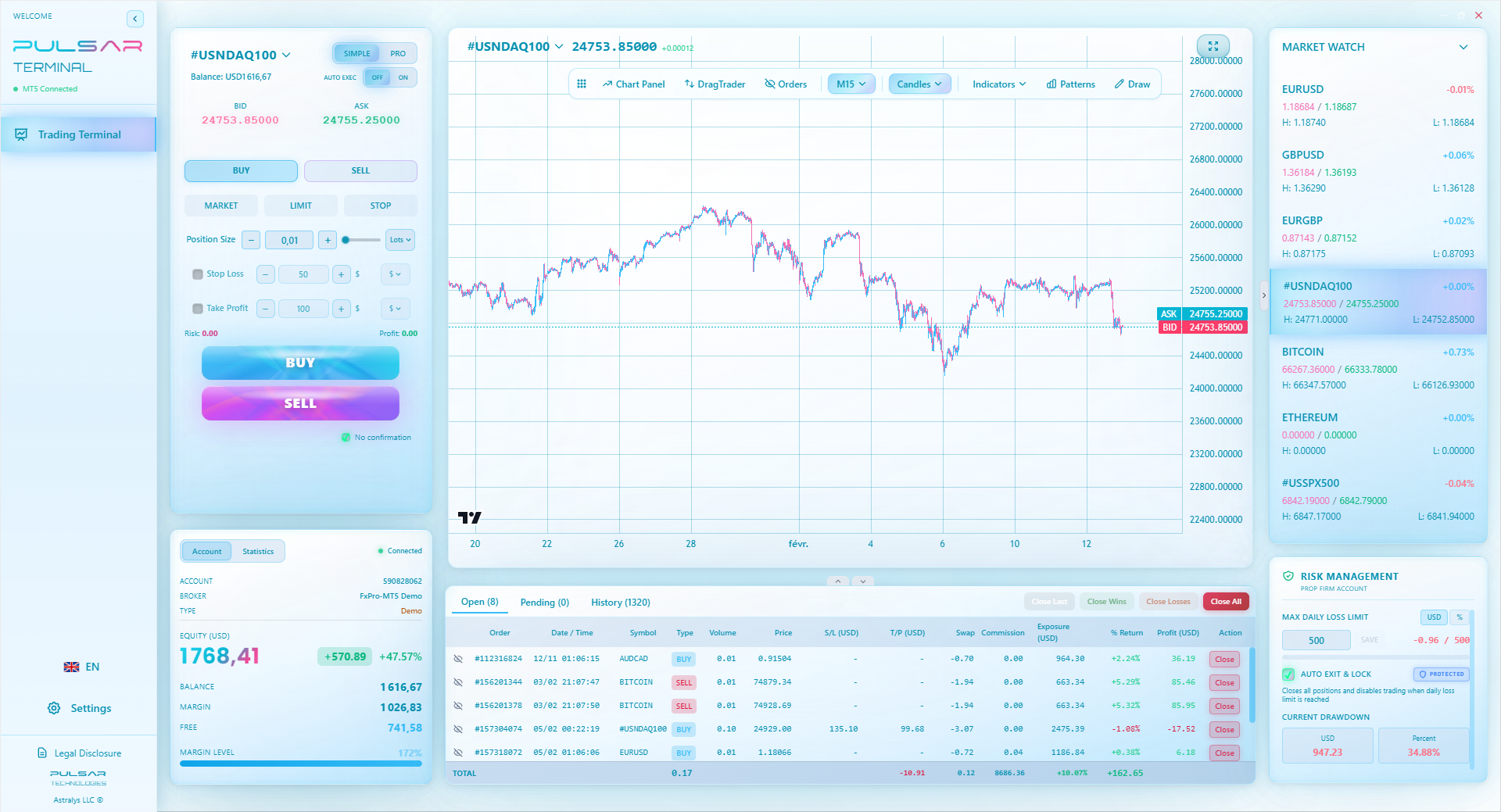
Executing a disciplined technical analysis plan requires precise order management, which Pulsar Terminal provides with its drag-and-drop orders and multi-take-profit tools directly on your MT5 chart.
Pulsar Terminal
The all-in-one MT5 companion: drag-and-drop orders, multi-TP/SL, trailing stop, grid trading, Volume Profile, and prop firm protection. Used by 1,000+ traders daily.
“The goal isn't to be right every time. The goal is to have a statistical edge and manage your losses.”
Technical analysis is a powerful tool, but it's not omnipotent. Ignoring its limits is a recipe for disaster.
It's Probabilistic, Not Certain: Even the best setup fails. That's why risk management is not optional. You might have a 60% win rate. That means 4 out of 10 trades will lose. If your losses are bigger than your wins, your 60% win rate still loses money.
It Can Be Self-Fulfilling... Until It Isn't: Because so many traders watch the same levels (like round numbers, major moving averages), buying and selling can cluster there, making the levels work. But when a fundamental shock hits - a surprise central bank decision, geopolitical news - technical levels can vaporize. Your stop-loss is your only defense.
The Lagging Nature of Indicators: By definition, most indicators lag price. They are telling you what just happened. Relying on them alone means you're always a step behind. Price leads, indicators follow.
Overcomplication: The rookie mistake is loading a chart with 10 different indicators that all say the same thing (e.g., three different momentum oscillators). It creates confusion and conflicting signals. Keep it stupidly simple.
The most expensive lesson of my career was on EUR/USD during a major ECB announcement. I had a perfect bearish pin bar at a strong resistance zone. The technicals were pristine. I entered short. Then the ECB statement was wildly more dovish than anyone expected. The pair ripped upward 150 pips in minutes. My stop-loss was hit, and the spread widened massively due to volatility, making the loss even worse. Technical analysis gave me no warning. That's why you never risk more than 1-2% per trade. That loss stung, but it didn't cripple my account.
💡 Winston's Tip
A clean chart is a clear mind. If you can't explain your trade setup in 10 seconds using just the price chart, you're overcomplicating it.
“Technical analysis gave me no warning during the ECB shock. That's why you never risk more than 1-2% per trade.”
If you're new to this, here's your action plan to learn what technical analysis in forex is, the right way.
- Open a Demo Account: This is non-negotiable. Use a reputable broker with a good demo platform like IC Markets or Pepperstone. Trade fake money for at least 3-6 months.
- Pick ONE Pair: Don't jump between 28 currencies. Start with a major pair like EUR/USD or GBP/USD. They have tight spreads and clear liquidity.
- Learn ONE Pattern & One Indicator: Master the head and shoulders pattern. Or learn how to properly draw support and resistance. Pair it with one indicator, like the RSI. Paper trade just that setup for weeks.
- Journal Religiously: For every trade, note: the setup, the chart time, your entry/exit, your emotional state, and the outcome. Review weekly. Your journal will tell you more about yourself than any indicator ever will.
- Integrate Risk Management From Day One: Before you even think about a live trade, decide your risk-per-trade (e.g., 1% of capital) and stick to it. Use your position size calculator for every single trade, demo or live.
Technical analysis is a skill, like learning a language or an instrument. You won't be fluent in a month. You will make mistakes. The goal in the beginning isn't profit. The goal is survival and consistency. Once you can consistently identify high-probability setups and manage your risk on demo, then you can consider a small live account. And I mean small - money you can afford to lose completely without affecting your life.

FAQ
Q1Can I make money using only technical analysis in forex?
Yes, absolutely. Many successful systematic traders use purely technical models. However, 'using technical analysis' doesn't mean just looking at indicators. It means having a strong, rules-based system that includes precise entry/exit criteria and, most importantly, strict risk management. The analysis finds the opportunities; the risk management keeps you in the game.
Q2What's more important, technical or fundamental analysis?
For most retail traders, especially those not trading on multi-day or weekly timeframes, technical analysis is more actionable. Fundamentals (like interest rates, GDP) create the long-term trend, but technicals tell you when to enter or exit that trend. Think of it this way: fundamentals are the 'why,' technicals are the 'when' and 'where.'
Q3What's the best time frame for technical analysis?
There isn't one 'best' frame. It depends on your personality and trading style. A common approach is multi-timeframe analysis: use a higher timeframe (like Daily) to determine the trend, a medium timeframe (like 4-Hour) to find key support/resistance zones, and a lower timeframe (like 1-Hour or 15-min) for precise entry triggers. Start with the 4-hour chart; it's less noisy than the 1-minute but more active than the daily.
Q4How many indicators should I use on my chart?
As few as possible. Seriously. One or two, max. More indicators increase complexity and often give conflicting signals, leading to paralysis. Choose one trend-following tool (like a moving average) and one momentum/oscillator (like RSI). Master what they tell you and, more importantly, what they don't tell you.
Q5Is technical analysis just a self-fulfilling prophecy?
Partly, and that's a strength, not a weakness. Because thousands of traders see the same key levels (like the 200-day moving average or a round number like 1.1000 in EUR/USD), they place their orders there. This collective action makes the level significant. However, it's not magic. During extreme news events or when large institutional orders hit the market, these levels can break easily. That's why you always use a stop-loss.
Q6How long does it take to become proficient at technical analysis?
You can learn the basic concepts in a few weeks. But becoming proficient - developing the eye for patterns, the discipline to wait, and the emotional control to follow your plan - takes years of screen time and practice. Expect to spend 6-12 months on a demo account before you see any real consistency. This is a marathon, not a sprint.
Prof. Winston's Lesson
Key Takeaways:
- ✓Price action is the primary source of truth; indicators are secondary.
- ✓Always define the trend on a higher timeframe first.
- ✓Wait for confluence: where multiple technical factors align.
- ✓Risk 1% per trade, no exceptions.
- ✓A 60% win rate can still lose money with poor risk management.
How useful was this article?
Click a star to rate
Weekly Trading Insights
Free weekly analysis & strategies. No spam.
About the Author
Olumide Adeyemi
West African Trading Pioneer
One of Nigeria's most active forex trading educators. 8 years of experience trading from Lagos. Specializes in low-capital strategies and prop firm challenges for African traders.
Comments
Risk Disclaimer
Trading financial instruments carries significant risk and may not be suitable for all investors. Past performance does not guarantee future results. This content is for educational purposes only and should not be considered investment advice. Always conduct your own research before trading.
You Might Also Like

Cara Trading Forex Sukses: 7 Prinsip dari Trader Profesional
Cara trading forex sukses dengan 7 prinsip trader pro: manajemen modal, disiplin, journal trading, backtest. Data nyata, bukan janji profit palsu.
Jam Trading Forex Terbaik untuk Trader Indonesia: Panduan Lengkap dengan Tabel Waktu
Panduan jam trading forex untuk trader Indonesia. Tabel 4 sesi dunia, jam emas 20:00-00:00, sesi mana yang harus dihindari. Data akurat + tips dari trader berpengalaman.
Top 5 Sàn Forex Uy Tín Nhất 2026: Review Jujur dari Trader Indonesia
Top 5 sàn forex uy tín 2026 untuk trader Indonesia. Review jujur: spread, deposit, withdraw, dukungan lokal. Exness, XM, IC Markets & lebih.
Get Pulsar Terminal
All these calculators are built into Pulsar Terminal with real-time data from your MT5 account. One-click position sizing, automatic risk management, and instant calculations.
Get Pulsar Terminal