


Did you know the broker you're trading with might not own the platform you're using? Over 60% of new retail brokerages in South Africa launch using a white label solution.

David van der Merwe
Emerging Markets Trader ·  South Africa
☕ 12 min read
What you'll learn:
- 1What Exactly Is a White Label Forex Platform?
- 2The Real Costs & Setup: What Your Broker Paid
- 3FSCA Rules: The Buck Stops With Your Broker
- 4The Trader's Perspective: How This Affects Your Choice
- 5White Label vs. Full License: What You're Actually Seeing
- 6The Future in South Africa: More Scrutiny, Better Tech
- 7Final Thoughts: Key Takeaways for the Savvy Trader
Did you know the broker you're trading with might not own the platform you're using? Over 60% of new retail brokerages in South Africa launch using a white label solution. It's the invisible engine of the forex industry, letting entrepreneurs slap their brand on someone else's proven technology. I spent years trading on these platforms before I understood what was really happening behind the login screen. This guide isn't for the broker wannabes; it's for you, the trader, to understand the machinery your money depends on.
Let's cut through the jargon. A white label forex platform is a ready-made trading system sold by a technology provider (like MetaQuotes, the maker of MT4/MT5, or others like Match-Trader) to a new brokerage. The broker buys it, customizes the colors and logo, and sells it to you as their own proprietary or 'powered by' platform.
Think of it like a franchise. You don't build the restaurant from scratch; you buy the brand and the operating manual. The provider handles the core tech - the trading servers, the bridge to liquidity, the user interface. The broker handles the client-facing stuff: marketing, customer support, and crucially, regulatory compliance.
I learned this the hard way early on. I was with a slick new broker boasting about their 'advanced trading software.' The spreads were tight, execution was fast. It felt premium. Then, one day, their platform went down for 'essential upgrades.' On a whim, I logged into my account with a different, much larger broker. Their platform was identical. Same layout, same order window, same chart setup. The only difference was the color scheme and logo in the top corner. That's when the penny dropped. I wasn't using a unique tool; I was using a rented, rebranded commodity. It changed how I judged a broker forever. The platform became less important than their liquidity sources and their regulatory standing.

Warning: A white label doesn't mean low quality. Major, reputable brokers use them to enter new markets quickly. But it does mean the broker's real value isn't in tech innovation - it's in their service, pricing, and regulatory integrity.

💡 Winston's Tip
A broker's platform is their shopfront. Spend your time auditing their warehouse - their liquidity, their execution reports, and their withdrawal policy. That's where the real business happens.
“I wasn't using a unique tool; I was using a rented, rebranded commodity. It changed how I judged a broker forever.”
If you've ever wondered about the barrier to entry for starting a broker, here are the numbers. They're eye-opening.
The FSCA License: The Big Ticket Item
Before anything else, you need the FSCA's blessing. Getting a Category I FSP license isn't cheap or fast. You need a locally incorporated company (a Pty Ltd), a physical office, and key staff registered with the FSCA. The real kicker is the capital requirement. You're looking at an initial capital outlay of ZAR 5 million to ZAR 10 million just to be considered. This isn't operating cash; it's proof you're financially solid. This is the primary filter keeping the market (somewhat) clean.
The Platform Itself
Once licensed, you shop for your white label. For the ubiquitous MT4 or MT5 platform, setup fees can range from $10,000 to $50,000. That's just to get it branded and installed. Then come the monthly fees: $1,000 to $3,000 for maintenance and updates. Some newer providers offer all-inclusive packages starting around $2,500 per month, which includes cloud hosting.
But that's just the shell. You then need to connect it to the real market. That's where a Liquidity Provider (LP) comes in - a giant bank or institution that provides the actual buy/sell prices. Their fees are usually based on your trading volume. Low volume, higher cost per trade. This is why new brokers often have wider spreads or commissions; they don't have the volume to negotiate the best rates from LPs like Citibank or JP Morgan.
The Hidden Extras
Want a fancy client portal or a custom CRM to manage you, the trader? That's another $300-$1,000 a month. Payment gateways for your ZAR deposits? More cost. Compliance software to handle KYC/AML checks? Yet another line item.

Example: Let's do a quick back-of-the-napkin calculation for a new broker's first-year burn rate, excluding the massive license capital:
- Platform Setup: $30,000 (one-time)
- Monthly Platform & Hosting: $2,500 x 12 = $30,000
- Basic CRM/Backoffice: $500 x 12 = $6,000
- Liquidity Provider Minimums & Fees: ~$20,000 (estimated) Total Year 1 Tech/Infra Cost: ~$86,000 And that's before a single employee, marketing budget, or office rent. It shows why brokers need your volume to survive.
“Your legal relationship is with the broker, not the technology company behind the scenes. The FSCA holds the licensed broker 100% accountable.”
This is the most critical part for you, the trader. When you sign up with a white label broker, your legal relationship is with them, not the technology company behind the scenes.
The FSCA holds the licensed broker 100% accountable. If there's a problem - a platform glitch loses your money, withdrawals are delayed, spreads suddenly widen - you complain to the broker and, if needed, the FSCA. The white label provider has no direct obligation to you.
The FSCA's rules are clear and non-negotiable for any broker operating here:
- Client Money Segregation: Your funds must be held in a separate bank account from the broker's operating money. This is supposed to protect you if the broker goes bankrupt. (Note: 'supposed to' is key - always verify the broker's claims).
- use Cap: Retail clients are capped at 30:1 use. No exceptions. If a broker offers you more, they are either breaking FSCA rules or classifying you as a professional client (which has its own strict criteria). I stick to 20:1 max, even on my EUR/USD guide trades. Sleep is better than marginal gains.
- Fair Execution: The broker must provide fair and timely order execution. They can't manipulate prices to trigger your stop-loss. This is where a good white label solution with a solid liquidity bridge is crucial; it ensures orders are routed to the real market.
The FSCA's new 2024-2027 plan is focusing heavily on outsourcing rules (which covers white labeling) and strengthening capital requirements. This is good news for traders. It means they're watching this model closely.

Pro Tip: Always check the FSP number on the FSCA's website. Don't just trust the logo on their site. I once nearly deposited with a firm that had a fake 'regulated' badge. A five-minute check on the FSCA registry showed their license was suspended. That saved me a lot of hassle.
“Your legal relationship is with the broker, not the technology company behind the scenes. The FSCA holds the licensed broker 100% accountable.”
So, your broker uses a white label. Does it matter? Yes, but not in the way you might think.
Don't choose a broker because they have a 'unique' white label platform. You're likely just choosing a different skin on MT5. Instead, focus on what the broker controls:
- Pricing & Spreads: This is their biggest lever. Since they all might be using similar tech and liquidity pools, compare their final cost to you. Check the EUR/USD spread during London open. Test their USD/ZAR spread - it's often a hidden profit center for them due to lower competition. I've seen spreads on the Rand pair as high as 800 pips (including commission) on some platforms. That's a massive cost.
- Execution Quality: This is where the rubber meets the road. Do they offer straight-through processing (STP) or are they a market maker trading against you? A good white label setup should help STP/ECN execution. Slippage on news events is a good test.
- Deposit/Withdrawal in ZAR: This is a huge practical point. A local FSCA broker must offer ZAR accounts. This saves you the 2-3% your bank charges for currency conversion on every deposit and withdrawal. I use a local broker for my ZAR-based swing trading account purely for this reason.
- Customer Service: When things go wrong, you need help. A broker reselling a white label has no excuse for bad support. They have one job: manage the client relationship. Test them with a pre-sales question. See how fast they respond.
I made a mistake years ago by chasing the broker with the flashiest platform tutorial. I ignored their wide fixed spreads and slow withdrawal process. I lost more to the spread over six months than I ever made from the 'advanced' charting tools. Now, I use brokers known for execution, like IC Markets or Pepperstone, regardless of how basic their branded platform looks. My edge comes from my strategy, not their GUI.
💡 Winston's Tip
The ZAR 5 million FSCA capital requirement is a trader's friend. It's a moat that keeps the pure scammers out. Always trade with a broker that had to cross that moat.
“I lost more to the spread over six months than I ever made from the 'advanced' charting tools.”
You'll encounter two main types of FSCA-regulated brokers. Understanding the difference explains a lot about their behavior.
| Feature | White Label Broker (FSCA Licensed) | Fully Licensed Broker with Own Tech |
|---|---|---|
| Platform | Licensed from a provider (MT4, MT5, cTrader, Match-Trader). | May have developed their own platform or deeply modified a white label. |
| Control | Limited. Depends on provider for updates, bug fixes, new features. | High. Can implement changes quickly based on client feedback. |
| Typical Speed | Fast to market. Can launch in months. | Slower. Years of development and testing. |
| Cost Structure | High fixed monthly fees. Pressure to generate volume quickly. | Massive upfront R&D cost, but lower ongoing tech fees. |
| Risk for Trader | Provider failure could disrupt service. Broker may be less technically adept. | Broker failure means everything goes down. More eggs in one basket. |
Most of the brokers you see advertising heavily on social media in South Africa are white labels. They need client acquisition to cover those monthly platform fees. This isn't inherently bad, but it explains their aggressive marketing.
The fully licensed brokers with their own tech (or massive customizations) are often the larger, more established players. They're not always cheaper, but they can be more stable. Their business isn't just about topping up the white label subscription each month.
When I see a new broker offering a $1 minimum deposit, I know exactly what their game is. They're using a low barrier to attract thousands of small accounts, hoping a percentage will deposit more and generate the volume they need to become profitable. It's a numbers game. There's nothing wrong with trading with them, but go in with your eyes open. Use a position size calculator religiously, because their business model might rely on you over-leveraging that tiny account.
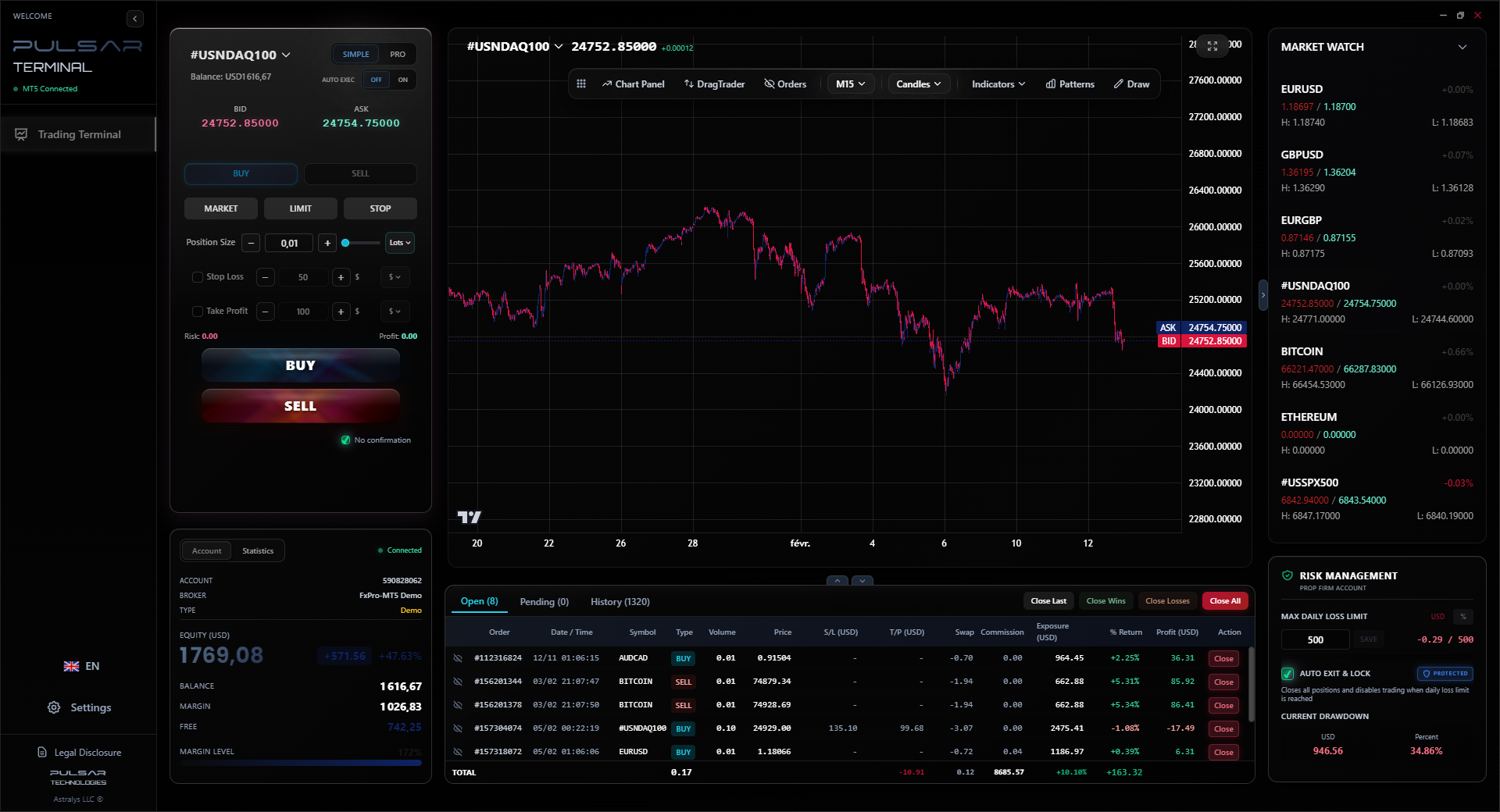
Since most white label platforms are built on MT5, a tool like Pulsar Terminal that supercharges MT5 with drag-and-drop orders and advanced risk management is a trader's real edge.
Pulsar Terminal
The all-in-one MT5 companion: drag-and-drop orders, multi-TP/SL, trailing stop, grid trading, Volume Profile, and prop firm protection. Used by 1,000+ traders daily.
“I lost more to the spread over six months than I ever made from the 'advanced' charting tools.”
The landscape is shifting, mostly in your favor.
The FSCA's updated regulation plan explicitly targets 'third-party service provision' - that's white labeling. They want to ensure brokers aren't using it as a way to dodge responsibility. Expect more stringent audits on how brokers manage their technology partners. This should weed out the shoddier operations.
Technologically, the white label offerings are getting better. It's not just MT4/MT5 anymore. Providers are offering packages with built-in advanced charting (like TradingView integration), social trading features, and better mobile apps from day one. The gap between a white label and a 'proprietary' platform is narrowing.
For you, this means two things:
- Better Default Tools: New brokers will launch with decent tech out of the box. The baseline is rising.
- More Focus on Value-Adds: Since the platform is a commodity, brokers will compete on other things: educational content (hopefully good), market analysis, tighter spreads on exotic pairs like USD/ZAR, and integration with local payment methods like instant EFTs.
The growth of the market (projected to nearly double by 2033) means more players, more competition, and theoretically, better conditions for traders. But more choice also means more noise. Your due diligence - checking that FSP number, testing spreads, reading the terms on withdrawals - becomes even more critical.
I'm cautiously optimistic. The regulatory push for the COFI Bill and stricter oversight of outsourcing could make the South African market one of the safer emerging markets for retail forex. Just remember, the platform is just the vehicle. You're still the driver. Don't blame the car for a bad journey if you didn't plan the route. Tools like a good MACD indicator setup matter more than the brand of the chart they're drawn on.
“The platform is just the vehicle. You're still the driver. Don't blame the car for a bad journey if you didn't plan the route.”
Let's wrap this up with what you need to remember next time you evaluate a broker.
First, stop being impressed by the platform. Ask who provides their liquidity and what their mark-up is. The connection to the LP is more important than the color of the buy button.
Second, embrace the standardization. Because most brokers use white label MT4/MT5, your skills are transferable. Your custom indicators, your chart templates, your whole workflow can move with you if you switch brokers. This is a huge advantage. It reduces lock-in.
Third, pressure-test their weakest link. For a white label broker, that's often customer service and financial operations. Before funding a large account, make a small deposit and then immediately request a withdrawal. See how smooth it is. That process is fully under their control, not the white label provider's.
I trade differently now that I understand the business. I see my broker as a utility provider, like an internet company. I want reliable service at a fair price. I don't need them to be tech visionaries. I keep my expectations grounded, and it's saved me from disappointment (and a few bad account choices).
, the white label model is just the plumbing. Your job is to find a broker who keeps the water clean and the pressure steady, while you focus on building a strategy that makes money when the taps are turned on. Everything else is just background noise.
FAQ
Q1Is it safe to trade with a white label forex broker in South Africa?
Yes, provided they hold a valid FSCA FSP license. The license is what guarantees safety measures like client fund segregation and use caps, not who built their platform. Always verify their FSP number on the official FSCA website.
Q2What's the main disadvantage for a trader using a white label platform?
Potential lack of customization and slower updates. If you need a specific feature, your broker must request it from their white label provider, who may or may not prioritize it. You're also reliant on the provider's server stability, which the broker has limited control over.
Q3Why do USD/ZAR spreads vary so wildly between brokers?
Liquidity and broker mark-up. USD/ZAR is less liquid than majors like EUR/USD. White label brokers with lower volume get worse rates from liquidity providers and often add a larger mark-up to ensure profitability on this popular local pair. Always compare this spread specifically.
Q4Can a white label broker offer lower spreads than a big broker with its own tech?
Absolutely. Spreads are determined by the broker's liquidity agreements and commercial strategy, not their tech ownership. A lean white label operation might compete aggressively on major pair spreads (like 0.0 pips on EUR/USD) to attract clients, even if they make money elsewhere.
Q5What happens if the white label technology provider goes out of business?
It causes major disruption, but your funds should be safe if held in segregated accounts. The licensed broker would need to urgently migrate to a new provider, during which trading may be halted. This highlights the importance of choosing a broker backed by a reputable, established technology firm.
Q6As a trader, should I prefer a broker that isn't a white label?
Not necessarily. Preference should be based on execution quality, costs, regulation, and service. Many excellent brokers use white labels. The key is to understand that their value isn't in proprietary tech, but in how well they manage the service wrapped around that tech.
Prof. Winston's Lesson
Key Takeaways:
- ✓Verify the FSP number, not the logo.
- ✓Compare USD/ZAR spreads; they reveal true cost.
- ✓Platforms are commodities; execution is king.
- ✓A $1 minimum deposit signals a volume game.
How useful was this article?
Click a star to rate
Weekly Trading Insights
Free weekly analysis & strategies. No spam.
About the Author
David van der Merwe
Emerging Markets Trader
Johannesburg-based trader with 11 years in emerging market currencies. Specializes in ZAR pairs, FSCA-regulated trading, and South African market analysis.
Comments
Risk Disclaimer
Trading financial instruments carries significant risk and may not be suitable for all investors. Past performance does not guarantee future results. This content is for educational purposes only and should not be considered investment advice. Always conduct your own research before trading.
You Might Also Like

Cara Trading Forex Sukses: 7 Prinsip dari Trader Profesional
Cara trading forex sukses dengan 7 prinsip trader pro: manajemen modal, disiplin, journal trading, backtest. Data nyata, bukan janji profit palsu.
Jam Trading Forex Terbaik untuk Trader Indonesia: Panduan Lengkap dengan Tabel Waktu
Panduan jam trading forex untuk trader Indonesia. Tabel 4 sesi dunia, jam emas 20:00-00:00, sesi mana yang harus dihindari. Data akurat + tips dari trader berpengalaman.
Top 5 Sàn Forex Uy Tín Nhất 2026: Review Jujur dari Trader Indonesia
Top 5 sàn forex uy tín 2026 untuk trader Indonesia. Review jujur: spread, deposit, withdraw, dukungan lokal. Exness, XM, IC Markets & lebih.
Get Pulsar Terminal
All these calculators are built into Pulsar Terminal with real-time data from your MT5 account. One-click position sizing, automatic risk management, and instant calculations.
Get Pulsar Terminal