
Chandelier Exit Indicator: ATR-Based Trailing Stop for Trend Traders
Chandelier Exit sets a trailing stop-loss based on ATR from the highest high or lowest low, dynamically adjusting to volatility for optimal trade exit timing.

Daniel Harrington
Senior Trading Analyst · MT5 Specialist
☕ 18 min read
Settings — CE
| Category | volatility |
| Default Period | 22 |
| Best Timeframes | H1, H4, D1 |
Most trailing stops are built on arbitrary logic — move the stop to breakeven after X pips, trail by a fixed number of points, or just eyeball it and hope for the best. Charles Le Beau had a better idea. He designed the Chandelier Exit to hang a trailing stop from the highest point of a trade, dangling at a distance measured by the market's own volatility through the Average True Range. The name is literal: like a chandelier hanging from a ceiling, this stop hangs from the peak. When volatility expands, the stop drops lower to give the trade room to breathe. When volatility contracts, the stop tightens automatically. Alexander Elder later popularized it in his trading books, and it became one of the most respected exit tools among trend followers. The default settings — a 22-period lookback with a 3x ATR multiplier — represent 22 trading days in a month, making it a natural fit for daily chart swing trading. But the real power of the Chandelier Exit is its simplicity: one indicator replaces an entire exit strategy, letting you focus on finding good entries instead of agonizing over where to place your stop.
Key Takeaways
- Charles Le Beau was a systematic trader obsessed with one question: how do you stay in a winning trade as long as possib...
- The Chandelier Exit calculation is refreshingly straightforward once you break it into components. No weighted averages,...
- Here is a controversial but surprisingly effective approach: use the Chandelier Exit as your sole exit mechanism and pai...
1Charles Le Beau's Chandelier: Why It Hangs from the Highest High
Charles Le Beau was a systematic trader obsessed with one question: how do you stay in a winning trade as long as possible without giving back too much profit when the trend finally reverses? Fixed-point trailing stops failed because they ignored volatility. A 50-pip trailing stop on EUR/USD might work beautifully during a quiet Tuesday afternoon and get obliterated by normal noise during a London open. Percentage-based stops had the same flaw — a 1% stop on a volatile stock behaves completely differently than a 1% stop on a sleepy utility.
Le Beau's insight was to let the market define its own noise level. If the average true range over the past 22 bars is 80 pips, then a move of 240 pips against the high (3 × 80) represents something genuinely abnormal — not just routine fluctuation. Any pullback smaller than that threshold is the market doing what markets do: breathing, consolidating, shaking out weak hands before continuing the trend.
The "chandelier" metaphor is not just clever naming. It describes the mechanical behavior perfectly. In a long trade, the stop is always attached to the highest high of the lookback period. As price makes new highs, the chandelier rises with it — your stop ratchets up. But when price pulls back, the chandelier stays where it is, suspended from that peak. It never drops. This ratcheting mechanism is what makes it a trailing stop rather than a static one.
For short trades, the logic inverts. The stop hangs upward from the lowest low, like an upside-down chandelier if you will (admittedly, the metaphor breaks down a bit here — but the math works perfectly). The formula adds the ATR multiple above the lowest low, creating a ceiling that the price must breach to invalidate the short trade.
Why 22 periods specifically? Le Beau chose this number because it approximates the number of trading days in a calendar month. On a daily chart, the Chandelier Exit therefore captures roughly one month of price action to determine the highest high and one month of volatility data for the ATR component. This is not a magic number — 20 works almost identically, and some traders prefer 14 for faster reaction. But 22 has historical significance and remains the most widely used default.
One detail that separates the Chandelier Exit from simpler ATR-based stops: it anchors to the highest high, not to the current price or entry price. This distinction matters enormously. An ATR stop measured from the current close would bounce up and down with every bar, sometimes moving backward. By anchoring to the peak, Le Beau ensured the stop only moves in the favorable direction. You can think of it as a one-way ratchet — it clicks upward with each new high and locks in place during pullbacks.
The practical result is an exit tool that automatically adapts to two dimensions of market behavior simultaneously: the trend (via the highest high anchor) and the volatility (via the ATR distance). No other single-line indicator achieves this dual adaptation with such a clean formula. It is worth noting that Le Beau did not design the Chandelier Exit for entries — he viewed it purely as an exit and risk management tool. Entry signals come from elsewhere. The Chandelier Exit answers one question and answers it well: when should you get out?
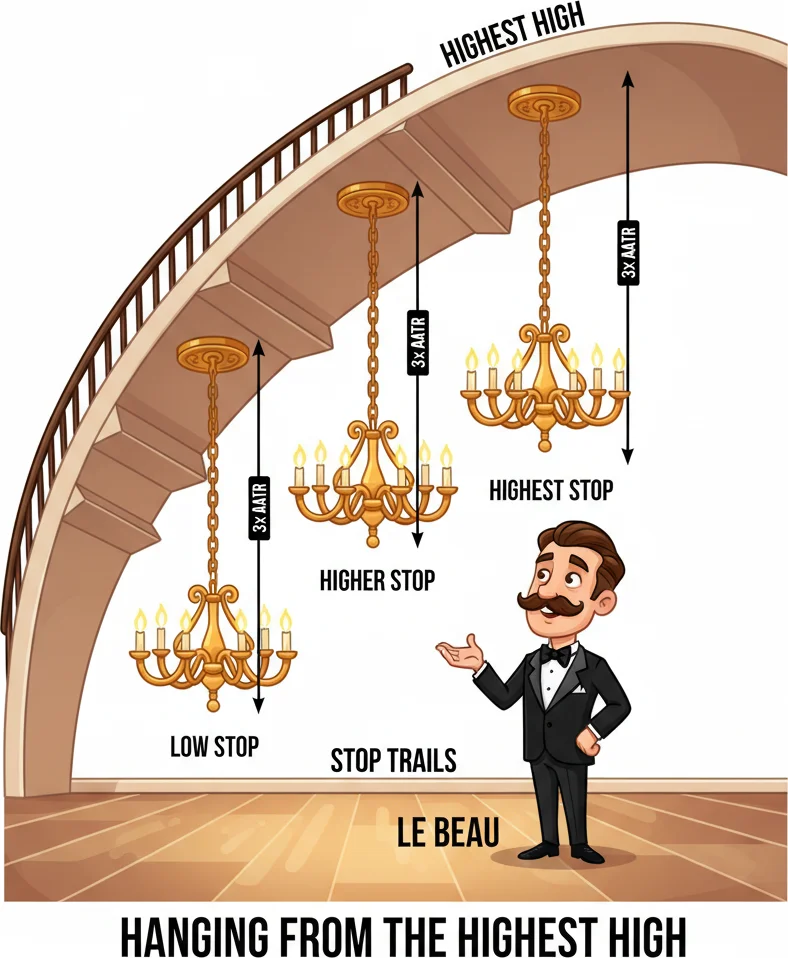
Charles Le Beau named it perfectly — your stop hangs from the trend ceiling, swinging with ATR like a chandelier.
2The Formula: Highest High Minus ATR × Multiplier
The Chandelier Exit calculation is refreshingly straightforward once you break it into components. No weighted averages, no recursive smoothing, no arcane normalization. Just three elements combined in one subtraction.
For long positions:
Chandelier Exit (Long) = Highest High (n periods) − ATR(n) × Multiplier
For short positions:
Chandelier Exit (Short) = Lowest Low (n periods) + ATR(n) × Multiplier
With default settings, that becomes:
- Long stop = Highest High (22) − ATR(22) × 3
- Short stop = Lowest Low (22) + ATR(22) × 3
Step 1 — Find the Highest High (or Lowest Low)
Look back over the last 22 bars and identify the single highest high. On a daily EUR/USD chart, this is the highest price reached in roughly the past month of trading. This value becomes the ceiling from which the chandelier hangs. Every time a new bar posts a higher high, the anchor point updates upward and the entire stop level ratchets higher. During pullbacks, the anchor stays fixed at the previous peak.
Step 2 — Calculate the Average True Range
ATR measures volatility using the True Range of each bar. True Range is the greatest of three values: current high minus current low, absolute value of current high minus previous close, or absolute value of current low minus previous close. The ATR then averages these True Range values over 22 periods. In forex, where overnight gaps are rare except at weekend opens, the True Range usually equals the simple high-minus-low range. For stocks and indices with regular gaps, the True Range adjustment captures the full extent of price movement including gap openings.
Step 3 — Apply the multiplier and subtract
Multiply the ATR by 3 (the default multiplier) and subtract the result from the Highest High. That is your stop level. If the 22-period highest high on GBP/USD is 1.2850 and ATR(22) is 90 pips, your Chandelier Exit sits at 1.2850 − (90 × 3) = 1.2850 − 270 pips = 1.2580.
The multiplier is the critical variable. It determines how much breathing room the stop provides. A multiplier of 3 means the price must retrace three full ATR units from the peak before the stop triggers. Le Beau and later Alexander Elder both argued that a move of this magnitude represents a genuine change in market character rather than normal volatility noise. Statistically, in a healthy trend, pullbacks exceeding 3× ATR from the peak are uncommon enough that getting stopped out carries real information — the trend is likely changing.
What happens on each new bar?
The indicator recalculates completely. A new highest high raises the anchor. A change in ATR widens or tightens the distance. The stop level updates accordingly. Crucially, most implementations include a ratchet rule: the new Chandelier Exit value for a long position can only be higher than or equal to the previous value. If the recalculation produces a lower stop (because ATR expanded or the highest high did not change), the stop stays at its previous level. This prevents the stop from moving backward against the trade.
Some platforms like TradingView and MT5 plot two lines — a long exit and a short exit — simultaneously. The long exit line sits below price during uptrends and the short exit line sits above price during downtrends. When price crosses the long exit from above, it generates a sell signal. When price crosses the short exit from below, it generates a buy signal. This creates a stop-and-reverse system, though Le Beau's original design focused on exits rather than reversals.
A quick sanity check for your settings
If your Chandelier Exit is getting hit on nearly every trade within a few bars of entry, your multiplier is too low for the instrument's volatility. If it almost never gets hit and you are riding trades deep into reversals before exiting, your multiplier is too high. A well-calibrated Chandelier Exit should survive normal pullbacks while catching genuine reversals within a reasonable distance from the peak.

Choose your multiplier wisely - the Chandelier Exit formula is your red pill to trend reality.
“Here is a controversial but surprisingly effective approach: use the Chandelier Exit as your sole exit mechanism and pair it with any trend-following entry you trust.”
3Chandelier Exit as Your Only Exit Rule: A Complete Trend-Following System
Here is a controversial but surprisingly effective approach: use the Chandelier Exit as your sole exit mechanism and pair it with any trend-following entry you trust. No take-profit targets. No time-based exits. No discretionary "I feel like the trade is done" exits. Just the Chandelier, doing its job.
This works because the Chandelier Exit solves the two hardest problems in trend trading simultaneously. First, it prevents you from exiting too early during normal pullbacks — the ATR buffer absorbs routine retracements without triggering. Second, it forces you out when the trend genuinely breaks — a 3× ATR reversal from the peak is a serious event that you should respect.
The entry does not matter (much)
Pair the Chandelier Exit with a moving average crossover, a breakout strategy, a momentum signal, or even a coin flip in the direction of the higher-timeframe trend. The entry gets you into the trade; the Chandelier keeps you in during the profitable phase and gets you out when the music stops. Multiple backtests across different markets have shown that a mediocre entry combined with a good exit outperforms a good entry combined with a mediocre exit. The Chandelier is a genuinely good exit.
Position sizing with the Chandelier
One practical advantage of using the Chandelier Exit as your stop-loss is that it gives you a precise risk distance before you enter the trade. If the current Chandelier Exit for a long entry on USD/JPY is 120 pips below the entry price, and you risk 1% of your account per trade, you can calculate your lot size immediately: (Account × 0.01) / (120 pips × pip value). No guessing, no arbitrary stops — the market's own volatility dictates your position size.
This also means your position size adapts automatically to market conditions. During low-volatility periods, the Chandelier is tighter, the risk distance is smaller, and you can take a larger position. During high-volatility periods, the Chandelier is wider, the risk distance is larger, and your position size shrinks accordingly. This is exactly the behavior you want — smaller positions in dangerous markets, larger positions in calm markets.
Handling the gap problem
The one scenario where the Chandelier Exit can fail spectacularly is a gap through the stop level. In forex, this primarily happens at the Sunday open. If you are long EUR/USD with a Chandelier stop at 1.0800 and the pair opens Monday at 1.0750, you get filled at the gap price, not your stop price. For stock traders, overnight gaps are an even bigger concern.
The mitigation is straightforward: if you know a high-impact event is coming (NFP, central bank decision, elections), either close the trade before the event or widen your mental stop to account for potential gap risk. The Chandelier Exit is a volatility tool, not an event-risk tool. It handles normal market breathing perfectly but was never designed to protect against binary outcomes.
Trailing behavior during a strong trend
In a sustained trend, the Chandelier Exit creates a beautiful staircase pattern. Each new high ratchets the stop upward by approximately the same amount (assuming ATR stays stable). The stop-to-price distance remains roughly constant, maintaining that 3× ATR buffer throughout the entire move. This means your risk on the trade actually decreases over time as the stop trails higher, while your unrealized profit grows. The risk-reward ratio improves with every new high — exactly the opposite of a fixed take-profit target, which forces you out just when the trade is working best.
When to NOT use the Chandelier as your only exit
Range-bound markets. If price is oscillating within a defined channel, the Chandelier Exit will either sit too far away (never triggering during the range, leaving you in a directionless trade) or too close (triggering on routine range oscillations, generating losses). The Chandelier Exit is fundamentally a trend tool. If there is no trend, it has nothing useful to tell you. Check for a trending condition first — an ADX reading above 25, or a clear series of higher highs and higher lows — before relying on the Chandelier as your sole exit rule.
The psychological benefit
This might be the most underrated advantage. When the Chandelier Exit is your only exit rule, you eliminate an entire category of trading mistakes: premature exits driven by fear, boredom, or impatience. You entered the trade for a reason. The Chandelier has not triggered. Therefore, you stay in the trade. Full stop. No second-guessing, no checking Twitter for reasons to be nervous, no closing at breakeven because you want to lock in a small win. The indicator makes the exit decision for you, and you follow it. For traders who struggle with the emotional side of holding winning trades, this single-indicator approach can be transformative.

Some traders use Chandelier Exit as their ONLY exit rule. Enter however you want, but always exit with the chandelier.
4Tuning the Multiplier: 2x vs 3x vs 4x ATR
The multiplier is the single most impactful setting in the Chandelier Exit. Changing the lookback period from 22 to 20 barely nudges the output. Changing the multiplier from 3 to 2 fundamentally transforms how the indicator behaves. Let us walk through each level and when it makes sense.
2x ATR — The tight leash
With a 2× multiplier, the stop sits two ATR units below the highest high. This is a relatively tight stop that tolerates only modest pullbacks. Normal market noise in many instruments regularly exceeds 2× ATR from a swing high, which means this setting will stop you out frequently during routine consolidations within an ongoing trend.
When does 2× make sense? Short-term trading on H1 or H4 charts where you want to capture quick momentum bursts and exit at the first sign of weakness. Also useful in low-volatility environments — if you are trading AUD/NZD during a quiet period where ATR is already compressed, a 2× multiplier provides a reasonable buffer because the ATR itself is small. Scalpers who use the Chandelier Exit on M15 or M30 often prefer 2× or even 1.5× because their trade duration is too short for the standard 3× buffer.
The main risk with 2× is getting whipsawed repeatedly during normal trending conditions. A healthy uptrend routinely pulls back 2-2.5× ATR from its highs before continuing. With a 2× stop, you exit on these pullbacks and then watch the trend resume without you. If you find yourself getting stopped out of trades that immediately continue in your original direction, your multiplier is too tight.
3x ATR — The default for good reason
Le Beau's original 3× multiplier sits in the sweet spot for daily chart trend following. In a trending market, pullbacks of 3× ATR from the highest high are genuinely uncommon. When they do occur, the trend has usually exhausted itself or is transitioning into a range. The 3× buffer absorbs the vast majority of normal retracements, keeping you in profitable trades through the pullbacks that shake out less patient traders.
For most swing traders on H4 and D1, the default 3× is the correct starting point. Do not change it unless you have a specific, backtested reason. The temptation to tighten the multiplier after a few trades where you could have exited earlier is strong but usually counterproductive. Those trades where a tighter stop would have helped are offset by the many trades where the tighter stop would have taken you out prematurely.
4x ATR — The loose leash
A 4× multiplier gives the trade significant room to fluctuate. The stop sits four ATR units below the peak, which on a daily forex chart might translate to 400+ pips of distance on a volatile pair like GBP/JPY. This is a position trader's setting — designed for trades you plan to hold for weeks or months.
The advantage is that you almost never get stopped out by normal market noise. Your trade survives consolidations, minor counter-trend corrections, and volatility spikes without triggering the exit. The disadvantage is equally clear: when the trend does reverse, you give back a substantial portion of your unrealized profit before the stop triggers. A 4× ATR reversal from the peak is a large move, and by the time it happens, the best of the trend is well behind you.
4× works best on weekly charts for position trading, or on daily charts for instruments with extreme volatility like crypto or emerging market currencies. It also suits traders who use the Chandelier Exit purely as a disaster stop — a final safety net — while using other tools like trendline breaks or moving average crossovers for their primary exit signals.
How to test which multiplier fits your trading
Pull up 100 trades from your journal or paper trade 100 entries on your chosen instrument and timeframe. For each trade, note where the Chandelier Exit would have triggered at 2×, 3×, and 4× ATR. Calculate the average exit price and total profit or loss for each multiplier. You will find that one multiplier consistently produces the best balance between holding winners long enough and exiting losers early enough for your specific market and timeframe.
A common finding: on H4 forex charts, 3× is optimal for most major pairs, 2.5× works better for low-volatility crosses like EUR/GBP, and 3.5× suits high-volatility pairs like GBP/JPY. On daily stock charts, 3× is the standard and 4× improves results on high-beta growth stocks. These are starting points, not gospel — your backtest data should be the final authority.
The multiplier and your risk tolerance
Ultimately, the multiplier choice is a statement about your pain tolerance. A 2× trader accepts more frequent small losses in exchange for protecting profits aggressively. A 4× trader accepts fewer but larger losses in exchange for staying in trends longer. Neither is objectively better — they match different trading personalities and strategies. The mistake is choosing a multiplier that does not match your psychology. If a 4× multiplier causes you to panic-close trades manually before the stop triggers, it is too wide for you regardless of what the backtest says. Pick the multiplier that you can actually follow, then build your system around it.

Finding your perfect ATR multiplier: 2x for tight stops, 3x for balance, 4x for riding the big waves.
“All three indicators serve the same basic purpose: trail a stop behind price during a trend and signal when the trend has likely reversed.”
5Chandelier Exit vs Parabolic SAR vs Supertrend: Three Trailing Stops Compared
All three indicators serve the same basic purpose: trail a stop behind price during a trend and signal when the trend has likely reversed. But they get there through very different mechanics, and those differences create meaningful performance gaps depending on market conditions.
Parabolic SAR — The accelerating stop
Welles Wilder designed the Parabolic SAR with a unique feature: its stop accelerates toward price over time. When a new trend begins, the SAR dots sit far from price. With each bar that continues the trend, the acceleration factor increases, pulling the dots closer. The longer the trend lasts, the tighter the stop becomes, until eventually the stop catches up to price and triggers a reversal signal.
This acceleration creates a fundamental behavioral difference from the Chandelier Exit. The Chandelier maintains a roughly constant distance from the peak (3× ATR, barring changes in volatility). The Parabolic SAR starts wide and progressively narrows, like a noose tightening around the trend. The practical consequence: the SAR exits trends faster than the Chandelier, which is both its strength and its weakness. It protects profits aggressively in the final stages of a move, but it also exits perfectly healthy trends prematurely when a minor consolidation coincides with an already-tight SAR level.
Many experienced traders have observed that the Parabolic SAR works better as an entry tool than an exit tool. Its reversal signals mark potential trend changes early, making it useful for timing entries. But for managing an existing position, the accelerating stop often forces exits too soon. A common professional setup uses the SAR for entries and the Chandelier Exit for exits — combining the SAR's responsiveness with the Chandelier's patience.
Supertrend — The smoothed alternative
The Supertrend indicator combines ATR with the average price (typically the midpoint of high and low) rather than anchoring to the highest high or lowest low. The formula uses:
- Upper Band = (High + Low) / 2 + ATR × Multiplier
- Lower Band = (High + Low) / 2 − ATR × Multiplier
The indicator then selects which band to display based on the current trend direction, flipping between upper and lower bands when price crosses through.
Because the Supertrend anchors to the average price rather than the extreme high or low, it produces a smoother line than the Chandelier Exit. It does not ratchet — instead, it flows with the general price movement, adjusting continuously. This smoothness makes it less prone to the staircase jumps that the Chandelier sometimes exhibits when a new highest high forms. However, it also means the Supertrend can occasionally move backward (lower in an uptrend) if the average price drops, whereas a properly implemented Chandelier Exit never retreats.
Head-to-head comparison
The Chandelier Exit anchors to the highest high or lowest low over N bars, the Parabolic SAR uses an acceleration factor from the previous SAR value, and the Supertrend anchors to the average price at (H+L)/2. For volatility, both the Chandelier and Supertrend use an ATR multiplier, while the SAR relies on its built-in acceleration factor that increases over time.
In terms of stop behavior, the Chandelier ratchets and never retreats in the favorable direction. The SAR accelerates progressively toward price, getting tighter as the trend ages. The Supertrend flows smoothly with average price but can occasionally drift backward.
Whipsaw frequency is lowest with the Supertrend, low-to-moderate with the Chandelier, and moderate-to-high with the Parabolic SAR — especially in ranging conditions where the SAR dots flip constantly.
Which wins in trending markets?
In a clean, sustained trend, the Chandelier Exit and Supertrend perform similarly — both keep you in the trade through normal pullbacks and exit when the trend breaks. The Chandelier is slightly better at protecting peak profits because it anchors to the highest high rather than the average, meaning its exit level is always referenced to the best price the trade achieved. The Supertrend's exit level references the average price, which lags behind the peak. The Parabolic SAR finishes last in trend-holding tests because its acceleration forces an exit while the trend is still healthy.
Which wins in choppy markets?
None of them, honestly. All three are trend-following tools and all three generate losses during extended sideways action. The Supertrend tends to flip the least frequently due to its smoothing, making it the least painful option in ranges. The Parabolic SAR flips the most frequently, generating the most whipsaw losses. The Chandelier Exit falls in between — it does not flip as often as the SAR, but its wide buffer means each losing trade in a range gives back more points than a Supertrend loss.
The practical recommendation
If you need one trailing stop for trend following on H4 or D1, the Chandelier Exit is the strongest standalone choice. Its ratcheting mechanism and ATR-based distance provide the best balance of trend-holding and profit protection. If you want a trend direction filter for entry decisions, the Supertrend's smooth line makes it easier to read at a glance. If you want early reversal signals for entries, the Parabolic SAR excels. The ideal setup for many swing traders combines two of these: Parabolic SAR or Supertrend for entries, Chandelier Exit for exits. Let each tool do what it does best rather than asking one indicator to handle everything.

Three trailing stops, three personalities. Chandelier is the gentleman, SAR is aggressive, Supertrend is the all-rounder.
Frequently Asked Questions
Q1What is the Chandelier Exit and who created it?
The Chandelier Exit is a volatility-based trailing stop indicator created by Charles Le Beau and later popularized by Alexander Elder in his trading books. It calculates a stop-loss level by subtracting a multiple of the Average True Range (ATR) from the highest high over a lookback period (default: 22 bars with a 3x ATR multiplier). The name comes from how the stop hangs from the price high like a chandelier from a ceiling, trailing upward with new highs but never moving downward during pullbacks.
Q2What are the best settings for the Chandelier Exit in forex trading?
The default 22-period lookback with a 3x ATR multiplier works well for H4 and D1 swing trading on most major forex pairs. For H1 charts or short-term trading, consider shortening to a 14-period lookback with a 2.5x multiplier. For weekly position trading, a 22-period lookback with a 4x multiplier gives trades more room. Low-volatility pairs like EUR/GBP or AUD/NZD may benefit from a tighter 2.5x multiplier, while volatile pairs like GBP/JPY often perform better with 3.5x. Always backtest on your specific instrument before changing defaults.
Q3How does the Chandelier Exit differ from a regular ATR trailing stop?
A standard ATR trailing stop measures the ATR distance from the current close or the current bar's high, which means the stop can move backward if price drops. The Chandelier Exit anchors specifically to the highest high (for longs) or lowest low (for shorts) over the entire lookback period, creating a ratchet effect where the stop only moves in the favorable direction. This prevents the stop from retreating during pullbacks, making it a true one-way trailing mechanism that locks in progress as the trend advances.
Q4Can the Chandelier Exit be used for trade entries or only exits?
Charles Le Beau designed the Chandelier Exit specifically as an exit and risk management tool, not an entry signal. However, some traders use it in a stop-and-reverse system: when price crosses below the long Chandelier line, they exit longs and enter shorts, and vice versa. This approach works in strongly trending markets but generates whipsaw losses during sideways periods. The more common professional approach is to use a separate entry tool like a moving average crossover, breakout signal, or Parabolic SAR, and rely on the Chandelier Exit exclusively for managing the exit.
Q5Why does the Chandelier Exit use 22 periods as the default lookback?
The number 22 represents the approximate number of trading days in a calendar month. Charles Le Beau chose this value so that on a daily chart, the indicator captures one full month of price history to identify the highest high and one month of volatility data for the ATR calculation. This creates a natural alignment with monthly market cycles. On other timeframes, 22 bars represent different calendar durations (about 4.5 trading days on H4, or roughly 5.5 months on weekly charts), so some traders adjust the lookback to match their intended time horizon rather than strictly using the default.
Top Brokers
About the Author
Daniel Harrington
Senior Trading Analyst
Daniel Harrington is a Senior Trading Analyst with a MScF (Master of Science in Finance) specializing in quantitative asset and risk management. With over 12 years of experience in forex and derivatives markets, he covers MT5 platform optimization, algorithmic trading strategies, and practical insights for retail traders.
Use This Indicator
Risk Disclaimer
Trading financial instruments carries significant risk and may not be suitable for all investors. Past performance does not guarantee future results. This content is for educational purposes only and should not be considered investment advice. Always conduct your own research before trading.