

Breakout
Breakout — breakout is when price finally busts out of its boring trading range — like a prisoner escaping jail — signaling a potential big move ahead.
§1So, what's all the fuss about breakouts?
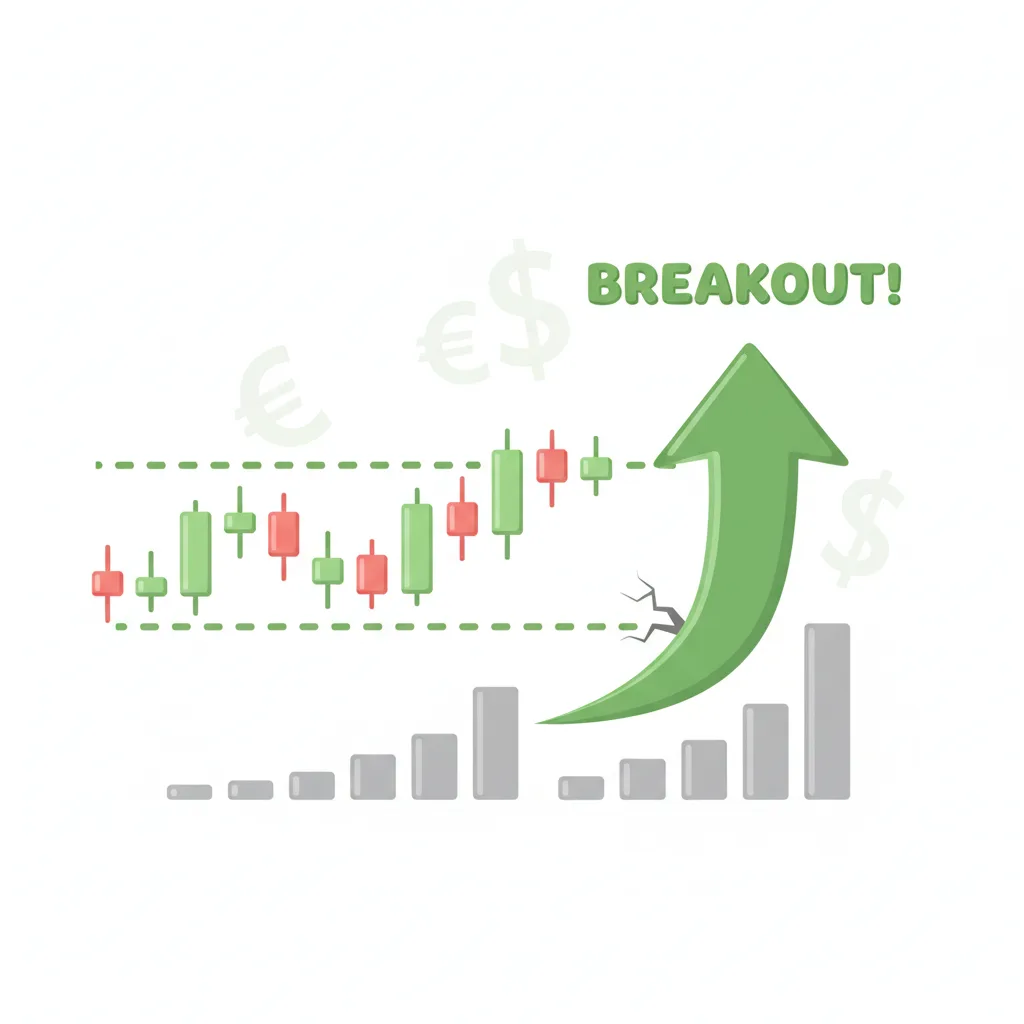
Picture this: price has been bouncing between the same two levels for days, maybe weeks. It's like watching a tennis match where the ball just keeps hitting the same spots on the court. Boring, right? Then suddenly — BAM! — the ball smashes through the fence. That's a breakout. It's when price finally escapes its established trading range, either punching above resistance or crashing below support. Think of it as the market's way of saying 'enough is enough!' and picking a new direction. I've seen traders get so excited about these moments they forget to breathe — and trust me, I've also seen accounts blown by jumping in too early. The key is that decisive move, where buyers or sellers finally overpower the other side. It's not just a little peek outside the range; it's a full-on escape with momentum. And when it's real, it often comes with increased volume — like the crowd cheering as the prisoner makes a run for it.
§2The math (don't worry, it's simpler than it looks)
Okay, so there's no single magical formula that shouts 'BREAKOUT!' — it's more about price action relative to those support and resistance levels you've drawn. But here's where numbers do matter. Some traders use filters to confirm a breakout isn't just a fakeout. The old stock market '3% rule' suggests a price needs to move 3% beyond the breakout point to be considered genuine. For forex, that's often too big — we might use something like 0.30% on a 1-hour chart. You're basically saying 'show me you mean it' before you commit. Also, remember those pip calculations? For most pairs, a pip is 0.0001, so when EUR/USD breaks above 1.0850 and hits 1.0870, that's 20 pips of conviction. The spread matters too — if it's 2 pips wide, you need the move to clear that plus some extra room. It's like needing to jump not just over the fence, but clear the ditch on the other side too.
§3Here's how it plays out in real trading
Let's walk through a classic example. Say EUR/USD has been stuck between 1.0800 (support) and 1.0850 (resistance) for a week. You're watching, waiting for something to give. Then, on a Tuesday morning, price pushes up to 1.0855, then 1.0860, and closes a strong bullish candle at 1.0870. Volume spikes — it's triple the average of the last 20 candles. That's your breakout signal. Now, here's where smart traders often wait: the retest. Price might pull back to 1.0850 (the old resistance, now new support) and bounce again. That retest is like the market saying 'yep, I meant that breakout.' You could enter there with a stop below 1.0840. Your target? Maybe 1.0900 or 1.0950, based on the height of the previous range. It's not just about spotting the initial move — it's about confirming it and managing your trade around it.
§4The sneaky fakeouts (and why JPY is weird)
Ah, the false breakout — the market's favorite trick to separate beginners from their money. This is when price briefly pokes beyond a level, gets everyone excited, then snaps back like a rubber band. I've been caught in these more times than I'd like to admit in my first year. They happen for all sorts of reasons: low volume (not enough real conviction), stop hunts (big players triggering retail stops), or just plain old fake momentum. The key is confirmation — don't jump in on the first candle. Wait for that close beyond the level, check volume, maybe see a retest. Also, remember JPY pairs are their own special universe. While most pairs use four decimal places (pip = 0.0001), JPY pairs use two (pip = 0.01). So a breakout on USD/JPY looks different on your screen. And regulatory stuff? The FCA's 2020 leverage cap (1:30 for majors) affects how much you can risk on these trades, but not the breakout concept itself.

§5Three real examples that'll make it click
Let's look at some concrete setups. First, a horizontal breakout: EUR/USD breaks above 1.0850 resistance, closes at 1.0870 with high volume, then retests 1.0850 before rallying to 1.0950. Second, a triangle breakout: GBP/USD forms an ascending triangle with resistance at 1.2500, breaks above to 1.2530, signaling continuation. Third, a head and shoulders breakdown: AUD/USD breaks below the 0.6550 neckline to 0.6520, confirming a bearish reversal. Here's a quick comparison:
| Scenario | Pair | Pattern | Breakout Level | Outcome |
|---|---|---|---|---|
| Bullish Continuation | EUR/USD | Horizontal Range | Above 1.0850 | Rally to 1.0950 |
| Bullish Continuation | GBP/USD | Ascending Triangle | Above 1.2500 | Move to 1.2530+ |
| Bearish Reversal | AUD/USD | Head & Shoulders | Below 0.6550 | Drop to 0.6520- |
Notice how each has a clear level, a decisive break, and a follow-through. That's what you're hunting for.
§6Where this breakout business even came from
The idea of prices moving beyond key levels isn't new — it's been part of technical analysis since the early days of Charles Dow in the late 1800s. While the exact term 'breakout' might not have been used back then, traders have always watched for price to escape ranges. Fast forward to modern forex and CFDs, and breakout trading became a staple strategy for active traders. Major events like the 2008 financial crisis created monster breakouts (and equally nasty fakeouts) as market structures shattered. Regulatory changes, like the 2020 FCA leverage caps, didn't change the concept but definitely changed how traders manage risk on these moves. Today, with algorithms and high-frequency trading, breakouts can happen in milliseconds — but the core idea remains: price breaking free from consolidation often signals the next big move. It's one of those timeless patterns that keeps working because, well, human psychology doesn't change much.
§7Key takeaways
- A breakout needs confirmation — don't trust the first candle. Look for increased volume and a decisive close beyond the level.
- False breakouts are common. Wait for a retest of the broken level (now support/resistance) to avoid getting trapped.
- Different patterns lead to breakouts: horizontal ranges, triangles, head and shoulders. Know what you're looking at.
- Use filters like the 0.30%-3% rule to distinguish real breakouts from fakeouts, especially in volatile markets.
§8Frequently asked questions
QHow do I know if a breakout is real or fake?
QWhat's the best chart pattern for breakout trading?
QHow much should price move to confirm a breakout?
QWhy do breakouts sometimes fail immediately?
QShould I enter as soon as price breaks the level?
§See also
§References
- Technical Analysis of the Financial Markets — John J. Murphy
- BabyPips School of Pipsology — BabyPips