


I stared at my bank statement in late 2025, a cold knot in my stomach.

David van der Merwe
Emerging Markets Trader ·  South Africa
☕ 9 min read
What you'll learn:
- 1Albaraka Bank is NOT a Forex Broker (And Why That Matters)
- 2Decoding the Rates: The Real Cost of Conversion
- 3The South African Regulatory Trap: SARB and FSCA
- 4Local Market Smarts: ZAR Accounts, EFTs, and ECNs
- 5Practical Strategies: Working With and Around Bank Rates
- 6Mistakes I Made (So You Don't Have To)
I stared at my bank statement in late 2025, a cold knot in my stomach. A client had paid me $5,000 for consulting work, and after the bank's conversion and fees, I was looking at nearly R1,200 less than the live mid-market rate suggested I should get. The culprit? Not understanding the difference between a bank's sell rate and the spot rate I watched on my trading charts. That moment, with Albaraka Bank's USD sell rate sitting at R17.49 against a mid-rate of around R16.89, was a brutal, expensive lesson. It forced me to truly unpack how forex works in South Africa - not just the leveraged trading I did with brokers, but the actual movement of money in and out of the country. This guide is what I wish I'd known back then.
This is the single most important distinction, and I've seen countless new traders get tripped up by it. When you look up Albaraka forex rates, you're looking at a bank's retail exchange service, not a trading platform.
Albaraka Bank is an Authorised Dealer. This is a specific, regulated status granted by the South African Reserve Bank (SARB) that allows them to legally convert your Rands into foreign currency for things like international payments, travel money, or receiving funds from abroad. Their rates include a built-in margin - the difference between their buy and sell price - which is how they make money on the service.
A forex broker like Exness or IC Markets, regulated by the FSCA, provides a completely different service: leveraged speculative trading on currency pair price movements. You're not buying physical dollars to send overseas; you're placing a bet on whether the EUR/ZAR will go up or down, often with borrowed money (use). The costs here are the spread and possibly commissions.

Warning: Trying to use a bank's transfer service to 'trade' by moving money between currencies is a surefire way to lose. The spreads are huge, the process is slow, and it's not what the system is designed for. I once tried to 'arbitrage' a small difference between two banks' rates. The fees and timing lag wiped out any theoretical profit before the transaction even settled.
Keep these worlds separate in your mind. Use Albaraka for moving real money for life or business. Use a regulated broker for trading.
“Albaraka's forex rates are for moving value, not capturing price movements.”
Let's use the provided Albaraka forex rates from April 2026 as a concrete example. This isn't abstract theory; this is the price list you'd actually see.
The Numbers on the Board
At 1:04 PM on April 7, 2026, Albaraka posted:
- USD: Buy R16.29 / Sell R17.49
- EUR: Buy R18.91 / Sell R20.11
- GBP: Buy R21.77 / Sell R22.97
What does this mean for you?
- If you are SELLING foreign currency to the bank (e.g., you have USD and want ZAR), you get the Buy Rate. So, $1,000 would get you roughly R16,290.
- If you are BUYING foreign currency from the bank (e.g., you need USD to pay an invoice), you pay the Sell Rate. To get $1,000, you'd need to pay roughly R17,490.
The difference between these two rates is the bank's margin. For USD, that's a massive R1.20 per dollar. On a $10,000 transaction, that's a R12,000 difference between the two sides of the trade. That's your cost.

Example: The mid-market rate for USD/ZAR at that time was likely around R16.89. If you bought $1,000 at Albaraka's sell rate of R17.49, you effectively paid a 3.55% premium (R600) above the fair market value. That's a significant haircut.
The Hidden Fees
Beyond the spread in the rate, check the transactional fees. That 2.75% conversion fee on international card purchases adds up fast. I learned this on a business trip to London. A R5,000 hotel charge cost me an extra R137.50 just in the bank's conversion fee, on top of the unfavourable rate applied.

💡 Winston's Tip
A bank's exchange rate is a retail price, not a market price. The spread is your fee for convenience and compliance. Never compare it directly to your trading platform's quote.
“The R1.20 spread between buying and selling USD at the bank isn't a cost; it's the entire business model.”
Ignoring South Africa's exchange controls isn't just risky; it's illegal. And the rules have gotten tighter. The SARB's October 2025 update to the Currency Manual threw a wrench in many smooth offshore processes.
Here’s the practical reality for traders and business people:
For Moving Money OUT (SARB Rules): You can't just wire large sums to your international broker on a whim. There are annual discretionary allowances (R1 million per adult per year) and required tax clearance for larger amounts. The new kicker? Since late 2025, if you're a non-resident receiving South African income (like royalties or consulting fees), the bank needs proof of your SARS tax compliance before sending the money offshore. This often means a TCS-AIT PIN. I had a Canadian trading partner's payment stuck for weeks because of this. The bank wouldn't budge without that PIN.
For Choosing a Broker (FSCA Rules): Always, always verify your broker is licensed by the FSCA. A Category I or II FSP license is what you're looking for. This is your primary protection against scams. Trading with an unregulated offshore broker might seem tempting for higher use, but if they vanish with your deposit, you have exactly zero recourse with South African authorities. I've had friends learn this the hard way.
These two bodies - SARB controlling the physical flow of currency, and FSCA regulating the conduct of financial firms - create the cage we operate within. Your trading strategy must account for this cage. A brilliant scalping strategy is useless if you can't get your profits back into the country efficiently.
“I was focused only on the charts. I treated the 'plumbing' of finance as an annoying afterthought. The market punished that arrogance.”
Working with the local system, not against it, saves money and headaches. Here’s what 12 years of trading from SA has taught me.
Use a ZAR-Denominated Trading Account: Many top international brokers like XM and Pepperstone offer this. You deposit and withdraw in Rands, and they handle the conversion internally, often at better rates than retail banks. This bypasses the need for you to do a separate forex conversion with Albaraka or another bank before funding your trading account. It simplifies your accounting and reduces cost layers.
Stick to Local Payment Methods: EFT is your friend. It’s direct, usually cheap, and processed in ZAR. Instant EFT services like Ozow are even better for funding your broker account quickly when you see a setup forming. I avoid international card deposits for trading funding - that’s where the 2.75% fee bites. E-wallets like Skrill can be useful, but check both your bank's and the broker's fees on both ends.
Understand the Underlying Market: When you trade USD/ZAR, you're trading one of the most liquid emerging market pairs. The shift towards electronic trading and algorithms (ECNs) means spreads can be tight during London and New York sessions, but volatility can spike on local political or economic news. This isn't like trading EUR/USD. You need a wider position size calculator buffer to account for the rand's larger swings. A 50-pip stop in EUR/USD is tight; in USD/ZAR, it can get taken out by a single news headline.
💡 Winston's Tip
Your trading strategy's profitability is calculated after all costs: spread, commission, slippage, and the cost of moving money in and out of your account. Ignore the last one at your peril.
“I was focused only on the charts. I treated the 'plumbing' of finance as an annoying afterthought. The market punished that arrogance.”
So how do you build a financial life that incorporates both necessary banking and active trading? You need a system.
For Business & Life (Using Banks like Albaraka):
- Plan Ahead: Need USD for a quarterly supplier payment? Don't buy it the day before. Watch the trend and place a forward contract if possible, locking in a rate. Banks offer this to hedge against adverse moves.
- Shop Around: Albaraka's albaraka forex rates are one data point. Check the rates at your other bank and even online FX specialists. The difference can be meaningful.
- Use Products Like Vivere: Albaraka's new Vivere account (launched Dec 2025) is a smart tool for frequent travellers or those with international expenses. Holding foreign currency directly can save on repeated conversion fees. The $10 annual fee is negligible if you travel often.
For Trading (Using Regulated Brokers):
- Separate Your Cores: I have a 'life' bank account (for salaries, living expenses, Albaraka forex conversions) and a dedicated 'trading' bank account linked only to my FSCA-regulated brokers. This clean separation prevents me from dipping into trading capital for life expenses, a classic psychological mistake.
- Withdraw Profits in ZAR: When I take profits from trading, I withdraw ZAR to my trading bank account via EFT. Only then, if I need to convert to USD for an international expense, do I involve Albaraka's rates. This lets me choose the timing.
- Factor in ALL Costs: Your trading edge isn't just entry and exit. It's entry, exit, spread, commission, AND the cost of getting money in and out. A strategy that yields a 5% return before costs might be a 2% return after bank spreads and fees. It changes everything.

Pro Tip: Keep a simple spreadsheet. Log every bank conversion: amount, rate used, mid-market rate at that time, and fees. After six months, you'll see exactly what your 'financial friction' cost is. Mine was over R15,000 one year. That visibility forced me to be smarter.
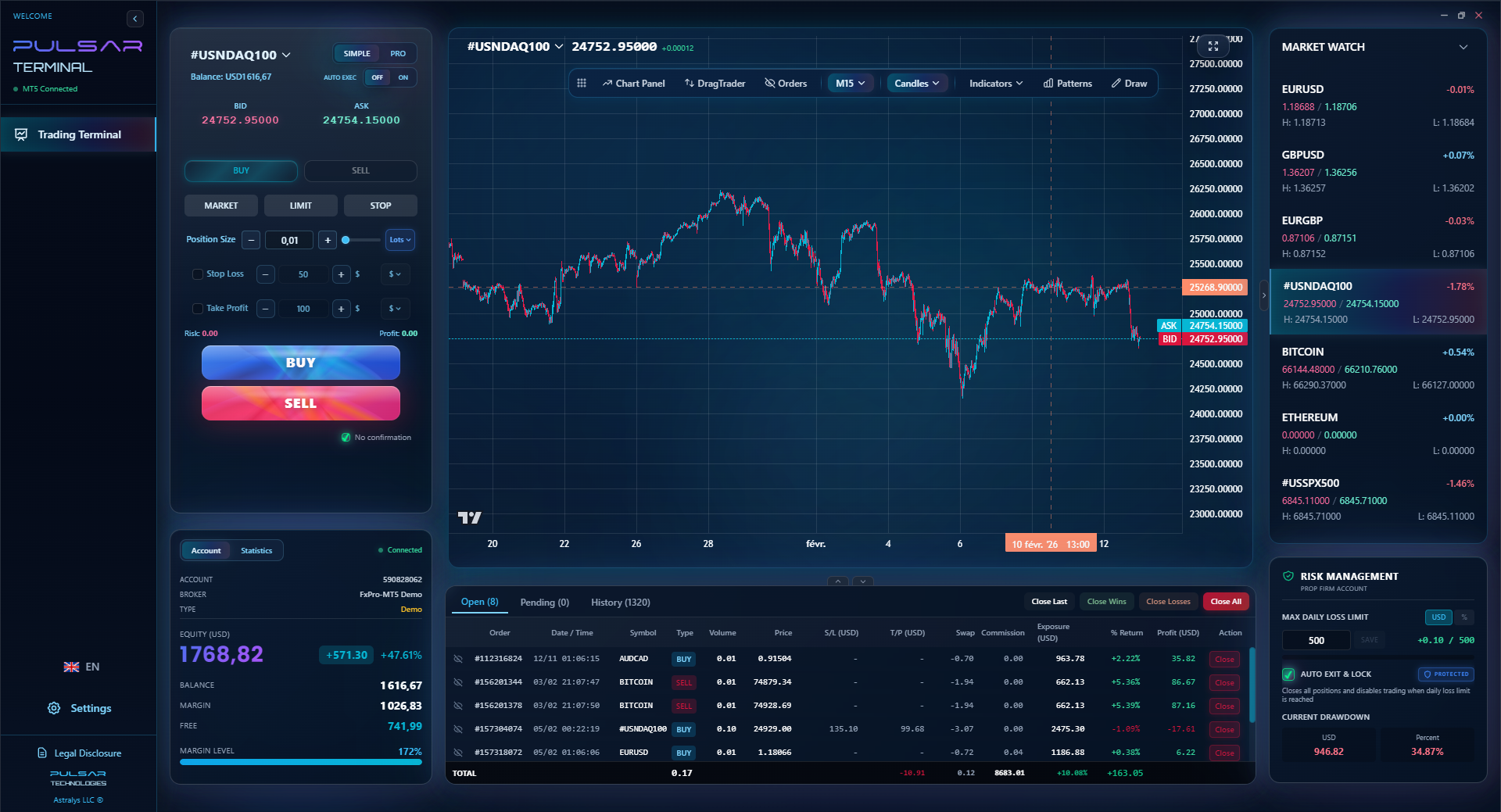
Managing complex trades and strict risk parameters—essential for navigating volatile pairs like USD/ZAR—is far easier with tools that automate partial closures and trailing stops directly on your MT5 charts.
Pulsar Terminal
The all-in-one MT5 companion: drag-and-drop orders, multi-TP/SL, trailing stop, grid trading, Volume Profile, and prop firm protection. Used by 1,000+ traders daily.
“A brilliant scalping strategy is useless if you can't get your profits back into the country.”
Let's get vulnerable. Here are my expensive lessons.
The Tax Ignorance Penalty (2023): I had a great year trading XAU/USD. Withdrew a healthy six-figure sum in ZAR. Come tax season, I hadn't kept clear records of my base currency (USD) cost for each trade versus the ZAR equivalent on settlement date. The accountant's bill to untangle it was huge, and SARS's interest on a provisional payment was worse. Now I use software that tracks this automatically by trade date.
The 'Quick Transfer' Mistake (2024): Saw a perfect setup on EUR/USD. My trading account was low. Instead of a planned EFT, I used a card deposit for speed. Got hit with the international purchase fee. Won the trade by 8 pips. The fee wiped out the entire profit. I literally traded for free, and took on risk, for nothing.
The Broker Assumption Error (Early Days): Signed up with a flashy broker offering 'tight spreads on ZAR pairs.' Didn't verify their FSCA status thoroughly. They were registered, but under a different entity name for their South African clients. When I had a withdrawal delay, the confusion added weeks of stress. Now, I cross-check the FSP number on the FSCA website myself.
The through-line? I was focused only on the charts - the MACD indicator crossover, the RSI divergence. I treated the 'plumbing' of finance as an annoying afterthought. The market punished that arrogance with real money. The trading is only half the battle. The other half is managing the real-world movement of value within a strict regulatory framework.
💡 Winston's Tip
Regulations are fences. A good trader doesn't waste energy raging at the fence; they learn its exact dimensions and then plot the most efficient path within them.
FAQ
Q1Can I use Albaraka Bank to trade forex with use?
No. Albaraka Bank is an Authorised Dealer for foreign exchange conversions and international payments, not a leveraged speculative trading broker. For trading, you need an account with an FSCA-regulated broker like IC Markets or XM, which provides platforms like MT5 for placing trades.
Q2Why is the difference between Albaraka's buy and sell rate so large?
That difference (e.g., R16.29 buy vs. R17.49 sell for USD) is the bank's margin or spread. It's how they make money on the currency conversion service, covering their costs, risk, and profit. It's inherently much wider than the spreads you see on a trading platform for major pairs.
Q3What's the best way to fund my international forex trading account from South Africa?
Use a ZAR-denominated account with an FSCA-regulated broker and fund it via local EFT or Instant EFT (like Ozow). This avoids international card fees and often gets you a better conversion rate than first buying USD from a retail bank at their high sell rate.
Q4I'm a non-resident. Can I get my South African trading profits paid offshore?
Yes, but it's stricter now. Since the SARB's October 2025 rules, your South African bank will likely require a SARS Tax Compliance Status for International Transfer (TCS-AIT PIN) before remitting funds offshore. Start this process early with SARS.
Q5Is Albaraka's new Vivere account good for traders?
It's excellent for lifestyle, not active trading. If you travel often or have expenses in USD, EUR, etc., holding those currencies can save on conversion fees. But it's a multi-currency wallet and card, not a trading platform. Don't confuse it for one.
Q6How do I check if my forex broker is legit in South Africa?
Go to the FSCA's website and use their 'Search for an authorised Financial Services Provider (FSP)' tool. Enter the broker's name or the FSP number they provide. Verify the license is active and includes the appropriate categories for forex trading.
Prof. Winston's Lesson
Key Takeaways:
- ✓Bank rates have a 3-4% built-in cost vs. market rates.
- ✓Always verify your broker's FSCA FSP number directly.
- ✓Use ZAR-denominated trading accounts to avoid double conversion.
- ✓SARB now requires tax clearance (TCS-AIT) for non-resident payouts.
- ✓Separate your 'life' banking from your 'trading' banking completely.
How useful was this article?
Click a star to rate
Weekly Trading Insights
Free weekly analysis & strategies. No spam.
About the Author
David van der Merwe
Emerging Markets Trader
Johannesburg-based trader with 11 years in emerging market currencies. Specializes in ZAR pairs, FSCA-regulated trading, and South African market analysis.
Comments
Risk Disclaimer
Trading financial instruments carries significant risk and may not be suitable for all investors. Past performance does not guarantee future results. This content is for educational purposes only and should not be considered investment advice. Always conduct your own research before trading.
You Might Also Like

Cara Trading Forex Sukses: 7 Prinsip dari Trader Profesional
Cara trading forex sukses dengan 7 prinsip trader pro: manajemen modal, disiplin, journal trading, backtest. Data nyata, bukan janji profit palsu.
Jam Trading Forex Terbaik untuk Trader Indonesia: Panduan Lengkap dengan Tabel Waktu
Panduan jam trading forex untuk trader Indonesia. Tabel 4 sesi dunia, jam emas 20:00-00:00, sesi mana yang harus dihindari. Data akurat + tips dari trader berpengalaman.
Top 5 Sàn Forex Uy Tín Nhất 2026: Review Jujur dari Trader Indonesia
Top 5 sàn forex uy tín 2026 untuk trader Indonesia. Review jujur: spread, deposit, withdraw, dukungan lokal. Exness, XM, IC Markets & lebih.
Get Pulsar Terminal
All these calculators are built into Pulsar Terminal with real-time data from your MT5 account. One-click position sizing, automatic risk management, and instant calculations.
Get Pulsar Terminal