


I remember staring at my screen in 2012, watching EUR/USD eat through my entire $500 account in about 45 minutes.

Olumide Adeyemi
West African Trading Pioneer ·  Nigeria
☕ 12 min read
What you'll learn:
- 1Forget 'Get Rich Quick' and Start Here
- 2Building Your Nigerian Trading Infrastructure
- 3The Core Curriculum: Price Action and Risk
- 4Developing and Testing Your Strategy
- 5Transitioning to Live Trading: The Mind Game
- 6Common Pitfalls for Nigerian Traders (And How to Avoid Them)
- 7Advanced Concepts (When You're Ready)
- 8Your Roadmap to Consistency
I remember staring at my screen in 2012, watching EUR/USD eat through my entire $500 account in about 45 minutes. The chart was a red waterfall, and I was just clicking buttons, hoping it would turn around. It didn't. That humiliating loss, paid for with money I couldn't really afford to lose, taught me the first brutal lesson: you don't learn forex by hoping. You learn by getting methodically, intentionally smashed in the face by the market until you finally learn to duck. The best way to learn forex in Nigeria isn't about finding a secret signal; it's about building a system for survival and growth, tailored to our unique challenges with power, internet, and finding trustworthy brokers.
If your first search was 'forex trading secrets Nigeria' or 'how to make 1 million naira in a week', you need a hard reset. That mindset is a one-way ticket to funding someone else's BMW. The market doesn't care about your dreams or your bills. It's a probability game played with real money.
The foundation isn't a fancy indicator. It's understanding why prices move. At its core, forex is about the changing value of one currency against another, driven by interest rates, economic data, geopolitics, and pure sentiment. Your first 100 hours should be spent here, not on YouTube watching someone draw lines on a chart.
You need to speak the language. What's a pip? A spread? A margin call? If you don't know these cold, you're driving a car without knowing what the brakes do. Start with the absolute basics on a demo account. I don't mean trade for a day. I mean live on that demo for a minimum of three months, treating every virtual Naira like it's real. This is your free apprenticeship.

Warning: The biggest lie in Nigerian forex circles is the 'funded account' guru who promises to manage your money. Nine times out of ten, it's a Ponzi scheme wrapped in forex terminology. If you wouldn't hand a stranger your wallet in Oshodi, don't hand them your trading capital.

💡 Winston's Tip
Your first profitable system will be boring. If it feels exciting, you're probably gambling.
You can't trade if you don't have the tools, and in Nigeria, that's a fight. Let's talk about the non-negotiable setup.
Choosing a Broker You Can Actually Trust
This is the minefield. You need a broker that accepts Nigerian clients, has decent Naira deposit/withdrawal options (think bank transfer, maybe USSD), and is regulated by a reputable authority like CySEC, ASIC, or FCA. Why? Because when there's a problem - and there will be - you want someone to complain to. I've had issues with withdrawals in the past; a regulated broker resolved it. A shady 'offshore' one just ghosted me.
Do your homework. Read real broker reviews from other Nigerian traders. Look for consistent feedback on withdrawal times. Expect to fund your account in USD or EUR, even if you deposit Naira, as most trading is done in major pairs.
The Tech Stack: More Than Just an App
A reliable inverter and solar setup aren't luxuries; they're part of your trading capital. I lost a profitable position during a 'NEPA take light' moment in 2018. The trade was up 80 pips. By the time my generator choked to life, it was at my stop loss. That was a $400 lesson in infrastructure.
You need a stable internet connection - a good MiFi or fiber if you can get it. Your phone is for monitoring, not for executing serious trades. Get a laptop or a proper desktop. The screen real estate matters more than you think.
The Demo Account: Your Laboratory
Your demo account is where you make all your catastrophic mistakes for free. Don't just randomly trade. Use it to test everything: how orders work, what happens during high volatility (like news releases), and how your platform behaves. Get so familiar with your platform's buttons that you could use it in the dark. This muscle memory is critical when real money is on the line and your heart is pounding.
“Your primary job as a trader is not to make money. It's to not lose money.”
Now we get to the meat. Most courses get this backwards. They start with 100 indicators. I'm telling you to start with two things only: naked price action and risk management.
Learning to Read the Chart Itself
Before you slap on an RSI indicator or MACD, learn what a chart is telling you. What are support and resistance levels? Where are the obvious highs and lows? What does a strong, impulsive candle look like versus a weak, indecisive one? This is price action. It's watching the auction play out between buyers and sellers.
I made my first consistent profits not from a complex system, but from simply buying at clear support levels on the 4-hour chart and selling at resistance, with a tight stop loss. It was boring. It was mechanical. It worked.
Risk Management: Your Only Job
This is the master key. Your primary job as a trader is not to make money. It's to not lose money. Sounds crazy, right? But if you protect your capital, you live to trade another day. The moment you start chasing losses or trading too big, you're finished.
You must use a position size calculator. Every single trade. No exceptions. My rule? Never risk more than 1% of your account on any one trade. For a $1,000 account, that's $10. If your stop loss is 50 pips away, you calculate the position size so that a 50-pip loss equals $10. This math saves you from yourself.

Pro Tip: The '1% rule' feels too small when you're eager. You'll think, 'If I just risk 5%, I'll make more!' That's the devil talking. In 2015, I got greedy on a GBP/USD short, risked 7% thinking it was a sure thing. A surprise BoE comment spiked the price, triggered my stop, and wiped out a week of careful profits in seconds. The 1% rule is your seatbelt.
You've got the basics. Now you need a plan. A trading strategy is just a set of rules that tells you when to enter, when to exit, and how much to risk. It removes emotion.
Find Your Timeframe Personality
Are you patient or impulsive? If you check your phone every 5 minutes, maybe scalping the 1-minute chart isn't for you (and honestly, with Nigerian internet, it's a terrible idea). If you can analyze a chart once a day and wait, then swing trading on the 4-hour or daily chart might be your style. I'm a swing trader. I found I made terrible, emotional decisions on lower timeframes.
Backtest, Then Forward Test
Once you have a rule-based idea (e.g., "Buy when price pulls back to the 50-period EMA on the 4H chart and RSI is above 50"), you must test it. Go back on your demo or a charting platform and look at the last 100 times that setup occurred. Did it work? What was the average win vs. loss? This is backtesting.
Then, forward test. Paper trade the strategy in real-time on your demo for at least 50 trades. Write down every trade in a journal: entry, exit, reason, emotion. This data is gold. If it's not profitable in simulation, it will destroy your live account.
The Trading Journal: Your Mirror
Your trading journal is the most important tool you own. It's not just a log. It's where you confront your own stupidity. Every entry must include:
- Date/Time, Pair (e.g., EUR/USD)
- Entry Price, Stop Loss, Take Profit
- Position Size & Risk (%)
- Reason for the trade (e.g., "Bounce off weekly support")
- Screenshot of the chart
- Outcome and P/L
- Emotion/Notes ("Felt rushed because I hadn't traded all day")
Review it weekly. You'll see patterns - like you always lose on trades you take after 10 PM, or you consistently cut your winners short. This is how you improve.
💡 Winston's Tip
The market's job is to make you feel the most pain possible. Your job is to have rules so solid that the pain doesn't change your actions.
“Boredom is a sign of discipline. The market will always be there tomorrow.”
Switching from demo to live is like going from a flight simulator to a real cockpit during a storm. Everything feels different because it is. Real money is on the line.
Start Stupidly Small
When you go live, take your demo-tested strategy and trade it with the smallest possible position. Your goal for the first 20 live trades is not to make money. Your goal is to execute your plan perfectly, despite the fear and greed. If you can follow your rules while real $10 is at risk, you can eventually do it with $100.
I started my first live account with $200. My first trade was a 0.01 lot on EUR/USD, risking $5. My hands were sweating. It won. The next one lost. The point was to acclimate my psychology to the feeling of real gain and loss without catastrophic damage.
Managing the Emotional Rollercoaster
You will feel fear when a trade goes against you. You will feel euphoria when you're in profit. Both are dangerous. Fear makes you move your stop loss wider (a fatal error). Euphoria makes you add to a winning position recklessly.
Your strategy is your anchor. When in doubt, refer to your rules. If the setup isn't there, don't trade. Boredom is a sign of discipline. The market will always be there tomorrow.

Example: Let's say you have a $500 account. Your 1% risk is $5 per trade. You see a setup on XAU/USD (gold) where your stop loss needs to be $15 away from your entry price. How many units can you buy? Position Size = Risk / (Stop Loss in $) = $5 / $15 = 0.33 units. So you'd buy 0.03 lots (or the nearest equivalent). This math keeps you safe.
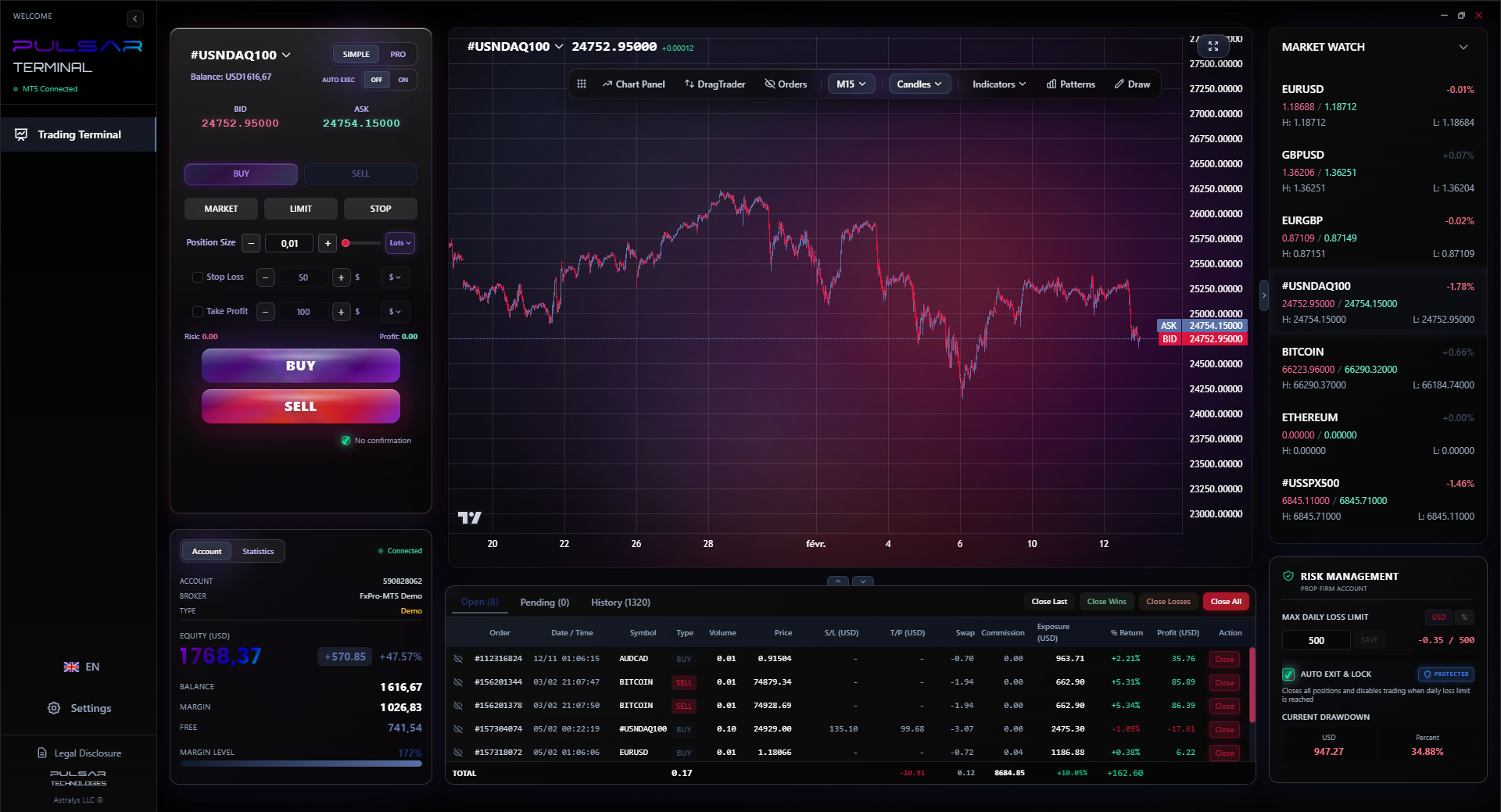
When you're ready to graduate from basic order placement, a tool like Pulsar Terminal lets you manage complex multi-TP/SL strategies and trailing stops on MT5 with a single click, turning your trading plan into automated action.
Pulsar Terminal
The all-in-one MT5 companion: drag-and-drop orders, multi-TP/SL, trailing stop, grid trading, Volume Profile, and prop firm protection. Used by 1,000+ traders daily.
We face unique challenges. Recognizing them is half the battle.
- The 'Signal Seller' Trap: WhatsApp groups are flooded with 'gurus' selling signals for 50k Naira a month. Don't. Even if the signals are sometimes right, you learn nothing. You become dependent. And when they're wrong (and they will be), it's your account that blows up. I bought signals for two months in 2014. The stress of blindly following someone else's calls was worse than losing my own trades.
- Overtrading: No clear setup? Don't trade. It's that simple. You don't get paid for how often you trade; you get paid for being right. Sitting on your hands is a skill. I used to feel I had to trade every day. My most profitable months are often the ones with the fewest trades.
- Ignoring Fundamentals: Because we often focus on technicals, we forget that big, scheduled news (like US Non-Farm Payrolls or ECB rate decisions) can vaporize your technical levels in milliseconds. Use an economic calendar. If you're a beginner, just stay out of the market 15 minutes before and after major news releases.
- Poor Record-Keeping for Tax: Keep impeccable records of your deposits, withdrawals, and trades. You may need them someday, and 'my broker statement' isn't always enough.
- Trading During Unstable Conditions: Is it election season? Is there a fuel scarcity causing nationwide tension? Market volatility might spike, and more importantly, your power and internet might be less reliable. Sometimes, the best trade is no trade. Preserve your capital and your sanity.
“This isn't fast. It's not sexy. But it's real. It's the path that turns a gambler into a trader.”
After a year or two of consistent, rule-based trading, you can start exploring deeper waters. Don't rush this.
- Correlation: Understanding how pairs move together. If you're long EUR/USD, you're short the USD. What does that mean for your USD/JPY position? You might be doubling your risk without knowing it.
- Carry Trade: This involves selling a currency with a low interest rate and buying one with a high rate to collect the 'swap' or rollover interest. It's a longer-term strategy that requires a strong understanding of central bank policy.
- Algorithmic/Automated Trading: This is coding your strategy into an Expert Advisor (EA) on MetaTrader. It removes emotion completely but requires strong programming and testing skills. Be wary of buying 'magic robot' EAs online - they're almost always scams.
- Market Structure & Order Flow: This is the deep end. It involves looking beyond candlesticks to understand where large institutional orders might be sitting (using tools like Volume Profile). It's fascinating but complex.
The path never ends. The market changes. Your job is to keep learning, but always from a foundation of solid risk management. The fancy stuff is useless if you haven't mastered the basics of preserving your capital.
💡 Winston's Tip
A losing trade where you followed your plan is a better trade than a winning trade where you broke your rules. One teaches you discipline; the other teaches you bad habits.
Let's tie this all together into a step-by-step, 12-month roadmap for a Nigerian beginner. This is the best way to learn forex, distilled.
Months 1-3: The Student Phase
- Open a demo account with a reputable broker like IC Markets or Pepperstone.
- Learn the absolute basics: pips, lots, order types, use.
- Watch price action on major pairs like EUR/USD for an hour a day. Don't trade yet. Just watch.
- Read one reputable trading book (e.g., 'Trading in the Zone' by Mark Douglas for psychology).
Months 4-6: The Practitioner Phase
- Choose one simple strategy (e.g., support/resistance bounce).
- Backtest it on your demo for 100 past setups.
- Start forward testing on demo: aim for 50-100 paper trades, journaling every one.
- Solidify your understanding of the spread and how it affects your entries/exits.
Months 7-9: The Transition Phase
- Fund a small live account with money you can afford to lose completely.
- Trade your tested strategy with minimum position sizes (0.01 lots).
- Your only goal: follow your rules. Ignore the P/L for these first 20-30 trades.
- Religiously use your position size calculator.
Months 10-12: The Refinement Phase
- Analyze your live trading journal. What's your win rate? Your average win vs. average loss?
- Tweak your strategy SLOWLY. Change one variable at a time and test again.
- Focus on consistency, not home runs. Can you have three profitable months in a row?
- Consider slightly increasing position size only if your equity curve is steadily rising.
This isn't fast. It's not sexy. But it's real. It's the path that turns a gambler into a trader. I've walked it, and so can you.
FAQ
Q1How much money do I need to start forex trading in Nigeria?
Technically, some brokers like XM allow you to start with as little as $5. Practically, I wouldn't recommend a live account with less than $200-$300. This gives you enough buffer to trade proper micro lots (0.01) and absorb a string of losses without a single trade wiping you out. Remember, your first live account is for learning to handle real emotions, not for making life-changing money.
Q2What is the best timeframe for beginners in Nigeria?
Start with the 4-hour (H4) or daily (D1) charts. They are slower, filter out a lot of market 'noise,' and are more forgiving than lower timeframes. They also don't require you to be glued to the screen all day, which is perfect given our occasional power and internet issues. Avoid the 1-minute and 5-minute charts like the plague when you're starting.
Q3Can I learn forex trading on my phone?
You can learn concepts and monitor trades on your phone, but you should not execute serious analysis or trades solely on a mobile app. The screen is too small, the execution can be clumsy, and it's too easy to make an emotional mistake. Use a computer for your main charting and order placement. Your phone is for checking in, not for deciding.
Q4How do I know if a forex mentor or signal seller in Nigeria is legitimate?
Assume they are not. A legitimate educator teaches you how to fish, they don't sell you fish daily. They should have a verifiable, long-term track record (not just screenshots), be transparent about both wins and losses, and focus on teaching concepts, not just giving out orders. Anyone pressuring you, promising guaranteed returns, or asking for direct control of your funds is a scammer.
Q5Is forex trading taxable in Nigeria?
The legal landscape is evolving. As of now, there is no specific, widely-enforced tax on individual forex trading profits in Nigeria. However, you are required to pay tax on income. The smart move is to maintain clear, detailed records of all your trading activity, deposits, and withdrawals. Consult a Nigerian accountant familiar with digital assets for the most current advice. Don't rely on forum gossip for tax information.
Q6Why do I keep blowing up my demo account but fail with real money?
This is 100% psychology. On a demo, it's play money. There's no fear of loss or greed for gain. When real money is involved, these emotions short-circuit your discipline. You move stop losses, take profits too early, or overtrade. The solution is to trade so small at first that the monetary value feels almost like a demo. Focus exclusively on executing your plan correctly, not on the dollar amount.
Prof. Winston's Lesson
Key Takeaways:
- ✓Demo trade for 3+ months minimum
- ✓Never risk more than 1% per trade
- ✓Journal every single trade, win or lose
- ✓Start live trading with less than $300
- ✓Master one timeframe before adding others
How useful was this article?
Click a star to rate
Weekly Trading Insights
Free weekly analysis & strategies. No spam.
About the Author
Olumide Adeyemi
West African Trading Pioneer
One of Nigeria's most active forex trading educators. 8 years of experience trading from Lagos. Specializes in low-capital strategies and prop firm challenges for African traders.
Comments
Risk Disclaimer
Trading financial instruments carries significant risk and may not be suitable for all investors. Past performance does not guarantee future results. This content is for educational purposes only and should not be considered investment advice. Always conduct your own research before trading.
You Might Also Like

Cara Trading Forex Sukses: 7 Prinsip dari Trader Profesional
Cara trading forex sukses dengan 7 prinsip trader pro: manajemen modal, disiplin, journal trading, backtest. Data nyata, bukan janji profit palsu.
Jam Trading Forex Terbaik untuk Trader Indonesia: Panduan Lengkap dengan Tabel Waktu
Panduan jam trading forex untuk trader Indonesia. Tabel 4 sesi dunia, jam emas 20:00-00:00, sesi mana yang harus dihindari. Data akurat + tips dari trader berpengalaman.
Top 5 Sàn Forex Uy Tín Nhất 2026: Review Jujur dari Trader Indonesia
Top 5 sàn forex uy tín 2026 untuk trader Indonesia. Review jujur: spread, deposit, withdraw, dukungan lokal. Exness, XM, IC Markets & lebih.
Get Pulsar Terminal
All these calculators are built into Pulsar Terminal with real-time data from your MT5 account. One-click position sizing, automatic risk management, and instant calculations.
Get Pulsar Terminal