


Let me be blunt: most people who try bot trading forex in South Africa lose everything within six months.

David van der Merwe
Emerging Markets Trader ·  South Africa
☕ 11 min read
What you'll learn:
- 1What Bot Trading Forex Actually Means (And What It Doesn't)
- 2My Three Biggest (and Most Expensive) Bot Failures
- 3Building a Bot That Works for the South African Trader
- 4Real Costs and Choosing the Right South African Broker
- 5The Unexpected Psychology of Automated Trading
- 6Your Safe, Step-by-Step Start in Bot Trading
Let me be blunt: most people who try bot trading forex in South Africa lose everything within six months. I know because I was one of them. Back in 2014, I wired R20,000 to an offshore broker for a 'guaranteed profit' EA, only to watch it evaporate in three weeks of sideways market action. That painful lesson cost me real money, but it taught me what actually works in our unique market. This isn't about get-rich-quick schemes. It's about building a sustainable automated edge that accounts for ZAR volatility, FSCA regulations, and the psychological traps that wreck most algo traders.
When South Africans hear 'bot trading forex,' they usually picture a magical black box that prints money while they sleep. I need to shatter that illusion right now. A trading bot is just a set of instructions - code that executes trades based on predefined rules. It has no intuition, can't read news sentiment, and will happily lose money in conditions it wasn't designed for.
Here's the reality: successful bot trading is 90% strategy design and 10% execution. The bot merely removes emotional interference. It will place that 100th losing trade with the same mechanical precision as the winning one, which is psychologically brutal if your edge is fragile.
In South Africa, we're dealing with specific challenges. Our market hours overlap with London and New York, but liquidity for ZAR pairs (like USD/ZAR) can dry up unexpectedly. A bot that works beautifully on EUR/USD might choke on the wider spreads and sudden jumps in our local exotics. I learned this the hard way in 2018. I had a mean-reversion scalper that nailed 5-pip moves on GBP/USD. I got greedy, copied it to USD/ZAR without adjusting for spread. The average spread was 25 pips. My bot's 5-pip profit target was mathematically impossible. It hit stop-loss after stop-loss for two straight days before I realized my error.

Warning: Never assume a strategy built for major pairs will work on ZAR pairs without significant testing. The spread alone can turn a profitable system into a loser.
The legal side is clear, but often ignored. According to the Financial Markets Act, your automated system needs to comply with market conduct rules. The FSCA doesn't care if it's you or a bot doing wash trades or spoofing - you're liable. I stick with FSCA-regulated brokers like Exness or IC Markets for my automated systems because their MT4/MT5 infrastructure is stable and they understand the local regulatory framework, including the SARB's exchange controls.

💡 Winston's Tip
A bot is only as smart as the person who programmed it. If you don't understand the strategy's core logic, you're not trading, you're gambling with extra steps.
We learn more from failure than success. Here are my three most costly bot trading mistakes, with real numbers. I'm sharing these so you don't fund your own expensive education.
Failure #1: The Martingale Disaster (2015) I bought an EA online that used a martingale strategy - doubling down after every loss. The sales page showed a smooth equity curve. What it didn't show was the risk of a 10-trade losing streak. I started with $2,000 on a Pepperstone demo, it worked for a month. I funded a live account with $5,000. In March 2015, during a sustained USD rally, the bot hit EUR/USD short 8 times in a row. The 8th trade required a position size that exceeded my margin. I got a margin call and lost $4,850 in 36 hours. Lesson: Any strategy that increases risk to recover losses is fundamentally flawed.
Failure #2: Over-optimization Ghost (2017) I spent months building a custom scalper for gold (XAU/USD). I backtested it on 5 years of data, tweaking until it had a 75% win rate. It looked perfect. I ran it live with $3,000. It made $400 in the first week. Then, it fell apart. It was so finely tuned to past data that it couldn't adapt to new market conditions. It lost $1,200 over the next month. The win rate in live markets? 42%. Lesson: If your strategy looks too good in backtests, it is. You've likely overfitted it to historical noise.
Failure #3: Ignoring Broker Execution (2019) I had a low-latency arbitrage bot designed to capture tiny price differences between brokers. I ran it on a VPS with a 1ms ping. On paper, it was profitable. I didn't account for broker rejection rates and slippage. The bot would fire 100 orders a minute; 30% would be rejected due to 'price no longer available,' and the filled orders often had 0.5-1 pip of negative slippage. It turned a theoretical 0.3 pip profit per trade into a 0.7 pip loss. I burned through $2,000 in commissions and spreads before shutting it down. This is why I now only use brokers known for execution quality, like Pepperstone or IC Markets, for high-frequency strategies.
“Watching a 10-trade losing streak unfold mechanically is a special kind of torture.”
Forget buying bots. The only sustainable path is to build or deeply understand a system that fits your risk tolerance and our market. Here's my framework.
Start with a Simple, Testable Hypothesis
Don't start with code. Start with a single, clear idea. Example: 'The RSI indicator will show oversold (<30) on the USD/ZAR 1-hour chart at least 70% of the time before a 50-pip rally.' Now you can test that. Is it true? My first profitable bot was based on a simple hypothesis about support and resistance on EUR/USD. It just looked for price bouncing off key levels identified by the previous day's high/low.
The Holy Trinity: Entry, Exit, Risk
Every bot needs these three rules, crystal clear.
- Entry Rule: e.g., 'Buy when the 50 EMA crosses above the 200 EMA on the daily chart, AND price closes above the weekly pivot point.'
- Exit Rule: This is more important than entry. e.g., 'Take profit at 1.5x Risk, OR after 5 days, whichever comes first. Stop loss is placed below the recent swing low.'
- Risk Rule: NON-NEGOTIABLE. e.g., 'Never risk more than 0.5% of account capital on any single trade.' Use a position size calculator religiously. This rule saved me in 2022 when a black swan event hit the JPY.
Backtest, Then Forward Test
Use MT5's strategy tester. Run your bot on at least 3-5 years of data. Look for consistency across different market conditions (trending, ranging, volatile). Then, run it in a demo/live environment with small size for 3-6 months. This 'forward test' is where you see real-world slippage and emotions (yes, you'll feel them even watching a bot).

Pro Tip: When forward testing, use the smallest possible lot size. The goal is to collect trade data, not make money. I once ran a 6-month forward test on a scalping strategy that generated over 1,000 trades. The data was worth far more than the R500 profit it made.
Account for ZAR Realities
If trading USD/ZAR, your bot must handle spreads that can widen from 15 to 60 pips during local news or illiquid periods. Build in a spread filter: 'Do not enter if current spread > 25 pips.' Also, remember your profits are in ZAR. A bot making 5% monthly in USD terms can be wiped out by a 10% ZAR strengthening if you're not hedged.
💡 Winston's Tip
The most important line of code in any bot is the one that defines maximum risk per trade. Everything else is secondary.
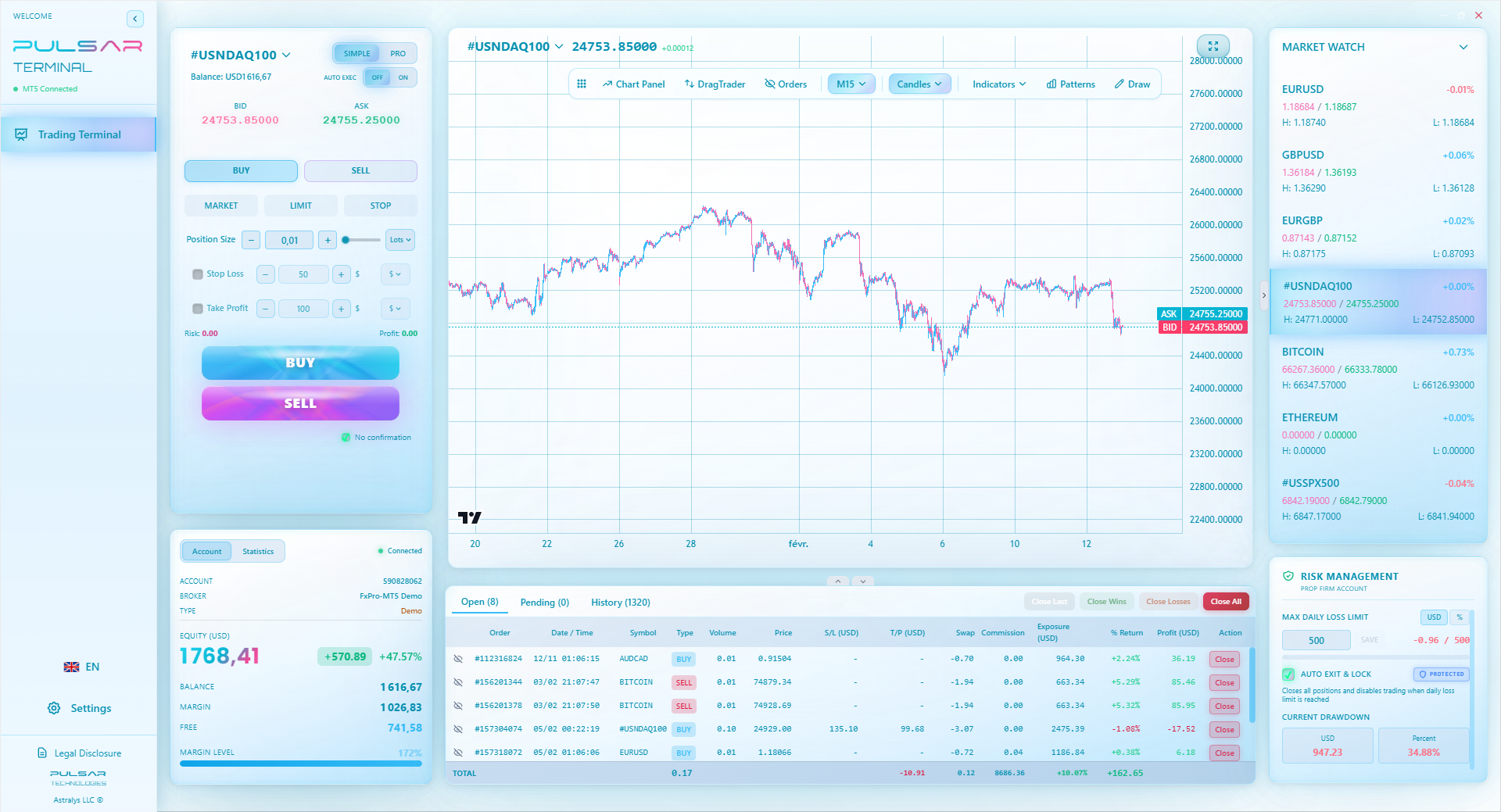
Managing complex exit rules like multiple take-profit levels and trailing stops is where most bots fail, but tools like Pulsar Terminal automate this directly on your MT5 chart.
Pulsar Terminal
The all-in-one MT5 companion: drag-and-drop orders, multi-TP/SL, trailing stop, grid trading, Volume Profile, and prop firm protection. Used by 1,000+ traders daily.
Let's talk numbers. Your bot's profitability hinges on managing costs. Here’s a breakdown from my trading logs.
| Cost Type | Typical Range (Major Pairs) | Impact on Bot Strategy |
|---|---|---|
| Spread | 0.0 - 1.5 pips | Critical for scalpers. A 1-pip spread vs. a 0.2-pip spread destroys a 5-pip target strategy. |
| Commission | $3 - $6 per standard lot | Adds a fixed cost. A bot making 100 trades/day pays $300-$600 daily just in commissions. |
| Slippage | 0 - 2 pips (during news) | Can turn winning trades into losers. Fast execution brokers minimize this. |
| Swap/Rollover | Variable, can be +/- | Matters for bots that hold trades overnight. Can be a significant profit or cost source. |
For major pairs, I use brokers with raw spreads + commission for my high-frequency bots. IC Markets offers that 0.0 pip spread, but you pay $3.50 per lot. For a slower swing trading bot, a broker with a slightly higher but fixed spread might be better, like XM (from 0.8 pips, no commission).
The FSCA Regulation is Your Friend I only use FSCA-regulated brokers for my serious capital. Why? Client money protection and recourse. When a broker I used (now defunct) delayed withdrawals in 2020, the FSCA was the entity that helped resolve it. It's not just a logo on a website.
Minimum Deposits & use Start small. Many brokers allow small deposits for testing. XM has a $5 minimum. Don't be tempted by 1:500 use. My bot's risk management caps effective use at 1:10. High use is a shortcut to a blown account, especially with a bot that can compound errors quickly.

Example: Let's say your bot risks 0.5% per trade on a $1,000 account. That's $5. On USD/ZAR, with a 25-pip stop loss, your position size is $5 / (25 pips * ZAR value of pip). Using a calculator prevents a simple math error from bankrupting you.
“Never assume a strategy built for major pairs will work on ZAR pairs without significant testing.”
This is the part nobody talks about. Running a bot is psychologically harder than manual trading in some ways. You feel powerless, yet responsible. You'll be tempted to commit the three cardinal sins of bot trading.
Sin #1: Intervention. The bot places a trade. You disagree. You override it and close the trade. Later, the market goes exactly where the bot predicted. You just broke your own system. I've done this. The solution? Once the bot is live, you are its mechanic, not its pilot. Your only jobs are to ensure it's running and to shut it down if market conditions violate its core assumptions (e.g., a war breaks out).
Sin #2: Chasing Performance. The bot has a losing week. You panic and tweak a parameter. Now it's a different system, untested. You've likely just tuned it to lose in the next market phase. I have a rule: No parameter changes until after 100 live trades, no matter what.
Sin #3: Neglect. 'Set and forget' is a myth. You need to monitor for technical failures: internet drop, broker disconnect, VPS crash. I check my systems twice daily. A bot left unattended for weeks is a liability.
The emotional rollercoaster is real. Watching a 10-trade losing streak unfold mechanically is a special kind of torture. It tests your faith in your own research. This is where a trading journal is vital - not of trades, but of your observations about the bot's behavior. It helps you separate normal drawdown from a broken system.
💡 Winston's Tip
Forward test for twice as long as you think you need to. The market will show you every flaw in your system; your job is to listen.
Ready to try? Follow this exact sequence. Skipping steps is how you lose money.
- Education First, No Money: Learn MQL4/5 basics (enough to modify simple code) or use a visual bot builder. Don't deposit a single rand yet.
- Find a Simple Strategy: Don't create one yet. Find a documented, simple public strategy (like a moving average crossover). Code it or have it coded. Its purpose is learning the process, not making money.
- Backtest Extensively: Run it on 10 years of data for EUR/USD. Analyze the report. See the max drawdown, the profit factor, the longest losing streak. This is reality-check number one.
- Forward Test on Demo: Run it on a demo account for 2-3 months. Log every trade. Get used to the emotional disconnect. This is where I failed early on - I jumped to live too fast.
- Micro-Live Testing: Open a live account with the absolute minimum deposit - maybe R500 or $30. Run the bot with the smallest possible position size (0.01 lots). Your goal is to test execution, spreads, and your own psychology with real, but insignificant, money. Do this for another 1-2 months.
- Evaluate and Scale: After 100+ live micro trades, look at the data. Does it match your demo and backtest? If yes, you can consider slowly scaling your position size by increasing your capital, NOT by increasing risk per trade.
Throughout this, keep a journal. Note when you wanted to interfere. Note when spreads widened. This log is your most valuable tool. Bot trading isn't passive income. It's active system management. It can free you from screen time, but it demands discipline, rigorous testing, and a deep respect for risk. Start small, go slow, and remember my R20,000 lesson: if a bot seems too good to be true, it's already counting your money.
FAQ
Q1Is bot trading forex legal in South Africa?
Yes, it's completely legal. However, it falls under the regulation of the Financial Sector Conduct Authority (FSCA). You must use an FSCA-regulated broker, and your trading activity (whether manual or automated) must comply with the Financial Markets Act, which prohibits market manipulation like spoofing. Always check your broker's regulatory status.
Q2How much money do I need to start bot trading forex?
Technically, you can start with a very small amount for testing. Brokers like XM have a $5 minimum deposit. However, for meaningful live testing that accounts for proper position sizing, I'd recommend a minimum of R2,000-R5,000. This allows you to trade 0.01-lot sizes while maintaining sane risk management. Remember, the initial capital is for learning and data collection, not for generating income.
Q3Can I use a free trading bot I found online?
You can, but you absolutely should not run it with real money. Free bots are often poorly coded, based on flawed logic (like martingale), or can even contain malicious code. Use them only as educational tools in a demo account to understand how they work. Never trust a strategy you didn't build or thoroughly vet.
Q4What's the biggest risk in bot trading?
Beyond standard market risk, the biggest danger is a strategy that works in the past but fails in the future (overfitting). The second biggest risk is technical failure: a bug in the code, an internet disconnection, or a broker platform issue that causes the bot to malfunction. This is why constant monitoring and strong error-handling in your code are essential.
Q5Do I need to know how to code to use trading bots?
Not necessarily, but it helps immensely. Platforms like MetaTrader have visual strategy builders and allow you to hire coders to build simple EAs. However, not knowing how to code means you're completely dependent on others to modify or fix your bot. Learning the basics of MQL5 allows you to make small adjustments, understand the logic, and be a more informed manager of your automated system.
Q6How are profits from forex bot trading taxed in South Africa?
SARS views profits from forex trading (manual or automated) as income, not capital gains, if you're trading regularly. This means it's added to your other income and taxed at your marginal rate. You must declare this income in your annual tax return. Keep careful records of all your trades, as these are your proof of profit and loss.
Q7Which is better for bot trading, MT4 or MT5?
For forex, MT4 is still the dominant platform with more community support and EAs. However, MT5 is more modern, handles multi-threading better (good for complex bots), and offers more timeframes and built-in indicators. Most serious algo traders are moving to MT5. All the major South African brokers like Exness and Pepperstone support both.
Prof. Winston's Lesson
Key Takeaways:
- ✓Test every bot for at least 100 live micro trades before scaling.
- ✓Never risk more than 0.5% of your capital on a single automated trade.
- ✓Factor in a 25-pip minimum spread filter for ZAR pairs like USD/ZAR.
- ✓Use only FSCA-regulated brokers for your live capital.
How useful was this article?
Click a star to rate
Weekly Trading Insights
Free weekly analysis & strategies. No spam.
About the Author
David van der Merwe
Emerging Markets Trader
Johannesburg-based trader with 11 years in emerging market currencies. Specializes in ZAR pairs, FSCA-regulated trading, and South African market analysis.
Comments
Risk Disclaimer
Trading financial instruments carries significant risk and may not be suitable for all investors. Past performance does not guarantee future results. This content is for educational purposes only and should not be considered investment advice. Always conduct your own research before trading.
You Might Also Like

Cara Trading Forex Sukses: 7 Prinsip dari Trader Profesional
Cara trading forex sukses dengan 7 prinsip trader pro: manajemen modal, disiplin, journal trading, backtest. Data nyata, bukan janji profit palsu.
Jam Trading Forex Terbaik untuk Trader Indonesia: Panduan Lengkap dengan Tabel Waktu
Panduan jam trading forex untuk trader Indonesia. Tabel 4 sesi dunia, jam emas 20:00-00:00, sesi mana yang harus dihindari. Data akurat + tips dari trader berpengalaman.
Top 5 Sàn Forex Uy Tín Nhất 2026: Review Jujur dari Trader Indonesia
Top 5 sàn forex uy tín 2026 untuk trader Indonesia. Review jujur: spread, deposit, withdraw, dukungan lokal. Exness, XM, IC Markets & lebih.
Get Pulsar Terminal
All these calculators are built into Pulsar Terminal with real-time data from your MT5 account. One-click position sizing, automatic risk management, and instant calculations.
Get Pulsar Terminal