


Let's start with a number that should make you pause: 90%.

David van der Merwe
Emerging Markets Trader ·  South Africa
☕ 10 min read
What you'll learn:
Let's start with a number that should make you pause: 90%. That's the percentage of retail forex traders who lose money over the long term. In South Africa, a 2020 survey found 69% of forex-only traders admitted to losses. This isn't a game for the faint-hearted or the uninformed. I've been in the trenches for over a decade, and I've seen more accounts blown up than I care to remember. This guide isn't about scaring you off. It's about giving you the cold, hard facts about the disadvantages of forex trading, specifically through a South African lens, so you can decide if you're built for this with your eyes wide open.
This is the biggest, most unavoidable disadvantage. You will lose money. The question is whether you lose it all, or just some of it while learning. The statistics aren't kind. That 90% figure isn't broker propaganda; it's a consistent reality across global markets. In South Africa, the FSCA itself has highlighted the risks, noting that most retail clients lose.
Why is the loss rate so astronomically high? It's a perfect storm of psychological pressure, poor education, and the seductive danger of use. People see a demo account making 5% in a week and think, 'With real money and more use, I could double that!' That's the trap. I fell into it myself early on. I put R15,000 into an account, got lucky on a few EUR/USD scalps, and within a month I was up to R22,000. I felt invincible. Then I took one oversized trade, a stubborn short on GBP/USD during a news spike. I didn't use a stop-loss because 'I knew it would come back.' It didn't. I watched, frozen, as my profit vanished and then my initial capital got chewed up. I closed it at a R9,800 loss. That was the cost of my first major lesson in humility and risk management.

Warning: The most dangerous thought you can have is 'This time is different.' The market doesn't care about your conviction, your analysis, or your rent payment. It will take your money if you let it.
The volatility that creates opportunity is the same volatility that destroys accounts. A few bad trades, especially if you're over-leveraged, can wipe out weeks or months of careful gains. This is why a solid position size calculator isn't a nice-to-have, it's your financial seatbelt.
The Psychology of the 90%
The loss isn't just about bad analysis. It's about ego, fear, and greed. Greed makes you hold a winner too long, turning a profit into a loss. Fear makes you cut a winner short, or worse, avoid taking a valid trade altogether. Ego makes you refuse to admit you're wrong, turning a small, manageable loss into a catastrophic margin call. Beating the market means first beating your own ingrained psychological responses. Most people never do.

💡 Winston's Tip
The market's job is to prove you wrong. Your job is to admit it quickly and cheaply. The stubborn trader is a bankrupt trader.
“Your forex profits are taxable as income. Even if your broker is offshore, you are responsible for declaring that income.”
A lot of new traders think regulation is purely for their protection. While that's true, it also creates specific limitations and pitfalls unique to South Africa.
The FSCA is our watchdog. A broker holding an FSP license from them is the bare minimum you should accept. But here's the twist: South Africans are not prohibited from using foreign brokers. This creates a massive grey area. You can easily sign up with a flashy, offshore broker offering 500:1 use. The catch? If they scam you, the FSCA can't help. You have zero South African consumer protection. I learned this the hard way years ago with a Cyprus-based bucket shop. Withdrew R5,000 profit without issue. When I tried to withdraw R40,000, suddenly there were 'verification delays' and then radio silence. Gone.
There's one golden, non-negotiable rule: South African residents cannot legally speculate against the Rand (ZAR). Any platform not registered here that offers you the chance to short the USD/ZAR pair is operating illegally regarding that instrument. This limits your direct play on your home currency, which can be frustrating.
Then there's use. Since 2021, the FSCA capped it at 30:1 for major pairs for retail traders. Compare that to the 1000:1 some unregulated offshore brokers dangle like candy. Yes, the cap protects you from instantly blowing up, but it also limits potential gains on small accounts, pushing some traders toward riskier brokers. It's a double-edged sword.
Finally, SARS. Your forex profits are taxable as income. Even if your broker is offshore, you are responsible for declaring that income. The admin alone is a headache, and if you're profitable, a significant chunk goes to the taxman. It's a disadvantage many forget until tax season hits.
“The most dangerous thought you can have is 'This time is different.' The market doesn't care about your conviction.”
You think you make R500 on a trade? Not quite. The costs are silent, relentless profit-eaters. If you're a frequent trader, especially a scalping strategy enthusiast, these can be the difference between profit and loss for the month.
Let's break down the real cost of a trade. Say you buy 1 standard lot (100,000 units) of EUR/USD.
| Cost Type | Example Amount | Impact on a R10,000 Account |
|---|---|---|
| Spread | 1.0 pip = $10 | You're down $10 (R185) the moment you click 'Buy'. |
| Commission | $7 per lot, round turn | Another $7 (R130) gone on exit. |
| Swap/Overnight | -$2.50 per night | Holding for 3 days costs $7.50 (R140). |
| Currency Conversion | 1.2% on deposit/withdrawal | Depositing R10,000 costs R120 upfront. |
Total Cost for One Trade: Before the market even moves in your favor, you could be down nearly R455 just in fees. Your trade needs to gain over 4.5% just to break even on costs alone. This is why chasing 5-pip scalps on a high-spread account is a fool's errand.

Example: I once reviewed a month of my own high-frequency trading. I executed 87 trades. My net profit from price movement was R8,200. My total costs (spreads + commissions) were R3,950. My real profit was R4,250. The costs had eaten almost half my gross gains. It was a wake-up call to trade less, and trade smarter.
Brokers like IC Markets or Pepperstone offer raw spread accounts with low commissions, which can be better for active traders. Others, like some XM accounts, have no commission but wider spreads. You need to know your trading style and do the math. And don't forget inactivity fees. Life gets busy, you take a month off, and boom, a R150 fee for the privilege of not losing money.
“The most dangerous thought you can have is 'This time is different.' The market doesn't care about your conviction.”
Trading from South Africa comes with its own set of logistical headaches.
First, the time zones. The most volatile session overlaps are London (10:00-19:00 SAST) and the London/New York overlap (15:00-19:00 SAST). That's good. But if you have a full-time job, you're trying to trade in between meetings and work tasks. It's distracting and leads to mistakes. The Asian session (Tokyo opens at 2:00 SAST) is a ghost town for most majors unless you're watching the AUD/USD or XAU/USD (gold).
Payment methods are generally good with EFT and credit cards. But try moving a large sum. Transfers over R1 million can trigger SARB scrutiny and require a mountain of paperwork. It's not a disadvantage for most starting out, but it's a friction point if you succeed.
Platform-wise, we're often stuck with MT4 or MT5. They're powerful, but let's be honest, their default mobile apps feel like they're from 2010. Some international brokers have slick proprietary apps, but many don't offer them here, or they're geo-blocked. You're managing complex risk on a tiny, clunky phone screen.
Finally, while you have access to all the majors, there's sometimes a lack of deep liquidity on more exotic pairs involving regional currencies. You might find wider spreads and less reliable execution if you venture too far from the EUR/USD and GBP/USD comfort zone.
💡 Winston's Tip
Your trading edge isn't a secret indicator. It's your discipline to follow your rules when every fiber of your being is screaming to break them.
“The pressure to be right is immense. When you're wrong, there's no one to blame but the face in the mirror.”
This is the disadvantage no one talks about enough, and it's the one that breaks most traders. Forex trading is isolating, stressful, and a constant battle against yourself.
You sit alone, staring at charts for hours. A loss can ruin your day, your week. A win can give you a dangerous high. It messes with your sleep, your relationships, and your self-worth when you tie your identity to your P&L. I've canceled weekend plans because I was 'in a drawdown' and couldn't enjoy myself. That's not healthy.
The pressure to be right is immense. When you're wrong, there's no one to blame but the face in the mirror. That level of personal accountability is brutal. Most people's professional lives don't have this immediate, monetary feedback loop for every decision.
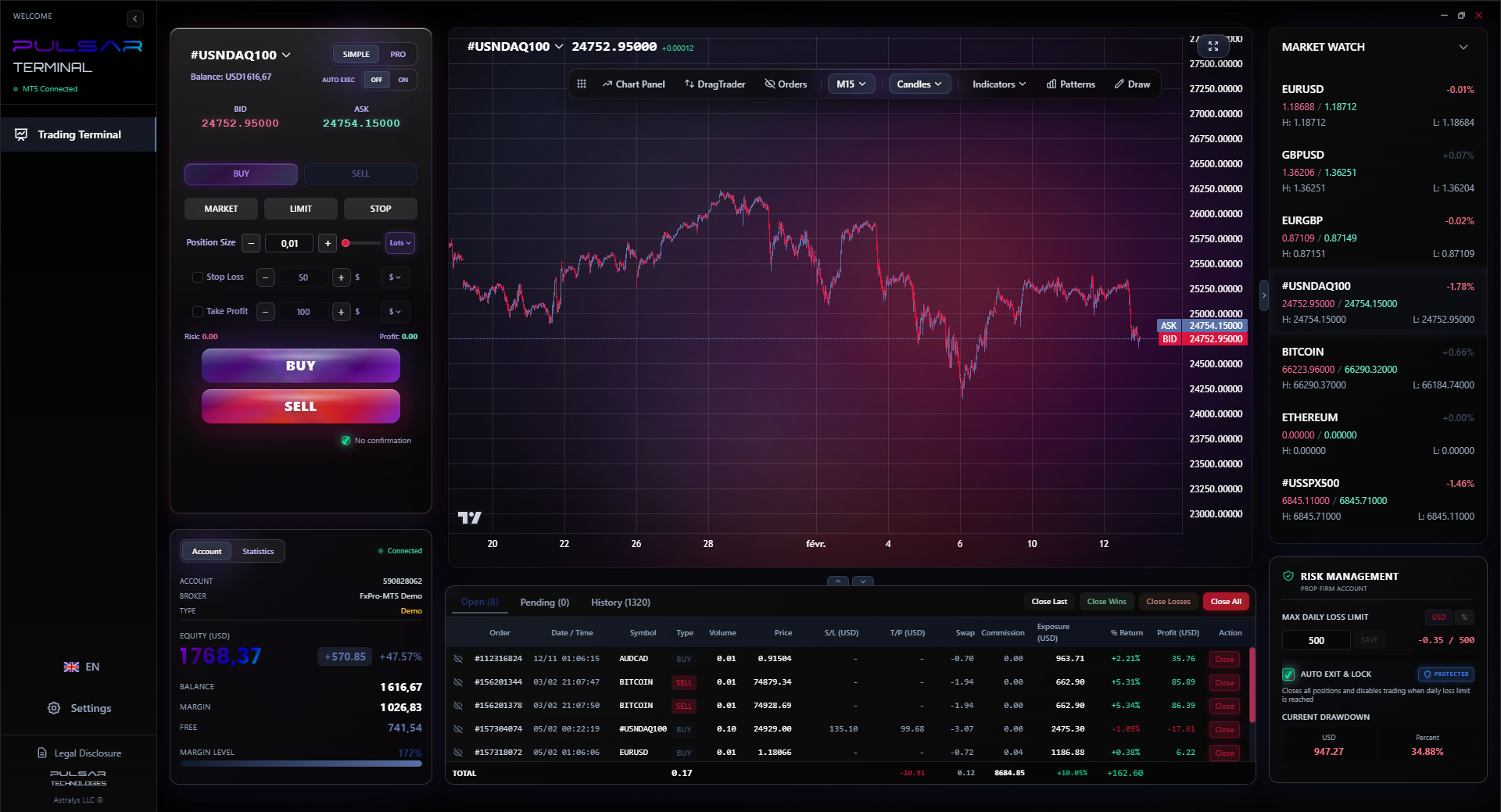
You also have to contend with information overload and conflicting analysis. One guru says buy, another says sell. News hits, the market spikes and dumps in seconds. The emotional whipsaw can lead to reactive, panic-driven trading - the kind that consistently loses money. Developing the discipline to follow a plan, especially when it's telling you to take a loss, is a skill forged in fire. Tools that help automate parts of this, like setting multiple take-profits or a trailing stop, are useful for removing emotion. It's one reason I value tools that integrate directly with MT5, letting me set a complex scalping strategy bracket order with a single click, so I'm not hovering over the mouse when price gets volatile.
Managing the psychological grind means automating your rules; Pulsar Terminal lets you set multi-level take-profits, trailing stops, and breakeven triggers directly on MT5, so you can step away without fear.
Pulsar Terminal
The all-in-one MT5 companion: drag-and-drop orders, multi-TP/SL, trailing stop, grid trading, Volume Profile, and prop firm protection. Used by 1,000+ traders daily.
“The pressure to be right is immense. When you're wrong, there's no one to blame but the face in the mirror.”
South Africa's forex scene has its share of sharks. From 'signal sellers' on Instagram guaranteeing 20% returns per month to outright bucket shops that manipulate prices, the unregulated fringe is dangerous.
The classic is the education scam. Pay R15,000 for a 'masterclass' that teaches you basic candlestick patterns you could find on YouTube. Then, they 'recommend' an unregulated broker where they get a kickback on your losses (a reintroducing broker model). Your success is not their interest.
Then there are the broker-specific scams. Requote abuse during fast markets, where your order just 'happens' to get a worse price. Slippage that always seems to work against you. Sudden, unexplained platform disconnections right before a major news event. With an FSCA-regulated broker like those we review (e.g., Exness for its local presence), you have a recourse path. With an offshore entity, you're shouting into the void.
My rule now is simple: If they're promising guaranteed profits, if they're pressuring you to deposit more after a loss ('to average down'), if their website looks like it was designed in 2005, run. The only thing guaranteed in forex is risk.
💡 Winston's Tip
If you can't articulate the exact reason for your stop-loss and take-profit levels before you enter, you're not trading. You're gambling.
“Your number one goal is survival. Use that position size calculator for every single trade.”
After all that, why would anyone trade forex? Because for the 10% who make it work, the advantages - flexibility, market access, potential profit - outweigh these brutal disadvantages. But you have to go in with a plan to mitigate the downsides.
- Treat it as a business, not a gamble. That means a written business plan, a dedicated risk capital fund (money you can afford to lose entirely), and proper accounting for taxes.
- Education before execution. Don't deposit a cent until you've spent months on a demo account. Not days, months. Test strategies, blow up demo accounts, learn. Understand indicators like the RSI and MACD inside out.
- Partner with a reputable, FSCA-regulated broker. It's your first line of defense. Check our broker reviews for details on who operates legitimately here.
- Master risk management first, profits second. Your number one goal is survival. Use that position size calculator for every single trade. Never risk more than 1-2% of your capital on a trade.
- Consider longer timeframes. The noise and costs are lower on higher timeframes. Swing trading over days or weeks avoids the intraday emotional rollercoaster and the death-by-a-thousand-cuts of scalping fees.
The disadvantages of forex trading are real and significant. They filter out the unprepared, the emotional, and the undercapitalized. But by acknowledging and planning for them, you give yourself a fighting chance to be in the minority that finds a way to succeed. I've managed it, but not without scars and lessons paid for in real Rand. Your journey will be your own.
FAQ
Q1What percentage of forex traders actually lose money in South Africa?
While global studies suggest around 90% of retail forex traders lose money long-term, a 2020 South African survey found 69% of forex-only traders admitted to losing money, with most losses under R9,999. The FSCA consistently warns that most retail clients lose.
Q2Is it illegal for South Africans to trade forex?
No, forex trading is legal. However, there is a critical restriction: South African residents are NOT permitted to speculate against the South African Rand (ZAR) on platforms not registered with local regulators. Always use an FSCA-regulated broker for compliance and protection.
Q3What is the maximum use I can get in South Africa?
For retail traders, the FSCA has capped use at a maximum of 30:1 for major currency pairs since 2021. This is a protective measure. Some offshore brokers may offer higher use, but using them carries significant regulatory and fraud risks.
Q4How are my forex profits taxed by SARS?
Profits from forex trading are considered taxable income in South Africa. You must declare them on your annual tax return, even if your broker is based offshore. It's your responsibility to keep accurate records of all trades, profits, and losses for SARS.
Q5What is the biggest hidden cost in forex trading?
The spread is the most consistent cost, as you pay it on every single trade. For active traders, commissions and swap fees add up quickly. On a small account, these costs can represent a huge percentage of your capital, making profitability much harder.
Q6Can I trade forex successfully with a full-time job in South Africa?
It's challenging but possible if you adopt a longer-term swing trading approach. Intraday trading conflicts with work hours and leads to distraction. Focus on the London/New York overlap after work or use end-of-day analysis to set trades that don't require constant screen watching.
Q7What's the single most important thing I can do to protect myself?
Use a stop-loss on every trade without exception. It's the simplest form of risk management that prevents a small loss from becoming an account-ending disaster. Couple this with sensible position sizing (risking 1-2% per trade) to ensure you can survive a string of losses.
Prof. Winston's Lesson
Key Takeaways:
- ✓Assume you are wrong on every trade. Plan your exit first.
- ✓Trade size determines your fate more than trade direction.
- ✓Regulation is a limit, but also your only shield.
- ✓Costs are a silent war against small accounts. Choose your broker wisely.
How useful was this article?
Click a star to rate
Weekly Trading Insights
Free weekly analysis & strategies. No spam.
About the Author
David van der Merwe
Emerging Markets Trader
Johannesburg-based trader with 11 years in emerging market currencies. Specializes in ZAR pairs, FSCA-regulated trading, and South African market analysis.
Comments
Risk Disclaimer
Trading financial instruments carries significant risk and may not be suitable for all investors. Past performance does not guarantee future results. This content is for educational purposes only and should not be considered investment advice. Always conduct your own research before trading.
You Might Also Like

Cara Trading Forex Sukses: 7 Prinsip dari Trader Profesional
Cara trading forex sukses dengan 7 prinsip trader pro: manajemen modal, disiplin, journal trading, backtest. Data nyata, bukan janji profit palsu.
Jam Trading Forex Terbaik untuk Trader Indonesia: Panduan Lengkap dengan Tabel Waktu
Panduan jam trading forex untuk trader Indonesia. Tabel 4 sesi dunia, jam emas 20:00-00:00, sesi mana yang harus dihindari. Data akurat + tips dari trader berpengalaman.
Top 5 Sàn Forex Uy Tín Nhất 2026: Review Jujur dari Trader Indonesia
Top 5 sàn forex uy tín 2026 untuk trader Indonesia. Review jujur: spread, deposit, withdraw, dukungan lokal. Exness, XM, IC Markets & lebih.
Get Pulsar Terminal
All these calculators are built into Pulsar Terminal with real-time data from your MT5 account. One-click position sizing, automatic risk management, and instant calculations.
Get Pulsar Terminal