


It was 3 AM, and my screen was glowing green.

David van der Merwe
Emerging Markets Trader ·  South Africa
☕ 9 min read
What you'll learn:
- 1What the Hell is an Expert Advisor, Really?
- 2Why Trading EAs in South Africa is a Different Beast
- 3Spotting a Scam: The Buyer's Checklist
- 4Should You Build Your Own EA?
- 5The Non-Negotiable Settings: Your Safety Net
- 6War Stories: What Actually Worked for Me
- 7The Only Way to Know: Forward Testing
- 8Where to From Here?

It was 3 AM, and my screen was glowing green. My 'Millionaire Maker' EA had just opened its 47th consecutive winning trade on EUR/ZAR. The account was up 12% for the month, running entirely on autopilot while I slept. I felt like a genius. Two weeks later, a single Reserve Bank announcement I hadn't coded for wiped out 80% of those gains in 90 seconds. That's the expert advisor robot forex game in a nutshell: moments of pure brilliance punctuated by spectacular, expensive lessons. Let's talk about what these things actually are, and more importantly, how you can use them without getting your financial teeth kicked in.
Forget the fancy name. An Expert Advisor (EA) is just a piece of software that tells your MetaTrader 4 or 5 platform what to do. You attach it to a chart, it reads the price, and based on its programming, it can open trades, set stop losses, take profits, and close positions. No magic, no AI (despite what the sales page says), just a set of rules written in MQL4 or MQL5 code.
Think of it like a very specific, very obsessive assistant. You can't tell it to 'make money.' You have to tell it: 'If the price closes above the 50-period moving average, and the RSI is below 70, buy 0.1 lots and place a stop loss 20 pips below the entry.' It will then do that, over and over, without emotion or fatigue. That's the theory, anyway.
The reality is most EAs you buy online are junk. They're curve-fitted – designed to look amazing on past data but fall apart in live markets. The good ones aren't for sale on public forums for R500. They're either built in-house by serious traders or developed by small teams who guard the logic like state secrets.

Warning: If an EA vendor's website has more Lamborghinis and Rolexes than actual trade statements, run. That's not a trading business; it's a marketing funnel aimed squarely at your desperation.
Trading from SA adds layers you won't hear about in generic guides. First, the rand pairs. An EA tuned for the steady, liquid flows of EUR/USD will choke on USD/ZAR's volatility. The spreads are wider, the gaps are more frequent (especially around SONA or MPC announcements), and the market can move on pure political sentiment.
I learned this the hard way. I imported a popular grid trading EA from Europe, set it loose on GBP/ZAR. It worked beautifully for a month, collecting small profits in a ranging market. Then, a sudden bout of load-shedding news hit. The rand weakened fast, the EA kept placing sell orders against the trend like a robot lemming, and I got a margin call before I could even switch on my generator. Lost R15,000 in an afternoon.
Broker Matters
Your choice of broker is critical. You need one with stable servers (low latency), allows EAs (some don't), and offers reasonable spreads on the pairs you're targeting. I've had good, reliable execution with IC Markets and Pepperstone for EA work. Their raw spread accounts are essential for scalping strategy EAs where every pip counts.
Tax and Legality
Is it legal? Absolutely. Is it a tax headache? Possibly. SARS sees profits from an EA the same as any other trading profit – it's taxable income. Keeping a detailed log of all automated trades (which your broker should provide) is non-negotiable.

💡 Winston's Tip
An EA is a reflection of its creator's psychology. If the strategy is frantic and complex, the creator is probably scared of missing out. The best EAs are often the most boring ones.
“The EA marketplace is 90% snake oil.”
The EA marketplace is 90% snake oil. Here’s how to filter it.
- Demand a Verified Live Statement: Not a backtest. A Myfxbook or FXBlue link showing real-money, real-time performance for at least 6 months. Check the duration of trades. An account with 1000 trades all lasting 2 minutes is likely a martingale/scalper ready to blow.
- Check the Drawdown: If they only show 'Profit: 300%' but hide the drawdown, it's a red flag. Any EA with a max drawdown over 25% is a gamble, not an investment. I ignore anything above 15%.
- What's the Strategy? If the seller says 'It's a secret algorithm,' walk away. You should understand the core logic: Is it a trend follower? A mean reversion bot? A news straddle? If they can't explain it in plain English, they're hiding something.
- Price is an Indicator: A truly profitable EA is a money-printing machine. Why would anyone sell it for a one-time fee of R2000? They wouldn't. They'd either keep it, sell it for six figures, or offer it via a high-fee monthly subscription. Cheap EAs are cheap for a reason.

Pro Tip: Go to the EA's Myfxbook page. Change the time frame to its worst performing month. If you wouldn't have had the stomach to hold through that period, you shouldn't buy it.

This is the crossroads. Buying is easy but risky. Building is hard but offers control.
The Case for Building: You have a solid, manually-tested strategy. Maybe you're consistently profitable with a specific swing trading setup on XAU/USD. Codifying it removes your emotional errors and lets you scale. You can hire a freelance coder on sites like MQL5.com. A simple EA might cost $200-$500. Be crystal clear in your instructions – coders do exactly what you say, not what you mean.
The Case for Buying (Carefully): You have capital but no time or coding skill. Your job is now due diligence. Treat it like a business investment. Allocate a tiny portion of your capital (I mean 1-2%) to forward-test it on a demo, then a live cent account for at least 3 months. Never, ever give an untested EA access to your main account.
My own journey involved both. I bought three EAs early on. Two failed. The third had a useful core idea I then hired a developer to modify and improve, turning it into my primary tool today. That hybrid approach – learn from the market, then build – saved me.
“Complexity kills. Simple, strong logic survives.”
Plugging in an EA and hitting 'Start' is suicide. You must configure these parameters, every single time.
- Maximum Risk per Trade: This is the big one. The EA should calculate its position size based on a fixed percentage of your account balance. I never risk more than 0.5% per trade on autopilot. This is controlled by the 'Risk' input in good EAs.
- Maximum Daily/Weekly Loss: A must-have. Set it to stop trading for the day if the EA hits a -3% loss. This prevents a death spiral.
- Trading Hours: Don't let it trade through major news events (like US Non-Farm Payrolls or SA Budget Speech) unless it's specifically designed for it. The volatility will trigger stops and wreak havoc.
- Symbols & Timeframes: Be specific. If it's built for the H1 chart, don't run it on M15.

Example: You have a R100,000 account. You set Max Risk to 0.5%. The EA's logic says to place a stop loss of 25 pips on USD/ZAR. Using a position size calculator, it should automatically open a position of roughly 0.20 lots to ensure a 25-pip loss equals R500 (0.5% of R100k). If it opens 1.0 lots, you know the logic is broken.
💡 Winston's Tip
The market's job is to find the point of maximum pain. It will inevitably find the flaw in your EA's logic. Your job is to ensure that flaw isn't fatal.
Let's get specific. My most successful EA isn't exotic. It's a boring trend-following bot on major pairs. It uses a combination of moving averages and the ADX indicator to filter for strength. It wins about 45% of the time, but the average winner is 2.5x the size of the average loser.
Trade Example (Real): On March 15, 2023, it went long on EUR/USD at 1.0675. The MACD indicator was bullish, ADX was rising. It placed a stop at 1.0645 (30 pips). It used a trailing stop of 20 pips once the trade was 40 pips in profit. The pair ran up to 1.0760 over two days. The EA closed the position at 1.0740 via the trailing stop. Net gain: 65 pips, or about R650 on my 0.1 lot position.
The Failure: Before this, I chased a 'high-frequency arbitrage' EA. It promised 5-10 trades per hour. It made money for a week. Then, during a period of low liquidity, it got caught in a slippage spiral. It tried to open and close the same position 8 times in a minute, each time at a worse price due to latency. I lost R2,800 in 60 seconds. The lesson? Complexity kills. Simple, strong logic survives.
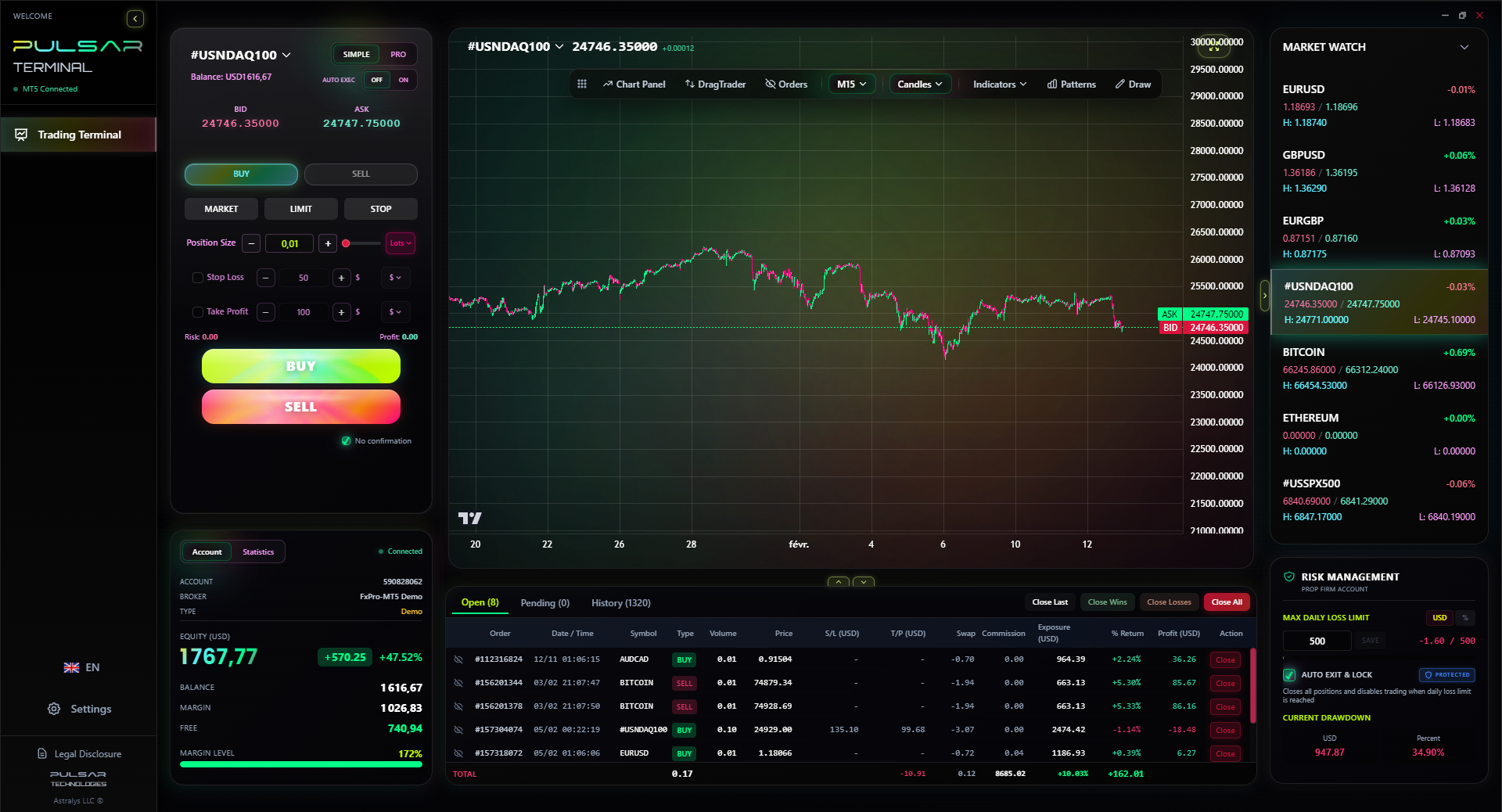
The tool I use now to manage these bots is indispensable. Setting multiple take-profit levels and automated trailing stops is a chore to code into every EA. But with a platform like Pulsar Terminal, I can apply those management rules externally, to any EA's trades, which is a game-saver.
Managing the trades your EA opens is half the battle, and Pulsar Terminal gives you professional tools like multi-level take profits and trailing stops that work on any position in your MT5 account.
Pulsar Terminal
The all-in-one MT5 companion: drag-and-drop orders, multi-TP/SL, trailing stop, grid trading, Volume Profile, and prop firm protection. Used by 1,000+ traders daily.
“Automation should free you from the screen, not from your common sense.”
Backtests are a fairy tale. Forward testing is the cold, hard truth.
Your Process:
- Demo Test: Run the EA on a demo account for a month. Does it behave as advertised? Ignore the profit; watch the behavior.
- Cent Account Test: This is crucial. Fund a live cent account with $50-$100 (real money, so execution is real). Run the EA here for at least 100 trades, or 3 months, whichever is longer. This costs you pennies but gives you live data.
- Analyze the Logs: Check the trade history. Are stop losses being respected? Is slippage acceptable? Does it trade during news? This is where you'll find the fatal flaws.
I forward-test every change, no matter how small. Tweaked a parameter? Back to the cent account for two weeks. It's boring. It's slow. It's the only thing that separates the professionals from the blown-up accounts.
The expert advisor robot forex space is evolving. We're seeing more machine learning elements, but they're still prone to overfitting. The core principles won't change: manage risk, keep it simple, verify everything.
Your Action Plan:
- Educate Yourself First. Understand basic trading concepts like pips, spreads, and risk management before you even think about automation.
- Start Manual. Be a profitable manual trader first. You can't automate a losing strategy into a winner.
- If Buying: Apply the scam checklist ruthlessly. Budget for a 3-6 month testing period with real, but tiny, money.
- If Building: Clearly define your manual strategy. Document every rule. Then, and only then, hire a coder.
Automation should free you from the screen, not from your common sense. The EA is the tool. You are the strategist, the risk manager, the one responsible. Don't ever forget that.
FAQ
Q1Can I really get rich with a Forex EA?
You can get rich with a well-designed, properly managed EA over a long period. You can get poor much, much faster with a bad one. It's a tool for systematic execution, not a magic wealth generator. Expecting consistent 10%+ monthly returns is a fast track to disappointment.
Q2What's the best EA for a beginner in South Africa?
The best EA for a beginner is no EA. Learn to trade manually first. Understand why trades win and lose. Once you have a grasp of the markets and solid risk management, then you can explore automation. Starting with an EA is like learning to drive in a self-driving car; you'll have no idea what to do when it fails.
Q3How much money do I need to start with an EA?
More than you think. You need enough capital so that position sizes are sensible and you can withstand the inevitable drawdown. I wouldn't seriously start with less than R50,000 in a dedicated account. With less, the position sizes become so small that costs (spreads) eat you alive, or a single decent trade doesn't move the needle.
Q4Are free EAs any good?
Rarely. Sometimes you'll find a decent simple script or indicator in community forums. But a fully-fledged, profitable trading system given away for free? Extremely unlikely. Often, free EAs are either outdated, poorly coded, or have a fatal flaw. They can be useful for learning how EAs are structured, but never trust them with real money without extensive forward testing.
Q5Do EAs work during load-shedding?
Only if your broker's server and your VPS (Virtual Private Server) have power. This is critical. You must run EAs on a paid VPS located near your broker's server (e.g., in London or New York). This ensures 24/7 uptime, eliminates the load-shedding problem, and reduces latency. It's a non-negotiable cost of doing business, about $20-$30 per month.
Q6How do I handle taxes on EA profits in South Africa?
SARS treats it as income. Keep impeccable records. Download monthly statements from your broker. Your total net profit for the tax year is added to your other income. It's wise to consult with a tax practitioner familiar with trading. Set aside a percentage of your profits (I aim for 25%) throughout the year to cover the potential tax liability.
Prof. Winston's Lesson
Key Takeaways:
- ✓Never risk more than 0.5% per trade on autopilot.
- ✓Forward test for 100 trades or 3 months minimum.
- ✓Run your EA on a VPS, always.
- ✓A cheap EA is a red flag, not a bargain.
How useful was this article?
Click a star to rate
Weekly Trading Insights
Free weekly analysis & strategies. No spam.
About the Author
David van der Merwe
Emerging Markets Trader
Johannesburg-based trader with 11 years in emerging market currencies. Specializes in ZAR pairs, FSCA-regulated trading, and South African market analysis.
Comments
Risk Disclaimer
Trading financial instruments carries significant risk and may not be suitable for all investors. Past performance does not guarantee future results. This content is for educational purposes only and should not be considered investment advice. Always conduct your own research before trading.
You Might Also Like

Cara Trading Forex Sukses: 7 Prinsip dari Trader Profesional
Cara trading forex sukses dengan 7 prinsip trader pro: manajemen modal, disiplin, journal trading, backtest. Data nyata, bukan janji profit palsu.
Jam Trading Forex Terbaik untuk Trader Indonesia: Panduan Lengkap dengan Tabel Waktu
Panduan jam trading forex untuk trader Indonesia. Tabel 4 sesi dunia, jam emas 20:00-00:00, sesi mana yang harus dihindari. Data akurat + tips dari trader berpengalaman.
Top 5 Sàn Forex Uy Tín Nhất 2026: Review Jujur dari Trader Indonesia
Top 5 sàn forex uy tín 2026 untuk trader Indonesia. Review jujur: spread, deposit, withdraw, dukungan lokal. Exness, XM, IC Markets & lebih.
Get Pulsar Terminal
All these calculators are built into Pulsar Terminal with real-time data from your MT5 account. One-click position sizing, automatic risk management, and instant calculations.
Get Pulsar Terminal