


What's the absolute minimum you need to start day trading forex in the US? If you're expecting a simple number, I've got bad news.
James Mitchell
Senior Trading Analyst
☕ 11 min read
What you'll learn:
What's the absolute minimum you need to start day trading forex in the US? If you're expecting a simple number, I've got bad news. You're asking the wrong question. I learned this the hard way, blowing up a $500 account in my first month because I focused on the deposit, not the reality of trading under US regulations. The real forex day trading minimum is a combination of legal rules, broker requirements, and, most importantly, the capital needed to survive your own mistakes. Let's break down what you actually need, not just what a broker's marketing page says.
First, the good news. The infamous Pattern Day Trader (PDT) rule that requires $25,000 for stock trading? It doesn't apply to forex. The CFTC and NFA regulate this space, not the SEC. So legally, you can open an account and trade as frequently as you want without that huge capital barrier.
Now, the reality check. The CFTC and NFA have their own set of rules that fundamentally shape your trading. The two biggest are use caps and the FIFO rule.
use is capped at 50:1 for major pairs like EUR/USD and 20:1 for minors. Coming from trading international brokers years ago, this felt like handcuffs. I was used to 200:1 or 500:1. But here's the lesson: those high use limits are a trap for the inexperienced. The US caps, while restrictive, probably saved me from even bigger losses early on. They force you to commit more capital per trade, which makes you think twice.
The FIFO (First-In, First-Out) rule means you can't pick and choose which lot to close. The oldest position gets closed first. This kills a common hedging strategy where you'd open opposing positions to manage risk without closing the original trade. You simply can't do that here. Your risk management has to be upfront with stop losses.

Warning: Don't even think about using an offshore broker to skirt these rules. The fund segregation and legal protections you get with a US-regulated broker like FOREX.com or OANDA are worth the regulatory constraints. I've heard horror stories of traders unable to withdraw funds from unregulated entities.
“The real forex day trading minimum is a combination of legal rules, broker requirements, and the capital needed to survive your own mistakes.”
This is where most beginners get fooled. You see "$0 minimum deposit" from brokers like OANDA or Interactive Brokers and think you're in the game. Technically, you are. Practically, you're setting yourself up for failure.
I made this exact mistake. I funded an account with $100 at a broker advertising no minimum. My logic was simple: I'll learn with real money, but not too much. Here's what happened on my very first trade.
I bought EUR/USD. The spread was 1.2 pips. My position size, thanks to use limits, was tiny. The market moved 5 pips in my favor, but after the spread cost, it felt like a win of only a few cents. Then it reversed. A 10-pip move against me triggered my stop-loss. I lost about $2.50 on the trade. The commission? It was $5 round trip. I made a trading decision that was technically correct on direction, but I lost money because the fixed costs ate my microscopic profit potential.
The Real Cost of Trading Small
With a $100 account, even a 50:1 use cap only lets you control $5,000. A single standard lot is $100,000. So you're trading micro or nano lots. The spread and commission costs become a massive percentage of your potential gain. It's like trying to fill a swimming pool with a teaspoon.
Brokers know this. FOREX.com "recommends" $2,500, and that's not a random number. It's the point where you can take a sensible position size (like 0.05 lots) and have the trading costs be a reasonable fraction of your trade expectancy. That $2,500 figure is closer to a functional forex day trading minimum than any advertised account minimum.

Pro Tip: Use a position size calculator before you deposit a cent. Input a $500 account, a 1% risk per trade, and a 30-pip stop loss on EUR/USD. See the tiny position size it gives you. Then realize that a 1-pip spread is a huge chunk of your risk. That's the math that kills small accounts.

💡 Winston's Tip
The broker's 'minimum deposit' is a marketing term. Your 'minimum survival capital' is a mathematical reality based on risk-per-trade and cost-per-trade. Calculate the second one, ignore the first.
“I funded an account with $100. I lost money on a technically correct trade because the fixed costs ate my microscopic profit potential.”
Forget broker minimums. The only number that matters is your survival capital. This is the amount needed to withstand losses, pay costs, and still have enough left to trade effectively.
Let's build this from the ground up with real 2025 numbers.
1. The Loss Buffer: The CFTC publishes data showing a high percentage of retail traders lose money. Let's assume you will have losing trades. A common risk management rule is to never risk more than 1-2% of your account per trade. If you want to survive a string of, say, 10 losses, you need capital that won't be decimated. If you start with $500 and risk 2% ($10) per trade, 10 losses is a $100 drawdown. That's 20% of your account gone, and your position sizes just got 20% smaller, making recovery harder.
2. The Cost of Doing Business: On a RAW account with FOREX.com, you pay $7 per $100,000 traded round trip. On a 0.05 lot position ($5,000), that's $0.35 in commission. The spread might be 0.2 pips, or $1 on that position. So your total cost to enter and exit is about $1.35. To make a net profit of $20 on that trade, the market needs to move over 21 pips in your favor just to cover costs and hit your target. That's a much taller order than it seems.
3. The Psychological Minimum: Trading with scared money is a recipe for disaster. If a $50 loss on your $500 account makes you sweat and abandon your strategy, you're undercapitalized. Your capital needs to be at a level where a normal losing streak doesn't trigger panic.
From my experience, and from coaching others, the bare minimum to even begin learning day trading with real stakes in the US market is $2,000. $5,000 is far more realistic. It allows for sensible position sizing, absorbs costs, and provides a psychological cushion. I didn't find any consistency until I stopped messing with sub-$1,000 accounts. I treated them as disposable, and they always obliged.
“I funded an account with $100. I lost money on a technically correct trade because the fixed costs ate my microscopic profit potential.”
Your forex day trading minimum is directly inflated by costs. You have to budget for them like a business.
| Cost Type | Example (Broker) | Impact on a $2,000 Account |
|---|---|---|
| Spread (Commission-Free) | OANDA: 1.2 pips EUR/USD | On a 0.05 lot trade, that's $6 gone before you start. You need a 6-pip move just to break even. |
| Commission (RAW/ECN) | FOREX.com: $7 per 100k | On a 0.05 lot ($5k), cost is $0.35. Spread might be 0.2 pips ($1). Total cost: ~$1.35. |
| Inactivity Fee | OANDA: $10/month after 1 year | A tax on hesitation. If you're not trading, you're being charged for the privilege of losing slowly. |
| Currency Conversion | FOREX.com: +/-0.5% | If your account is USD but you trade AUD pairs, this nibbles at profits. |
I used to chase the lowest spreads, thinking it was the key. I opened a RAW account. But I was trading tiny sizes. The commission became a larger percentage of my potential profit than the spread was on a standard account. I had to switch my strategy. For scalping tiny timeframes, the RAW account was better. For the swing trading I was more suited to, the wider but commission-free spread was less of a headache.

Example: Let's say you're a scalper aiming for 10 pips per trade on EUR/USD.
- Commission-Free Account: Spread is 1.2 pips. You need an 11.2-pip move to net 10 pips.
- RAW Account: Spread is 0.2 pips, commission is $1.35 on a 0.05 lot. That commission is roughly 1.35 pips. You need an 11.55-pip move to net 10 pips. The difference is marginal. The choice depends on your trade frequency and size. Don't obsess over the lowest number; obsess over the total cost structure relative to your strategy.
💡 Winston's Tip
If a $50 loss on your account makes you angry or scared, your account is too small. You cannot trade rationally with scared money. The solution is more capital, not more courage.
“Trading with scared money is a recipe for disaster. Your capital needs to be at a level where a normal losing streak doesn't trigger panic.”
Here's what I wish I had done, based on 12 years of mistakes.
Step 1: Paper Trade with Realistic Conditions. Don't use a simulator with infinite money. Start with a virtual $5,000. Use the real use caps (50:1). Deduct realistic spreads (1.2 pips for majors) from every trade. If you use a broker's demo, configure it to mirror their commission-based account if that's your target. Track every trade for a minimum of three months. Your goal isn't profit, it's consistency and not blowing up.
Step 2: Choose Your Broker Based on Your Style. Are you a scalper? You need tight spreads and a stable platform. Check out Pepperstone for their Razor account (though note, Pepperstone does not accept US clients; this is for the principle of ECN pricing). In the US, look at FOREX.com's RAW account. Are you a swing trader holding for days? A commission-free account from OANDA might be simpler. Ensure they offer the tools you need. I'm a heavy user of TradingView for analysis, so I picked a broker that integrated with it.
Step 3: Fund with Your 'Survival Capital.' Save up until you can deposit at least $2,000 without it affecting your bills. This is non-negotiable. Deposit via ACH to avoid wire fees. Start with the smallest position size possible, even if it feels silly. Your first 10 real trades are about managing emotion, not making money.
Step 4: Implement Risk Management from Trade #1. Decide your maximum risk per trade (I use 1%). Set your stop-loss BEFORE you enter the trade. Use a position size calculator every single time. This habit is more important than your entry technique.
Step 5: Review Weekly, Not Daily. Staring at daily P&L will drive you mad. Review your trades weekly. Are you following your plan? Are your stops logical? Adjust your process, not your goals based on short-term results.
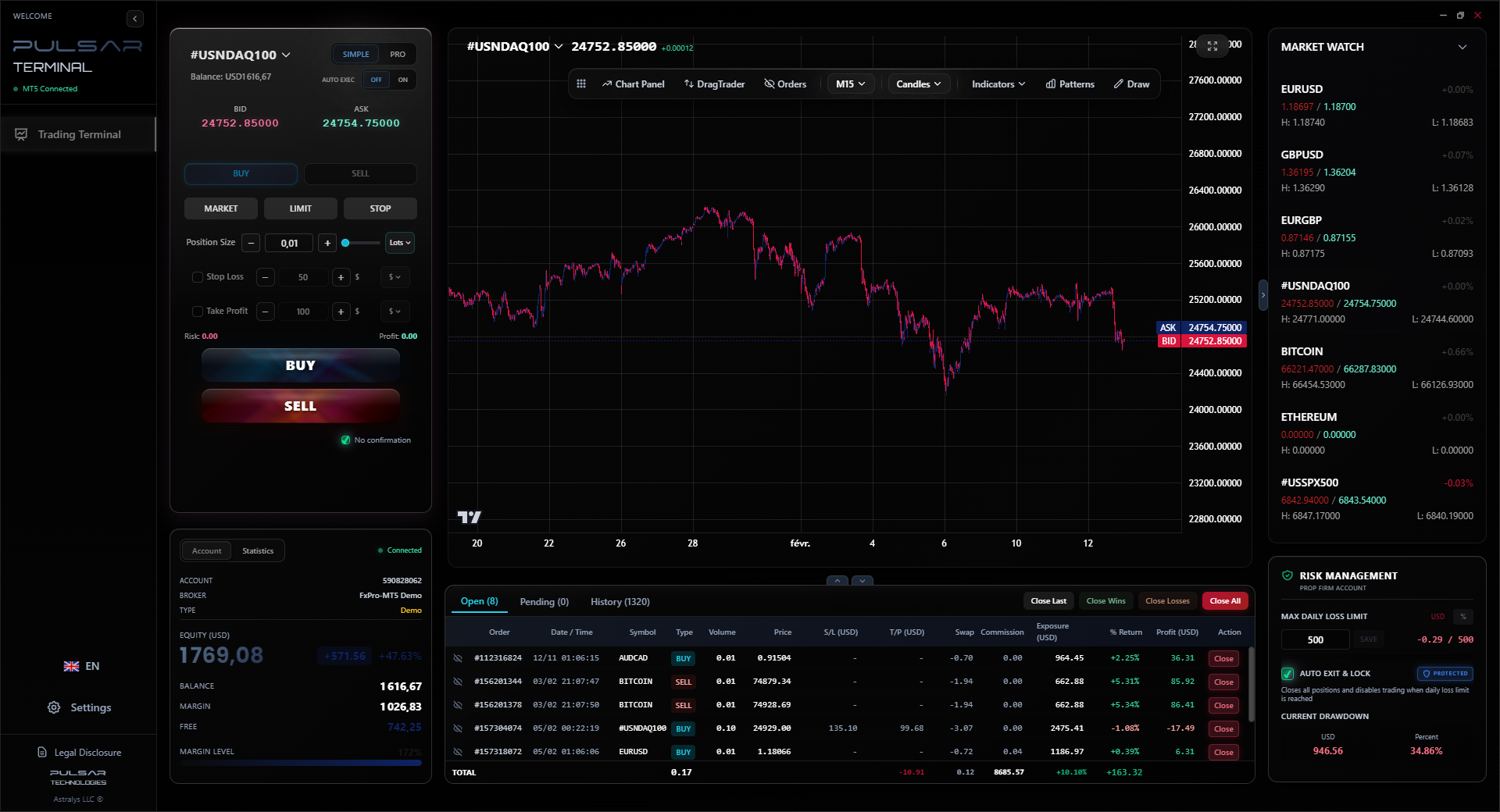
Sticking to a risk management plan is the hardest part of day trading, which is why tools that automate stop-loss and breakeven orders, like those in Pulsar Terminal, are essential for enforcing discipline.
Pulsar Terminal
The all-in-one MT5 companion: drag-and-drop orders, multi-TP/SL, trailing stop, grid trading, Volume Profile, and prop firm protection. Used by 1,000+ traders daily.
“Trading with scared money is a recipe for disaster. Your capital needs to be at a level where a normal losing streak doesn't trigger panic.”
Pitfall 1: Over-leveraging the 'Small' Account. With $500 and 50:1 use, you control $25,000. That's tempting. I'd throw on 0.25 lots, risking 5% of my account on a single trade. A 20-pip move would make or break my day. This is gambling, not trading. I had a trade on GBP/USD where I did this. It moved 30 pips in my favor quickly. I was up over $75. Greed set in. I moved my stop to breakeven. It reversed, hit my breakeven stop, and I made nothing. The emotional rollercoaster wasn't worth it.
Pitfall 2: Ignoring the Cost of the Trade. As shown earlier, I'd take profits at 5 pips, thrilled, only to see my account balance barely move because the spread and commission took most of it. You need a strategy where your average target is significantly larger than your total trade cost. If your edge is 5 pips, you need spreads under 0.5 pips to make it work. Most retail traders don't have that edge.
Pitfall 3: Changing Strategy After Two Losses. A small account magnifies losses. After two $10 losses on my $500 account, I'd abandon my careful plan and look for a 'sure thing' to get back to even. That's when I'd take a terrible trade and lose $50. This is the direct path to a margin call. The solution is to have a larger account where a 2% loss doesn't feel like a crisis.
Pitfall 4: Picking the Wrong Instrument. Trying to day trade exotics or minor pairs with a small account is suicide. The spreads are wider (remember, capped at 20:1 use too). Stick to the major pairs like EUR/USD when starting. The liquidity is high, spreads are tightest, and it moves predictably relative to news.
💡 Winston's Tip
Your first $1,000 in trading isn't for profits. It's tuition. Expect to pay it to learn the real costs, your own psychology, and the weight of the rules. Fund accordingly.
“The minimum is less about a dollar figure and more about a mindset figure.”
You can't change the use caps, but you can trade smarter.
1. Master One Strategy: Don't jump from scalping to swing trading. Find a single set-up on a single pair and become an expert. I focused solely on London session breakouts on GBP/USD for a year. It reduced noise and improved my win rate.
2. Use Technology for Precision: Manual stop-loss placement is emotional. Use tools that automate risk management. A platform that lets you set a breakeven stop or a trailing stop automatically removes a huge psychological burden.
3. Focus on Risk/Reward, Not Frequency: With a small account, you're tempted to trade often to 'grow it fast.' This just runs up costs. Aim for fewer, higher-quality trades with a solid 1:2 or 1:3 risk-to-reward ratio. One good 3:R trade can cover several small losses.
4. Keep a Trading Journal: This is non-negotiable. Note your entry, exit, reasoning, and emotion for every trade. Review it. My journal from 2015 shows me repeatedly breaking my rules when my account dropped below $1,000. The data doesn't lie. It showed me my personal forex day trading minimum was a psychological threshold, not a financial one.
, the minimum is less about a dollar figure and more about a mindset figure. Have enough capital to trade without fear, and to absorb the unavoidable costs of being a participant in this market. Start there, and you've already passed the biggest hurdle most never clear.
FAQ
Q1What is the absolute minimum deposit to start forex day trading in the US?
Technically, $0 at brokers like OANDA or Interactive Brokers. But this is a trap. To actually trade effectively, cover costs, and manage risk, a functional minimum is at least $2,000. Brokers like FOREX.com recommend $2,500 for a reason.
Q2Does the $25,000 Pattern Day Trader (PDT) rule apply to forex?
No. The PDT rule is a FINRA/SEC rule for equities. Forex is regulated by the CFTC and NFA, which have different rules like use caps (50:1 for majors) and the FIFO rule, but no minimum capital requirement for frequent trading.
Q3What are the biggest costs that eat into a small day trading account?
The spread is the most immediate cost. On a commission-free account, a 1.2-pip spread on EUR/USD means you start every trade down $12 on a standard lot. On a RAW/ECN account, you pay a commission per trade. For small position sizes, these fixed costs represent a huge percentage of your potential profit, making consistent gains extremely difficult.
Q4Can I use high use to grow a small account quickly?
You can try, but it's the fastest way to lose it. US use is capped at 50:1. Even at that level, using maximum use on a $500 account means a 2% market move against you wipes out 100% of your capital. It's not a strategy; it's a lottery ticket with terrible odds.
Q5Is it better to use a commission-free or a commission-based (RAW) account with a small balance?
It depends on your trade size and strategy. For very small positions (under 0.1 lots), the fixed commission on a RAW account can be a larger burden than the wider spread on a commission-free account. You need to calculate the total cost (spread + commission) as a percentage of your typical trade target. Often, for beginners with sub-$5,000 accounts, a commission-free account is simpler and has more predictable costs.
Q6What's the single most important thing to do before funding a live account?
Paper trade with realistic conditions for a minimum of three months. Use a virtual account size of $5,000, enforce the 50:1 use cap, and deduct real spreads and commissions from your results. If you can't be profitable in simulation with these constraints, you have no chance with real money.
Prof. Winston's Lesson
Key Takeaways:
- ✓Functional minimum capital is $2,000+, not $0.
- ✓US use caps (50:1) protect you from yourself.
- ✓Trade cost must be under 30% of your target profit.
- ✓A 1% risk rule is impossible under $1,000.
How useful was this article?
Click a star to rate
Weekly Trading Insights
Free weekly analysis & strategies. No spam.
About the Author
James Mitchell
Senior Trading Analyst
Based in New York with over 9 years of trading experience. Focuses on major USD pairs, prop firm challenges, and the US regulatory landscape.
Comments
Risk Disclaimer
Trading financial instruments carries significant risk and may not be suitable for all investors. Past performance does not guarantee future results. This content is for educational purposes only and should not be considered investment advice. Always conduct your own research before trading.
You Might Also Like

Cara Trading Forex Sukses: 7 Prinsip dari Trader Profesional
Cara trading forex sukses dengan 7 prinsip trader pro: manajemen modal, disiplin, journal trading, backtest. Data nyata, bukan janji profit palsu.
Jam Trading Forex Terbaik untuk Trader Indonesia: Panduan Lengkap dengan Tabel Waktu
Panduan jam trading forex untuk trader Indonesia. Tabel 4 sesi dunia, jam emas 20:00-00:00, sesi mana yang harus dihindari. Data akurat + tips dari trader berpengalaman.
Top 5 Sàn Forex Uy Tín Nhất 2026: Review Jujur dari Trader Indonesia
Top 5 sàn forex uy tín 2026 untuk trader Indonesia. Review jujur: spread, deposit, withdraw, dukungan lokal. Exness, XM, IC Markets & lebih.
Get Pulsar Terminal
All these calculators are built into Pulsar Terminal with real-time data from your MT5 account. One-click position sizing, automatic risk management, and instant calculations.
Get Pulsar Terminal