


Let's be brutally honest: the term 'forex game app' is a marketing lie designed to separate you from your money.

David van der Merwe
Emerging Markets Trader ·  South Africa
☕ 10 min read
What you'll learn:
- 1What Exactly Is a 'Forex Game App'? (Spoiler: It's Not a Game)
- 2South African Regulations: Your Safety Net Isn't Optional
- 3The Real Costs of Trading in ZAR: Where Your Money Actually Goes
- 4Top Platforms & Apps: Beyond the Gimmicks
- 5How to Start Safely: Your Step-by-Step Plan
- 6Red Flags & Pitfalls: How to Spot the Scams
- 7Making the Shift: From 'Game' to Serious Trading Tool
Let's be brutally honest: the term 'forex game app' is a marketing lie designed to separate you from your money. It makes trading sound like a casual mobile game where you tap to win. In reality, you're entering one of the most regulated, complex, and high-stakes financial markets on the planet, especially here in South Africa. I've seen too many new traders download these 'games,' deposit R500, and lose it all in an afternoon because they didn't understand the difference between a demo and the real thing. This guide will strip away the fantasy, show you exactly how the South African market works under FSCA rules, and give you the hard numbers on what trading really costs in ZAR.
When you hear 'forex game app,' you're probably picturing something like Candy Crush with currency pairs. That's the illusion. In South Africa, any application that lets you trade real money on forex is not a game. It's a regulated financial platform offered by a broker licensed by the Financial Sector Conduct Authority (FSCA).
The 'game' part usually refers to two things: a slick, gamified interface with flashy charts and one-tap trades, or a demo/simulated trading account. The demo account is the only part that's remotely like a game, and it's a critical training tool. But the moment you fund that app with real Rand, you're playing for keeps under strict financial laws.
I made this mistake early on. I downloaded a broker's app that had achievement badges and a 'leaderboard.' I treated my first R2000 deposit like play money, chasing those badges with reckless trades. I was liquidated in three days. The app was fun, but the losses were very real. The FSCA doesn't regulate games; it regulates Financial Service Providers (FSPs). If your 'game' isn't backed by a broker with a verifiable FSP number, you're likely in a scam.

Warning: If an app downplays the risk, uses excessive 'get rich quick' language, or isn't transparent about its FSCA license, delete it immediately. Real trading isn't about leveling up; it's about risk management and discipline.

💡 Winston's Tip
A demo account is for testing your strategy, not your luck. If you're not journaling every demo trade, you're just playing a game and learning nothing.
“The term 'forex game app' is a marketing lie designed to separate you from your money.”
Trading in South Africa isn't the wild west. We have a strong regulatory framework designed to protect you, the retail trader. Ignoring it is the fastest way to get burned.
The FSCA is the Gatekeeper
The Financial Sector Conduct Authority (FSCA) is the main regulator. Every legitimate broker offering services here must be authorized as an FSP. You can and must check their FSP number on the FSCA's public register. This isn't bureaucracy; it's your first line of defense. It means the broker must segregate your client funds from their company money, adhere to fair conduct rules, and maintain financial soundness.
The use Cap: A Lifesaver
Since 2021, the FSCA has capped use for retail traders at 30:1. This is a crucial protection. On a R10,000 account, that means maximum exposure of R300,000. Before this cap, I saw brokers offering 1000:1 to South Africans. It was insane. A 0.1% move against you would wipe out your entire account. The 30:1 cap forces a bit of sanity, though it's still plenty to blow up an account if you're careless. You can learn more about this risk in our guide on margin calls.
What Regulation Means for 'Game Apps'
There is no special category for 'forex game apps.' If the app facilitates real-money trading, the company behind it must be FSCA-regulated. The app itself is just the front-end. Many top brokers like Exness and XM have their own sleek apps, but they're all backed by their FSCA licenses. The app's design might be playful, but its operation is dead serious.
“The 30:1 use cap forces a bit of sanity, though it's still plenty to blow up an account if you're careless.”
Forget the fantasy of free money. Every trade has a cost, and these silent fees eat into your profits (or amplify your losses). Let's break down the numbers in South African terms.
The Spread: This is the difference between the buy and sell price. It's how many brokers make money. On EUR/USD, a 'tight' spread might be 0.8 pips. On a standard lot (R1.6 million notional value at USD/ZAR 16), that 0.8 pip cost is roughly R128 the moment you enter the trade. On more volatile pairs like USD/ZAR, spreads can be 50 pips or more. That's a R8,000 cost on a standard lot right off the bat.
Commissions: Some accounts offer raw spreads but charge a commission. A typical rate is $7 per standard lot per side. At USD/ZAR 16, that's about R112 to open and another R112 to close.
Overnight Financing (Swap): Hold a trade past 10 PM SAST? You'll pay or earn interest. For USD/ZAR, if you're long USD (short ZAR), you might pay a hefty daily fee because of South Africa's higher interest rates. I once held a USD/ZAR long position over a weekend, forgetting about triple swap charges. The R450 in financing fees erased my entire paper profit on the trade. It was a brutal lesson in attention to detail.
Payment Fees: Funding your account isn't always free. While many brokers offer free EFT deposits in ZAR, withdrawals or instant EFT services like Ozow might have a small fee. Always check the broker's schedule.

Example: Let's say you buy 0.1 lots of EUR/USD.
- Spread Cost: 0.8 pips = ~R12.80
- Commission (if applicable): R11.20 x 2 (open/close) = R22.40
- Swap (if held 1 night): Variable, say R5 Total Cost for One Round-Turn Trade: Between R12.80 and R40.20. Your trade needs to move at least that much in your favor just to break even. Use a position size calculator to factor these costs in before every trade.
💡 Winston's Tip
The FSCA's 30:1 use cap is a gift. The old 500:1 offers were a trap for your account. Use even less while you're learning - try 10:1.
“The 30:1 use cap forces a bit of sanity, though it's still plenty to blow up an account if you're careless.”
The best trading app for you isn't the one with the flashiest graphics. It's the one that gives you reliable execution, the tools you need, and connects to a reputable, regulated broker. Here's the real breakdown for South Africans.
MetaTrader 4 & 5 (MT4/MT5): The industry standards. They're not 'games,' they're professional workstations. Nearly every FSCA broker supports them. They have mobile apps that are functional, if a bit dated. The power is in the custom indicators, expert advisors (EAs), and deep functionality. If you're serious about analysis, you start here. Brokers like IC Markets and Pepperstone offer excellent MT4/MT5 integration with tight spreads.
Broker-Proprietary Apps: These are where the 'game app' feel often appears. Apps like Exness Trade App, AvaTradeGO, and FXTM Trader are designed for mobile-first trading. They're clean, simple, and great for execution and basic analysis. But never mistake simplicity for a lack of power. They're portals to the same volatile market.
My Experience: I use MT5 on desktop for deep analysis and my broker's app for monitoring and managing trades on the go. In 2023, I was in a meeting when the SARB made an unexpected announcement. I used my broker's mobile app to quickly adjust the stop-loss on my ZAR positions, saving me from a significant loss. The right tool for the right job.
| Platform | Best For | Feels Like a 'Game'? | Key Consideration for ZA Traders |
|---|---|---|---|
| MT4/MT5 Mobile | Serious analysis, custom tools | No. It's a professional tool. | Universal, connects to most FSCA brokers. |
| Broker's Own App | Quick execution, monitoring | Sometimes, by design. | Ensure the broker behind it is FSCA-licensed. |
| WebTrader | Trading from any browser | Rarely. | Good backup; depends on internet stability. |
“Your daily goal shouldn't be 'make R500.' It should be 'follow my trading plan for all set-ups.'”
If you're intrigued but want to avoid being a statistic, follow this plan. It's boring, but it works.
Step 1: Download a Demo App, Not a 'Game.' Go to the website of a well-regulated FSCA broker like those we've reviewed (XM, Exness). Download their official trading app and open a demo account. This is your simulator. Practice for at least three months. Treat the virtual R100,000 as if it were real. This is where you learn the mechanics without the pain.
Step 2: Develop a REAL Strategy. Don't just tap buttons. Are you a scalping or swing trading person? Learn how to use the RSI indicator or MACD within the app. Backtest your idea on the demo. I spent my first demo month just learning how to read basic support and resistance on USD/ZAR charts. No trades, just learning.
Step 3: Fund with 'Risk Capital' Only. This is money you can afford to lose completely. Start small. Many brokers allow deposits as low as R500 ($0). Start with R1000-R2000. Your goal in your first live month is not to get rich. It's to execute your plan and manage your emotions while real money is on the line. The psychological jump from demo to live is massive.
Step 4: Use a Position Size Calculator Religiously. Before every live trade, calculate your position size so you're never risking more than 1-2% of your account. This is non-negotiable. The 'game' ends when you break this rule.
💡 Winston's Tip
Your first R10,000 live account is tuition, not capital. Your goal is to pay as little tuition as possible by risking no more than 1% per trade.
“Your daily goal shouldn't be 'make R500.' It should be 'follow my trading plan for all set-ups.'”
The market is full of predators. Here’s what to run from.
Red Flag 1: Guaranteed Profits or 'Low Risk' Promises. If it sounds too good to be true, it's a scam. The FSCA regularly warns about these. Remember the statistic: between 51% and 89% of retail CFD traders lose money. Any legitimate broker will hammer this risk warning into you.
Red Flag 2: Unregulated or Offshore 'Game' Apps. An app that isn't linked to an FSCA-regulated broker is illegal to use for real-money trading in South Africa. You will have zero protection if they disappear with your funds.
Red Flag 3: Pressure to Deposit More. A legitimate broker doesn't care if you trade with R500 or R50,000. If an 'account manager' from your app is calling you, pressuring you to deposit more to 'recover losses,' hang up. It's a classic boiler-room tactic.
Red Flag 4: Withdrawal Problems. The biggest test of a broker's legitimacy is how easily you can get your money back. If they delay, charge outrageous fees, or make excuses, you've got a problem. I once tested a new broker by depositing R1000 and immediately requesting a R900 withdrawal. The hassle they created told me all I needed to know. I closed the account.

Pro Tip: The single best thing you can do is slow down. A real opportunity in forex will still be there tomorrow. A scam relies on your FOMO (Fear Of Missing Out). If an app, ad, or person is creating urgency, it's a trap.
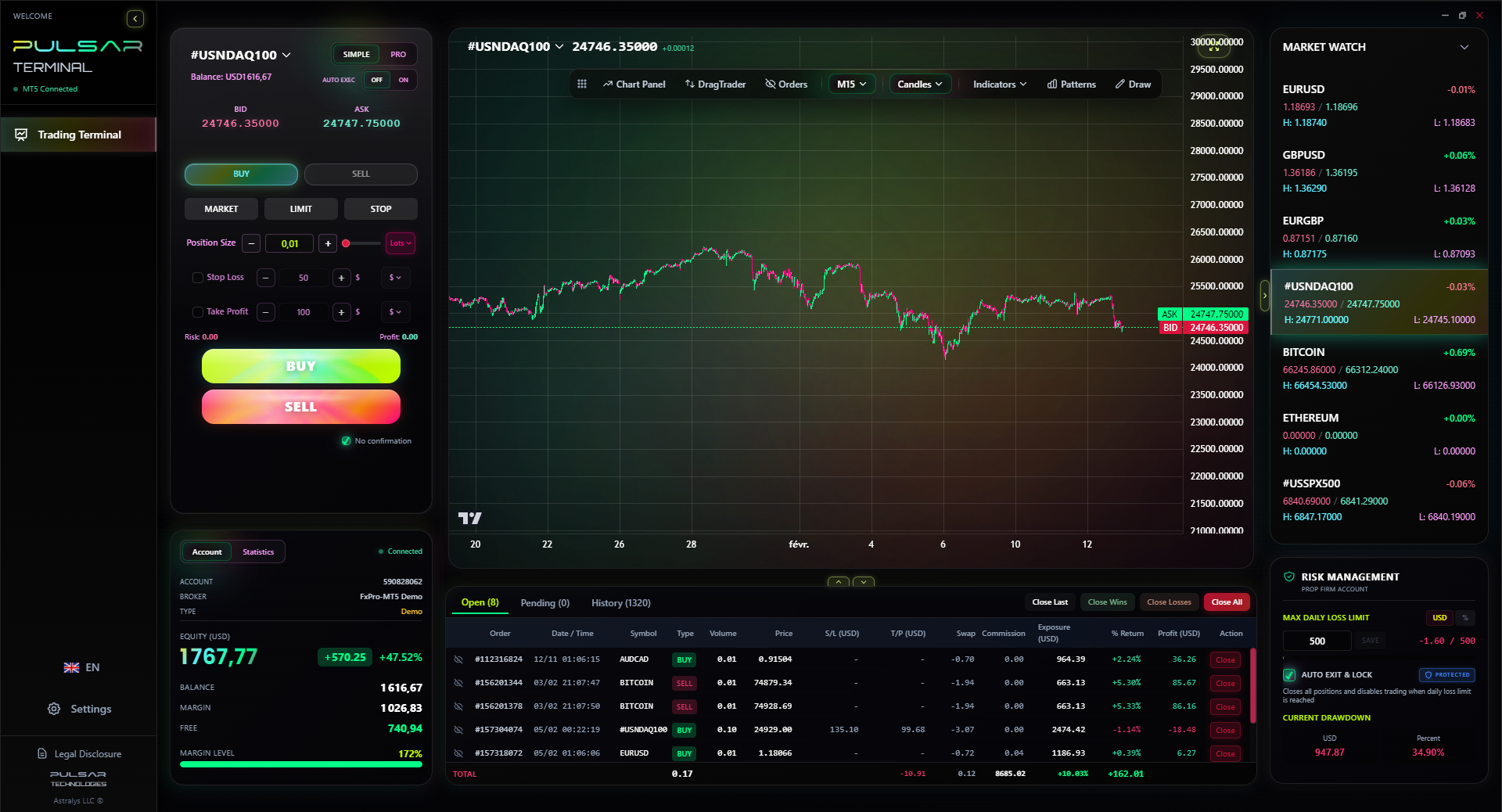
When you're ready to move beyond basic apps and need professional-grade trade management on MT5, tools like Pulsar Terminal allow you to drag-and-drop orders and set advanced stops directly on your chart.
Pulsar Terminal
The all-in-one MT5 companion: drag-and-drop orders, multi-TP/SL, trailing stop, grid trading, Volume Profile, and prop firm protection. Used by 1,000+ traders daily.
“A good loss is better than a bad win.”
The goal is to transform your perspective. The app on your phone isn't a slot machine. It's a powerful financial terminal. Here's how to make that mental shift.
Log Your Trades. Every single one. Entry, exit, reason, emotion. I use a simple spreadsheet. Review it weekly. This turns random 'gameplay' into a reviewable process. You'll quickly see if you're chasing losses or breaking your own rules.
Focus on the Process, Not the P&L. Your daily goal shouldn't be 'make R500.' It should be 'follow my trading plan for all set-ups.' Some days the plan will result in a loss. That's okay. A good loss (one where you followed your rules) is better than a bad win (where you got lucky by breaking them).
Upgrade Your Tools. As you progress, you'll need more than a basic mobile app. This is where professional trading software becomes essential. For managing complex trades on MT5, a tool that lets you drag-and-drop orders, set multiple take-profits, and automate trailing stops can be the difference between a good and a great trader.
Final Thought: The most successful South African traders I know are the least emotional about it. They see their trading app as a tool for executing a business plan, not a source of entertainment. They respect the market's power, they use their FSCA-regulated brokers, and they manage their risk in ZAR with cold, hard calculation. That's the real 'game' – and the only way to play for the long term.
FAQ
Q1Are forex trading apps legal in South Africa?
Yes, but with a critical condition. The app must be provided by a broker that is licensed and regulated by the Financial Sector Conduct Authority (FSCA). Using an unregulated international app for real-money trading is not legal for South African residents and offers you no protection.
Q2What is the best forex trading app for beginners in South Africa?
The best app for a beginner is the demo version of a reputable, FSCA-regulated broker's platform. Start with the mobile apps from brokers like XM or Exness. They are user-friendly and, more importantly, connected to a real regulated entity. Practice extensively on demo before even thinking about live funds.
Q3How much money do I need to start trading forex in South Africa?
Technically, you can start with as little as R500 (some brokers have $0 minimums). However, a more realistic and safer starting point is R2000-R5000. This allows for proper position sizing without being wiped out by a single small loss. Remember, the minimum deposit isn't your risk capital; you should only trade with a fraction of that.
Q4What is the maximum use I can use in South Africa?
For retail traders, the FSCA has capped maximum use at 30:1. This applies to all FSCA-regulated brokers. Some brokers may offer lower default use. Professional clients may qualify for higher use, but the criteria are strict.
Q5Can I trade the South African Rand (ZAR) on these apps?
Absolutely. USD/ZAR is one of the most popular exotic pairs and is available on almost every platform. Be aware that ZAR pairs often have much wider spreads (e.g., 50+ pips) compared to majors like EUR/USD, which significantly increases your transaction costs.
Q6How do I know if my forex broker's app is legit?
- Get the broker's FSP number from their website. 2. Verify it on the official FSCA FSP Register. 3. Ensure the app you download comes directly from the broker's official website or a trusted app store link they provide. Never download a trading app from a random social media ad.
Q7Why did I make money on a demo app but lose immediately with real money?
This is the universal trader's rite of passage. On demo, there's no emotional attachment. With real money, fear and greed distort your judgment. You hesitate, you overtrade, you break your rules. The market and the app are the same; the only variable that changed was your psychology. This is why prolonged demo practice is crucial.
Prof. Winston's Lesson
Key Takeaways:
- ✓Verify FSCA FSP number before depositing any money.
- ✓Practice 3+ months on demo treating it like real capital.
- ✓Never risk more than 1-2% of your account on a single trade.
- ✓Wider spreads on ZAR pairs mean higher immediate costs.
- ✓use is a tool, not a reward. Start below the 30:1 cap.
How useful was this article?
Click a star to rate
Weekly Trading Insights
Free weekly analysis & strategies. No spam.
About the Author
David van der Merwe
Emerging Markets Trader
Johannesburg-based trader with 11 years in emerging market currencies. Specializes in ZAR pairs, FSCA-regulated trading, and South African market analysis.
Comments
Risk Disclaimer
Trading financial instruments carries significant risk and may not be suitable for all investors. Past performance does not guarantee future results. This content is for educational purposes only and should not be considered investment advice. Always conduct your own research before trading.
You Might Also Like

Cara Trading Forex Sukses: 7 Prinsip dari Trader Profesional
Cara trading forex sukses dengan 7 prinsip trader pro: manajemen modal, disiplin, journal trading, backtest. Data nyata, bukan janji profit palsu.
Jam Trading Forex Terbaik untuk Trader Indonesia: Panduan Lengkap dengan Tabel Waktu
Panduan jam trading forex untuk trader Indonesia. Tabel 4 sesi dunia, jam emas 20:00-00:00, sesi mana yang harus dihindari. Data akurat + tips dari trader berpengalaman.
Top 5 Sàn Forex Uy Tín Nhất 2026: Review Jujur dari Trader Indonesia
Top 5 sàn forex uy tín 2026 untuk trader Indonesia. Review jujur: spread, deposit, withdraw, dukungan lokal. Exness, XM, IC Markets & lebih.
Get Pulsar Terminal
All these calculators are built into Pulsar Terminal with real-time data from your MT5 account. One-click position sizing, automatic risk management, and instant calculations.
Get Pulsar Terminal