


So, you want to trade the big leagues? The forex majors are where the action is, but as a South African trader, you've got a few extra things to think about.

David van der Merwe
Emerging Markets Trader ·  South Africa
☕ 11 min read
What you'll learn:
- 1What Are the Forex Majors, Really?
- 2Which Majors Should a South African Actually Trade?
- 3When to Trade: SA Time vs. Market Volatility
- 4How to Analyse and Trade the Majors
- 5Risk Management When Your Account is in ZAR
- 6Choosing a Broker & Understanding the Real Costs
- 7Mistakes I Made (So You Don't Have To)
- 8Your First 90-Day Plan with the Forex Majors

So, you want to trade the big leagues? The forex majors are where the action is, but as a South African trader, you've got a few extra things to think about. It's not just about picking EUR/USD and hoping for the best. You're dealing with ZAR-based accounts, weird trading hours, and spreads that can eat your lunch if you're not careful. I've been trading these pairs for over a decade, and I'll tell you straight: they're predictable in some ways and utterly chaotic in others. Let's break down what you really need to know.
Forget the textbook definition. In the trenches, the forex majors are the seven currency pairs that include the US Dollar and one other major economy's currency. They're the most liquid, which means tight spreads and less chance of getting screwed by a broker's quote. But liquidity has a dark side: it attracts every hedge fund and algo on the planet.
The core list is simple:
- EUR/USD (The Euro and US Dollar)
- USD/JPY (US Dollar and Japanese Yen)
- GBP/USD (British Pound and US Dollar)
- USD/CHF (US Dollar and Swiss Franc)
- AUD/USD (Australian Dollar and US Dollar)
- USD/CAD (US Dollar and Canadian Dollar)
- NZD/USD (New Zealand Dollar and US Dollar)
Notice a pattern? The USD is on one side of every single pair. That's not an accident. It's the world's reserve currency. When the US sneezes, these pairs catch a cold. For us trading from SA, this is crucial. Your profit or loss in ZAR is a double conversion: first from the pair's movement, then from USD to ZAR in your account. A strong ZAR can wipe out gains on a perfectly good USD/JPY trade. I learned that the hard way back in 2015. I was up $400 on a USD/CAD swing trade, but the Rand had strengthened like crazy. When I converted, my profit was barely enough for a decent bottle of wine. You always have to keep one eye on the USD/ZAR rate, even when you're not trading it.

Pro Tip: Don't just watch the pair you're trading. Have a USD/ZAR chart open in a corner. A sudden move there can be the difference between a green and red day in your account balance.
This is where local context matters. Your trading window, your broker's spreads on ZAR accounts, and even your sleep schedule all play a part.
The Time Zone Sweet Spot
Your biggest advantage is the overlap between the London and New York sessions (our 4 PM to 10 PM). This is when EUR/USD, GBP/USD, and USD/JPY see their biggest moves. It's perfect for after-work trading. I've built most of my scalping strategy around this window on EUR/USD.
The Spreads You'll Actually Get
Brokers like Exness or IC Markets offer decent raw spreads on majors for international clients, but always check their specific ZAR account conditions. Sometimes the conversion fee is baked into a slightly wider spread. EUR/USD is almost always the cheapest, often below 0.1 pips on ECN accounts. Pairs like NZD/USD can be wider, especially during our early morning.
My Personal Picks
- EUR/USD: My bread and butter. The most predictable in terms of technical patterns and news flow. The spread is so low you can breathe.
- GBP/USD: More volatile, more fun (and more pain). It reacts strongly to UK politics. Great for momentum plays.
- AUD/USD: Aligns well with Asian market hours if you're an early riser. Heavily influenced by Chinese economic data and commodity prices.
I largely avoid USD/CHF and USD/CAD unless there's a very clear thematic play (like an oil crisis for CAD). The liquidity isn't as good for our purposes, and the setups are less frequent.

Warning: Just because a pair is a 'major' doesn't mean it's safe. GBP/USD can gap hundreds of pips on a Sunday night if there's political news. Always use a stop loss. I don't care how 'sure' you are.
“The golden hours are clear: the London-New York overlap is the main event.”
Trading the London open at 10 AM our time is a classic move, but it's become crowded. The real edge now? Knowing when not to trade.
Here’s a brutal truth: the Asian session (our early morning) is dead for most majors except USD/JPY. You'll sit there watching paint dry, and the low volume makes prices prone to weird, whippy moves that stop you out for no reason. I wasted six months trying to scalp EUR/USD at 6 AM before admitting it was a loser's game.
The golden hours are clear:
- London Open (10:00 - 12:00 SAST): Good initial momentum. Look for breakouts from the Asian range.
- London-NY Overlap (16:00 - 22:00 SAST): This is the main event. Highest volume, strongest trends. This is where you run your swing trading positions or aggressive day trades.
- US Economic Data Releases (Usually 16:30 SAST): Volatility spikes. You can profit, but you must be already in a position or be incredibly fast. Trying to jump in after the number hits is like trying to board a moving train.
A practical table for your schedule:
| SA Time (SAST) | Session | Recommended Action |
|---|---|---|
| 02:00 - 10:00 | Asian / Early EU | Avoid majors (maybe watch USD/JPY) |
| 10:00 - 16:00 | London | Good for establishing new positions |
| 16:00 - 22:00 | London/NY Overlap | Best for active trading |
| 22:00 - 02:00 | Late NY | Manage existing trades, avoid new ones |
Sticking to this schedule alone will improve your results. It forces discipline.

💡 Winston's Tip
The market's job is to take your money. Your job is to not give it to them. On the majors, that means trading only when the market is open for business (London/NY overlap) and ignoring the noise the rest of the time.

You can't just throw darts. The majors demand a method. Here's what's worked for me, and more importantly, what hasn't.
Price Action is King
With all the liquidity, pure price action - support/resistance, swing highs/lows - works beautifully on the 4-hour and daily charts for the forex majors. Forget overloading your chart with indicators. A major trendline on EUR/USD is respected by the entire market.
Keep Indicators Simple
I use two, max.
- A moving average bundle (like 50 and 200 EMA) to define the trend on the H1 chart.
- The RSI indicator or MACD indicator on the daily chart for divergence signals. That's it. When I used more, they just conflicted and caused paralysis.
A Simple Swing Trade Example
In January 2023, GBP/USD was in a clear downtrend on the daily chart. It rallied up to a key previous resistance zone near 1.2450. The daily RSI indicator showed bearish divergence (price made a higher high, RSI made a lower high). I sold at 1.2435.
- Stop Loss: Placed at 1.2520 (above the swing high).
- Take Profit 1: At 1.2250 (previous support).
- Take Profit 2: At 1.2100 (next major level).
I used my position size calculator to risk 1% of my account. The trade hit TP1, I closed half, and trailed the stop on the rest. It eventually hit TP2. That's the blueprint: trend, confluence, clear levels, managed risk.
What Didn't Work
Trying to trade counter-trend during major news events. Fading a strong breakout on USD/JPY because 'it's overbought' has blown up more accounts than I can count. Go with the flow of liquidity.
“Managing risk in a foreign currency account adds a layer of complexity most YouTube gurus never mention.”
This is the most critical section for you. Managing risk in a foreign currency account adds a layer of complexity most YouTube gurus never mention.
The ZAR Volatility Tax
The Rand is one of the most volatile emerging market currencies. Your broker automatically converts your P&L from USD to ZAR. A 50-pip win on EUR/USD could be a loss in Rands if the ZAR spiked that day. You have to factor in this 'background noise'. I now risk less per trade (0.5%-0.75% instead of 1%) to account for this hidden volatility.
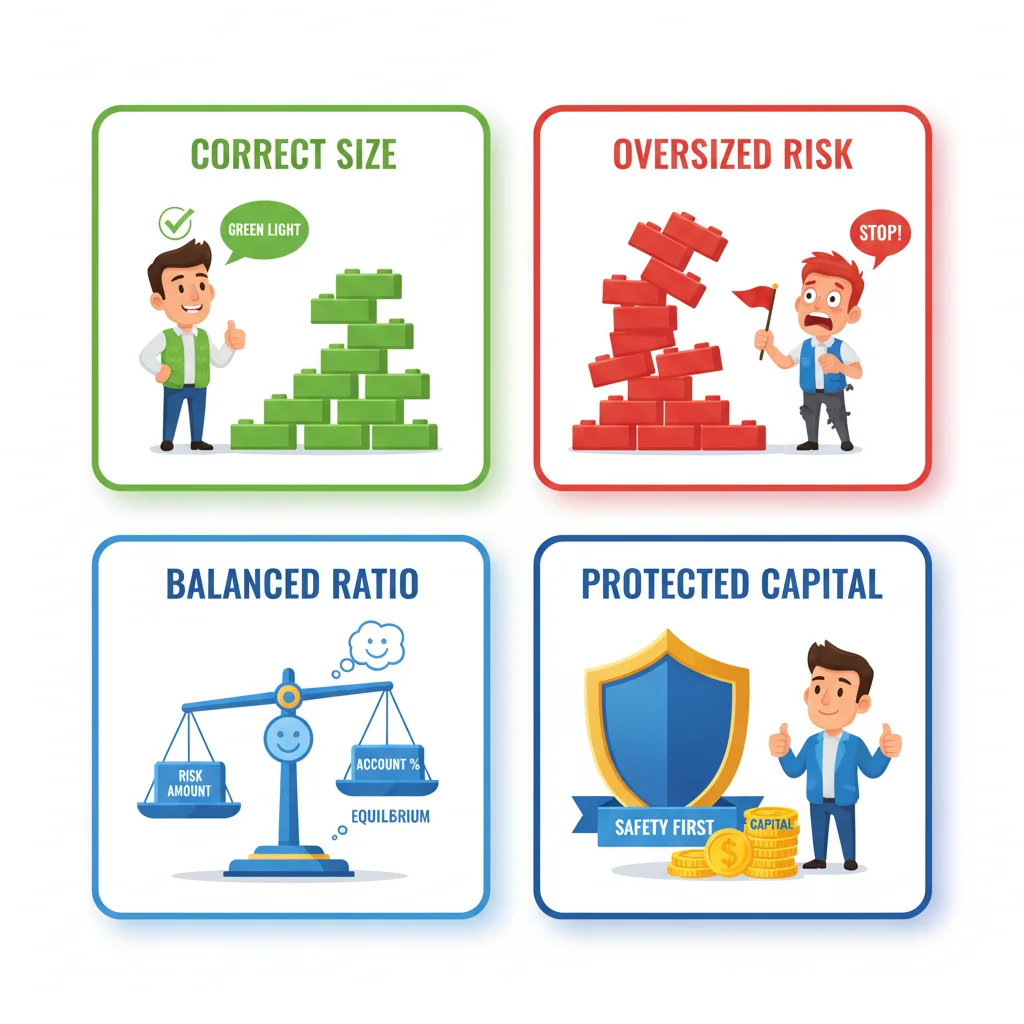
Position Sizing is Non-Negotiable
Never, ever guess. Use a position size calculator religiously. Here’s the kicker: you must calculate your pip value in ZAR, not USD. Most calculators default to USD. If your account is with XM or Pepperstone in ZAR, the platform will do this for you, but you need to understand it.

Example: You have a R100,000 account. You want to risk 1% (R1,000) on a EUR/USD trade. Your stop loss is 20 pips away. Your pip value needs to be R1,000 / 20 pips = R50 per pip. You then set your lot size to achieve that pip value. If you get this wrong, you're either risking your whole account on one trade or making no money at all.
Protecting Against the Worst
A margin call is a real danger if you're over-leveraged and the market gaps against you over a weekend. Always use stops, and never use 100% of your margin. I keep at least 50% of my equity as free margin as a buffer against ZAR conversion swings and gaps.
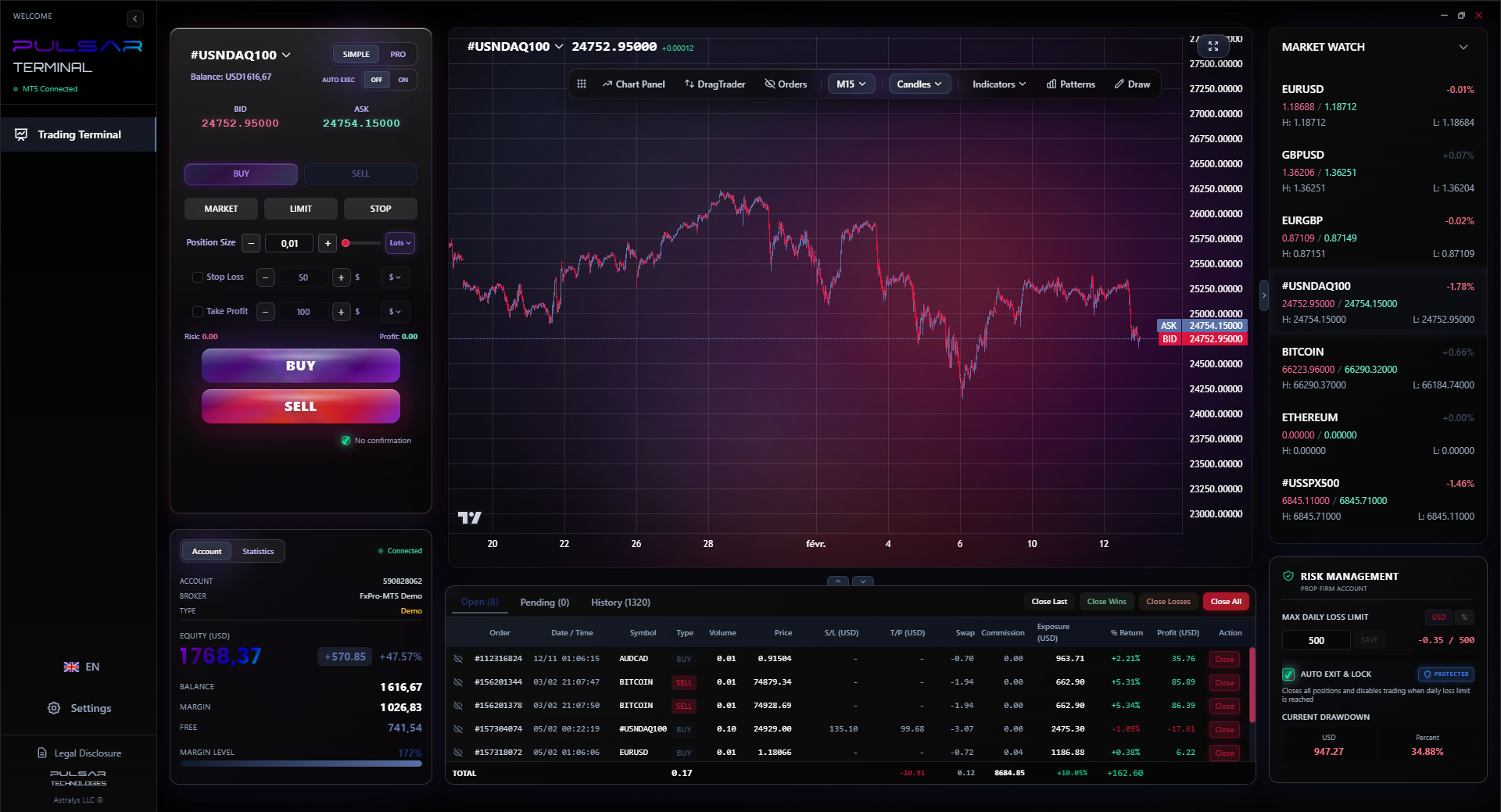
Managing multiple take-profit levels and trailing stops on volatile majors is complex, but tools like Pulsar Terminal automate it directly within your MT5 platform.
Pulsar Terminal
The all-in-one MT5 companion: drag-and-drop orders, multi-TP/SL, trailing stop, grid trading, Volume Profile, and prop firm protection. Used by 1,000+ traders daily.
Not all brokers are created equal for a South African trading majors. You're looking for three things: low spreads on majors, reliable ZAR deposits/withdrawals, and a platform that doesn't freeze during news events.
The Spread is the Fee
The spread is your primary cost. For EUR/USD, anything under 0.5 pips on a standard account is decent. Under 0.2 on an ECN/RAW account is good. But watch for commissions! ECN accounts have low spreads but charge a commission per lot. Do the math. Sometimes the 'zero spread' account is more expensive once you add the commission.
Local vs. International
Local SA brokers are convenient for deposits, but their spreads on majors are often terrible. International brokers like IC Markets or Exness offer far better trading conditions. The hassle of an international wire transfer is worth it for the lower costs, which directly increase your profitability over hundreds of trades.
My Experience
I've used both. I started with a local broker and was paying an effective 1.8 pip spread on GBP/USD. Switching to an international ECN broker cut that to 0.4 pips plus commission. That's 1.4 pips saved on every trade. If you take 100 trades a month, that's 140 pips back in your pocket. That's massive.
💡 Winston's Tip
Your first loss is often your smallest loss. If a trade on a major pair goes against your thesis, get out. The liquidity means you can always get back in. Stubbornness is a luxury you can't afford.
“The goal of the first 90 days is survival and education, not Lamborghinis.”
Let's get vulnerable. Here's where I've lost money so you can skip the tuition fees.
Chasing News: I once tried to trade the US Non-Farm Payrolls report live. The spread on EUR/USD widened to 15 pips, the price shot up 30 pips, reversed, and stopped me out - all in 8 seconds. I lost 2% of my account in less time than it takes to make coffee. Now, I either have a position on before the news with a wide stop, or I wait 15 minutes for the chaos to settle.
Over-trading the Minor Moves: During quiet periods, it's tempting to scalp for 5-pip profits. The spreads and commission will grind you down to zero. Wait for the A+ setups.
Ignoring Correlations: I was once long EUR/USD and, thinking I was 'hedged,' also long GBP/USD. They are highly correlated. When the Dollar rallied, I got double-smacked. Know that EUR/USD and USD/CHF often move inversely. Don't cancel yourself out (or double your risk) by accident.
Not Accounting for Swap Rates: Holding a USD/JPY position overnight? You pay or earn interest (swap). If you're swing trading for weeks, this can add up. Sometimes it's a nice credit. Sometimes it's a constant drain. Check the swap rates on your broker's platform before entering a long-term hold.
Okay, let's put this all together into an action plan.
Weeks 1-4: Observation & Paper Trading
- Pick ONE major pair. I suggest EUR/USD.
- Don't trade it with real money. Just watch it during the London-NY overlap (4-10 PM).
- Mark up support/resistance on the H4 chart. Practice identifying the trend using the 50 EMA.
- Use a demo account to practice entering and exiting with a clear stop and target. Get comfortable with the position size calculator.
Weeks 5-8: Live Trading with Micro Lots
- Fund a live account with an amount you can afford to lose. Start small.
- Trade only with micro lots (0.01). Your goal is not profit, it's execution.
- Aim for just 2-3 trades per week, only during your best hours.
- Journal every trade. Why did you enter? Did you follow your plan? What was the outcome?
Weeks 9-12: Review and Refine
- Analyze your journal. Are you profitable? If not, where are the leaks? Is it timing, risk management, or entry selection?
- Once you have 3 consecutive profitable weeks, you can consider slightly increasing your position size.
- Start incorporating one more analysis tool, like looking for RSI indicator divergence on your entries.
The goal of the first 90 days is survival and education, not Lamborghinis. If you can protect your capital while learning the personality of your chosen major, you're miles ahead of 90% of beginners who blow their first account in a month.
FAQ
Q1Which forex major is the easiest to trade for beginners?
EUR/USD, no contest. It has the lowest spreads, the most predictable movements, and the most available analysis. It's the deep, liquid pool where it's hardest to drown while you're learning to swim.
Q2Do I need to monitor the South African Rand (ZAR) when trading majors?
Absolutely. Your profit/loss is converted to ZAR. A strong rally in the Rand can significantly reduce your USD-denominated gains. Keep a casual eye on USD/ZAR, especially if you're holding trades for more than a day.
Q3What's a good time of day for a South African to trade forex majors?
The London and New York session overlap, from about 4 PM to 10 PM SAST. This is when volume and volatility are highest, providing the best trading opportunities for pairs like EUR/USD and GBP/USD.
Q4How much money do I need to start trading forex majors?
You can start with a few thousand Rand, but it's more about risk. With a R10,000 account, you should be trading micro lots (0.01) to properly manage risk. The amount is less important than your position size discipline. Never risk more than 1% of your account on a single trade.
Q5Are international brokers better than local South African brokers for trading majors?
For trading conditions (spreads, execution speed), yes, international brokers are typically superior. The trade-off is slightly more complex deposits/withdrawals. For active traders of majors, the better pricing of brokers like IC Markets or Pepperstone usually outweighs the convenience factor.
Q6Can I make a living trading forex majors from South Africa?
It's possible, but it's a marathon, not a sprint. You need significant capital (think R500,000+) to generate meaningful income without taking suicidal risks. Most successful full-time traders spent years building their skills and account size. Treat it as a serious business, not a get-rich-quick scheme.
Q7What's the biggest mistake new traders make with majors?
Over-leveraging. They see tight margins and think they can control a huge position with little money. One bad move wipes them out. The second biggest mistake is trading during low-volume periods (like the Asian session) where spreads are wider and price action is unreliable.
Prof. Winston's Lesson
Key Takeaways:
- ✓Trade EUR/USD first; it's the most forgiving major.
- ✓Only trade actively during the 4 PM-10 PM SAST window.
- ✓Risk 0.5%-1% max per trade to account for ZAR volatility.
- ✓Use a position size calculator for every single trade.
- ✓International brokers usually offer better spreads on majors.
How useful was this article?
Click a star to rate
Weekly Trading Insights
Free weekly analysis & strategies. No spam.
About the Author
David van der Merwe
Emerging Markets Trader
Johannesburg-based trader with 11 years in emerging market currencies. Specializes in ZAR pairs, FSCA-regulated trading, and South African market analysis.
Comments
Risk Disclaimer
Trading financial instruments carries significant risk and may not be suitable for all investors. Past performance does not guarantee future results. This content is for educational purposes only and should not be considered investment advice. Always conduct your own research before trading.
You Might Also Like

Cara Trading Forex Sukses: 7 Prinsip dari Trader Profesional
Cara trading forex sukses dengan 7 prinsip trader pro: manajemen modal, disiplin, journal trading, backtest. Data nyata, bukan janji profit palsu.
Jam Trading Forex Terbaik untuk Trader Indonesia: Panduan Lengkap dengan Tabel Waktu
Panduan jam trading forex untuk trader Indonesia. Tabel 4 sesi dunia, jam emas 20:00-00:00, sesi mana yang harus dihindari. Data akurat + tips dari trader berpengalaman.
Top 5 Sàn Forex Uy Tín Nhất 2026: Review Jujur dari Trader Indonesia
Top 5 sàn forex uy tín 2026 untuk trader Indonesia. Review jujur: spread, deposit, withdraw, dukungan lokal. Exness, XM, IC Markets & lebih.
Get Pulsar Terminal
All these calculators are built into Pulsar Terminal with real-time data from your MT5 account. One-click position sizing, automatic risk management, and instant calculations.
Get Pulsar Terminal