


Let's be brutally honest: most people chasing a 'forex market analyst job' in South Africa are chasing a fantasy.

David van der Merwe
Emerging Markets Trader ·  South Africa
☕ 10 min read
What you'll learn:
- 1What a Forex Market Analyst Actually Does (Hint: It's Not Just Trading)
- 2The Skills and Qualifications You Really Need
- 3Salary Expectations: The Real Numbers in South Africa
- 4Navigating FSCA Regulations and Compliance
- 5How to Actually Break Into the Industry
- 6The Dark Side: Burnout, Pressure, and Being Wrong
- 7The Future of the Role in South Africa
Let's be brutally honest: most people chasing a 'forex market analyst job' in South Africa are chasing a fantasy. They picture themselves as the next great predictor of ZAR moves, sipping coffee in Sandton while banks hang on their every word. The reality is messier, tougher, and far more interesting. I've been on both sides of the hiring desk in this industry for over a decade, and I'm here to strip away the glamour and show you what the job actually entails, what it pays, and how you can realistically break in. We'll talk FSCA regulations, the real skills you need, and why your personal trading P&L might be the least important thing on your CV.
If you think this job is about placing your own trades all day, you're already off track. A professional forex market analyst for a bank, brokerage, or asset manager has a very different set of responsibilities. Your primary job is to produce actionable intelligence for clients or internal desks. This means writing daily and weekly reports, building economic models, and presenting your views on currency pairs, especially those involving the ZAR.
You're not a lone wolf trader. You're part of a machine. A big part of your day is consumed by meetings, client calls, and digesting a firehose of data - local CPI prints from Stats SA, SARB interest rate decisions, global risk sentiment, and commodity price moves (remember, gold and platinum moves can shake the rand). I spent my first two years in a junior analyst role feeling like a glorified data clerk, until I realized that synthesizing that data into a clear narrative was the entire skill.
The Daily Grind Isn't Glamorous
Your output is research. A buy-side analyst (working for a fund) might make specific trade recommendations for the portfolio managers. A sell-side analyst (working for a broker or bank) provides broader market commentary to support the sales team. At a retail broker like those regulated by the FSCA, your analysis might feed into client newsletters, webinars, and educational content. The pressure isn't just to be right; it's to be clear, timely, and compliant with a ton of financial regulations.

Warning: Many aspiring analysts confuse a successful YouTube channel with a professional career. Entertaining a crowd and providing regulated, institutional-grade analysis are worlds apart. The latter requires rigorous methodology and accountability.
I learned this the hard way early on. I made a bold public call on USD/ZAR based on a technical pattern, and it went spectacularly wrong. My personal account took a hit, but my professional reputation took a bigger one because I hadn't adequately factored in a pending SARB speech. In a real forex market analyst job, you have to justify your reasoning with more than just a chart.

💡 Winston's Tip
An analyst's value isn't in predicting the future, but in framing the present with such clarity that the probable paths become obvious to everyone else.
“The pressure isn't just to be right; it's to be clear, timely, and compliant with a ton of financial regulations.”
Forget the 'self-taught trading guru' story. To get your CV past HR at a reputable firm, you need a foundation they can recognize.
Formal Education is Your Entry Ticket: A bachelor's degree in Finance, Economics, Financial Mathematics, or even Engineering is almost non-negotiable. For the top roles, a CFA charter or a Master's in Financial Engineering (or similar) is a massive differentiator. These show you understand the theory behind the charts.
The Practical Skill Set:
- Economic Analysis: You must understand how interest rates, inflation, and GDP growth drive currencies. For South Africa, you need a deep dive into local factors like Eskom's stability, political risk, and commodity export cycles.
- Technical Proficiency: Knowing how to use MACD or RSI is basic. You need to be proficient with platforms like Bloomberg or Reuters Eikon, Excel (advanced functions, macros), and statistical software like Python or R for data analysis. Knowing how to properly use a position size calculator is risk management 101, but building your own in Excel shows next-level skill.
- Communication: This is the most important skill. Can you explain why the rand is tanking in a single, clear paragraph for a client email? Can you present a complex carry trade idea in a 10-minute webinar without putting people to sleep?

Pro Tip: Build a 'research portfolio'. Start a blog or a detailed Twitter thread where you analyze ZAR pairs. Don't just say "I think USD/ZAR will go up." Show your work: "Here's the forward rate model I built, here's the correlation with iron ore prices, here's the key technical level. My target is 18.50, my stop is 17.80." This tangible proof of your process is worth more than any generic certificate.
“You're not going to earn a hedge fund manager's salary straight out of university.”
Let's talk money, because the fantasies are wild. You're not going to earn a hedge fund manager's salary straight out of university.
Based on my experience and recent industry surveys, here’s the breakdown for a forex market analyst job in South Africa:
| Experience Level | Typical Employer | Annual Salary Range (ZAR) | Notes |
|---|---|---|---|
| Junior Analyst | Retail Broker, Small Asset Manager | R250,000 - R400,000 | Mostly research support, data crunching. |
| Analyst (3-5 yrs) | Major Bank, Int'l Broker, Larger Fund | R450,000 - R750,000 | Own coverage, client interaction. |
| Senior Analyst/Head of Research | Top-tier Bank, Leading Broker | R800,000 - R1,500,000+ | Sets strategy, high-profile commentary. |
These are base salaries. Bonuses can add 20-50% in a good year, but they are highly variable and tied to firm and personal performance.
I started near the bottom of that junior range back in the day. My first real analysis job paid R280,000. It felt like a fortune until I saw the hours. The key is to view the first few years as a paid education. You're getting access to information and mentors you'd never have on your own. The real financial upside often comes later, either by climbing the corporate ladder or by parlaying that credibility into a successful independent venture, like running a swing trading syndicate or consulting.
“You're not going to earn a hedge fund manager's salary straight out of university.”
This isn't a boring legal section; it's the rulebook that defines your job. The Financial Sector Conduct Authority (FSCA) is the referee, and if you work for a licensed firm, you play by their rules. Ignorance isn't an excuse.
If your forex market analyst job involves giving specific advice or dealing with clients, you or your firm likely needs to be licensed as a Financial Services Provider (FSP). Many analysts are appointed as "Representatives" under their company's FSP license. This means you might need to pass the FSCA's regulatory exams. It's a hassle, but it's what separates professionals from hobbyists.
Your analysis must include clear, mandated risk warnings. You can't just shout "Buy USD/ZAR!" You have to discuss volatility, use risks, and the possibility of losing all your capital. The FSCA requires brokers to segregate client funds, which is why I always recommend traders use FSCA-licensed brokers like Exness or IC Markets for that extra layer of security. Your analysis should guide clients to understand these protections, not just the potential profits.
Compliance also affects your personal trading. Most firms have strict "personal account dealing" policies. You'll likely need pre-clearance for any trades, and you'll be prohibited from trading ahead of your published research. This is a major mindset shift for many who come from retail trading.
💡 Winston's Tip
Your first 100 trade ideas will be mostly wrong. Your job is to ensure the 101st is built on the bones of the previous 100, with the errors carefully dissected and learned from.
“Discipline isn't just for traders; it's for analysts, too.”
Okay, you have the skills and know the rules. How do you get the job? The traditional path is through graduate programmes at the big banks (Standard Bank, Absa, FNB) or international brokers with a local presence. These are competitive, but they're the golden ticket.
The Non-Traditional Path (The One I See Working More Often):
- Start in a Related Role: Get your foot in the door in any finance role - operations, sales support, even IT at a brokerage. I know a brilliant analyst who started in client withdrawals at a broker. He saw all the mistakes traders made and used that insight to build better research.
- Specialise in the ZAR: Become an undeniable expert on the South African Rand. Understand its quirks, its liquidity (that ~$21 billion daily volume), and its drivers better than anyone else. When everyone is analyzing EUR/USD, deep local knowledge can be your niche.
- Network Relentlessly, But Smartly: Attend FSCA conferences, SARB briefings (when possible), and industry meetups in Johannesburg or Cape Town. Don't just ask for a job. Ask smart questions about market structure. Offer a genuine, insightful comment on someone's presentation.
- Get Published: Contribute articles to local financial websites like Moneyweb or BizNews. A well-reasoned piece on the impact of load-shedding on ZAR volatility is a fantastic calling card.

Example: In an interview, I was once asked to walk through my analysis for USD/ZAR, which was at 18.20 at the time. I didn't just show a chart. I said: "My model, based on the interest rate differential and SA credit risk premium, suggests fair value is 17.80. We're at 18.20 because of short-term risk-off flows. I'm watching the 18.50 level, which is the 2024 high. A break there could trigger a run toward 19.00. My core view is a pullback to 17.80, so I'd recommend selling rallies with a stop above 18.55." I got the job. Preparation beats passion every time.
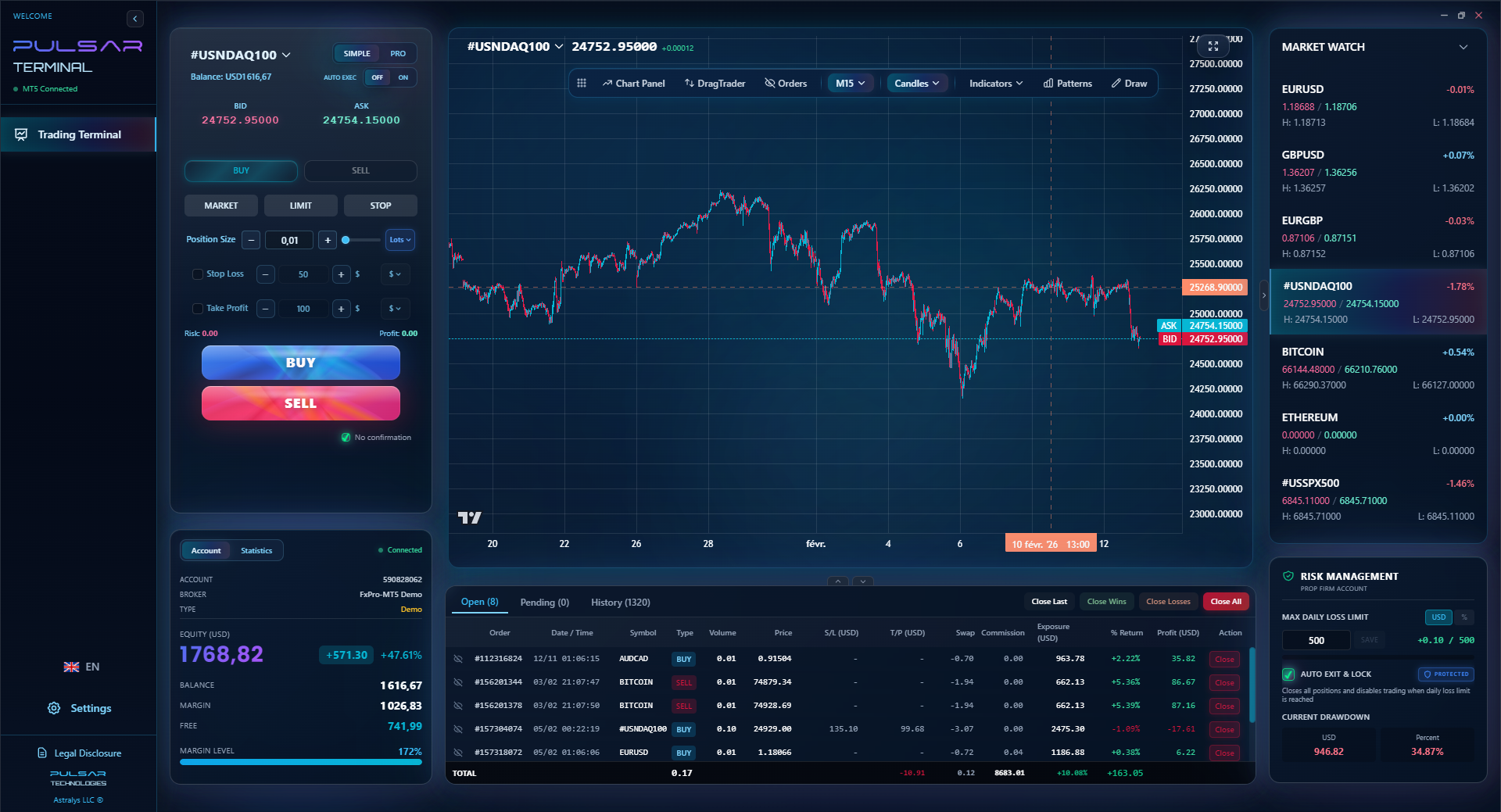
When testing your high-conviction ZAR trade ideas, managing multiple scenarios and protecting your capital with automated tools is essential for maintaining discipline.
Pulsar Terminal
The all-in-one MT5 companion: drag-and-drop orders, multi-TP/SL, trailing stop, grid trading, Volume Profile, and prop firm protection. Used by 1,000+ traders daily.
“Discipline isn't just for traders; it's for analysts, too.”
Nobody talks about this enough. A forex market analyst job can be brutal on your mental health. The market is open 24/5, and with South Africa's time zone, the London and New York sessions happen during your workday and often spill into your evening. You're expected to have an instant, intelligent take on any piece of news that moves the rand.
The pressure to be consistently right is immense, even though it's an impossible standard. I've had weeks where I was hailed as a genius for calling a SARB hike correctly, only to be ghosted by the same clients the next week when a global risk avalanche wiped out my short ZAR trade idea. You have to develop a thick skin and a disciplined process that separates your self-worth from your daily market calls.
The worst mistake I ever made professionally was letting a string of good calls go to my head. I started taking bigger, conviction-based positions in my personal account that mirrored my research. Then, a black swan event hit, and I ignored my own scalping strategy rules for cutting losses quickly. I didn't just get a margin call; I blew up an account it had taken me a year to build. The professional humiliation of having my published view and my personal account both fail spectacularly was a lesson I never forgot. Discipline isn't just for traders; it's for analysts, too.
“The human element of interpretation and communication is becoming more valuable, not less.”
The job is evolving, not disappearing. Yes, AI can crunch data faster, but it can't yet weave a compelling narrative about South African political risk or explain the nuance of a mining strike's impact on the rand. The human element of interpretation and communication is becoming more valuable, not less.
Growth areas include:
- Crypto-Fiat Crosses: With the FSCA now regulating crypto assets, analysis of pairs like BTC/ZAR or ETH/ZAR will become a legitimate specialty.
- Structured Products: As the market matures, demand for analysts who can understand and explain complex currency-linked structured products to high-net-worth individuals will grow.
- Independent Research: The barrier to entry for producing high-quality, subscription-based research is lower than ever. A credible analyst with a strong track record can build their own brand outside of a big bank.
The key is adaptability. The analyst of 2026 needs to be part economist, part data scientist, and part storyteller. The core of the job - making sense of chaos for those who need to make decisions - will always be in demand, especially in a volatile, commodity-driven market like South Africa's.
💡 Winston's Tip
Specialize in the noise. When everyone is looking at the US dollar, become the undisputed expert on the liquidity flows and political whispers that move the rand. Obscurity is opportunity.
FAQ
Q1Do I need to be a profitable trader to get a forex market analyst job?
No, and sometimes it's a red flag. Firms want analytical skill, risk awareness, and communication ability. A profitable trader might take undisciplined risks. They care more about your process for arriving at a conclusion than your personal P&L. Showing a deep understanding of concepts like spread and pip dynamics in your analysis is more valuable.
Q2What's the biggest difference between analyzing forex for a bank vs. a retail broker?
Audience and depth. A bank analyst writes for institutional clients, hedge funds, and corporate treasuries. The analysis is often more quantitative and focuses on high-value, low-frequency trades. A retail broker analyst writes for everyday traders. The analysis needs to be more accessible, often includes more technical analysis, and might support higher-frequency trading styles. Both require FSCA compliance, but the tone and tools differ.
Q3Are there remote forex analyst jobs based in South Africa?
Yes, but they're less common for junior roles. After establishing a reputation and a track record, remote or freelance opportunities open up. Many analysts write for international research houses or provide specialist ZAR commentary to global firms. Initially, being in the office to learn the culture and processes is usually essential.
Q4Is the CFA necessary for a forex analyst career in SA?
It's not strictly necessary, but it's a powerful signal. For roles at major investment banks or asset managers, it's often a de facto requirement for advancement. It demonstrates a commitment to the profession and a mastery of the investment toolkit that goes beyond just forex. For retail broker roles, practical experience and demonstrable skill might weigh more heavily.
Q5How important are coding skills like Python for a forex analyst today?
Increasingly critical. It's the difference between being a consumer of analysis and a creator. With Python, you can build your own models to test correlations (e.g., ZAR vs. platinum prices), automate data collection, and backtest trading ideas. It won't get you the job alone, but lacking it will limit your ceiling and make you dependent on others for quantitative work.
Q6What's a typical career path for a forex analyst in South Africa?
Junior Analyst -> Analyst -> Senior Analyst -> Head of Research/Chief Strategist. From there, you might move into portfolio management, sales/trading (where you execute on the ideas), or into a high-level advisory role. Some of the best end up as independent commentators or start their own research firms.
Prof. Winston's Lesson
Key Takeaways:
- ✓A professional analyst provides research, not personal trades.
- ✓Master both economic theory and practical tools like Python.
- ✓Build a public research portfolio to prove your process.
- ✓FSCA compliance is non-negotiable for credible analysis.
- ✓Starting salaries range from R250k to R400k for juniors.
How useful was this article?
Click a star to rate
Weekly Trading Insights
Free weekly analysis & strategies. No spam.
About the Author
David van der Merwe
Emerging Markets Trader
Johannesburg-based trader with 11 years in emerging market currencies. Specializes in ZAR pairs, FSCA-regulated trading, and South African market analysis.
Comments
Risk Disclaimer
Trading financial instruments carries significant risk and may not be suitable for all investors. Past performance does not guarantee future results. This content is for educational purposes only and should not be considered investment advice. Always conduct your own research before trading.
You Might Also Like

Cara Trading Forex Sukses: 7 Prinsip dari Trader Profesional
Cara trading forex sukses dengan 7 prinsip trader pro: manajemen modal, disiplin, journal trading, backtest. Data nyata, bukan janji profit palsu.
Jam Trading Forex Terbaik untuk Trader Indonesia: Panduan Lengkap dengan Tabel Waktu
Panduan jam trading forex untuk trader Indonesia. Tabel 4 sesi dunia, jam emas 20:00-00:00, sesi mana yang harus dihindari. Data akurat + tips dari trader berpengalaman.
Top 5 Sàn Forex Uy Tín Nhất 2026: Review Jujur dari Trader Indonesia
Top 5 sàn forex uy tín 2026 untuk trader Indonesia. Review jujur: spread, deposit, withdraw, dukungan lokal. Exness, XM, IC Markets & lebih.
Get Pulsar Terminal
All these calculators are built into Pulsar Terminal with real-time data from your MT5 account. One-click position sizing, automatic risk management, and instant calculations.
Get Pulsar Terminal