


I bought a 'Proven Scalping Strategy PDF' for R1,200 back in 2015.

David van der Merwe
Emerging Markets Trader ·  South Africa
☕ 11 min read
What you'll learn:
- 1The PDF Trap: Why Static Plans Fail in Dynamic Markets
- 2What Actually Makes a Strategy (It's Not a Checklist)
- 3Why This Hits South African Traders Harder
- 4How to Build Your Own (PDF-Free) Framework
- 5The Only Time a Forex Strategies PDF is Useful
- 6Invest in Tools, Not Templates
- 7Your Action Plan: Ditch the Download

I bought a 'Proven Scalping Strategy PDF' for R1,200 back in 2015. It had beautiful charts, clear rules, and promised 20-pip daily wins. My first live trade with it, on USD/ZAR, hit my stop-loss for a R800 loss in 12 minutes. The strategy wasn't wrong, the market was just different that Tuesday. That's the core problem with any forex strategies pdf you download: it's a snapshot of a past market, sold as a map for a future one that's already changed. Most traders blow up not from a lack of strategy, but from a fatal misunderstanding of what a strategy actually is and does.
Let's be blunt. The entire business model of selling forex strategies as downloadable PDFs is built on a trader's desperation for a shortcut. You're not buying an edge. You're buying a beautifully formatted story about an edge that used to exist.
The fatal flaw is in the format itself. A PDF is a fixed document. It describes specific indicator settings (like an RSI of 30 for oversold), exact entry points, and rigid stop-loss percentages. The forex market, especially for pairs involving the Rand like USD/ZAR or EUR/ZAR, is a living, breathing entity driven by liquidity, sentiment, and sudden news out of the SARB or National Treasury.
I learned this the hard way. The PDF I bought said to enter a long trade on EUR/USD when the price touched the 50-period moving average and the MACD histogram turned positive. It worked flawlessly on the 6 months of backtested charts included. In reality, when the price touched that MA, it was during a London news spike. The 'signal' was just the market pausing for a millisecond before ripping through my stop. The strategy failed because it couldn't account for context. A PDF can't tell you if institutional volume is drying up or if a key option barrier is defending a price level. It gives you rules, not judgment.

Warning: A strategy that fits neatly into a 20-page PDF is almost always over-optimized. It's been tweaked to death on historical data until the curve looks perfect. This is called curve-fitting, and it guarantees the strategy will fail on new, unseen data. You're buying a report on yesterday's weather.

A real trading strategy isn't a list of instructions. It's an adaptive framework for making decisions under uncertainty. Think of it as the difference between having a recipe for a cake and being a chef who can cook a meal with whatever's in the fridge.
A strong strategy has four non-negotiable components that most PDFs completely ignore or grossly oversimplify.
1. The Market Condition Filter
This is the most critical missing piece. Does your strategy work in a trending USD/ZAR market, or a ranging one? In high volatility after a SARB interest rate announcement, or in the sleepy Asian session? A real strategy starts with identifying the type of market you're currently in. If your PDF doesn't have a clear, objective way to determine this (and most don't), you're using a hammer for every job, including screwing in lightbulbs.
2. The Risk Management Protocol
Here's where I see the most fantasy. PDFs often say "use a 2% stop loss." That's not a plan. A real protocol answers: What is my maximum daily loss limit (e.g., R1,500)? My weekly limit? Where do I place my stop based on market structure, not an arbitrary percentage? How do I adjust my position size calculator if my account is down 5% this month? This is the unsexy engine that keeps you alive. I once ignored my own protocol, doubled my size after two losses to 'make it back quickly,' and turned a R2,000 bad day into a R8,500 margin call disaster.
3. The Entry & Exit Logic
Yes, this is the part the PDF gives you. But it's only valid if components 1 and 2 are satisfied. An entry is the lowest-priority part of the trio. Your exit plan, especially, needs multiple scenarios: Where's your profit target? Will you scale out? What's your plan if the trade goes sideways for days? A simple "take profit at 2:1 risk-reward" isn't enough.
4. The Review & Adaptation Loop
No strategy lasts forever. A real strategy includes a scheduled review process - every month or every 50 trades - to ask: Is this still working? Do the rules need tweaking? Has market behavior changed? A PDF is a dead end. It offers no mechanism for evolution.

Example: My own swing trading framework for commodity pairs. It doesn't give fixed levels. It says: "In a confirmed weekly uptrend (filter), look for a pullback to the 4H demand zone near the 61.8% Fib. Risk no more than 1.5% of capital (protocol). Enter on a 1H close above the zone's high (entry). Scale out 50% at 1.5R, move stop to breakeven, trail remainder on a 4H swing low (exit)." The exact zones and Fib levels change every time. The framework doesn't.

💡 Winston's Tip
A strategy is a hypothesis. The market is the experiment. Your job is to design a good experiment, not to buy someone else's lab report from last year.
“You're not buying an edge. You're buying a beautifully formatted story about an edge that *used* to exist.”
Our trading environment has unique quirks that a generic, often US/UK-centric forex strategies pdf will never address.
First, the spreads. Trading USD/ZAR at 2 a.m. on a local broker? Your spread might be 50 pips or more. That PDF strategy built on a 1-pip EUR/USD spread just died before you placed the trade. You need strategies that account for wider costs, which often means avoiding scalping strategy methods that require ultra-tight spreads.
Second, liquidity events. The Rand is an emerging market currency. It can gap violently on local political news, budget speeches, or sudden shifts in commodity prices (like platinum or gold). A rigid strategy has no 'if President announces X, cancel all orders' rule. You need discretion and awareness.
Third, broker limitations. Not all international strategies work with South African FSCA-regulated brokers. Some ban hedging, others have specific rules on bonuses. Your strategy must be executable within your broker's environment. I've found brokers like IC Markets review and Pepperstone review offer the raw spreads and MT4/5 access needed for more professional approaches, but you still need to adapt.
Finally, capital size. Many PDFs show massive returns starting with $10,000. For a South African trading with R20,000, the position sizing and psychological pressure are completely different. A 2% risk is R400. One bad trade can feel devastating, leading to panic changes. Your strategy must be built for your real account size, not a fantasy one.

Forget downloading. Start building. It's slower, but it's the only way it becomes yours and actually works.
Step 1: Find Your Market Niche. Don't trade everything. Pick one or two pairs. For South Africans, it makes sense to master USD/ZAR and maybe one major like EUR/USD or XAU/USD guide (Gold). Learn their personality, their average daily range, when they're most active.
Step 2: Define ONE Market Condition. Start simple. Don't try to build a strategy for all seasons. Start with: "I will only trade when USD/ZAR is in a strong, clear daily chart trend." Define what 'strong trend' means objectively (e.g., price above 200 EMA, higher highs/lows).
Step 3: Find a Repeatable Setup. Now, within trending markets, where do pullbacks tend to find support or resistance? Is it a moving average? A previous swing high/low? Use the RSI indicator or MACD indicator not for direct signals, but for confluence (e.g., pullback to MA and RSI showing loss of momentum).
Step 4: Engineer Your Risk. This is non-negotiable. Decide your max risk per trade (e.g., 1% of capital). Your stop-loss must be placed at a logical level where your setup is invalidated, NOT at a random 20-pip distance. Use your position size calculator to work backwards: if your logical stop is 75 pips away on USD/ZAR, how many lots can you trade to risk only 1%? That's your position size.
Step 5: Define Exit Rules Before Entry. Will you take profit at a fixed 1:2 ratio? Will you take half off at 1:1 and let the rest run? Write it down. Your worst enemy is your future self, watching profits turn to losses and saying "I'll just hold a bit longer."
Step 6: Test in a Spreadsheet, Not Just a Demo. Demo tests emotion. I track every single test trade in a Google Sheet: entry price, stop, target, reason for entry, market condition, result. After 50 trades, you'll see the truth. Is your win rate 30% but your risk-reward 4:1? That works. Is it a 60% win rate but you keep getting stopped out before hitting your big targets? The exit rule is wrong.

Pro Tip: Your first framework will be terrible. That's the point. My first one had a 22% win rate over 100 trades. But by journaling and adjusting the exit rules, I turned it into a viable system. The learning is in the failure, not in following a pre-packaged 'success.'
💡 Winston's Tip
If you can't explain your strategy's edge in one simple sentence, you don't have one. 'It uses the MACD and RSI' is not an edge. That's just describing the furniture in the room.

“Your first framework will be terrible. That's the point. The learning is in the failure, not in following a pre-packaged 'success.'”
I'm not saying all PDFs are garbage. But their value is not as a plug-and-play solution. Their value is as a library book.
Use them for idea generation. Download ten different PDFs on price action, or breakouts, or Fibonacci strategies. Don't follow any of them. Instead, read them all and look for common themes. You might notice three different authors all talk about 'order blocks' or 'liquidity sweeps.' That's a clue there might be a real market concept there worth studying independently.
Treat the PDF as a case study. Look at their example trades and ask critical questions: Why did they enter there? Where was the stop? Could I have seen that same structure on my charts last week? This turns a passive consumption into active learning.
Finally, some of the best 'PDFs' aren't strategies at all. They are free ebooks from reputable broker education centres or market analysts that explain core concepts: what is a pip definition, how does the spread definition affect your cost, an introduction to central bank policy. This foundational knowledge is priceless and often free. The moment a PDF transitions from explaining concepts to giving you a 'secret set of numbers' for your indicators, your B.S. detector should scream.
If you have R500 to spend on your trading education, don't buy a strategy PDF. Buy a month of a proper charting platform's data feed, or a book on market psychology, or a course on how to backtest properly.
Better yet, invest in tools that give you an information edge. The market isn't fair. The big players have better data and faster execution. While you can't compete with their speed, you can improve your decision-making clarity.
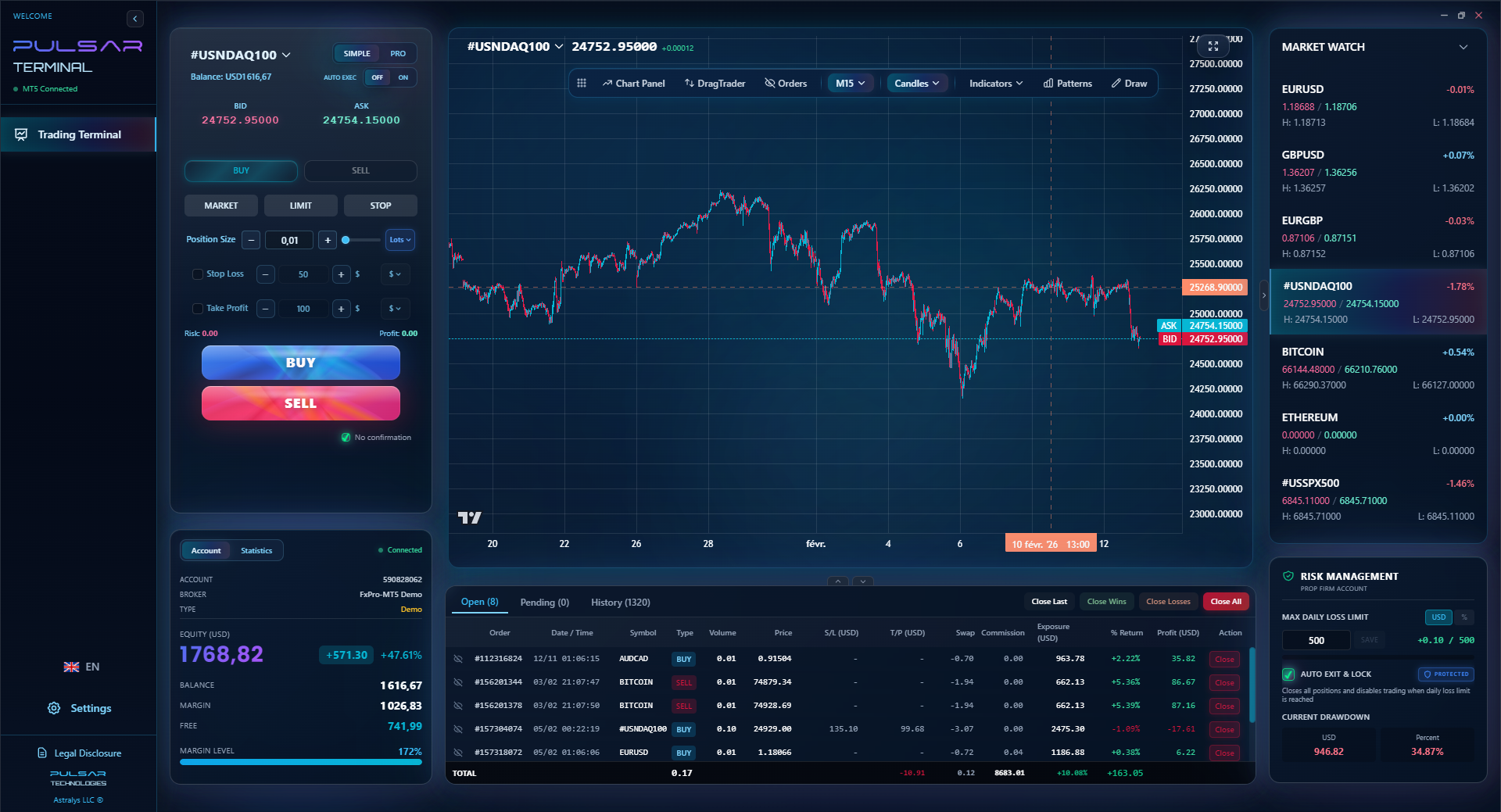
This is where a platform like Pulsar Terminal, which works as a companion to MT5, shows its value. It's not a strategy in a box. It's a toolset that lets you execute your own framework with precision and discipline. For example, if your framework requires a complex entry with multiple take-profit levels and a trailing stop, manually managing that on a fast-moving Rand pair is stressful and error-prone. A tool that automates that trade management based on your rules removes emotion and sloppiness.
The key is that you define the rules. The tool just follows them flawlessly. That's the opposite of a PDF, where the rules are defined for you, and you have to follow them blindly, often without the tools to do so effectively. Look for tools that help you visualize market structure, manage risk automatically, and backtest your ideas - not ones that promise to do the thinking for you.
💡 Winston's Tip
The most profitable adjustment you'll ever make to a strategy is to reduce your position size. Survival is the ultimate edge.

Building a robust framework is one thing; executing it without emotion under pressure is another, which is where precise trade management tools become essential.
Pulsar Terminal
The all-in-one MT5 companion: drag-and-drop orders, multi-TP/SL, trailing stop, grid trading, Volume Profile, and prop firm protection. Used by 1,000+ traders daily.
“The path isn't in a downloaded file. It's in the tedious process of building your own understanding.”
- Stop Searching: Unsubscribe from the YouTube gurus and Instagram ads promising the 'Holy Grail PDF.' The search itself is a distraction from real work.
- Open a Chart: Pick USD/ZAR. Look at the last three months. Can you visually identify clear trends and ranges? Just practice that for a week.
- Start a Journal: Not just of trades, but of observations. "Today, the price rejected the 18.50 level three times with long wicks." This builds pattern recognition.
- Paper Trade ONE Idea: Take the simple framework idea from earlier (trade pullbacks in a trend). Define your trend filter. Define your pullback spot. Paper trade it for 20 trades. Record every outcome in your spreadsheet.
- Analyze the Cold Data: After 20 trades, look at the numbers. Not your feelings. What was the average loss? The average win? The win rate? This data is your first, real, tiny piece of an edge.
The path isn't in a downloaded file. It's in the tedious, frustrating, and rewarding process of building your own understanding. You'll lose money along the way. I did. But the losses will be tuition fees for your own education, not a subscription fee for someone else's fairy tale.

FAQ
Q1Aren't some paid strategy PDFs sold by successful traders?
Maybe. But a truly successful trader makes money from trading, not from selling PDFs at 2 a.m. via Facebook ads. Even if the original strategy was valid, by the time it's packaged and sold to thousands, the edge is often diluted or the market has adapted. The incentive for the seller is to create a compelling product, not a sustainable one for you.
Q2How can I tell if a free forex strategies pdf is legit?
Check the source. Is it from a regulated broker's education section (like those from Exness review or XM review)? These are usually solid primers on basics. Is it from a known analyst with a transparent track record? If it's from 'TraderProSecrets.com' with no real name attached, it's almost certainly junk. Legit education teaches you how to fish; scams just sell you a picture of a fish.
Q3I'm new. Isn't a PDF strategy better than having no strategy at all?
It's more dangerous. It gives you false confidence. You'll follow its rules, lose money, and blame yourself for not executing perfectly - when the fault lies with the strategy itself. Starting with no strategy is better. It forces you to learn, observe, and build cautiously. Start with risk management first: learn to lose small before you ever try to win big.
Q4What should I look for in a trading course instead of a PDF?
Look for courses that focus on process: how to backtest, how to journal, how to manage psychology. Avoid any that focus on a 'secret indicator' or guarantee specific returns. The best courses teach you how to build your own framework, not hand you a finished, fragile one.
Q5Can I modify a strategy from a PDF to make it work?
That's the only way it might have value. But at that point, you're not using the PDF strategy. You're using it as inspiration for your own research. You're backtesting, adjusting parameters, and stress-testing it under different market conditions. You've become the strategy developer. The PDF is just the starting clay, and you're doing all the sculpting.
Q6Is automated trading (Expert Advisors) the same as using a strategy PDF?
It's the same logic trap, just in code form. You're buying a fixed set of rules (an EA) instead of a PDF. Unless you can code and understand the logic inside the 'black box,' you're trusting a static program to navigate a dynamic market. It can work, but when it fails - and it will - you'll have no idea why or how to fix it.
Prof. Winston's Lesson
Key Takeaways:
- ✓A PDF strategy is a snapshot; the market is a live video feed.
- ✓Real strategies require a market filter, a risk protocol, and an exit plan.
- ✓South African traders face wider spreads and liquidity gaps that break generic plans.
- ✓Build, don't buy. Test 50 trades in a spreadsheet before risking real capital.
- ✓Invest in tools for execution, not templates for thought.
How useful was this article?
Click a star to rate
Weekly Trading Insights
Free weekly analysis & strategies. No spam.
About the Author
David van der Merwe
Emerging Markets Trader
Johannesburg-based trader with 11 years in emerging market currencies. Specializes in ZAR pairs, FSCA-regulated trading, and South African market analysis.
Comments
Risk Disclaimer
Trading financial instruments carries significant risk and may not be suitable for all investors. Past performance does not guarantee future results. This content is for educational purposes only and should not be considered investment advice. Always conduct your own research before trading.
You Might Also Like

Cara Trading Forex Sukses: 7 Prinsip dari Trader Profesional
Cara trading forex sukses dengan 7 prinsip trader pro: manajemen modal, disiplin, journal trading, backtest. Data nyata, bukan janji profit palsu.
Jam Trading Forex Terbaik untuk Trader Indonesia: Panduan Lengkap dengan Tabel Waktu
Panduan jam trading forex untuk trader Indonesia. Tabel 4 sesi dunia, jam emas 20:00-00:00, sesi mana yang harus dihindari. Data akurat + tips dari trader berpengalaman.
Top 5 Sàn Forex Uy Tín Nhất 2026: Review Jujur dari Trader Indonesia
Top 5 sàn forex uy tín 2026 untuk trader Indonesia. Review jujur: spread, deposit, withdraw, dukungan lokal. Exness, XM, IC Markets & lebih.
Get Pulsar Terminal
All these calculators are built into Pulsar Terminal with real-time data from your MT5 account. One-click position sizing, automatic risk management, and instant calculations.
Get Pulsar Terminal