


My first 'real' trade was a disaster.

David van der Merwe
Emerging Markets Trader ·  South Africa
☕ 11 min read
What you'll learn:
- 1What is Forex and Why Should a South African Care?
- 2The Rules of the Game: FSCA, use, and SARS
- 3How Much Money Do You Really Need to Start?
- 4Picking Your First Broker and Platform
- 5Your First Trade: A Step-by-Step Walkthrough
- 6Mistakes to Avoid Like the Plague
- 7Building a Simple, South African-Friendly Strategy
- 8From Dummy to Disciplined: What Comes Next?
My first 'real' trade was a disaster. I put R5,000 into a USD/ZAR position because some guy on a forum said the rand was about to collapse. I didn't know what a spread was, didn't set a stop loss, and used maximum use. Two hours later, a bit of positive SA news hit the wires. The pair moved 80 pips against me. My broker's platform flashed a warning I didn't understand, and then my position was gone. Poof. R5,000 became about R800. That's the expensive lesson this forex trading for dummies guide is designed to help you avoid. Let's talk about how this market really works for us in South Africa.
Forex is just short for foreign exchange. You're buying one currency and selling another, betting on which one will get stronger or weaker. It's the biggest financial market in the world, open 24 hours a day during the week. For us, it's not just about trading Euros or Yen. It's about the Rand.
Every time your parents complain about the petrol price or the cost of an overseas holiday, they're talking about forex. The USD/ZAR pair is our home game. It's volatile, it's emotional, and it's directly tied to our economy - commodity prices, load-shedding news, political drama. Trading it feels personal, which is both an advantage and a massive risk. You think you understand the story, but the market often has a different ending in mind.

Warning: Trading USD/ZAR as a South African is tempting, but it's classified as an exotic pair. Spreads are wider (sometimes 50-100 pips vs. 0.5 on EUR/USD), and moves can be vicious. It's not the gentle introduction to forex trading for dummies that you might want.
You can't play if you don't know the rules. In South Africa, the referee is the Financial Sector Conduct Authority (FSCA).
The FSCA License is Non-Negotiable If a broker isn't on the FSCA's Financial Service Provider Register, walk away. I don't care about their "international licenses" from obscure islands. An FSCA license means they have to follow local law, keep your money in a separate account (segregated client funds), and gives you a local avenue for complaint. This is your first and most important check.
The 30:1 use Cap Since 2021, the FSCA capped use for retail traders at 30:1. This is a good thing, trust me. My R5,000 blow-up? That was at 100:1 use through an offshore broker. At 30:1, my loss would have been painful, but not catastrophic. It forces a bit of discipline. Some brokers' international entities offer higher use (like 500:1), but you'd be trading under a different regulator, losing that local FSCA protection.
SARS Wants Its Share Here's the kicker many new traders miss: your forex profits are taxable income. Full stop. It doesn't matter if your broker is in Cyprus or the Bahamas. If you're a South African tax resident, you declare that profit to SARS. Keep a detailed trade journal. Losses can be offset against other income, but the admin is on you. Get this wrong, and the penalty hurts more than a bad trade.

💡 Winston's Tip
Your first R10,000 in profits isn't money. It's tuition fees the market paid you for learning to not lose. Don't spend it. Reinvest it in your trading capital.
“Your first 100 trades are not about making money. They're about not losing your entire account.”
You'll see ads screaming "Trade with $5!" Technically true. Practically useless. With $5 (about R90) and 30:1 use, you have $150 in buying power. A 10-pip move on a micro lot might make or lose you $0.10. You'll die of boredom or overtrade into oblivion just to feel something.
Let's talk real numbers for a forex trading for dummies plan in Rands.
The Realistic Starter Figure A R2,000 to R5,000 deposit (roughly $100-$275) is a common starting point. This isn't to get rich. It's to learn without the panic sweats. Your goal with this capital is survival and education, not a Lamborghini.
Why This Amount Matters With R5,000, you can practice proper position sizing. A good rule is to risk no more than 1-2% of your capital on a single trade. That's R50-R100. Using a position size calculator, you can work backwards: if your stop loss is 20 pips away, you can figure out exactly how many lots (or microlots) to trade so that a 20-pip loss only costs you R100. This is the single most important skill you'll learn.
The Cost of Trading You pay to play. The main cost is the spread - the difference between the buy and sell price. On EUR/USD, a good tight spread is under 0.5 pips. On USD/ZAR, expect 50 pips or more. If the spread is 50 pips, the pair needs to move 50 pips in your favor just for you to break even. That's a huge hurdle. Some brokers charge a commission instead of, or on top of, a spread. Know your costs before you click buy.

Example: You buy EUR/USD at 1.0850. The sell price (bid) is 1.0849. The spread is 1 pip. If you sold immediately, you'd lose that 1 pip. That's the broker's fee. On a standard lot (100,000 units), 1 pip = $10. You're down $10 before the market even moves.
This choice matters. A bad broker with requotes, slippage, and dodgy withdrawals will kill your career before it starts.
The FSCA-Regulated Shortlist
Based on years of watching this market, brokers like IC Markets, Pepperstone, and XM have maintained decent reputations among experienced South African traders. They're FSCA-licensed, offer ZAR accounts, and accept local EFTs. Exness is also popular for its variety of account types. Don't just take my word for it. Go to the FSCA register and verify the FSP number they give you.
The Platform: MT4/MT5 is King
In South Africa, MetaTrader 4 and 5 are the standard. Every broker supports it. Every tutorial uses it. Start with MT5 (it's the newer version). Learn one platform deeply before you get distracted by shiny alternatives. All your charts, indicators like the RSI or MACD, and orders will be placed here.
ZAR Accounts Are a Lifesaver
This is a local pro-tip. Fund your account in Rands. Trade instruments denominated in USD or Euros, but let the broker handle the conversion. If you deposit USD from your SA bank account, they'll nail you with a 7-10% conversion fee. A ZAR account avoids that hidden cost on every deposit and withdrawal.
“The secret is a simple strategy combined with iron-clad risk management and psychology.”
Let's simulate a real trade. This is the core of any forex trading for dummies guide.
Step 1: The Analysis (Not Guessing) Don't just look at a chart and guess. Have a reason. Maybe EUR/USD has bounced twice off a support level at 1.0800. The RSI is showing oversold conditions below 30. You decide: If price approaches 1.0800 again and shows signs of bouncing (a bullish candlestick pattern), you'll buy.
Step 2: The Plan
- Entry: Buy at 1.0805 (a bit above the support to confirm the bounce).
- Stop Loss: Place at 1.0785, 20 pips below your entry. This is your "I was wrong" exit.
- Take Profit: Aim for a previous resistance level at 1.0865. That's a 60-pip target.
- Risk/Reward: You're risking 20 pips to make 60. That's a 1:3 ratio. Good.
Step 3: The Position Size You have a R10,000 account. You decide to risk 1% (R100). Your stop loss is 20 pips. On EUR/USD, 1 pip on a standard lot = $10. But we need the value in Rands. Let's say USD/ZAR is at R18.50.
- Your risk in USD: R100 / 18.50 = ~$5.40.
- If 20 pips of risk = $5.40, then 1 pip of risk = $0.27.
- Therefore, you need a position size where 1 pip = $0.27. That's a 0.027 lot size (a micro lot is 0.01, so this is 2.7 micro lots).
Most platforms let you enter 0.03 lots. That's close enough. This is why using a position size calculator is essential.
Step 4: Placing the Order On MT5, right-click the chart, select "Trading," then "New Order." Set your volume to 0.03. Set your Stop Loss and Take Profit prices. Click "Buy." Now, walk away. The hard part is over.
Step 5: The Psychology (The Real Battle) The price drops to 1.0810. Your brain screams "Cancel the stop loss! It's just 5 pips away!" Do not listen. This is where 80% of traders fail. If you get stopped out for a R100 loss, that's a successful trade. You followed your plan. Most trades will lose. You need those losses to be small.
💡 Winston's Tip
The most important line on your chart isn't a moving average. It's the horizontal line where your stop loss goes. Draw it first, before you even think about your entry price.
I've made most of these. Learn from my Rands.
1. Chasing the 'Holy Grail' Strategy: There isn't one. I spent two years and thousands on systems, indicators, and signal services. The secret is a simple strategy combined with iron-clad risk management and psychology. A basic support/resistance swing trading plan is enough.
2. Overleveraging: Even at 30:1, you can blow up. Trading 0.1 lots with a R5,000 account is overleveraged. Your position size is your control knob. Turn it down.
3. Revenge Trading: You lose R200. You're angry. You jump right back in with a double-sized trade to "make it back fast." This is how R200 losses become R2,000 losses. After a loss, shut the platform down for the day.
4. Ignoring the News: As a South African, you MUST know when SARB interest rate decisions, local CPI data, or budget speeches are happening. These events cause massive volatility and can blow through your stop loss in seconds (slippage). The economic calendar is your friend.
5. Confusing a Demo Account with Reality: Demo trading with R1,000,000 feels easy. There's no emotion. The moment you switch to real money, even R5,000, everything changes. Use demo to learn the platform buttons, then switch to a small real account to learn your own psychology.

Pro Tip: Your first 100 trades are not about making money. They're about not losing your entire account. If you can survive 6 months, you're ahead of 90% of starters.
“Your position size is your control knob. Turn it down.”
You need a repeatable process. Here's a basic framework you can start with tonight.
The Instrument: Start with EUR/USD. It's liquid, tight spreads, and moves predictably. Leave USD/ZAR until you're consistently profitable.
The Timeframe: Use the 4-hour chart (H4) for direction and the 1-hour chart (H1) for precise entries. This avoids the noise of scalping but is faster than weekly charts.
The Tools:
- Support & Resistance: Draw horizontal lines where the price has reversed before. These are your trade zones.
- A Trend Filter: A simple 50-period Exponential Moving Average (EMA) on the H4 chart. If price is above it, look for buys only. Below it, look for sells only.
- An Entry Signal: Use a basic pin bar or engulfing candlestick pattern at your support/resistance level.
The Trade Example: On the H4 chart, EUR/USD is above the 50 EMA (uptrend). It pulls back to a previous support level at 1.0950. On the H1 chart, you wait. A bullish engulfing candle forms. You enter a buy at the close of that candle. Stop loss: 20 pips below the support low. Take profit: 60 pips up, near the next resistance.
Manage 10 trades like this with perfect risk management. Record every outcome in a journal. That's your foundation.
💡 Winston's Tip
If you feel a strong urge to override your trading plan - to move a stop loss, take early profit, or double down - that's your signal to do the exact opposite. Your emotions are your worst indicator.
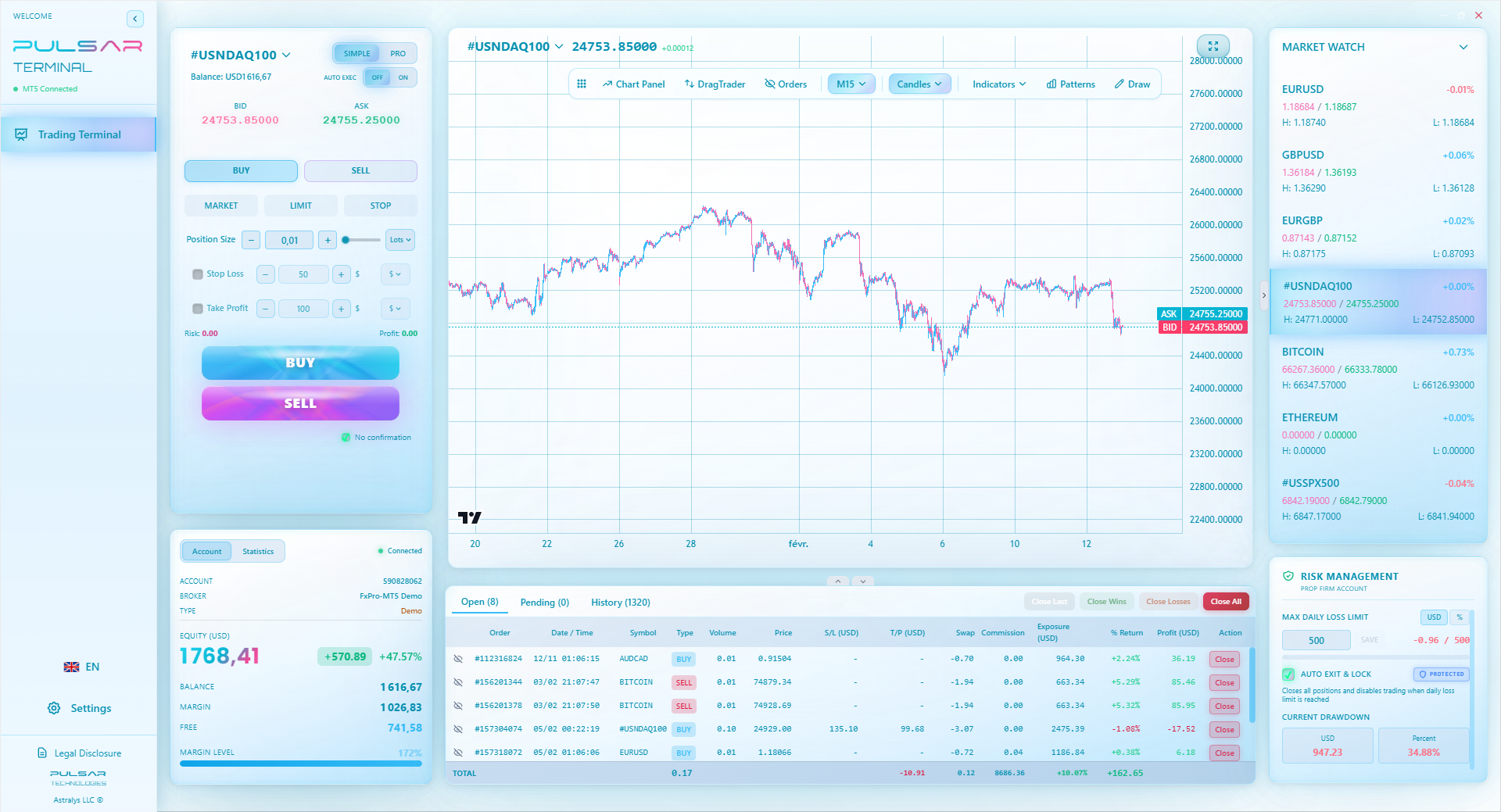
Once you have a strategy, the hard part is executing it without emotion—tools like Pulsar Terminal automate stop-loss adjustments and enforce daily loss limits directly on your MT5, turning your plan into automatic action.
Pulsar Terminal
The all-in-one MT5 companion: drag-and-drop orders, multi-TP/SL, trailing stop, grid trading, Volume Profile, and prop firm protection. Used by 1,000+ traders daily.
You've got the basics of forex trading for dummies. Now what?
The Grind: The next year is about consistency. Can you take every signal your strategy gives, even after 3 losses in a row? Can you move your stop loss to breakeven when a trade is in profit? This is where tools that automate these tasks become valuable, letting you focus on analysis instead of order management.
Scaling Up: Once you have 6 months of profitable statements (even if just R500 a month), you can think about scaling. Add R5,000 more to your account. Your risk per trade stays at 1%, so now you're risking R150 per trade instead of R100. You grow slowly, with the market's money, not your life savings.
The Prop Firm Path: Many South Africans look at prop firms. They give you a funded account to trade (e.g., $100,000) in exchange for a profit split. The catch? The challenges have strict drawdown rules. A tool that automatically enforces your daily loss limit can be the difference between passing and blowing the account on one bad day.
Continuous Learning: Learn about Volume Profile to see where big money is trading. Study market structure. The learning never stops, but the core - risk management - never changes. Protect your capital first. The profits will follow, in time.
FAQ
Q1Is forex trading legal in South Africa?
Yes, absolutely. It's legal and regulated by the Financial Sector Conduct Authority (FSCA). The key is to only use a broker that holds a valid FSCA FSP license. You can verify any broker's license number on the FSCA's public register.
Q2What is the minimum amount I need to start forex trading in South Africa?
While some brokers let you start with $5 (about R90), that's not practical for learning. A realistic starting amount that allows for proper risk management is between R2,000 and R5,000. This lets you trade small positions (microlots) and survive the inevitable losing streaks without blowing your account.
Q3How much tax do I pay on forex profits in South Africa?
Forex trading profits are considered taxable income by SARS. You must declare your net profit (profits minus losses and trading expenses) on your annual tax return. The tax rate will depend on your total income tax bracket. Keep a detailed trade journal from day one for your accountant.
Q4What is use and what are the limits in SA?
use is borrowed capital from your broker that amplifies your trading size. The FSCA limits use for retail traders to a maximum of 30:1. This means with R1,000, you can control a position worth R30,000. It magnifies both profits and losses, so use it cautiously.
Q5Which currency pairs should a beginner from South Africa trade?
Start with major pairs like EUR/USD or GBP/USD. They have the tightest spreads (often under 1 pip) and are highly liquid, meaning they move more predictably. Avoid USD/ZAR as a beginner - its wide spreads (50+ pips) and high volatility make it much harder to trade profitably.
Q6What is a pip and how much is it worth?
A pip is the smallest price move a currency pair can make. For most pairs, it's 0.0001. Its value in Rands depends on your trade size and the pair. On a standard lot (100,000 units) of EUR/USD, 1 pip is worth about $10. With USD/ZAR at R18.50, that's roughly R185. You can use a pip calculator to figure it out for any trade.
Q7What happens if I lose all my money in a trade?
If a trade moves against you and hits your stop loss, you lose the amount you risked on that trade. If you didn't set a stop loss and the market moves catastrophically against you, you can lose more than your deposit - this is a margin call. Always, always use a stop loss.
Prof. Winston's Lesson
Key Takeaways:
- ✓Verify your broker's FSCA license. Always.
- ✓Start with at least R2,000 for realistic practice.
- ✓Risk a maximum of 1% of your capital per trade.
- ✓Use a stop loss on every single trade, no exceptions.
- ✓Trade EUR/USD first, not USD/ZAR.
How useful was this article?
Click a star to rate
Weekly Trading Insights
Free weekly analysis & strategies. No spam.
About the Author
David van der Merwe
Emerging Markets Trader
Johannesburg-based trader with 11 years in emerging market currencies. Specializes in ZAR pairs, FSCA-regulated trading, and South African market analysis.
Comments
Risk Disclaimer
Trading financial instruments carries significant risk and may not be suitable for all investors. Past performance does not guarantee future results. This content is for educational purposes only and should not be considered investment advice. Always conduct your own research before trading.
You Might Also Like

Cara Trading Forex Sukses: 7 Prinsip dari Trader Profesional
Cara trading forex sukses dengan 7 prinsip trader pro: manajemen modal, disiplin, journal trading, backtest. Data nyata, bukan janji profit palsu.
Jam Trading Forex Terbaik untuk Trader Indonesia: Panduan Lengkap dengan Tabel Waktu
Panduan jam trading forex untuk trader Indonesia. Tabel 4 sesi dunia, jam emas 20:00-00:00, sesi mana yang harus dihindari. Data akurat + tips dari trader berpengalaman.
Top 5 Sàn Forex Uy Tín Nhất 2026: Review Jujur dari Trader Indonesia
Top 5 sàn forex uy tín 2026 untuk trader Indonesia. Review jujur: spread, deposit, withdraw, dukungan lokal. Exness, XM, IC Markets & lebih.
Get Pulsar Terminal
All these calculators are built into Pulsar Terminal with real-time data from your MT5 account. One-click position sizing, automatic risk management, and instant calculations.
Get Pulsar Terminal