


Let's cut through the noise.

Olumide Adeyemi
West African Trading Pioneer ·  Nigeria
☕ 10 min read
What you'll learn:
Let's cut through the noise. Most guides on forex trading sign up in Nigeria make it sound like filling a form and clicking 'deposit' is the hard part. They're wrong. The real work starts before you ever enter your email address. I've seen too many traders - smart people - blow accounts because they signed up with the wrong broker, misunderstood Nigerian rules, or didn't calculate what 10% of their profits really means. This isn't about getting an account; it's about building a foundation that won't collapse when you place your first real trade. I'll walk you through exactly what matters, from SEC warnings to which payment method won't get your card blocked.
Before you even think about a forex trading sign up, you need to understand the ground you're standing on. Nigeria's market is booming - turnover hit $8.6 billion in 2025 - but it's what we call a 'wild west' regulatory environment. The Securities and Exchange Commission (SEC) is mainly focused on shutting down Ponzi schemes masquerading as forex funds. The Central Bank of Nigeria (CBN) cares about monetary stability and how you move money internationally. They don't stop you from trading, but they can make funding a pain.
This creates a gap. You're largely responsible for your own safety. Signing up with an unregulated offshore bucket shop is a surefire way to lose your deposit before the market takes it. I learned this the hard way early on. I deposited $500 with a flashy broker promising 1:2000 use. Won $1,200 on a GBP/USD swing trade, and suddenly my withdrawal was 'under review' for weeks. The support tickets went unanswered. That money is still gone.

Warning: High use (like 1:1000) is a marketing trap, not a feature. It amplifies losses faster than gains. A 10-pip move against you on a maxed-out account can trigger a margin call instantly. Nigerian brokers offer it because it sells, not because it's good for you.
The youth drive this market - over 93% of traders are under 35. The energy is incredible, but it often lacks the discipline that comes from understanding the rules of the game. Your first step isn't picking a broker; it's accepting that you need one with real oversight, even if it's not based in Lagos.

💡 Winston's Tip
Your first deposit is a test payment. If a broker makes withdrawing $25 difficult, imagine the fight for $2,500.
Regulation is Your First Filter
Forget the $30 no-deposit bonus. Look at who's watching the broker. You want Tier-1 regulation (UK's FCA, Australia's ASIC) or solid Tier-2 (CySEC, FSCA). These bodies enforce client fund segregation. If the broker goes under, your money isn't part of their assets. Many top international brokers accept Nigerians. I personally use and have accounts with IC Markets (ASIC-regulated) and Pepperstone (FCA-regulated). Their spreads are tight, and withdrawals hit my account in 24 hours.
The Numbers That Actually Matter
- Minimum Deposit: Starting with $100 is possible, but it's a handicap. With a $100 account and a sensible 1% risk per trade ($1), a 50-pip stop loss on EUR/USD means you're trading a micro lot. The spread eats a larger percentage of your potential profit. I recommend a starting capital of at least $500. It gives you breathing room.
- Spreads & Commissions: This is your cost of doing business. For major pairs like EUR/USD, look for average spreads under 1.0 pip on a standard account, or raw spreads + commission on an ECN account. Exness offers razor-thin spreads, but check their model suits your style.
- Platform: MT4/MT5 is non-negotiable. It's the standard. Some brokers like XTB have great proprietary platforms (xStation 5), but ensure MT4/5 is available.
Nigerian-Specific Needs
Does the broker offer local payment methods? Bank transfer, Paystack, Flutterwave? Do they have a Naira-denominated account option to avoid conversion fees on every deposit? XM and HFM are popular here for these reasons. Check their withdrawal policy in writing. 'Instant' should mean instant.

Example: Let's compare costs on a 1.0 standard lot ($100,000) EUR/USD trade.
| Broker Type | Spread | Commission | Total Cost |
|---|---|---|---|
| Standard Account | 1.2 pips | $0 | $12 |
| ECN/Raw Account | 0.1 pips | $7 round turn | $8 |
| The ECN account is cheaper for larger volumes. For a scalping strategy, those savings add up fast. |
“The real work of signing up starts before you ever enter your email address.”
This is the mechanical part, but do it carefully. A mistake here can freeze your account later.
- Go to the Official Site: Not a link from a WhatsApp group. Type the broker's URL directly. I've seen phishing sites that are perfect copies.
- Click 'Open Account': You'll choose between an Individual or Corporate account. Start with Individual.
- The Application Form: They'll ask for:
- Full name (exactly as on your ID).
- Date of birth.
- Country of residence (Nigeria).
- Email and phone number (use active ones).
- Employment status and estimated annual income. Be honest. This is for regulatory compliance (Know Your Customer - KYC). Lying can be grounds for account closure.
- Financial Knowledge & Experience: They'll ask about your trading experience, knowledge, and risk tolerance. Don't inflate your answers to get higher use. If you're a beginner, say so.
- Account Verification (KYC): This is crucial. You'll need to upload:
- A clear photo of your International Passport, Driver's License, or National ID card.
- A proof of address. This must be recent (within 3 months) and show your name and address. A utility bill (PHCN, water), bank statement, or tenancy agreement works. Your ID card address might not suffice.
Verification can take from a few hours to 2 business days. Don't deposit until your account is verified. I once deposited $200 before verification was complete, and it created a whole customer service headache to get the funds allocated correctly after.
This is where many Nigerians get stuck. The CBN restricts international transactions on Naira debit cards. Trying to deposit $1,000 might get declined.
Your best options:
- Cryptocurrency (USDT): Increasingly the fastest and most reliable method. Deposit USDT to the broker's wallet address. No bank intermediaries. Brokers like IC Markets and Pepperstone support this.
- Bank Transfer to a Local Representative: Some brokers have local entities or payment partners. You transfer Naira to a Nigerian bank account, and they credit your trading account in USD. Ask support for details.
- E-wallets: Skrill, Neteller, or Perfect Money. Fund the e-wallet first (which can be tricky), then transfer to the broker.
- Domiciliary Account: If you have one, you can wire USD directly.

Pro Tip: Start small with your first deposit. Use the minimum or just above it to test the entire cycle - deposit, place a trade, withdraw. If you can't get $50 back out smoothly, you don't want to put $5,000 in.
Remember the 10% Capital Gains Tax. The FIRS expects you to declare and pay this on your gross profits annually. Keep a detailed trade journal. Your broker's statement is your starting point, but the tax man will want to see it.
💡 Winston's Tip
Write your trading plan on paper and stick it to your monitor. When you're emotional, you'll ignore the file on your desktop.
“High use is a marketing trap, not a feature. It amplifies losses faster than gains.”
Your account is funded. Now, the real work begins on the platform.
Download MT4/MT5 from your broker's website (not a random site). Log in with the server, login number, and password provided in your client area.
Before you click 'Buy' or 'Sell':
- Check the Spread: Is it what was advertised? For EUR/USD, it should be around 0.8-1.2 pips on a standard account during London/NY overlap.
- Set Up Your Risk Management: This is non-negotiable. Decide your risk per trade (I recommend 1% of your account balance). Use a position size calculator. If you have a $500 account, you risk $5 per trade. If your stop loss is 25 pips on GBP/USD, your position size should be 0.02 lots. Do the math every time.
- Place a Practice Trade: Use the platform's demo feature or place a tiny live trade (0.01 lot) just to understand the order window, setting stop-loss and take-profit levels, and how to close a trade.
I'll be blunt: Your first ten trades should be more about testing your discipline in using stops than about making money. In 2019, I got excited about a USD/JPY setup, ignored my own 20-pip stop, and watched it run 120 pips against me. That was a $120 lesson on a $1,000 account. A 12% loss from one stupid trade. Don't be me.
Familiarize yourself with basic tools. Learn how to draw support/resistance lines and add an RSI indicator or MACD indicator. But keep it simple at first.
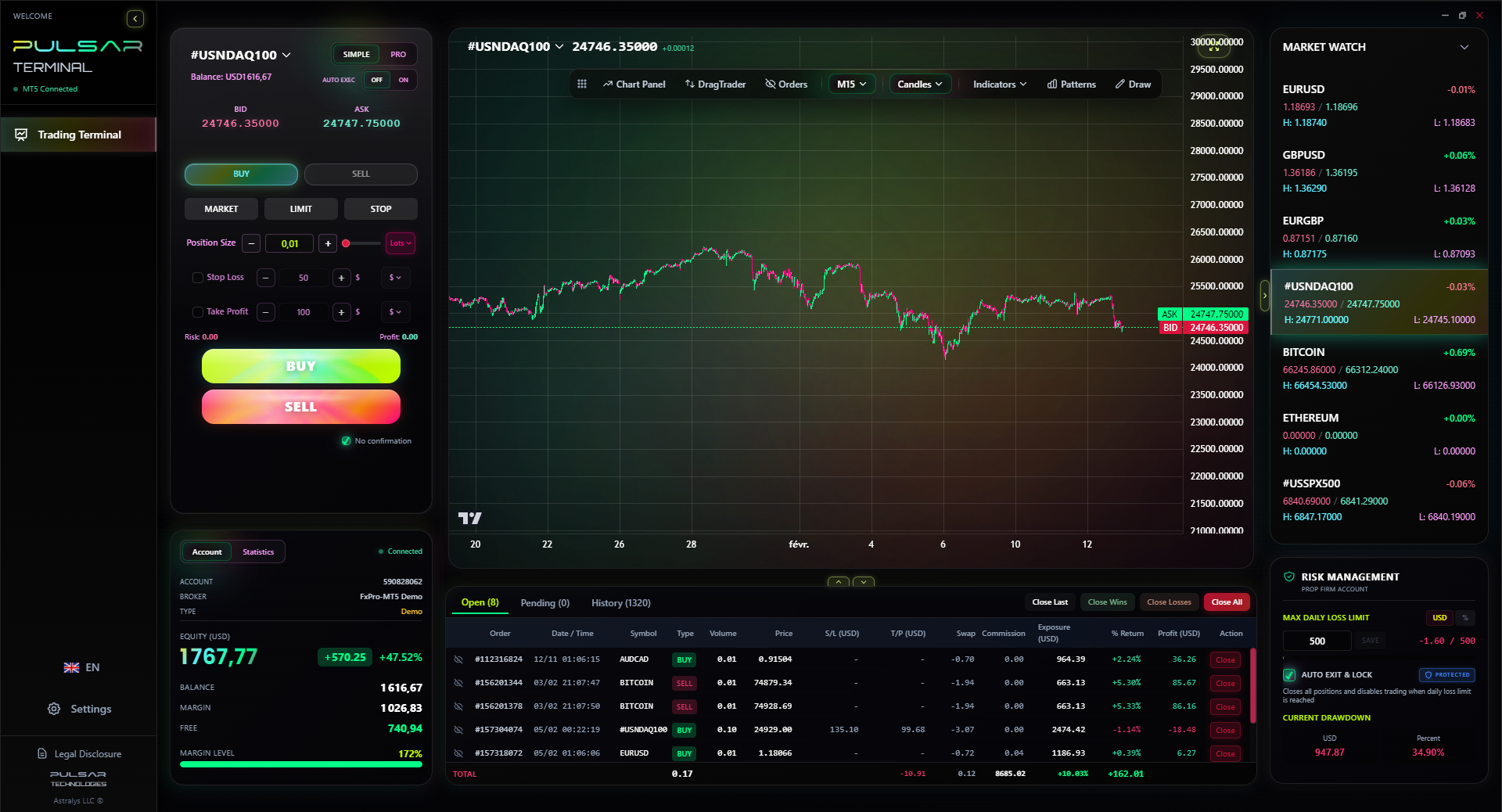
Manually moving stop-losses is a chore; Pulsar Terminal automates trailing stops and breakeven triggers directly on your MT5 charts.
Pulsar Terminal
The all-in-one MT5 companion: drag-and-drop orders, multi-TP/SL, trailing stop, grid trading, Volume Profile, and prop firm protection. Used by 1,000+ traders daily.
Let me save you some money and frustration.
- Pitfall 1: Chasing the 'Hot' Broker on Social Media. That guy on Instagram with the Lamborghini is probably selling a course, not trading. His 'recommended' broker might be paying him for referrals. Do your own due diligence.
- Pitfall 2: Ignoring the Tax Man. That 10% tax is real. Set aside 10% of every profitable withdrawal immediately. Open a separate savings account for it. When the FIRS comes knocking, you'll be ready.
- Pitfall 3: Overleveraging from Day One. You have 1:500 use. That doesn't mean you should use it. Using more than 1:10 when starting is suicidal. A pip definition becomes terrifying when each one is worth $50 on a tiny account.
- Pitfall 4: Not Understanding the Spread. If you're scalping for 5-pip profits and the spread is 3 pips, you've already lost 60% of your potential gain. Your strategy must account for costs.
- Pitfall 5: No Trading Plan. You wouldn't build a house without a plan. Don't trade without one. A plan states: What pairs you trade (stick to majors like EUR/USD or XAU/USD at first), your entry/exit rules, and your daily loss limit (e.g., stop trading if you lose 3% of your account).
💡 Winston's Tip
The 10% tax is on gross profits. If you make $10,000 but have $9,000 in losses, you only pay tax on $1,000. Keep every statement.
“The goal of your first year is not to buy a car. The goal is to not blow up your account.”
The forex trading sign up is complete. You're not a trader yet; you're a student with a live account. Here's your syllabus:
Month 1: Paper trade or trade 0.01 lots only. Focus on executing your plan perfectly, even if it means taking 10 small losses in a row with tight stops. Journal every trade: Why did you enter? What was the outcome? What did you feel?
Month 2-3: If your journal shows consistency in following rules, you can gradually increase position size. Start studying price action in depth. Understand what economic news (like US NFP) does to your pairs.
Ongoing: Never stop being a student. The market changes. Re-evaluate your broker annually. Are their spreads still competitive? Are withdrawals still smooth?
Finally, manage your expectations. This isn't a get-rich-quick scheme. It's a skill. It takes time to become consistently profitable. The goal of your first year is not to buy a car. The goal is to not blow up your account, to learn, and to still be in the game. If you can do that, you're ahead of 80% of people who sign up.
FAQ
Q1Is forex trading legal in Nigeria?
Yes, it's legal for individuals to trade forex with their personal funds. However, the retail online forex market is considered poorly regulated. The SEC warns against unregulated platforms, and the CBN regulates fund flows. You are responsible for choosing a reputable, internationally regulated broker.
Q2How much money do I need to start forex trading in Nigeria?
Technically, you can start with as little as $1 with some brokers. Practically, I recommend a minimum of $500. This allows for proper risk management. With a $100 account, trading costs (spreads) consume a huge percentage of your potential profits, and a few losses can wipe you out.
Q3Which broker is the best for Nigerians?
There's no single 'best' broker. It depends on your needs. For low spreads, look at IC Markets or Pepperstone. For easy local deposits and Naira accounts, consider XM or HFM. The critical factor is strong international regulation (like ASIC or FCA). Always check recent reviews and test their withdrawal process with a small amount first.
Q4How do I pay taxes on forex profits in Nigeria?
You are required to pay a 10% Capital Gains Tax on your gross forex trading profits annually to the Federal Inland Revenue Service (FIRS). You must declare this income yourself. Keep all your trading statements from your broker as proof of your profits and losses.
Q5Why is my Nigerian debit card declined when funding my trading account?
The Central Bank of Nigeria (CBN) places restrictions on international transactions using Naira debit cards to preserve foreign exchange. Your card may be declined for larger amounts or for certain merchant categories. Use alternative methods like cryptocurrency (USDT), bank transfer to a local partner, or e-wallets like Skrill.
Q6What is the most traded currency pair in Nigeria?
While EUR/USD and GBP/USD are popular globally, the USD/NGN pair is heavily traded due to its direct impact on the local economy. However, for most Nigerian retail traders on international platforms, EUR/USD remains the most common pair due to its high liquidity and lower spreads.
Q7Can I use MetaTrader 4/5 in Nigeria?
Absolutely. MT4 and MT5 are the most widely used trading platforms in Nigeria. Almost every reputable international broker offers them. They are stable, support expert advisors (EAs), and have a massive community for support and indicators.
Prof. Winston's Lesson
Key Takeaways:
- ✓Filter brokers by Tier-1 regulation first, not bonuses.
- ✓Start with at least $500 for realistic risk management.
- ✓Set aside 10% of every profit immediately for taxes.
- ✓Your first 10 trades should test discipline, not make money.
- ✓Use crypto or local transfer to avoid CBN card blocks.
How useful was this article?
Click a star to rate
Weekly Trading Insights
Free weekly analysis & strategies. No spam.
About the Author
Olumide Adeyemi
West African Trading Pioneer
One of Nigeria's most active forex trading educators. 8 years of experience trading from Lagos. Specializes in low-capital strategies and prop firm challenges for African traders.
Comments
Risk Disclaimer
Trading financial instruments carries significant risk and may not be suitable for all investors. Past performance does not guarantee future results. This content is for educational purposes only and should not be considered investment advice. Always conduct your own research before trading.
You Might Also Like

Cara Trading Forex Sukses: 7 Prinsip dari Trader Profesional
Cara trading forex sukses dengan 7 prinsip trader pro: manajemen modal, disiplin, journal trading, backtest. Data nyata, bukan janji profit palsu.
Jam Trading Forex Terbaik untuk Trader Indonesia: Panduan Lengkap dengan Tabel Waktu
Panduan jam trading forex untuk trader Indonesia. Tabel 4 sesi dunia, jam emas 20:00-00:00, sesi mana yang harus dihindari. Data akurat + tips dari trader berpengalaman.
Top 5 Sàn Forex Uy Tín Nhất 2026: Review Jujur dari Trader Indonesia
Top 5 sàn forex uy tín 2026 untuk trader Indonesia. Review jujur: spread, deposit, withdraw, dukungan lokal. Exness, XM, IC Markets & lebih.
Get Pulsar Terminal
All these calculators are built into Pulsar Terminal with real-time data from your MT5 account. One-click position sizing, automatic risk management, and instant calculations.
Get Pulsar Terminal