


Here's a fact that might surprise you: over 60% of all daily forex volume happens when the London and New York sessions overlap.

Olumide Adeyemi
West African Trading Pioneer ·  Nigeria
☕ 9 min read
What you'll learn:
- 1What Exactly Is the US Session and Why Should You Care?
- 2The Exact US Session Times for Nigerian Traders (WAT)
- 3What to Trade During the US Session: Pairs & Strategies That Work
- 4Risk Management & The Naira Reality
- 5Essential Tools & Indicators for the US Session
- 6Common Mistakes Nigerian Traders Make (And How to Avoid Them)
- 7Your US Session Trading Plan: A Sample Day
Here's a fact that might surprise you: over 60% of all daily forex volume happens when the London and New York sessions overlap. For us in Nigeria, that overlap falls right in the middle of our afternoon. If you're trading with Naira and missing this window, you're literally leaving money on the table. I've seen too many traders here get the timing wrong, trading sleepy Asian session pairs when the real action is about to kick off. Let's fix that.
The US session, often called the New York session, is when the American financial markets wake up. It's not just about Wall Street banks. This is when economic data from the world's largest economy hits the wires - think US Non-Farm Payrolls, inflation reports (CPI), and Federal Reserve announcements. For a Nigerian trader, this session is pure opportunity. The liquidity is massive, which means spreads on major pairs like EUR/USD often tighten up. But that liquidity comes with volatility. Price can move fast, especially in the first hour after the open. I learned this the hard way back in 2019. I was long on GBP/USD just before some Fed comments, and the pair dropped 80 pips in about 12 minutes. My stop-loss got hit, and it was a tough lesson in respecting US session power. The key is that most brokers, including popular ones here like Exness and IC Markets, show their best pricing during this time because so many buyers and sellers are in the market.
The Nigerian Time Zone Advantage
We're on West Africa Time (WAT), which is GMT+1. This gives us a pretty convenient schedule. The US session starts in our early afternoon and runs into our evening. You don't have to pull all-nighters like traders in Asia might. You can have a normal day job, wrap up by 2 PM, and still catch the entire New York open. It's one of the best geographical perks for trading we have.
This is the most important part. Getting the timing wrong by an hour can mean missing a key breakout or getting caught in a false move. The US observes Daylight Saving Time (DST), which shifts their clocks forward in spring and back in fall. This changes the session start for us by one hour.
Here’s the simple breakdown for Nigerian local time:
| US Season | US Session Start (WAT) | US Session End (WAT) | Key Overlap Period (London/NY) |
|---|---|---|---|
| Daylight Saving Time (Mar - Nov) | 1:00 PM | 10:00 PM | 1:00 PM - 4:00 PM WAT |
| Standard Time (Nov - Mar) | 2:00 PM | 11:00 PM | 2:00 PM - 5:00 PM WAT |

Warning: The most volatile period is almost always the first 1-2 hours after the open. That's 1-3 PM WAT in summer, 2-4 PM WAT in winter. If you're a new trader, consider this the 'danger zone' until you get used to the pace. This is when news is released and big banks adjust their positions.
The 3-hour overlap with the London session (from about 1/2 PM to 4/5 PM WAT) is the sweet spot. It's when you get the highest volume and the cleanest trends. I plan my main swing trading entries during this window whenever possible. After London closes around 4/5 PM WAT, the market can sometimes get choppy as volume dips slightly, but major US news can still rock the boat until about 8 PM WAT.

💡 Winston's Tip
The market's first move after the US open is often a false one. Wait for the initial 15-minute candle to close before committing your capital. Let the institutional money show its hand first.
“For a Nigerian trader, the London-NY overlap from 1-4 PM WAT isn't just a trading window; it's a geographical gift.”
You don't want to trade just anything. You want to trade the instruments that actually move with the US dollar and US sentiment.
Top Pairs for the US Session:
- EUR/USD: This is the king. It's the most liquid pair in the world, and it reacts directly to US data and Eurozone data released during the London overlap. Spreads are at their tightest. My most consistent scalping strategy revolves around EUR/USD between 1:30 PM and 3:30 PM WAT.
- USD/JPY: Follows US Treasury yields and risk sentiment closely. Great for trend moves.
- XAU/USD (Gold): Gold is priced in USD. It's incredibly sensitive to US interest rate expectations and real yields. Big moves happen on US inflation data. Check out our deeper guide on trading XAU/USD for specifics.
- US Stock Indices (US30, SPX500, NAS100): These only move during the US session. They're perfect if you want to trade the direct reaction to US earnings and economic health.
A Simple US Session Strategy: I call this the 'Overlap Breakout.' It's not fancy, but it works. Around 12:45 PM WAT (just before the US open), I identify the high and low of the London session's range on the 15-minute chart for EUR/USD. I then place buy-stop orders 2 pips above the high and sell-stop orders 2 pips below the low. Whichever order gets triggered first, I ride the momentum with a 1:2 risk-to-reward ratio. I cancel the other order. This strategy capitalizes on the initial burst of directional volume. Just remember to always use a stop-loss - the market can reverse quickly. A good position size calculator is essential here to keep your risk in check.
Trading the US session with a Nigerian account has some unique considerations. First, let's talk taxes. Profits from forex trading are subject to Capital Gains Tax in Nigeria. The standard rate is 10% of your gross profits. You need to factor this into your profit targets. It's not the broker's job to deduct it; that's on you to declare.
Funding your account has gotten easier but has limits. The CBN restricts using the official forex window to fund trading accounts. So, you'll be using your broker's payment processors or crypto. This means you might face transfer fees or exchange rate spreads when converting your Naira to USD to trade. I use brokers like XM or Pepperstone that have solid local deposit options to minimize these costs.

Pro Tip: Always check if your broker offers a USD-denominated account or a NGN-denominated account. With a NGN account, your profit/loss is converted instantly, but you're exposed to the USD/NGN rate. With a USD account, you avoid that, but you have to manage the currency conversion yourself on deposits. I prefer USD accounts for consistency.
The high volatility of the US session means your stop-losses are sacred. A 50-pip move on GBP/USD can happen in minutes. If your account is small, a few bad trades can lead to a margin call. Never risk more than 1-2% of your account on a single US session trade. The speed of price action doesn't forgive poor position sizing.
💡 Winston's Tip
If you're trading USD/JPY, have the 10-year US Treasury yield chart open on another screen. They move in lockstep 90% of the time. It's a clearer signal than any lagging indicator.
“I learned the hard way: trading the US session without an economic calendar is like driving in Lagos at night with your headlights off.”
You need the right dashboard to navigate the fast-moving US session. Here’s what I have on my charts:
- Economic Calendar: Non-negotiable. You must know when US data is released. I mark high-impact events (red news) like CPI and NFP in my calendar. I often avoid opening new positions 5 minutes before and after these releases.
- Volume Indicator: Since you can't see the actual order book, a volume indicator on MT4/MT5 is the next best thing. I look for spikes in volume to confirm a breakout is real, not just a fakeout.
- RSI Indicator: Set to 14 periods. During the US session, I use it to spot potential overbought (above 70) or oversold (below 30) conditions, especially on the 5-minute or 15-minute charts for short-term reversals.
- MACD Indicator: Great for confirming the strength of a trend that starts during the overlap period. A strong MACD crossover with the histogram rising can be a good signal to stay in a trade.
The most important tool, however, is a fast, reliable internet connection. You don't want your power or data to cut out at 1:05 PM WAT. It's happened to me, and by the time I reconnected, my trade was in a deep drawdown.
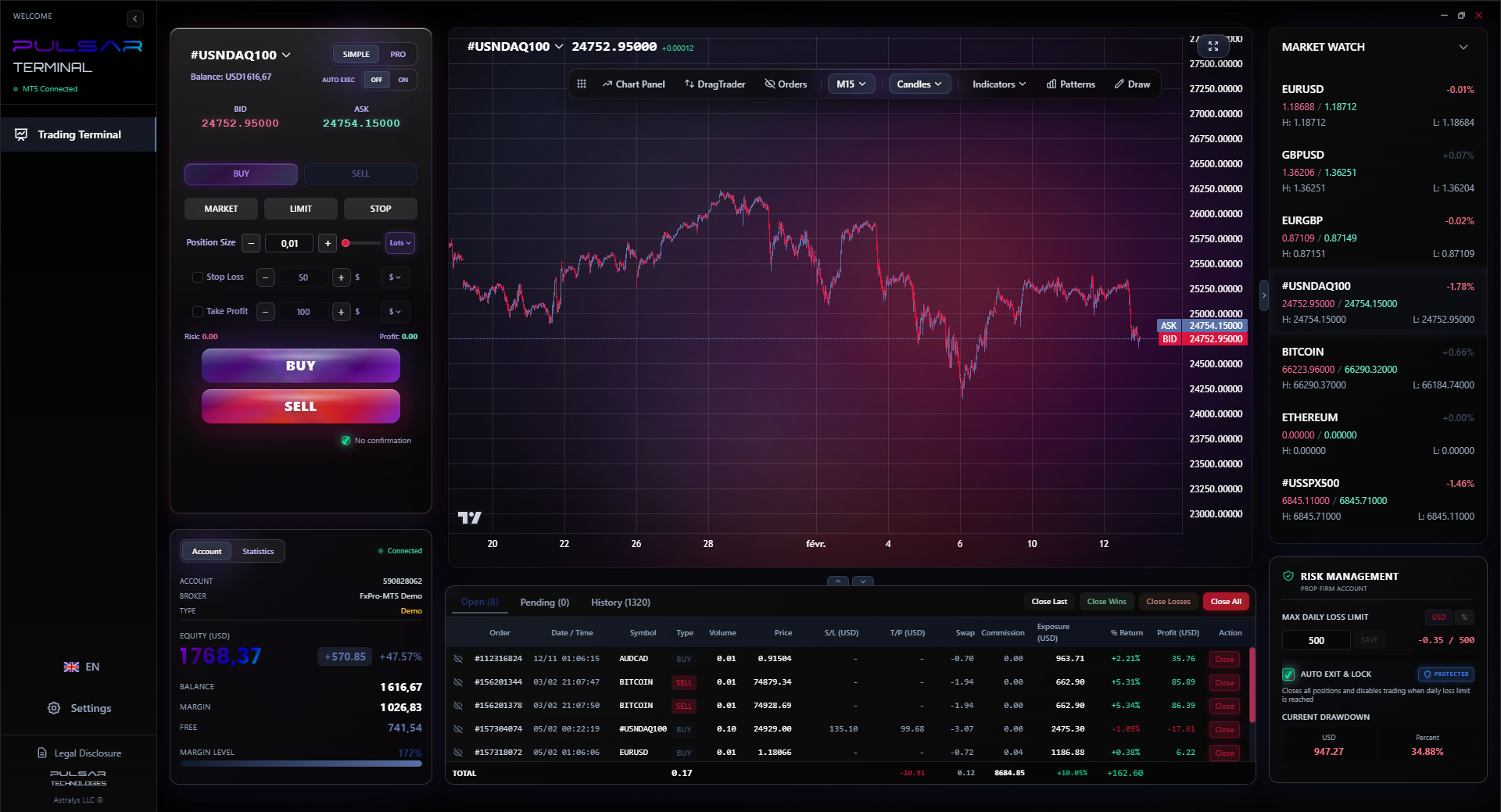
When trading fast US session breakouts, manually moving stop-losses to breakeven is slow and risky; Pulsar Terminal automates breakeven and trailing stops directly on your MT5 chart with one click.
Pulsar Terminal
The all-in-one MT5 companion: drag-and-drop orders, multi-TP/SL, trailing stop, grid trading, Volume Profile, and prop firm protection. Used by 1,000+ traders daily.
I've made most of these, so learn from my losses.
Mistake 1: Trading Exotic Pairs During US Hours. Stick to the majors and commodities linked to the USD. Trading USD/TRY or EUR/SEK during New York hours is a recipe for wide, unpredictable spreads and low liquidity.
Mistake 2: Ignoring the London Overlap. The first hour of the US session is not an island. It's a continuation of London's flow. If London was in a strong downtrend, and US data is bearish for the USD, that's a powerful confluence. I once ignored a strong London sell-off on EUR/USD and tried to buy the 'dip' at the US open. The pair dropped another 60 pips. The trend is your friend, especially during the overlap.
Mistake 3: Overtrading the Volatility. Just because the market is moving doesn't mean you need to be in a trade every 5 minutes. The US session can create a sense of FOMO (Fear Of Missing Out). Pick your best 1 or 2 setups and stick to your plan. Chasing price leads to revenge trading and blown accounts.
Mistake 4: Forgetting About Daylight Saving Time. This one seems small but it's critical. Showing up an hour late in November means you've missed the most important moves. Put a recurring reminder in your phone for the second Sunday in March and the first Sunday in November.
💡 Winston's Tip
Your most important profit target during the US session is the London session high or low. Price will often test these levels as resistance or support. Take partial profits there.
“The 10% capital gains tax on profits isn't a burden; it's a reminder to only take high-probability, well-planned trades.”
Let's walk through what a focused US session day looks like for me now.
12:00 PM WAT: I'm at my desk. I review the economic calendar. High-impact US event at 1:30 PM WAT? I note it. I check the overall market sentiment - are stocks up or down in pre-market?
12:30 PM WAT: I analyze the charts. I draw key support/resistance levels on EUR/USD and Gold from the London session. I calculate my position size using my position size calculator based on my account balance and where I'd place my stop-loss.
1:00 PM WAT (Session Open): I'm not trading yet. I'm watching. I see where price goes in the first 15-30 minutes. Is it respecting the London levels? Is volume high?
1:30 PM - 4:00 PM WAT (Prime Time): This is my active trading window. If my pre-defined setup triggers (like the Overlap Breakout), I take the trade. I set my stop-loss and take-profit orders immediately. If news hits, I stay out unless I was already in a trade with a cushion.
After 4:00 PM WAT: I manage any open trades. I might move stops to breakeven. I rarely open new trades after London closes unless there's a very clear, strong trend. I'm more in 'protect profits' mode.
By 8:00 PM WAT: I'm usually done for the day. I review my trades, journal what worked and what didn't, and shut down. Trading the US session effectively isn't about being glued to the screen for 9 hours. It's about being intensely focused for the 3-4 hours that matter most.
FAQ
Q1What is the best time to trade forex in Nigeria?
The absolute best time is during the London-New York session overlap, from 1:00 PM to 4:00 PM WAT (in summer) or 2:00 PM to 5:00 PM WAT (in winter). This 3-hour window has the highest liquidity and volatility, offering the best trading conditions for pairs like EUR/USD.
Q2Do I have to stay up late to trade the US session from Nigeria?
Not at all. That's the beauty of our time zone. The core US session ends by 11:00 PM WAT at the latest. You can trade the most active hours (1 PM - 8 PM WAT) and still have a normal evening. No all-nighters needed.
Q3Is forex trading legal in Nigeria?
Yes, retail forex trading is legal for individuals. However, the regulatory landscape is evolving. The new Investments and Securities Act (ISA) 2025 requires platforms to register with the SEC. Most Nigerian traders use internationally regulated brokers like those authorized by the UK's FCA or Australia's ASIC.
Q4What is the most volatile pair during the US session?
While EUR/USD has the most volume, pairs like GBP/USD and USD/JPY can be extremely volatile on US news. Also, don't forget Gold (XAU/USD), which often has its biggest moves on US inflation and interest rate data.
Q5How does Daylight Saving Time affect my trading in Nigeria?
When the US springs forward (March), the US session starts at 1:00 PM WAT for us. When they fall back (November), it starts at 2:00 PM WAT. Missing this one-hour shift means missing the critical market open. Always double-check the dates.
Q6Can I fund my forex account with Naira?
Yes, many international brokers now accept Naira deposits through local payment processors, bank transfers, or even crypto. Brokers like Exness and HFM offer NGN-denominated accounts, simplifying the process.
Q7What's the minimum deposit to start trading the US session?
It varies. Some brokers like XTB offer $0 minimums. Others like IC Markets start at $200. For Naira accounts, some payment processors allow deposits as low as 4,000 NGN. Start with an amount you can afford to lose while you learn the session's pace.
Prof. Winston's Lesson
Key Takeaways:
- ✓The US session starts at 1 PM WAT in summer, 2 PM WAT in winter.
- ✓Trade only USD pairs & Gold during New York hours for best liquidity.
- ✓Risk no more than 2% per trade in high-volatility US sessions.
- ✓The first 2 hours post-open see 40% of the session's major moves.
- ✓Always know the high-impact US news time before placing a trade.
How useful was this article?
Click a star to rate
Weekly Trading Insights
Free weekly analysis & strategies. No spam.
About the Author
Olumide Adeyemi
West African Trading Pioneer
One of Nigeria's most active forex trading educators. 8 years of experience trading from Lagos. Specializes in low-capital strategies and prop firm challenges for African traders.
Comments
Risk Disclaimer
Trading financial instruments carries significant risk and may not be suitable for all investors. Past performance does not guarantee future results. This content is for educational purposes only and should not be considered investment advice. Always conduct your own research before trading.
You Might Also Like

Cara Trading Forex Sukses: 7 Prinsip dari Trader Profesional
Cara trading forex sukses dengan 7 prinsip trader pro: manajemen modal, disiplin, journal trading, backtest. Data nyata, bukan janji profit palsu.
Jam Trading Forex Terbaik untuk Trader Indonesia: Panduan Lengkap dengan Tabel Waktu
Panduan jam trading forex untuk trader Indonesia. Tabel 4 sesi dunia, jam emas 20:00-00:00, sesi mana yang harus dihindari. Data akurat + tips dari trader berpengalaman.
Top 5 Sàn Forex Uy Tín Nhất 2026: Review Jujur dari Trader Indonesia
Top 5 sàn forex uy tín 2026 untuk trader Indonesia. Review jujur: spread, deposit, withdraw, dukungan lokal. Exness, XM, IC Markets & lebih.
Get Pulsar Terminal
All these calculators are built into Pulsar Terminal with real-time data from your MT5 account. One-click position sizing, automatic risk management, and instant calculations.
Get Pulsar Terminal