


I remember my first free forex demo account.

Olumide Adeyemi
West African Trading Pioneer ·  Nigeria
☕ 9 min read
What you'll learn:
- 1What Exactly Is a Free Forex Demo Account?
- 2Why Every Nigerian Trader Absolutely Needs One
- 3How to Choose a Broker for Your Demo (The Nigerian Checklist)
- 4The 3 Biggest Demo Account Mistakes (I Made Them All)
- 5A 4-Week Structured Demo Practice Plan
- 6The Scary Jump: Transitioning from Demo to Live Trading
- 7The Nigerian Reality: Taxes, Costs, and the Live Market
I remember my first free forex demo account. I funded it with $50,000 of virtual money and felt like a king. Within a week, I was 'up' $15,000 trading GBP/JPY with massive use. I thought I'd cracked the code. Then I deposited my real $500. I blew it in two days. The reason? My demo account taught me nothing but bad habits. It was a toy, not a training tool. In Nigeria, where the market is buzzing but poorly regulated, a demo account is your most important - and most misused - first line of defense. Let's talk about how to use it right.
A free forex demo account is a simulated trading environment offered by brokers. They give you virtual money - often $10,000, $50,000, or even $100,000 - to trade with real-time market data. It looks, feels, and operates exactly like a live account, but you're not risking a single Naira.
For Nigerian traders, this is a non-negotiable starting point. Why? Because our regulatory scene is, frankly, a bit wild. The CBN and SEC have their hands full, and specific rules for online retail forex are thin. You're largely on your own when picking an international broker. A demo lets you test their platform, execution speeds, and customer service without committing funds.

Warning: A demo account is a simulation of market mechanics, not market psychology. The absence of real financial consequence is its greatest feature and its most dangerous flaw. You won't feel the gut punch of a 50-pip loss when it's not your money.
The key is to understand what it's for: learning the buttons, testing a broker's tech, and practicing your execution. It is not for proving you're a trading genius. That illusion cost me my first $500.

💡 Winston's Tip
A demo account is a flight simulator. You wouldn't let a pilot who only flew a simulator land a real plane in a storm. Don't let simulated success make you overconfident for the live market storm.
Look, I get the impatience. You see the potential, you want to start making money now. But skipping the demo phase is like trying to drive a Lagos danfo without ever sitting in the driver's seat. You will crash.
The Nigerian Market Reality
Our market is unique. We deal with power outages, internet fluctuations, and the constant mental math of Naira to Dollar conversions. A demo account lets you stress-test your entire setup. Can your MT4 platform on your phone handle a quick trade when the light goes out and you switch to mobile data? You need to know that before real money is on the line.
Testing Broker Execution
Not all brokers are equal, especially for Nigerian clients. Spreads can widen dramatically during volatile news events (like CBN announcements). On a demo, you can watch how your broker behaves. Do they slip your orders? Does the platform freeze? I once tested a popular broker's demo during a US NFP report and saw a 15-pip slippage on EUR/USD. I never funded a live account with them. That demo saved me real cash.
Practice Without Pressure
This is the core benefit. You can try out different styles. Maybe you think scalping is for you, or perhaps swing trading fits your schedule better. A demo account gives you the space to fail, learn, and adjust without the emotional burden. It's where you make your beginner mistakes for free.
“A demo account is a simulation of market mechanics, not market psychology. The absence of real financial consequence is its greatest feature and its most dangerous flaw.”
Don't just pick any broker. Your demo should be on the same platform you intend to use live. Here’s what to look for, with a focus on brokers accessible in Nigeria.
1. Platform & Tools: Most brokers offer MT4 or MT5. Pick one. If you want advanced tools like Volume Profile or advanced order types, you might need a broker that supports MT5 or has a good proprietary platform. Some tools, like a position size calculator, are essential and you should practice using them in demo.
2. Realistic Demo Conditions: Some brokers give you dream conditions - zero latency, perfect fills. That's useless. Look for a demo that mimics their live server conditions. Brokers like IC Markets and Pepperstone are known for this.
3. Local Support & Deposits: This is crucial for Nigeria. Does the broker have a local office or support line? Can you deposit in Naira, or do you face forex restrictions? Brokers like Exness and XM have strong local presence and Naira payment options. Test their customer service from your demo account.
4. Regulatory Safety (Even for Demo): Start with a broker that has real regulation, even if offshore. It sets a standard. Here’s a quick comparison of popular options:
| Broker | Demo Feature | Key for Nigerians |
|---|---|---|
| Exness | Unlimited demo, MT4/MT5 | Very low minimum deposit ($10 live), strong local support. |
| IC Markets | Realistic raw spread demo | True ECN conditions, good for testing scalping. |
| XM | $100,000 virtual demo | Extensive educational resources, good for beginners. |
| Pepperstone | 60-day demo limit | Top-tier tech and execution, but demo expires. |
Spend a week demo-trading with two different brokers. Compare the feel, the spread on pairs you care about, and the platform stability.
Here’s how we waste this precious resource. Avoid these like a bad signal during low liquidity.
1. Trading with Monopoly Money Mentality. This was my sin. $50,000 in demo feels like a lot. So you take huge, reckless positions. A 5-lot trade on EUR/USD? Why not! In reality, with a $500 account, that's a guaranteed margin call. You must trade your demo with the position size you'll actually use live. If you plan to start with $200, demo-trade with a $200 virtual balance. Not $50,000.
2. Not Tracking Your Performance. You just click buttons. You have no idea what your win rate is, your average win vs. average loss, your risk per trade. Without this data, you're not practicing; you're gambling. Use the demo's journal or keep a simple spreadsheet. Every trade. Every time.
3. The Unlimited ‘Reset’ Button. You blow up your demo? Just reset it! This destroys any concept of risk management. In the real world, you can't reset your account. You have to protect your capital. Treat your demo balance as finite. If you lose 50% of it, stop. Analyze what went wrong. That's the lesson.

Pro Tip: Set a hard rule for your demo. For example: "I will not reset this account. If I lose 30% of the starting capital, I must write a 500-word post-mortem on what happened before I trade again." This builds discipline.
💡 Winston's Tip
The moment you feel bored with your demo account is the moment you're ready to start taking it seriously. Boredom means you're comfortable with the mechanics. Now, add strict, written rules.
“Your first live trade should be embarrassingly small. The goal of your first 10 live trades is not to make money. It's to survive the psychological shock.”
Don't just wander. Have a plan. Here’s a blueprint I wish I’d followed.
Week 1: Learn the Machine. Goal: Zero profitable trades. Seriously.
- Open charts for EUR/USD and XAU/USD.
- Practice placing market orders, limit orders, stop orders.
- Set stop-loss and take-profit levels. Move them around.
- Learn how to calculate your position size for a 1% risk. Use a position size calculator until it's second nature.
- Purposefully trigger a margin call to see how it works. Better now than later.
Week 2: Test Your Strategy. Goal: Consistency in execution, not P&L.
- Paper-trade your chosen strategy. If it uses the RSI indicator or MACD, practice identifying signals.
- Enter 20-30 trades strictly by your rules. No deviations.
- Record every entry, exit, reason, and emotional state.
Week 3: Introduce ‘Life’. Goal: Test under realistic Nigerian conditions.
- Trade only during unstable internet (switch to your phone's hotspot).
- Simulate a power outage: close your laptop, reopen, and see if you can manage your positions.
- Trade around major news events (simulate the stress of CBN announcements).
Week 4: The Simulation. Goal: A one-month mock live account.
- Fund your demo with the exact amount you plan to start with live (e.g., $200).
- Trade your full strategy with strict 1-2% risk per trade.
- You cannot reset. You cannot add more virtual funds. This is it.
- At the end of the month, are you up or down? What's your drawdown? This is your probable real-world starting point.
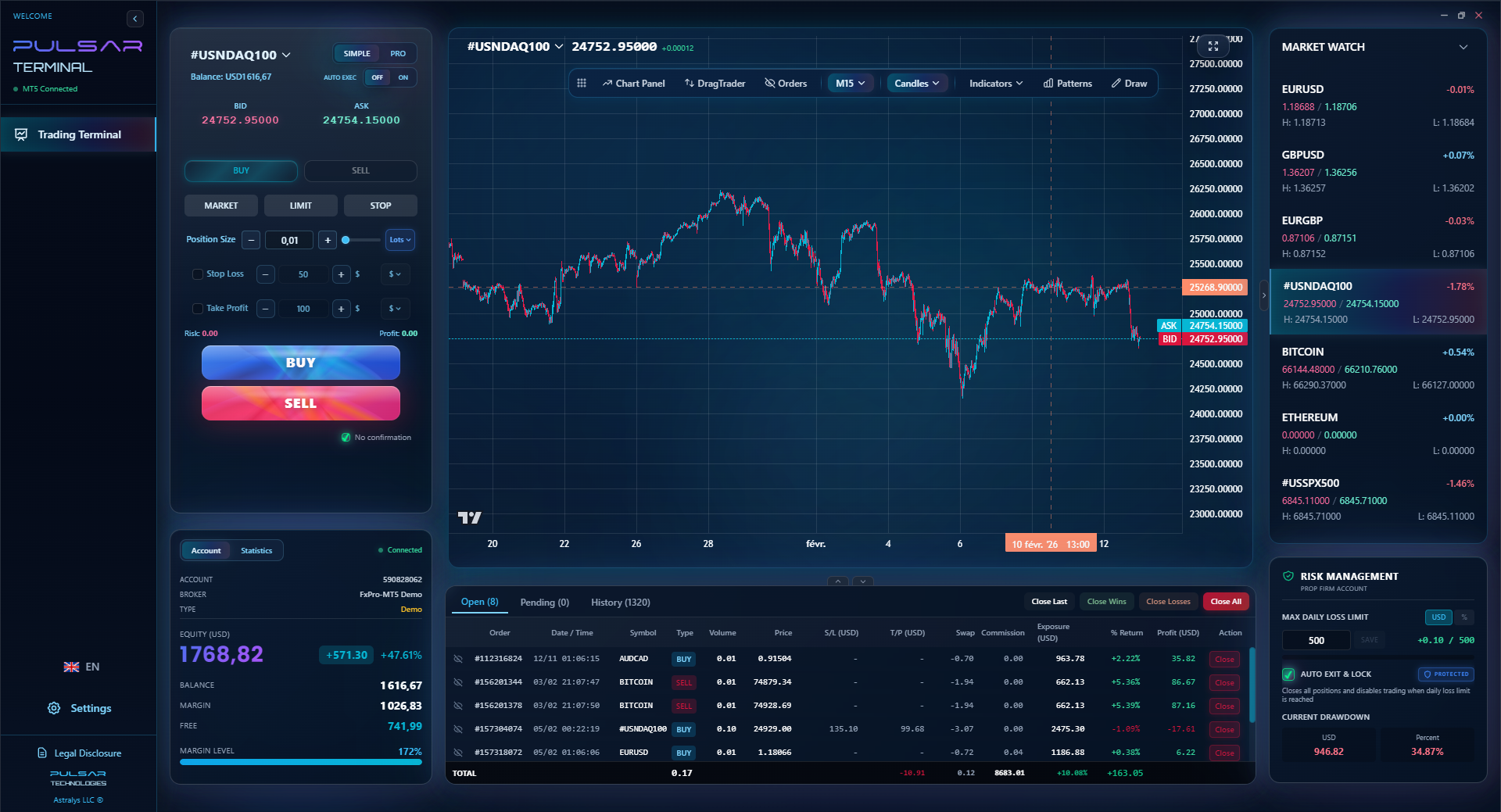
When practicing your structured demo plan, managing multiple orders and risk levels manually is a hassle; Pulsar Terminal's drag-and-drop order system and multi-TP/SL tools let you execute complex trade plans on MT5 with the precision you're training for.
Pulsar Terminal
The all-in-one MT5 companion: drag-and-drop orders, multi-TP/SL, trailing stop, grid trading, Volume Profile, and prop firm protection. Used by 1,000+ traders daily.
This is where most fail. The psychology shifts completely. That calm you had in demo? Gone. Here’s how to make the leap without breaking your legs.
Start Stupidly Small. Your first live trade should be embarrassingly small. If you practiced with 0.01 lots on a $200 demo, start with 0.01 lots on a $200 live account. The goal of your first 10 live trades is not to make money. It's to survive the psychological shock and execute your plan. The profit is a bonus.
Expect and Accept the Difference. Live spreads might be slightly wider. Orders might have a micro-second of slippage. This is normal. If you practiced on a quality demo from a broker like IC Markets, the difference should be minimal. But your heart will race on a live trade in a way it never did in demo. Breathe. Stick to your pre-defined plan.
The One-Half Rule. A mentor once told me this: "Your first live account should be half the size you think you can handle, and you should risk half of what you did in demo." So if you were risking 2% per trade in demo, risk 1% live. This buffers the emotional volatility. I ignored this and paid for it.

Example: You have ₦100,000 ($~125). You plan to risk 1% per trade = ₦1,000. On a EUR/USD trade with a 50-pip stop loss, that dictates your position size. This is non-negotiable math you must master in demo first.
“Demo trading is a hobby. Live trading is a business with real psychological overhead. Budget for it.”
The demo hides the financial realities. Before you go live, you must understand the Nigerian context.
The 10% Capital Gains Tax. This is the big one. The Nigerian government taxes your gross forex trading profits at 10%. It's your responsibility to declare and pay this. In demo, you keep 100% of 'profits.' Live, you keep 90%. This changes your profit calculations significantly. A strategy that seems profitable in demo might only break even after tax.
Real Costs Beyond the Spread. You've practiced watching the spread. Now consider:
- Bank transfer fees for funding/withdrawal.
- Currency conversion fees if your broker doesn't hold Naira.
- Potential overnight financing (swap) costs if you hold positions.
The Psychological Cost. This is the real tax. The stress, the sleepless nights after a loss, the emotional energy. Demo trading is a hobby. Live trading is a business with real psychological overhead. Budget for it. Have a support system. Take breaks.
The free forex demo account is your sandbox. It's where you build your foundation without risk. But remember, no one ever built a real house in a sandbox. Use it to learn the tools, then have the courage and discipline to step into the real, messy, stressful, and potentially rewarding world of live trading - with your eyes wide open.
FAQ
Q1Are free forex demo accounts really free in Nigeria?
Yes, completely. Brokers provide them as a marketing and educational tool. You don't need to deposit any money. However, you are using their infrastructure, so ensure you have a stable internet connection, which is your own cost.
Q2How long does a free demo account last?
It varies by broker. Some, like Exness, offer unlimited demo accounts. Others, like Pepperstone, have a 30 or 60-day limit. Some will expire after a period of inactivity. Always check the broker's terms.
Q3Can I test Nigerian Naira (NGN) pairs on a demo account?
Usually not. Most international brokers' demos are stocked with major, minor, and exotic forex pairs, but rarely include Naira pairs like USD/NGN (which is often restricted). You'll primarily practice on pairs like EUR/USD, GBP/USD, and USD/JPY.
Q4Is my demo trading performance a guarantee of live success?
Absolutely not. It's the most dangerous assumption you can make. Demo performance shows you can operate the platform and understand a strategy under zero psychological pressure. Live trading introduces fear and greed, which are far more powerful than any indicator. Demo success is a prerequisite, not a promise.
Q5Should I use demo money that matches my real starting capital?
100% yes. This is critical. If you plan to start live trading with $200, fund your demo with $200. Trading a $50,000 demo teaches you habits that will destroy a $200 account. Practice with realistic size from day one.
Q6Can I use a demo account to pass a prop firm challenge?
A demo is the perfect place to practice the specific rules of a prop firm challenge (like maximum daily loss). You can simulate the exact conditions. Tools that help automate risk rules, like those in advanced trading terminals, can be conceptualized here, but you'll need to execute the live challenge on the prop firm's own system.
Prof. Winston's Lesson
Key Takeaways:
- ✓Trade your demo with the exact capital you plan to use live.
- ✓The 10% capital gains tax in Nigeria turns demo profits into live break-evens.
- ✓If you lose 30% of your demo balance, stop and write a post-mortem.
- ✓Your first live position size should feel laughably small.
How useful was this article?
Click a star to rate
Weekly Trading Insights
Free weekly analysis & strategies. No spam.
About the Author
Olumide Adeyemi
West African Trading Pioneer
One of Nigeria's most active forex trading educators. 8 years of experience trading from Lagos. Specializes in low-capital strategies and prop firm challenges for African traders.
Comments
Risk Disclaimer
Trading financial instruments carries significant risk and may not be suitable for all investors. Past performance does not guarantee future results. This content is for educational purposes only and should not be considered investment advice. Always conduct your own research before trading.
You Might Also Like

Cara Trading Forex Sukses: 7 Prinsip dari Trader Profesional
Cara trading forex sukses dengan 7 prinsip trader pro: manajemen modal, disiplin, journal trading, backtest. Data nyata, bukan janji profit palsu.
Jam Trading Forex Terbaik untuk Trader Indonesia: Panduan Lengkap dengan Tabel Waktu
Panduan jam trading forex untuk trader Indonesia. Tabel 4 sesi dunia, jam emas 20:00-00:00, sesi mana yang harus dihindari. Data akurat + tips dari trader berpengalaman.
Top 5 Sàn Forex Uy Tín Nhất 2026: Review Jujur dari Trader Indonesia
Top 5 sàn forex uy tín 2026 untuk trader Indonesia. Review jujur: spread, deposit, withdraw, dukungan lokal. Exness, XM, IC Markets & lebih.
Get Pulsar Terminal
All these calculators are built into Pulsar Terminal with real-time data from your MT5 account. One-click position sizing, automatic risk management, and instant calculations.
Get Pulsar Terminal