


So you want to trade gold, but you're not sure when the best times are, or maybe you've heard the rules are different here in the States? You're right to ask.
James Mitchell
Senior Trading Analyst
☕ 11 min read
What you'll learn:
- 1Gold in the Forex Market: It's Not What You Think
- 2The 24-Hour Gold Clock: From Sydney to New York
- 3The Sweet Spot: When a US Trader Should Actually Trade
- 4The Rulebook: What You Can (and Can't) Trade in the US
- 5Matching Your Strategy to the Clock
- 6What It Really Costs to Trade Gold in the US
- 7Mistakes I've Made (So You Don't Have To)
- 8Your Weekly Gold Trading Action Plan
So you want to trade gold, but you're not sure when the best times are, or maybe you've heard the rules are different here in the States? You're right to ask. Trading gold (XAU/USD) in the US forex market isn't just about watching charts. It's a dance with global sessions, wrapped in a unique set of regulations that can trip you up if you're not careful. I've traded through the quiet Asian sessions and the chaotic New York opens, and I'll tell you exactly when to be at your screen and what rules you absolutely cannot ignore.
First things first, let's clear up a major point of confusion. When you trade gold on a forex platform, you're almost never actually buying physical gold. In the US, you're typically trading a spot contract on the price of gold versus the US dollar (XAU/USD). This is crucial because the popular CFD (Contract for Difference) model you hear about from international traders? That's generally off-limits for US retail traders due to CFTC regulations.
What you're trading is the real-time price movement. One standard lot is 100 ounces of gold. If the price moves from $2350 to $2351, that's a $100 move per lot (since 100 ounces * $1 = $100). That's your pip definition in action, though with metals, we often call it a 'tick' or just measure in dollars.

The appeal is obvious. Gold is a classic hedge, it moves on its own rhythm (often inverse to the dollar), and it can offer serious volatility. But that volatility is a double-edged sword, and its schedule is global.
Gold trades nearly 24 hours a day, five days a week. The market opens Sunday evening New York time and runs until Friday afternoon. But not all hours are created equal. The activity comes in waves based on which financial center is awake.
The Sydney/Tokyo Session (Evening EST)
This is the quiet shift. It starts when the US goes to sleep. Liquidity is thinner, spreads can be wider, and moves are often just a slow drift following the Friday close. I rarely place new trades here. It's more for monitoring existing positions from the prior day.
The London Session (Pre-dawn to Late Morning EST)
This is where the engine starts. London is the world's biggest forex hub. Volume picks up significantly between 3 AM and 8 AM EST. This session often sets the tone for the day. Major economic data from Europe can spark the first big moves. If you're a swing trading type, London open is a key decision point.
The New York Session (Morning to Afternoon EST)
Now we're cooking. The New York session, from 8 AM EST onward, is the main event for US traders. The highest liquidity and volatility usually occur during the overlap with London, from about 8 AM to 11 AM EST. This is when banks, funds, and everyone else are most active.
Here's a personal example: On March 15, 2023, during the banking stress, I was watching XAU/USD like a hawk at the New York open. Price was consolidating around $1905 after a wild Asian session. At 8:30 AM, with London still active, US retail sales data hit. A miss. Gold spiked $15 in under two minutes. I had a buy limit order at $1907 that filled, and I took profit at $1918. That $11 move was a $1,100 gain on a single lot, all thanks to being active during the right window.
There's a daily break, usually from 5 PM to 6 PM EST (it shifts with Daylight Saving). The market resets. Don't expect much action then.
“Trading gold CFDs with an offshore broker as a US resident is a fast track to losing your entire deposit.”
Let's be practical. You probably have a job, a life. You can't stare at screens for 24 hours. Based on volatility and opportunity, here’s my ranked list of the best gold trading hours forex for someone in the US.
- The London-New York Overlap (8:00 AM - 11:00 AM EST): This is non-negotiable prime time. The highest volume leads to cleaner technical breaks and tighter spreads. If you only have one hour to trade, make it this one. Set your alerts, have your charts ready.
- The First Hour of New York (8:00 AM - 9:00 AM EST): This is often where the day's trend is confirmed or rejected. It's great for breakout strategies.
- The Asian Session Wake-Up Call (2:00 AM - 4:00 AM EST): This is for the night owls or very early risers. Sometimes, major moves start in Asia on unexpected news. If you're holding swings, check your positions at this time. I once woke up at 3 AM to see gold had gapped up $25 on a geopolitical headline. My stop-loss was miles away, but it was a stressful lesson in managing overnight risk.

Pro Tip: Don't trade the first and last 15 minutes of the New York session if you're new. The opening volatility and the Friday afternoon 'squeeze' are where amateurs get chewed up. Watch first, trade later.
For the 9-to-5 crowd, the lunchtime lull (12 PM - 2 PM EST) is usually quiet. The late afternoon (3 PM - 5 PM EST) can see some action as London traders come back online for their close, but it's often choppy and unpredictable.

💡 Winston's Tip
The market's quiet hours are for planning, not panicking. Use the Asian session to mark your charts. The battle is won before the London bell rings.
This is the most important section for US traders. We play by different rules. The CFTC and NFA are not kidding around.
You CANNOT trade:
- Gold CFDs with most offshore brokers. If a broker doesn't ask for your SSN and isn't listed on the NFA website, assume offering you a gold CFD is a violation.
- Use use above 20:1 on gold. That's the CFTC cap for commodities. If a broker offers you 500:1 on XAU/USD, they are not US-regulated. Period. This limit drastically changes your position size calculator math.
You CAN trade:
- Spot XAU/USD with US-regulated Retail Foreign Exchange Dealers (RFEDs) like the ones mentioned. This is a direct, regulated spot contract.
- Gold Futures (GC) on the COMEX via a futures broker. This is a different beast with contract expiries and different margin rules.
- Gold ETFs (like GLD) in your stock brokerage account. No use, but straightforward exposure.
I learned the use lesson the hard way early on. On a demo with an international broker, I used 100:1. I turned $1,000 into $3,000 on a gold rally and felt like a genius. When I moved to a real US broker and was capped at 20:1, my same aggressive trade size led to a margin call on a routine pullback. My risk was five times higher than I was used to. It wiped out a chunk of my account. The rules are there for a reason, even if they feel restrictive.
“If you only have one hour a day to trade gold, make it the first hour of the New York session.”
Your approach should change with the session. Trying to scalp during the dead Tokyo session is like fishing in a pond that's been drained.
For the London/New York Overlap (High Volatility): This is where trend-following and news-based strategies shine. Breakouts from key Asian session ranges are more likely to follow through. I heavily rely on the MACD indicator on the 15-minute and 1-hour charts here to confirm momentum. Avoid mean-reversion strategies here; the train can keep going for a long time.
For the Asian Session (Low Volatility): This is the domain of the range trader. Price often bounces between clear support and resistance levels established during the New York close. The RSI indicator can be useful here to spot overbought/oversold conditions within the range. It's also a good time for analysis and planning for the coming London session.
For the New York Afternoon (Choppy): This is tricky. I often switch to lower timeframes if I trade at all. A scalping strategy aiming for 5-10 dollar moves can work, but you have to be quick and disciplined. Most days, I just close my platform after 1 PM EST. The probability of a clean, predictable move drops significantly.

Example: Let's say the Asian session range is $2332-$2340. At 8:05 AM EST, a strong US data print hits. Price is at $2338. It spikes, takes out the $2340 high, and holds above it for two 5-minute candles. A breakout long entry at $2341.50 with a stop at $2339 and a target at $2348 is a classic overlap strategy. The high volume gives the breakout credibility.
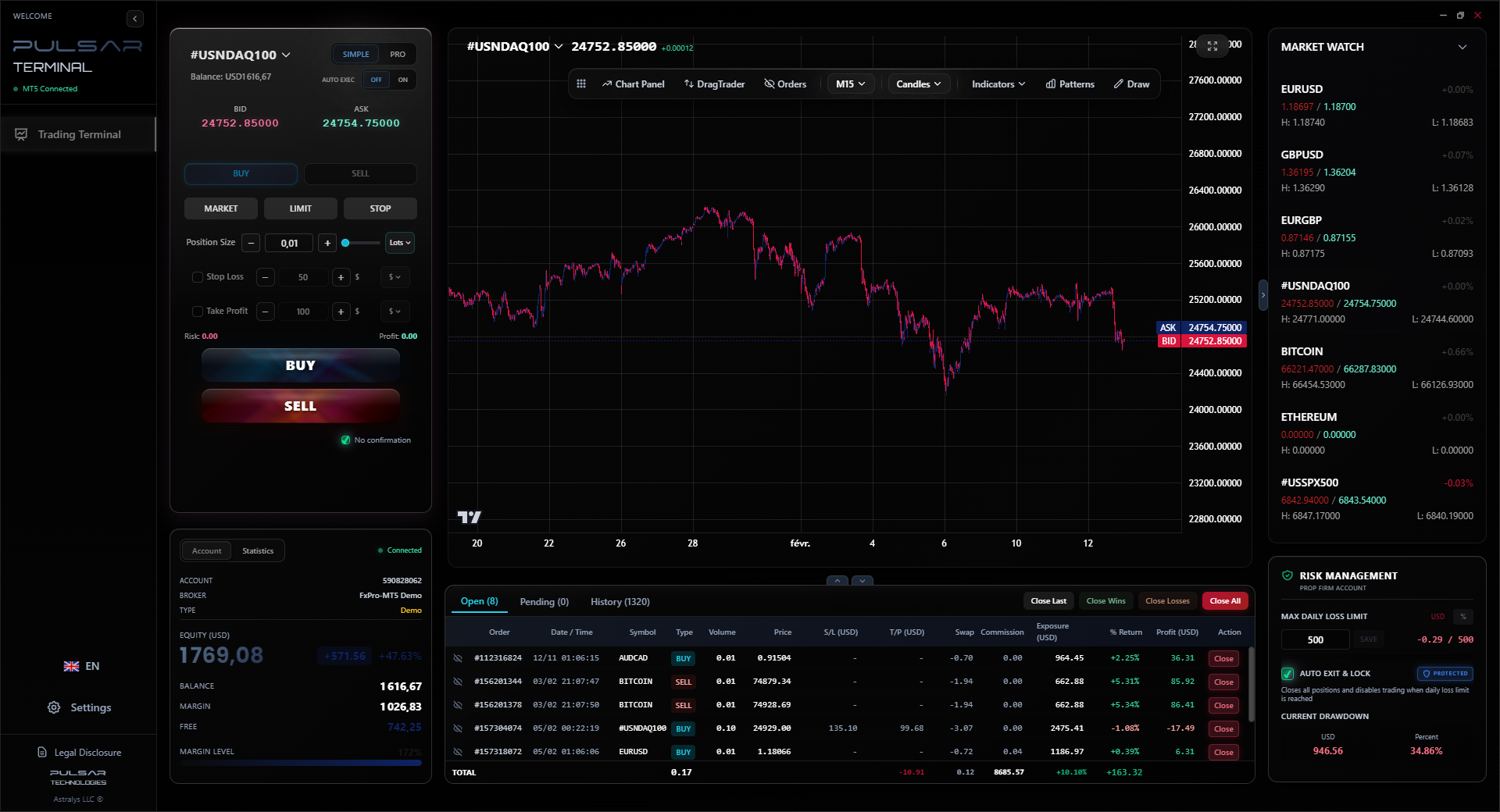
Managing multiple targets and stops across volatile gold sessions is complex, but tools like Pulsar Terminal automate partial closures and trailing stops directly on your MT5 platform.
Pulsar Terminal
The all-in-one MT5 companion: drag-and-drop orders, multi-TP/SL, trailing stop, grid trading, Volume Profile, and prop firm protection. Used by 1,000+ traders daily.
Trading costs eat into profits, and with gold's volatility, you need to know them cold.
The Spread: This is your main cost. A typical spread for XAU/USD with a good US broker during the London/NY overlap might be 25-40 cents ($25-$40 per lot). At 3 AM EST, it can widen to $1.00 or more. Always check the live spread before clicking buy.
Overnight Financing (Swap): Holding a spot gold position overnight incurs a swap fee or credit. It's based on the interest rate differential between gold (which has a lease rate) and the USD. Usually, it's a small daily debit. For a long position of one lot, I've seen daily swaps of -$4 to -$8. It adds up if you're a long-term holder. This is why many traders prefer futures for longer-term gold plays - no daily swap.
Commissions: Some US broker account types charge a commission plus a tighter spread. For example, $5 per 100k traded (so $5 per standard lot) plus a 10-cent spread. Do the math for your style. For high-frequency trading, commission-based can be cheaper.
Broker Choice: You need a broker that offers reliable execution during volatile times. Interactive Brokers is solid for futures and has deep liquidity. For spot forex XAU/USD, the dedicated forex RFEDs are your go-to. Their platforms are built for this. Don't choose a broker just for a pretty chart; choose them for fast, reliable fills when gold is moving $50 in an hour.
💡 Winston's Tip
Regulations aren't walls, they're guardrails. The 20:1 use limit feels slow until you survive a 3% flash crash that would have obliterated a 100:1 account.
“Your strategy must change with the session; trying to scalp in the quiet Asian market is like fishing in a drained pond.”
Let's get real. I've blown up accounts. Here are the top gold-trading pitfalls for US traders.
Pitfall 1: Trading Around the Daily Break (5-6 PM EST). The liquidity evaporates. I once had a stop-loss order during this break. A tiny, random trade spiked the price, triggered my stop, and immediately reversed. I was filled at the worst possible price due to the thin market. Now, I never have stops too close to the market during that hour, or I just don't trade.
Pitfall 2: Ignoring the Friday Afternoon Squeeze. Especially around 2-4 PM EST on Friday, traders close positions for the weekend. This can cause exaggerated, illogical moves that reverse on Sunday open. Don't enter new trades hoping the Friday move will continue.
Pitfall 3: Underestimating the Impact of US Dollar News. Gold is XAU/USD. A strong US dollar report (like CPI or NFP) will hammer gold, regardless of any other 'gold bullish' story. You must watch the DXY (Dollar Index) as much as the gold chart. My EUR/USD guide mentality often helps, as EUR/USD and gold often move inversely to the dollar together.
Pitfall 4: Using the Wrong Timeframe for the Session. Don't use a 4-hour chart to make a decision during the volatile overlap. The noise will stop you out. Match your chart timeframe to the session's activity: faster charts for fast sessions, slower charts for quiet ones.
Here's a simple plan to implement what we've covered.
Sunday Evening: Market opens at 6 PM EDT (5 PM EST). Review the weekly chart. What was Friday's close? Did it gap? Note key weekly support/resistance. No trading, just planning.
Monday-Thursday:
- 3:00 AM EST: Quick check. Any major Asia-Pacific news? Note the overnight range.
- 7:45 AM EST: Get to your desk. Analyze. Where is price relative to the Asian range? What's the economic calendar for London/NY? Set alerts at key levels.
- 8:00 AM - 11:00 AM EST: Trading Window. Execute your planned strategy based on the breakout or rejection of the early range.
- After 1:00 PM EST: Review trades. Manage or close positions. Do not open new ones unless you have a very specific, high-probability setup.
Friday:
- Follow the AM routine, but be aggressive about closing positions by 2 PM EST. Do not hold speculative swings over the weekend unless you are very confident and have a wide stop.
Stick to this discipline. The market will always be there tomorrow. Knowing the best gold trading hours forex offers isn't just about making money; it's about protecting your capital by not trading when the odds are stacked against you.
FAQ
Q1Can I trade gold 24 hours a day in the US?
Almost, but not quite. The spot XAU/USD market is open from Sunday 5 PM EST to Friday 5 PM EST, with a one-hour daily break from 5 PM to 6 PM EST (shifts with Daylight Saving). While technically accessible, liquidity is extremely thin outside the London and New York session overlaps.
Q2Why is use on gold so low for US traders?
The CFTC limits use to 20:1 on commodities like gold for retail traders. This is a post-2008 financial crisis rule designed to protect traders from catastrophic losses. While it feels restrictive, it forces better risk management. A 20:1 limit means a 5% move against you will wipe out your margin, whereas 100:1 use would do it with just a 1% move.
Q3What's the difference between XAU/USD on a forex platform and a gold ETF like GLD?
XAU/USD is a leveraged, spot price contract traded on the forex market with a broker. It involves margin, swaps, and direct price action. GLD is an exchange-traded fund that holds physical gold bullion. You buy shares of it in a stock brokerage account with no use (unless you use a margin loan). GLD is better for long-term buy-and-hold, while XAU/USD is for active trading.
Q4Is the London-New York overlap always the most volatile?
It's consistently the most liquid, which usually leads to the cleanest volatility. However, the most volatile single moments often occur at 8:30 AM EST when major US economic data (like Non-Farm Payrolls or CPI) is released. That's when you can see $20-$50 moves in minutes. The overlap provides the fuel, but the news provides the spark.
Q5I work a 9-5 job. Can I still trade gold effectively?
Yes, but you have to adapt. Your best window is the first hour of the New York session (8 AM - 9 AM EST). You can place orders based on your pre-market analysis before you start work. Consider longer-term swing trading on the 4-hour or daily charts, where you only need to check your positions once or twice a day, rather than intraday scalping.
Q6What's the single biggest mistake new gold traders make?
Trading too big, too early. They see the big dollar moves ($10 = $1000 per lot) and use a position size that their account can't withstand the normal noise. A $500 account should not be trading a full lot. Use a position size calculator and never risk more than 1-2% of your account on a single trade, especially with gold's volatility.
Prof. Winston's Lesson
Key Takeaways:
- ✓Prime gold trading hours are 8-11 AM EST during the London/NY overlap.
- ✓US traders are capped at 20:1 use on gold by the CFTC.
- ✓Avoid trading during the daily break (5-6 PM EST) and Friday afternoon.
- ✓The spread is your main cost; it widens significantly in thin sessions.
- ✓Always match your trading strategy to the current session's volatility.
How useful was this article?
Click a star to rate
Weekly Trading Insights
Free weekly analysis & strategies. No spam.
About the Author
James Mitchell
Senior Trading Analyst
Based in New York with over 9 years of trading experience. Focuses on major USD pairs, prop firm challenges, and the US regulatory landscape.
Comments
Risk Disclaimer
Trading financial instruments carries significant risk and may not be suitable for all investors. Past performance does not guarantee future results. This content is for educational purposes only and should not be considered investment advice. Always conduct your own research before trading.
You Might Also Like

Cara Trading Forex Sukses: 7 Prinsip dari Trader Profesional
Cara trading forex sukses dengan 7 prinsip trader pro: manajemen modal, disiplin, journal trading, backtest. Data nyata, bukan janji profit palsu.
Jam Trading Forex Terbaik untuk Trader Indonesia: Panduan Lengkap dengan Tabel Waktu
Panduan jam trading forex untuk trader Indonesia. Tabel 4 sesi dunia, jam emas 20:00-00:00, sesi mana yang harus dihindari. Data akurat + tips dari trader berpengalaman.
Top 5 Sàn Forex Uy Tín Nhất 2026: Review Jujur dari Trader Indonesia
Top 5 sàn forex uy tín 2026 untuk trader Indonesia. Review jujur: spread, deposit, withdraw, dukungan lokal. Exness, XM, IC Markets & lebih.
Get Pulsar Terminal
All these calculators are built into Pulsar Terminal with real-time data from your MT5 account. One-click position sizing, automatic risk management, and instant calculations.
Get Pulsar Terminal